Feeders, Fountains & Bowls
Microchip Feeder vs Automatic Feeder
These two machines look like competitors and solve unrelated problems. Buying the wrong one is the most common feeder mistake in a multi-cat house.
Affiliate disclosure: we earn a commission if you buy through our links, at no extra cost to you. It never changes which product we rank first — here is how we're funded.
Everyone in this category says they tested twenty litter boxes. We have not tested any, and we say so. What we do instead: compile the published specs, read the manuals, and do the arithmetic on what this gear costs to run and how it behaves once there is more than one cat using it. Every spec is linked to the document it came from. Prices are checked daily — last verified September 27, 2026. Here is exactly how we pick.
Both machines sit on the kitchen floor and both have a lid that moves. They answer completely different questions, and the question you actually have decides which is money well spent.
Two different problems
A microchip feeder answers who. It reads the cat’s implanted chip or a collar tag and opens the lid only for that cat. Food can sit down all day and still belong to one animal.
An automatic feeder answers when and how much. It holds a reservoir of dry food and drops measured portions on a timer, whether you are home or not. It has no idea which cat is standing in front of it.
What the two publish
| Specification | SureFeed Microchip Pet Feeder | PetSafe Smart Feed, 2nd Gen |
|---|---|---|
| Controls | Who eats -- registered chip or collar tag | When and how much -- scheduled portions |
| Capacity | 400 ml bowl, about two pouches of wet food | 24 cups (6 L) hopper |
| Food types | Wet and dry | Dry or semi-moist |
| Portioning | None -- you fill the bowl | 1/8 cup to 4 cups, up to 12 meals a day |
| Identities stored | Up to 32 | Not applicable |
| Power | 4 x C cells, 6-month stated battery life | Mains, with the app schedule |
| Notable extra | 3-year warranty | Slow feed spreads a meal over 15 minutes |
Manufacturers' published figures.
What separating two diets actually costs
A SureFeed stores up to 32 identities, which sounds like a multi-cat solution. It is not, because it is still one bowl: it opens for any registered cat that approaches.
To keep cat A out of cat B’s food you need two units, each registered to one cat. The 32-identity figure is about which cats are allowed at a given bowl, not about serving several cats from one.
So the honest budget for two separated diets is two microchip feeders plus the floor space for two stations, ideally out of sight of one another. Our different diets page lays out that layout.
The gear discussed here
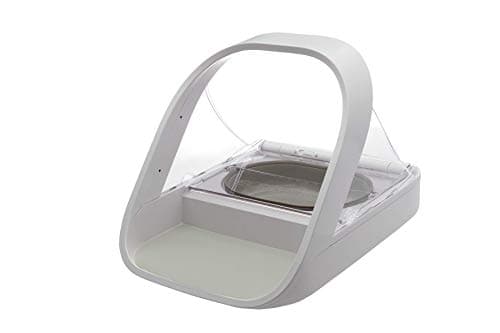
The SureFeed Microchip Pet Feeder is the access-control option, and the wet-food capability is what sets it apart: a 400 ml sealed bowl means a pouch can sit down without becoming a free buffet. The honest cons: it does no portioning at all, it runs on 4 C cells rather than mains, and you need one per cat you are separating.
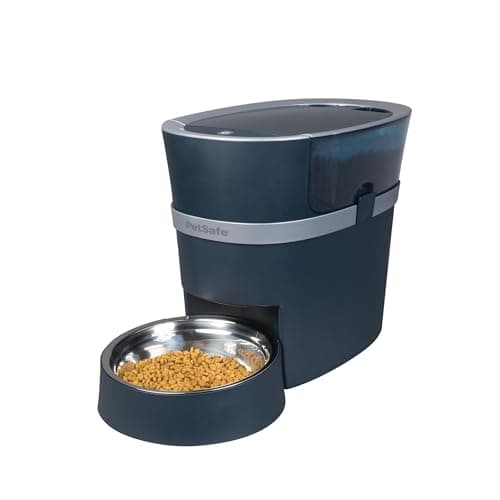
The PetSafe Smart Feed is the scheduling option, with a genuinely large 24-cup hopper and portions from an eighth of a cup up to four cups across as many as twelve meals a day. The slow-feed mode spreading a meal over 15 minutes is the feature most owners end up using. The honest cons: dry or semi-moist food only, and no ability whatsoever to tell your cats apart.
Which one your house needs
- One cat, and you are out all day: automatic feeder. Portion control and timing are the whole problem.
- Two cats, same food, one eats too fast: automatic feeder plus a slow feeder bowl, or the slow-feed dispensing mode.
- Two cats, different food: microchip feeders, one per cat. Nothing else solves it.
- A cat that needs wet food left down safely: microchip feeder, or a refrigerated unit from our wet food feeder page.
- You want to know who is eating what: a camera feeder answers that before you spend on access control. Our camera feeder page treats it as a diagnostic instrument.
Compare the two
If you remember one line from this page: a hopper cannot tell cats apart, and a microchip lid cannot tell time. Decide which of those two failures is the one happening in your kitchen, and buy the machine that fixes it. Before either arrives, our introduction guide covers the week that keeps a cat from rejecting the thing outright.
The gear discussed here
Specs are the manufacturer's own, linked to the page they came from. Prices come from a live daily check; where we have no verified price we say so rather than print a stale one.
SureFeed Microchip Pet Feeder
Sure Petcare · Microchip feeder · Our score 8.5/10
#ad Price as of September 27, 2026. Prices move; we check daily. How we're funded.
The only feeder here that solves the actual multi-cat feeding problem, which is not portioning -- it is one cat eating another cat's food.
Published specs
| Bowl capacity | 400 ml, or two pouches of wet food |
|---|---|
| Pets stored | Up to 32 identities |
| Food types | Wet and dry |
| Power | 4 x C cells, 6-month stated battery life |
| Warranty | 3 years from date of purchase |
| Opens for | Registered microchips or a collar tag |
Source: Sure Petcare -- SureFeed Microchip Pet Feeder product page
Sure Petcare states 6 months from a set of 4 C cells, so 8 cells a year per feeder. In a three-cat house you need one feeder per cat on a controlled diet -- 24 cells a year for three. That is the running cost nobody mentions.
What the specs favor
- Stores up to 32 pet identities -- more than any household needs
- Works with an existing microchip, no new collar required
- Takes wet food, which almost no automatic feeder does
- Three-year warranty, the longest here
What they don't
- Battery only -- 8 C cells a year, per feeder
- One feeder feeds one cat, so a three-cat house needs three
- 400 ml bowl is a meal, not a hopper -- it does not solve holidays
Your problem is being out all day rather than food stealing. This is a lid that opens for the right cat, not a scheduled dispenser -- it will not feed anyone at 6pm on its own.
How it scores
Scores are our editorial weighting of the published specs above, not a test result. They are deliberately kept out of this page's structured data.
PetSafe Smart Feed, 2nd Generation
PetSafe · Automatic feeder · Our score 7.9/10
#ad Price as of September 27, 2026. Prices move; we check daily. How we're funded.
24 cups of hopper and portions from an eighth of a cup up to four cups -- the widest published portion range of any feeder on this page.
Published specs
| Hopper capacity | 24 cups (6 L) |
|---|---|
| Portion range | 1/8 cup to 4 cups |
| Meals per day | Up to 12 |
| Dimensions | 20.3" x 9.4" x 12.6" |
| Slow feed | Dispenses a meal over 15 minutes |
| Dishwasher | Lid, hopper, bowl and holder, top shelf |
| Food type | Dry or semi-moist |
Source: PetSafe -- Smart Feed Automatic Dog and Cat Feeder, 2nd Generation
24 cups of hopper. Three cats eating half a cup each per day is 1.5 cups daily, so about 16 days. The slow-feed setting spreads one meal over 15 minutes, which is the published feature that matters if one of your cats inhales food and then takes the other's.
What the specs favor
- Largest published hopper here at 24 cups
- Portions from 1/8 cup to 4 cups -- the widest range on this page
- Slow feed spreads a meal over 15 minutes
- All food-contact parts are dishwasher safe
What they don't
- Single bowl, so no separation between cats
- Dry or semi-moist only
- 20 inches long -- it takes real counter or floor space
You feed wet food. Nothing about this feeder handles it, and leaving wet food in an open bowl on a timer is a food-safety problem, not a convenience.
How it scores
Scores are our editorial weighting of the published specs above, not a test result. They are deliberately kept out of this page's structured data.
Common questions
What is the difference between a microchip feeder and an automatic feeder?
Which one do I need for two cats on different diets?
Can a microchip feeder handle wet food?
Can an automatic feeder stop one cat stealing another's food?
Can you use both together?
Sources
Read next
- Best Microchip Cat Feeders (2026)
Selective-access feeders compared against timed and hopper feeders, and which one solves the problem you actually have.
- Best Automatic Cat Feeders (2026)
Hopper capacity converted into days of food for one, two and three cats, plus which feeders handle wet food and which do not.
- Feeding Cats on Different Diets
Four ways to feed cats different diets in one household, ranked by whether they still work when nobody is home.
- Best Automatic Cat Feeders for Multiple Cats (2026)
Ranked on whether a feeder can actually separate two cats' food, plus the battery and hopper arithmetic nobody publishes.
- Automatic Feeder vs Free Feeding
Free feeding against scheduled feeding, compared on cost, control, and the information meal feeding gives that a full bowl does not.