Feeders, Fountains & Bowls
Best Slow Feeder Cat Bowls (2026)
Most slow feeders are sized for dogs. A cat's actual portion disappears into a 2-cup maze, and a maze with food only in the bottom is not a maze.
Affiliate disclosure: we earn a commission if you buy through our links, at no extra cost to you. It never changes which product we rank first — here is how we're funded.
Everyone in this category says they tested twenty litter boxes. We have not tested any, and we say so. What we do instead: compile the published specs, read the manuals, and do the arithmetic on what this gear costs to run and how it behaves once there is more than one cat using it. Every spec is linked to the document it came from. Prices are checked daily — last verified October 21, 2026. Here is exactly how we pick.
Quick picks
Ranked on the published specs and the arithmetic below. Tap any row to jump to the full write-up. We have not tested these — here is exactly how we pick.
| # | Product | Best for | Score | Price |
|---|---|---|---|---|
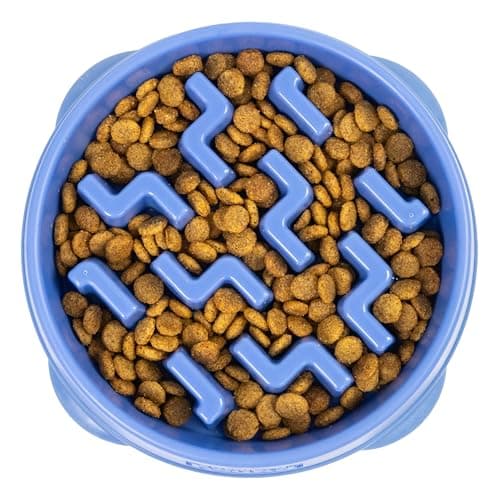
| 1 | Outward Hound Fun Feeder Slo Bowl Published capacities per size and three named difficulty levels, so you can match the maze to the cat instead of buying the deepest one and watching it get abandoned. | The cat that eats too fast and brings it back | 7.2 | |
| 2 | 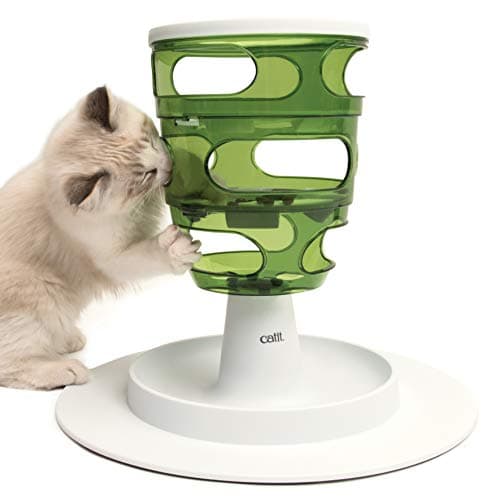 Catit Senses 2.0 Digger Five tubes of varying width on a weighted base -- the only foraging toy here you can make harder as the cat works it out. | Slowing down a cat that inhales food | 8.0 | |
| 3 | No photo Dr. Catsby's Food Bowl for Whisker Relief A single piece of stainless 7.08 inches across and only 1.25 inches deep -- the shallow-and-wide geometry the whisker-fatigue argument actually calls for. | A cat that paws food out of the dish | 8.2 |
#ad Buy links are affiliate links. Prices come from a live daily check; where we have no verified price we say "check price" rather than print a stale one.
A slow feeder is the rare pet product where the mechanism is completely transparent: ridges make a cat take fewer kibbles per mouthful. It still fails more often than it should, and almost always for the same reason.
The size error
A typical adult cat eats well under a cup of dry food a day, usually split across two or three meals. Call one meal a third of a cup.
Outward Hound publishes capacities of 3/4 cup, 2 cups and 4 cups. A third of a cup in the 2 cup medium fills roughly 17 percent of the bowl — so it sits in the deepest channels and the maze above never comes into play.
The same portion in the 3/4 cup small fills about 44 percent, spread across the pattern. That is the difference between a slow feeder and an oddly shaped bowl.
What each one publishes
| Product | Capacity | Material | Dishwasher |
|---|---|---|---|
| Outward Hound Fun Feeder Slo Bowl | 3/4 cup, 2 cups, 4 cups by size | 90% polypropylene, 10% thermoplastic elastomer | Top rack |
| Catit Senses Digger | See product page | Plastic tubes on a base | See product page |
| Dr. Catsby's Bowl | See product page | Stainless steel | Yes |
Where Outward Hound publishes three capacities, the others publish a single configuration. Blank cells are absent specs, not omissions on our part.
Three different ways to slow a cat down
The maze bowl is the direct approach: raised ridges in a shallow dish, three difficulty levels published as Slow, Slower and Slowest. If the cat gives up, you can step it down a level rather than abandoning the idea.
The Catit Senses Digger takes the opposite route: vertical tubes that make the cat fish kibble out with a paw. It is slower still, and it converts feeding into a foraging activity, which is the enrichment argument rather than the digestion one. Our puzzle feeder page covers that side of it properly.
Dr. Catsby’s wide shallow bowl is here as the counter-argument. It does nothing to slow a cat down — and if the problem you actually have is a cat that walks away from a full bowl or paws food onto the floor, the answer is a wider bowl, not a slower one.
The whisker trade-off nobody flags
Our bowls page makes the case for wide and shallow: a cat eating from a deep narrow dish drags its whiskers along the sides on every mouthful, and some cats respond by eating less or eating messily.
A slow feeder is deliberately the opposite geometry. Deep channels are the point. So these two pieces of advice genuinely conflict, and being straight about it is more useful than pretending otherwise:
- Cat eats too fast and vomits: slow feeder, smallest size, and choose the shallowest difficulty level that works.
- Cat eats messily or leaves food: wide shallow bowl. A slow feeder will make it worse.
- Both: start with the wide bowl and split the daily ration across more, smaller meals. Portion size is a lever that costs nothing, and our portion control page covers automating it.
Cleaning is the reason these get abandoned
A maze is a set of channels that are awkward to reach with a cloth. Outward Hound publishes top-rack dishwasher safe, which is the specification that decides whether the bowl stays in service, and it matters far more with wet food than dry.
In a multi-cat house
A slow feeder makes each meal take longer, which means a longer window in which a faster cat can finish its own bowl and start on a housemate’s. If one cat is thin and another is not, that is the mechanism, and no bowl shape fixes it.
The instrument for that problem is a microchip feeder that opens for one cat only. We work through it in feeding cats on different diets, and Cornell Feline Health Center is worth reading first if weight or urinary signs are part of the picture.
The picks in full
Specs are the manufacturer's own, linked to the page they came from. Prices come from a live daily check; where we have no verified price we say so rather than print a stale one.
Outward Hound Fun Feeder Slo Bowl
Outward Hound · Slow feeder bowl · Our score 7.2/10
#ad Price as of October 21, 2026. Prices move; we check daily. How we're funded.
Published capacities per size and three named difficulty levels, so you can match the maze to the cat instead of buying the deepest one and watching it get abandoned.
Published specs
| Capacities | 3/4 cup, 2 cups, 4 cups by size |
|---|---|
| Medium dimensions | 11.75" L x 11.75" W x 2.0" H |
| Material | 90 percent polypropylene, 10 percent thermoplastic elastomer |
| Base | Non-slip |
| Dishwasher | Top rack safe |
| Difficulty levels | Slow, Slower, Slowest |
| Free of | BPA, PVC, lead, phthalate |
A typical adult cat eats well under a cup of dry food a day, split across meals. The 2 cup medium is sized for a small dog. Buying the small is not a compromise here -- it is the size where a cat's actual portion covers enough of the maze to slow it down.
What the specs favor
- Capacity published per size rather than one vague figure
- Three difficulty levels, so a cat that gives up can be stepped down
- Top-rack dishwasher safe, which a wet-food bowl needs to be
- Materials named, including what it is free of
What they don't
- Sized and marketed for dogs first; the cat-appropriate size is the smallest
- Deep grooves are awkward to hand-wash
- Plastic, so it scratches -- see our bowls page on why that matters
Your cat is losing weight or eating less than usual. Slowing a cat that has stopped eating properly is the wrong intervention, and that is a veterinary conversation first.
How it scores
Scores are our editorial weighting of the published specs above, not a test result. They are deliberately kept out of this page's structured data.
Catit Senses 2.0 Digger
Catit · Foraging toy · Our score 8.0/10
#ad Price as of October 21, 2026. Prices move; we check daily. How we're funded.
Five tubes of varying width on a weighted base -- the only foraging toy here you can make harder as the cat works it out.
Published specs
| Dimensions | 14.6" x 14.6" x 4.3" |
|---|---|
| Tubes | 3 short and narrow, 2 long and wide |
| Base | Rubber mat to stop it sliding |
| Material | BPA-free |
| Food | Dry food or treats |
Source: Catit -- Senses Digger product page
Three narrow tubes and two wide ones means you can start with the wide pair and add narrow ones as the cat gets faster. Fixed-difficulty puzzles get solved once and then ignored -- adjustability is the spec that decides whether a puzzle toy is still in use in a month.
What the specs favor
- Two tube widths, so difficulty scales with the cat
- Rubber base mat -- it does not slide across a hard floor
- Uses the cat's ordinary dry food, so it costs nothing to run
- Large 14.6-inch footprint two cats can work at once
What they don't
- Dry food only
- Tubes need washing, and few people do it
- A determined cat tips it if the mat is on carpet
You feed wet food exclusively. Every foraging toy here assumes kibble, and there is no version of this that works with pate.
How it scores
Scores are our editorial weighting of the published specs above, not a test result. They are deliberately kept out of this page's structured data.
Dr. Catsby's Food Bowl for Whisker Relief
Dr. Catsby · Cat bowl · Our score 8.2/10
#ad No verified live price right now, so we show none rather than a stale one. How we're funded.
A single piece of stainless 7.08 inches across and only 1.25 inches deep -- the shallow-and-wide geometry the whisker-fatigue argument actually calls for.
Published specs
| Diameter | 7.08" |
|---|---|
| Depth | 1.25" |
| Weight | 14.1 oz |
| Capacity | Holds a 5 oz can of wet food |
| Material | Stainless steel, one piece |
| Included | Silicone non-slip mat for the base |
| Cleaning | Dishwasher safe |
Source: Amazon -- Dr. Catsby's Food Bowl for Whisker Relief listing
7.08 inches wide divided by 1.25 inches deep = 5.7. A typical deep ceramic cat dish is nearer 2:1. That ratio is the entire whisker-fatigue argument expressed as a number you can check on any bowl before buying -- and almost no listing publishes both figures.
What the specs favor
- Published width and depth, so the ratio above is checkable
- One piece of stainless -- nothing to scratch and harbor residue
- Silicone mat included rather than sold separately
- Dishwasher safe
What they don't
- 1.25 inches deep is shallow for a large dry-food portion
- Stainless is light enough that a determined cat can move it
- One bowl per cat gets expensive in a multi-cat house
You free-feed a big daily ration of dry food. A 1.25-inch dish is sized around a 5 oz can, not around a cup of kibble.
How it scores
Scores are our editorial weighting of the published specs above, not a test result. They are deliberately kept out of this page's structured data.
Common questions
Do slow feeder bowls work for cats?
What size slow feeder does a cat need?
Why does my cat throw up after eating?
Are slow feeders bad for whisker fatigue?
Can you use a slow feeder for wet food?
Sources
Read next
- Best Cat Food Bowls (2026)
Bowls compared on published width-to-depth ratio, material and elevation, with the whisker-fatigue claim handled carefully.
- Best Cat Puzzle Feeders and Foraging Toys (2026)
Puzzle feeders ranked on published capacity and adjustable difficulty, with the multi-cat rule that stops them causing fights.
- Best Portion Control Cat Feeders (2026)
Feeders that publish portion sizes in real units, plus how to set one from the ration on your food bag.
- How to Clean a Cat Water Fountain
A cat fountain cleaning routine built around published filter intervals, including the pump strip-down that decides whether the fountain gets refused.
- Best Automatic Cat Feeders for Multiple Cats (2026)
Ranked on whether a feeder can actually separate two cats' food, plus the battery and hopper arithmetic nobody publishes.
- Best Lick Mats for Cats (2026)
A lick mat compared with a puzzle feeder and a slow-feeder bowl, matched to wet food, dry food and the cat that needs a job.
- How to Stop a Cat Eating Too Fast
Three ways to slow a fast eater, matched to wet food, dry food and the cat that needs a job rather than an obstacle.