Feeders, Fountains & Bowls
How to Stop a Cat Eating Too Fast
There are three tools for this and they are not interchangeable. Pick the wrong one for your food type and nothing changes.
Affiliate disclosure: we earn a commission if you buy through our links, at no extra cost to you. It never changes which product we rank first — here is how we're funded.
Everyone in this category says they tested twenty litter boxes. We have not tested any, and we say so. What we do instead: compile the published specs, read the manuals, and do the arithmetic on what this gear costs to run and how it behaves once there is more than one cat using it. Every spec is linked to the document it came from. Prices are checked daily — last verified September 25, 2026. Here is exactly how we pick.
A cat that finishes a meal in forty seconds and then throws it up on the rug is the most common feeding complaint we get. The fix is cheap, and it depends entirely on what is in the bowl.
First, the part we do not solve
Eating fast and vomiting regularly afterwards is worth a vet appointment. Regurgitation has causes a feeding bowl cannot touch, and the point of this page is pacing, not diagnosis.
Match the tool to the food
| If you feed | Use | Why |
|---|---|---|
| Dry food | A cat-sized slow-feeder bowl | Obstacles work because kibble falls between them |
| Wet food | A lick mat | Food is spread thin and has to be licked out of texture |
| Either, and the cat is bored | A puzzle feeder | Pacing plus a job; adjustable difficulty as the cat learns |
The common mistake is buying a slow-feeder bowl for a wet-food cat, where it does nothing.
The sizing mistake
Outward Hound publishes capacities of 3/4 cup, 2 cups and 4 cups. The 2 and 4 cup versions are dog bowls: the ridges are spaced for a muzzle, and a cat simply eats between them.
The 3/4 cup size is the one with cat-scale channels, and it is also about the right volume for a cat’s meal in the first place. Our slow feeder page makes the same point with the published dimensions.
The same trap exists with lick mats, most of which are dog-sized. The LickiMat Felix is 22 by 15 cm, which is a cat’s feeding footprint rather than a Labrador’s.
The three tools
The Outward Hound Fun Feeder in its smallest size is the default for dry food: non-slip base, top-rack dishwasher safe, three published difficulty patterns. Buy the 3/4 cup and ignore the rest of the range.
The LickiMat Felix is the wet-food answer, in food-safe TPR that goes in the dishwasher -- which matters more here than anywhere else, because dried wet food in fine grooves is genuinely unpleasant to scrub.
The Catit Senses Digger is the enrichment route: five tubes in two profiles, so it gets harder as the cat gets better. The Ohio State Indoor Pet Initiative specifically suggests food-delivery toys so cats feel they are working for a meal, which a bowl of any shape cannot do.
Changes that cost nothing
- Feed the cats apart. Competition is the most common cause of speed in a multi-cat house, and separation fixes it for free. Our feeding station page covers distances.
- Split the ration into more meals. Four small meals beat two large ones for a fast eater.
- Scatter dry food across a mat or a few small dishes rather than one bowl.
- Check the bowl itself. A narrow, deep bowl presses on whiskers, and some cats bolt food to get out of it -- our bowls page covers the width-to-depth ratio.
The gear discussed here
Specs are the manufacturer's own, linked to the page they came from. Prices come from a live daily check; where we have no verified price we say so rather than print a stale one.
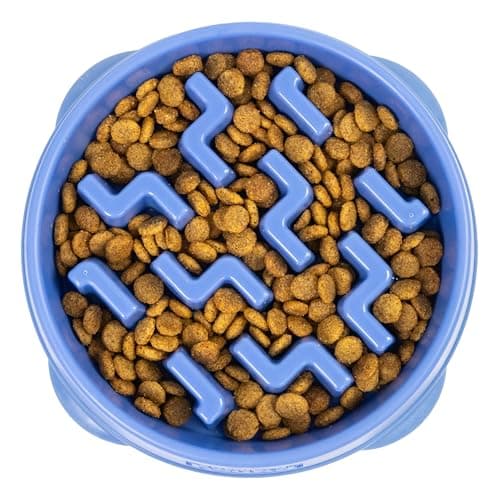
Outward Hound Fun Feeder Slo Bowl
Outward Hound · Slow feeder bowl · Our score 7.2/10
#ad Price as of September 25, 2026. Prices move; we check daily. How we're funded.
Published capacities per size and three named difficulty levels, so you can match the maze to the cat instead of buying the deepest one and watching it get abandoned.
Published specs
| Capacities | 3/4 cup, 2 cups, 4 cups by size |
|---|---|
| Medium dimensions | 11.75" L x 11.75" W x 2.0" H |
| Material | 90 percent polypropylene, 10 percent thermoplastic elastomer |
| Base | Non-slip |
| Dishwasher | Top rack safe |
| Difficulty levels | Slow, Slower, Slowest |
| Free of | BPA, PVC, lead, phthalate |
A typical adult cat eats well under a cup of dry food a day, split across meals. The 2 cup medium is sized for a small dog. Buying the small is not a compromise here -- it is the size where a cat's actual portion covers enough of the maze to slow it down.
What the specs favor
- Capacity published per size rather than one vague figure
- Three difficulty levels, so a cat that gives up can be stepped down
- Top-rack dishwasher safe, which a wet-food bowl needs to be
- Materials named, including what it is free of
What they don't
- Sized and marketed for dogs first; the cat-appropriate size is the smallest
- Deep grooves are awkward to hand-wash
- Plastic, so it scratches -- see our bowls page on why that matters
Your cat is losing weight or eating less than usual. Slowing a cat that has stopped eating properly is the wrong intervention, and that is a veterinary conversation first.
How it scores
Scores are our editorial weighting of the published specs above, not a test result. They are deliberately kept out of this page's structured data.
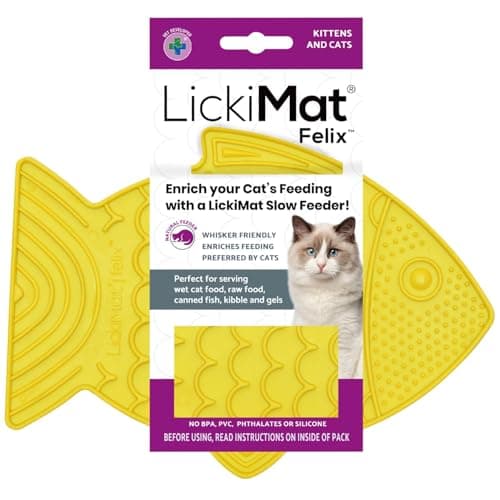
LickiMat Felix
LickiMat · Lick mat · Our score 7.8/10
#ad Price as of September 25, 2026. Prices move; we check daily. How we're funded.
A 22 by 15 cm fish-shaped mat in food-safe TPR -- spread wet food into its grooves and a meal that took one minute takes ten.
Published specs
| Dimensions | 22 x 15 cm (8.6" x 5.9") |
|---|---|
| Material | Human-grade, food-safe TPR |
| Cleaning | Dishwasher safe |
| Use | Wet food, pastes, treats |
Source: LickiMat -- Classic Felix product page (22 x 15 cm, human-grade food-safe TPR, dishwasher safe)
8.6 x 5.9 inches is about 51 square inches of textured surface. A thin layer of wet food spread across all of it has to be licked out of the grooves rather than eaten in bites, which is where the slowing comes from. It works for wet food and pastes; it does nothing for kibble.
What the specs favor
- Slows wet food, which slow-feeder bowls handle poorly
- Dishwasher safe
- Food-safe material stated
- Small enough for a cat's feeding spot
What they don't
- No use for dry food
- Grooves need scrubbing if not dishwashed
- A determined cat may chew the edges -- supervise at first
Your cat eats only dry food. A slow-feeder bowl or puzzle feeder handles kibble; a lick mat does not.
How it scores
Scores are our editorial weighting of the published specs above, not a test result. They are deliberately kept out of this page's structured data.
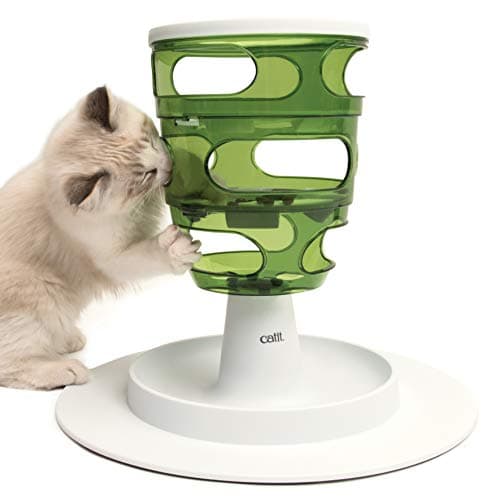
Catit Senses 2.0 Digger
Catit · Foraging toy · Our score 8.0/10
#ad Price as of September 25, 2026. Prices move; we check daily. How we're funded.
Five tubes of varying width on a weighted base -- the only foraging toy here you can make harder as the cat works it out.
Published specs
| Dimensions | 14.6" x 14.6" x 4.3" |
|---|---|
| Tubes | 3 short and narrow, 2 long and wide |
| Base | Rubber mat to stop it sliding |
| Material | BPA-free |
| Food | Dry food or treats |
Source: Catit -- Senses Digger product page
Three narrow tubes and two wide ones means you can start with the wide pair and add narrow ones as the cat gets faster. Fixed-difficulty puzzles get solved once and then ignored -- adjustability is the spec that decides whether a puzzle toy is still in use in a month.
What the specs favor
- Two tube widths, so difficulty scales with the cat
- Rubber base mat -- it does not slide across a hard floor
- Uses the cat's ordinary dry food, so it costs nothing to run
- Large 14.6-inch footprint two cats can work at once
What they don't
- Dry food only
- Tubes need washing, and few people do it
- A determined cat tips it if the mat is on carpet
You feed wet food exclusively. Every foraging toy here assumes kibble, and there is no version of this that works with pate.
How it scores
Scores are our editorial weighting of the published specs above, not a test result. They are deliberately kept out of this page's structured data.
Common questions
Why does my cat eat so fast?
Do slow feeder bowls work for cats?
What slows a cat eating wet food?
Should I just feed smaller meals more often?
Is a puzzle feeder better than a slow bowl?
Sources
- Outward Hound -- Fun Feeder Slo Bowl listing (3/4 cup, 2 cup and 4 cup sizes, 11.75 x 11.75 x 2.0 in medium, top-rack dishwasher safe)
- LickiMat -- Classic Felix product page (22 x 15 cm, human-grade food-safe TPR, dishwasher safe)
- Catit -- Senses Digger product page
- Ohio State University Indoor Pet Initiative -- For Cat Owners
Read next
- Best Slow Feeder Cat Bowls (2026)
Slow feeder bowls compared on published capacity and why the smallest size is the one a cat needs.
- Best Lick Mats for Cats (2026)
A lick mat compared with a puzzle feeder and a slow-feeder bowl, matched to wet food, dry food and the cat that needs a job.
- Best Cat Puzzle Feeders and Foraging Toys (2026)
Puzzle feeders ranked on published capacity and adjustable difficulty, with the multi-cat rule that stops them causing fights.
- Best Cat Food Bowls (2026)
Bowls compared on published width-to-depth ratio, material and elevation, with the whisker-fatigue claim handled carefully.
- Automatic Feeder vs Free Feeding
Free feeding against scheduled feeding, compared on cost, control, and the information meal feeding gives that a full bowl does not.