Multi-Cat Households
The Multi-Cat Household Guide
Most multi-cat problems are resource problems wearing a behavior costume. This is the setup that prevents them.
Affiliate disclosure: we earn a commission if you buy through our links, at no extra cost to you. It never changes which product we rank first — here is how we're funded.
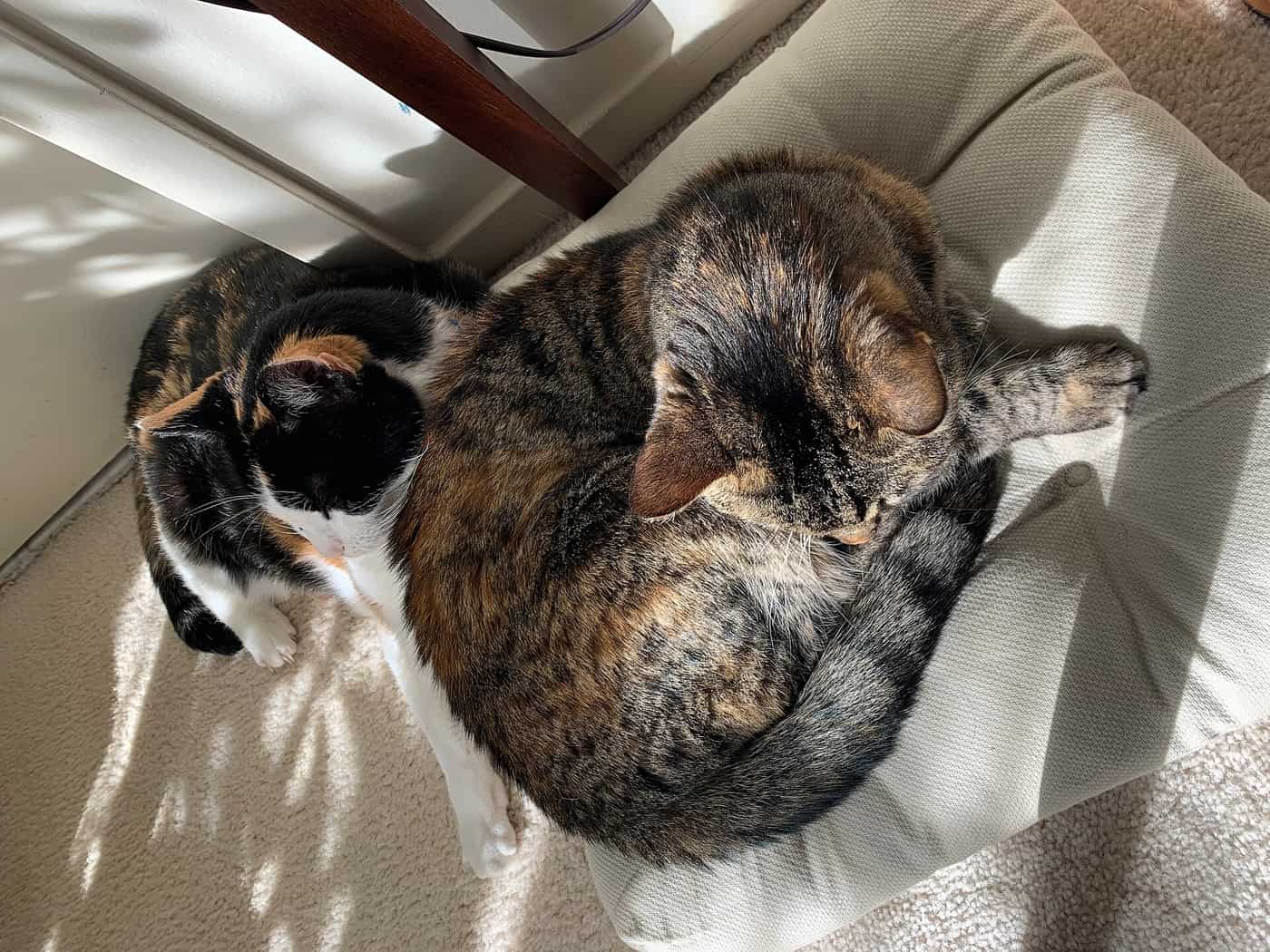
Everyone in this category says they tested twenty litter boxes. We have not tested any, and we say so. What we do instead: compile the published specs, read the manuals, and do the arithmetic on what this gear costs to run and how it behaves once there is more than one cat using it. Every spec is linked to the document it came from. Prices are checked daily — last verified October 19, 2026. Here is exactly how we pick.
Almost every problem in a multi-cat household presents as a behavior problem and resolves as a resource problem. The cat going outside the box, the one that has started ambushing another on the stairs, the one that stopped using the tree — these usually change by adding or separating resources, not by correcting a cat.
“Resources” means litter boxes, water, feeding stations, elevated resting places, hiding places, and the routes between them. This page is the setup. The rest of this section, and most of this site, is the detail.
The counts
| Resource | 1 cat | 2 cats | 3 cats | 4 cats |
|---|---|---|---|---|
| Litter boxes | 2 | 3 | 4 | 5 |
| Water stations | 2 | 2-3 | 3 | 4 |
| Feeding stations | 1 | 2 separated | 3 separated | 4 separated |
| Elevated resting places | 2 | 4 | 6 | 8 |
| Hiding places | 2 | 3 | 4 | 5 |
The litter box row is published guidance: Cornell's n+1 rule, echoed by the Ohio State Indoor Pet Initiative's 'one litter box per cat, plus one'. Every other row is OURS -- the same shape applied to other resource types. We think it is a sound extension and we are not going to present it as somebody else's recommendation.
That footnote is the most important thing on this page. The n+1 rule is published guidance for litter boxes specifically. Applying it to water bowls and resting places is a reasonable extension and we believe in it, but it is our reasoning, not Cornell’s, and it is labeled accordingly.
Separation beats quantity
The Ohio State Indoor Pet Initiative makes the placement requirement explicit for litter: in homes with more than one story, boxes must be available on each level. It also advises placing food and litter boxes away from appliances and air ducts that could start unexpectedly, and locating them so that another animal cannot sneak up on the cat while she uses them.
Generalize that and you have the multi-cat placement rule: every resource in more than one location, in rooms with more than one exit, away from anything that makes a sudden noise, and never all clustered into a single “cat area” for the household’s tidiness.
Vertical space is territory
In a crowded house, height does something floor space cannot: it lets two cats occupy the same room without occupying the same space. A cat that can go up has somewhere to be that is not through another cat.
Our practical recommendation for a three-cat home: one stable tree as the accessible route up, wall shelves to extend the territory sideways, and a window perch in whichever room gets sun. The comparison is in cat tree versus wall shelves.
The order to fix things in
- Anything sudden goes to a vet first. Pain and illness change behavior, and a cat that has abruptly changed how it uses the house is a medical question before it is a furniture question.
- Count the litter boxes. Most struggling households are below n+1, often well below. Closing that gap is the cheapest high-impact change available.
- Spread what you already have. Same boxes, same bowls, different rooms. Free.
- Separate the feeding stations. Ideally out of sight of one another.
- Add vertical territory. Even a cleared bookshelf top counts while you decide what to buy.
- Add hiding places. A cardboard box in each room costs nothing and gives the least confident cat somewhere to withdraw to.
- Then buy gear, if anything is still short.
Steps two through six are almost free and they resolve a large share of multi-cat complaints. Step seven is where the multi-cat gear picks come in, and deliberately not before.
Where to go next, by category
- Litter: the multi-cat litter setup, then the box picks and the automatic box picks.
- Food and water: multi-cat feeders and multi-cat fountains.
- Territory: multi-cat cat trees and where to put them.
- Conflict: the resource competition guide.
- Play: toys for bored indoor cats — separate sessions, one cat at a time.
The gear discussed here
Specs are the manufacturer's own, linked to the page they came from. Prices come from a live daily check; where we have no verified price we say so rather than print a stale one.
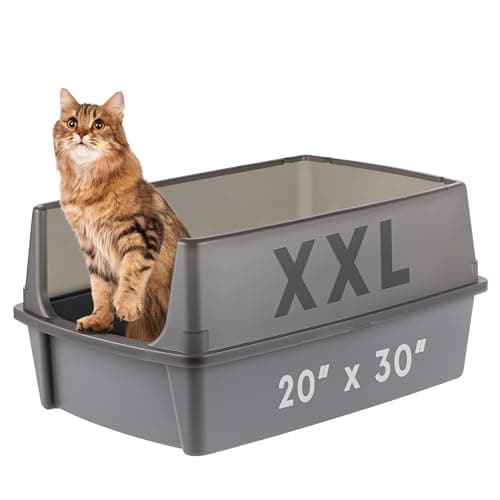
IRIS USA XX-Large Open Top Litter Box
IRIS USA · Litter box · Our score 8.7/10
#ad Price as of October 19, 2026. Prices move; we check daily. How we're funded.
At 30.18 by 20.13 inches this is the largest open-top pan in general retail, and floor area is the single spec that decides whether two cats will share a box.
Published specs
| External dimensions | 30.18" L x 20.13" W x 13.12" H |
|---|---|
| Type | Open top with scatter shield |
| Litter type | Any |
| Weight capacity | Not published |
Source: Amazon -- IRIS USA XX-Large open top litter box listing
30.18 x 20.13 = 607 sq inches of external footprint. Two cats sharing it get roughly 304 sq inches each -- still more than a whole standard jumbo pan gives one cat. That is why one very large box beats two small ones when floor space is tight.
What the specs favor
- Largest published open-top footprint here at 30.18 x 20.13 inches
- 13.12-inch walls with a scatter shield -- the combination that stops high sprayers
- Open top, the configuration cats are documented to prefer
- Takes any litter, no proprietary anything
What they don't
- 607 square inches of floor is a lot of floor to give up
- IRIS does not publish a weight capacity
- High walls make it a genuine step up for a senior cat
Your cat is elderly or arthritic. A 13-inch wall is a real climb, and a cat that starts avoiding the box because getting in hurts is a much worse problem than litter scatter.
How it scores
Scores are our editorial weighting of the published specs above, not a test result. They are deliberately kept out of this page's structured data.
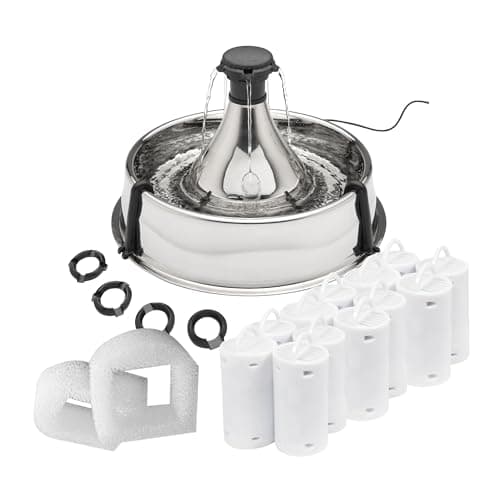
PetSafe Drinkwell 360 Stainless Steel
PetSafe · Water fountain · Our score 8.0/10
#ad Price as of October 19, 2026. Prices move; we check daily. How we're funded.
128 ounces and access from all sides -- the only fountain here designed so two cats can drink without one of them being cornered.
Published specs
| Capacity | 128 oz (3.8 L) |
|---|---|
| Streams | 5 interchangeable stream options |
| Access | 360 degrees, open bowl |
| Filtration | Charcoal plus foam pre-filter |
| Cleaning | Top-rack dishwasher safe |
| Pump | Submersible; wattage not published by PetSafe |
Source: PetSafe -- Drinkwell 360 Stainless Steel Pet Fountain product page
3.8 L divided three ways is 1.27 L a cat between refills -- far more than any cat drinks in a day, so the constraint is not capacity, it is how long water stays fresh. At fortnightly filter intervals the practical refill cycle is what governs, not the tank.
What the specs favor
- Largest capacity here at 128 oz
- 360-degree access removes the cornering problem in a multi-cat house
- Five stream options, so a fussy drinker has somewhere to go
- Top-rack dishwasher safe
What they don't
- PetSafe does not publish pump wattage, so electricity cannot be computed
- Two filter types to buy rather than one
- Big footprint for a water bowl
You want to know what it costs to run. PetSafe publishes no wattage for this pump, and we are not going to invent one.
How it scores
Scores are our editorial weighting of the published specs above, not a test result. They are deliberately kept out of this page's structured data.
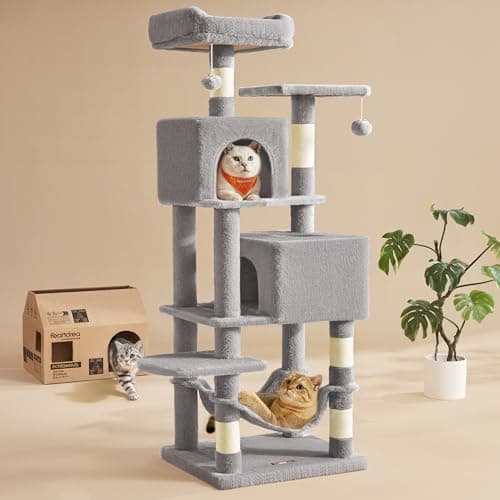
FEANDREA 67-inch Multi-Level Cat Tree
FEANDREA · Cat tree · Our score 8.6/10
#ad Price as of October 19, 2026. Prices move; we check daily. How we're funded.
The best base-to-height ratio of any tree here, and base-to-height is the only spec that predicts whether a tree rocks when a 15 lb cat lands on the top perch.
Published specs
| Dimensions | 24" L x 19.3" W x 67" H |
|---|---|
| Assembled weight | 57.5 lb |
| Materials | Particleboard, plush, sisal rope |
| Post diameter | 3.4" sisal-wrapped |
| Per-platform rating | Not published in the retail listing |
Source: Chewy -- FEANDREA 67-in Multi-Level Cat Tree listing
Our figure, not the maker's: shortest base dimension divided by height, multiplied by assembled weight. 19.3 / 67 = 0.288, x 57.5 lb = 16.5. The Yaheetech 72-inch scores 8.7 on the same sum and the Go Pet Club F2081 scores 15.9. Higher is harder to tip. Redo it yourself on any tree from two published numbers.
What the specs favor
- Heaviest tree here at 57.5 lb, and weight is what resists tipping
- Widest base relative to height of the three trees on this page
- 3.4-inch sisal posts are thick enough for a large cat to actually pull against
- Multiple platforms so two cats are not forced to share one
What they don't
- Particleboard, so it does not survive being moved often
- 57.5 lb is a two-person assembly
- FEANDREA does not publish a per-platform weight rating in the retail listing
You move house often or rearrange furniture. Particleboard trees come apart badly and go back together worse.
How it scores
Scores are our editorial weighting of the published specs above, not a test result. They are deliberately kept out of this page's structured data.
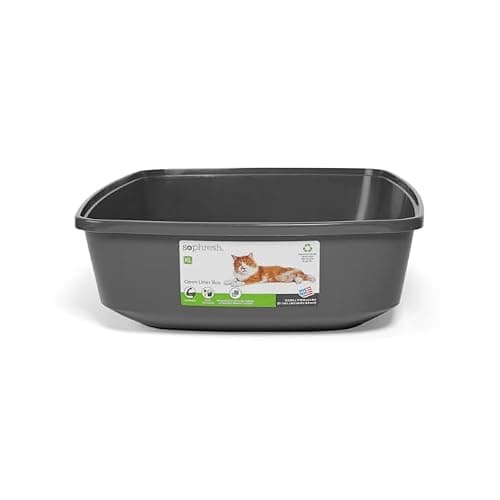
So Phresh Open Cat Litter Box, X-Large
So Phresh · Litter box · Our score 7.4/10
#ad Price as of October 19, 2026. Prices move; we check daily. How we're funded.
The plain plastic pan that lets you follow the one-box-per-cat-plus-one rule without spending like it -- 379 square inches of open floor for the price of a bag of litter.
Published specs
| External dimensions | 22.4" L x 16.9" W x 5.4" H |
|---|---|
| Wall height | 5.4" |
| Type | Open pan, no cover |
| Material | Plastic |
| Color | Charcoal |
| Litter type | Any |
| Published interior | Not published |
| Weight | Not published |
Cornell's guidance is one box more than you have cats. For three cats that is four boxes. The cheapest automatic box on this site is $269.99 -- four plain open pans is a fraction of one of those, and four boxes beat one clever one every time. At 22.4 x 16.9 inches each, four of these is 1,514 square inches of litter floor spread across four rooms, which is the thing a single automatic box cannot buy at any price.
What the specs favor
- Cheap enough to buy four without thinking about it
- 22.4 inches long, which is genuinely jumbo for a plain pan
- Open, uncovered, low -- the configuration cats prefer
- A 5.4 inch wall is an easy step for a kitten or an arthritic cat
- Nothing to break, nothing proprietary
What they don't
- A 5.4 inch wall will not contain a cat that sprays standing up, and it is lower than the 6.5 inch pans it replaces
- No scatter shield at all
- Thin plastic scratches, and scratched plastic holds odor
- No published interior dimension, so usable floor is smaller than the external figure
- No published weight
Odor or scatter is your actual complaint. This pan solves the count problem, not the containment problem -- pair it with a high-sided box rather than replacing one.
How it scores
Scores are our editorial weighting of the published specs above, not a test result. They are deliberately kept out of this page's structured data.
Common questions
How many litter boxes for a multi-cat household?
Why are my cats suddenly fighting?
How much space do multiple cats need?
Should cats share food bowls?
How do I introduce a new cat to my existing cats?
Do cats in multi-cat homes need more vertical space?
Sources
Read next
- Litter Setup for Multiple Cats
Box counts, room-by-room placement, which box types to mix and why, for households with two or more cats.
- Resource Competition Between Cats
How to recognize resource guarding, why it rarely looks like fighting, and the environmental changes that reduce it.
- Can Two Cats Share One Litter Box?
The honest answer on litter box sharing, what it costs, and the four situations where it breaks down.
- Best Gear for Multi-Cat Homes (2026)
The complete multi-cat kit list: one pick per category, with what each one costs to run and what to fix for free first.
- How Many Litter Boxes Per Cat?
The n+1 rule, its published source, a count-by-household table, and why four boxes in a row is really only one box.
- What to Buy Before Getting a Second Cat
A pre-arrival shopping list built from resource counts: boxes, separate stations, a second carrier, height, and what the safe room actually needs.