Multi-Cat Households
Best Gear for Multi-Cat Homes (2026)
One pick per category, chosen for households with more than one cat. Plus the free changes worth making before any of it.
Affiliate disclosure: we earn a commission if you buy through our links, at no extra cost to you. It never changes which product we rank first — here is how we're funded.
Everyone in this category says they tested twenty litter boxes. We have not tested any, and we say so. What we do instead: compile the published specs, read the manuals, and do the arithmetic on what this gear costs to run and how it behaves once there is more than one cat using it. Every spec is linked to the document it came from. Prices are checked daily — last verified October 19, 2026. Here is exactly how we pick.
Quick picks
Ranked on the published specs and the arithmetic below. Tap any row to jump to the full write-up. We have not tested these — here is exactly how we pick.
| # | Product | Best for | Score | Price |
|---|---|---|---|---|
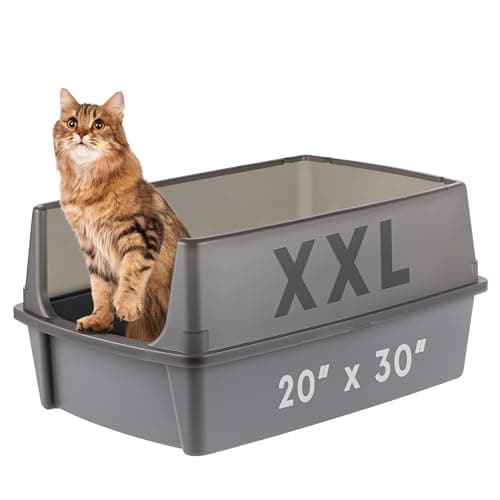
| 1 | IRIS USA XX-Large Open Top Litter Box At 30.18 by 20.13 inches this is the largest open-top pan in general retail, and floor area is the single spec that decides whether two cats will share a box. | The biggest floor area you can buy | 8.7 | |
| 2 | 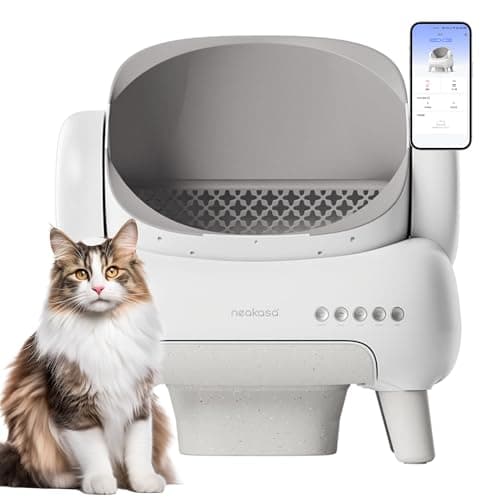 Neakasa M1 Open-Top Self-Cleaning Litter Box The only automatic box here that publishes both its litter capacity and its noise figure, and the only open-top design -- which matters because cats prefer uncovered boxes. | Cats that refuse an enclosed box | 8.6 | |
| 3 | 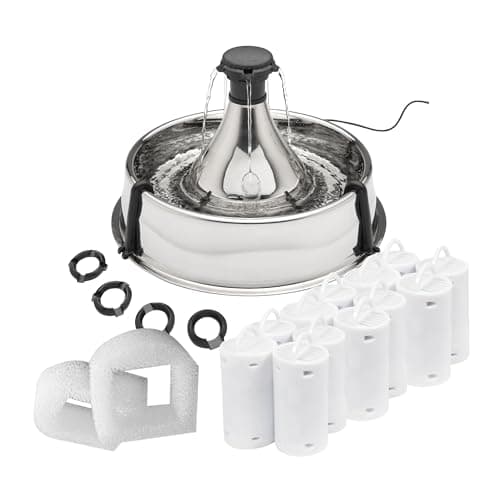 PetSafe Drinkwell 360 Stainless Steel 128 ounces and access from all sides -- the only fountain here designed so two cats can drink without one of them being cornered. | Three or more cats drinking at once | 8.0 | |
| 4 | 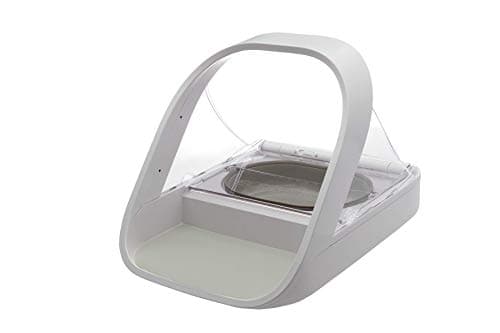 SureFeed Microchip Pet Feeder The only feeder here that solves the actual multi-cat feeding problem, which is not portioning -- it is one cat eating another cat's food. | One cat on a prescription diet | 8.5 | |
| 5 | 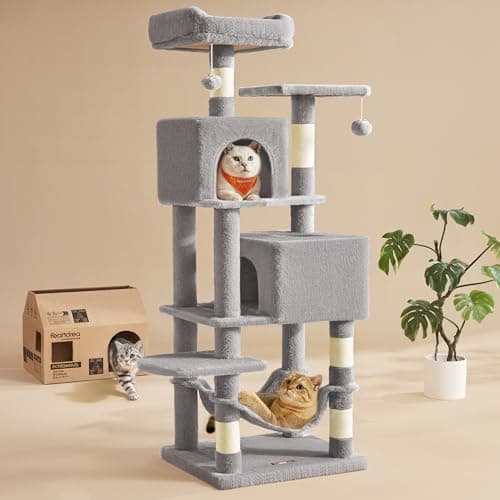 FEANDREA 67-inch Multi-Level Cat Tree The best base-to-height ratio of any tree here, and base-to-height is the only spec that predicts whether a tree rocks when a 15 lb cat lands on the top perch. | Two or three cats sharing one tree | 8.6 | |
| 6 | No photo Go Cat Da Bird Wand, 36-inch A 36-inch rod on 50 lb braided line with feathers shaped to fly properly -- the only toy here that delivers the full hunt sequence, which is what boredom behavior is missing. | The play a bored indoor cat actually needs | 8.8 |
#ad Buy links are affiliate links. Prices come from a live daily check; where we have no verified price we say "check price" rather than print a stale one.
This is the shopping list, and it deliberately comes after the free changes. If you have not read the household guide yet, start there — several of the changes that fix multi-cat problems cost nothing, and buying gear on top of a wrong setup buys you a more expensive version of the same problem.
The free changes, first
- Spread out what you already own. Same boxes, same bowls, different rooms and different floors.
- Separate the feeding stations, ideally out of sight of one another.
- Clear a high surface. The top of a bookshelf is vertical territory today, for nothing.
- Put a cardboard box in each room. Hiding places are a need, and this is the cheapest way to meet it.
- Rotate the toys you own rather than buying more — the published advice from the Indoor Pet Initiative.
The kit list, one pick per category
| Category | Pick | Why this one | Running cost |
|---|---|---|---|
| Litter box | IRIS XX-Large Open Top | Largest published open-top footprint at 30.18 x 20.13 in | Litter only |
| Automatic box | Neakasa M1 | Publishes 7.17 L litter and 11.23 L waste; ordinary litter and bin bags | Litter only |
| Water | PetSafe Drinkwell 360 | 360-degree access so two cats are not cornered; 128 oz | Filters |
| Feeding | SureFeed Microchip Feeder | The only product type that separates two cats' food | 8 C cells per feeder per year |
| Territory | FEANDREA 67-inch | Best stability index here at 16.5 | None |
| Play | Da Bird wand, 36 in | 68 in working radius; supports the full hunt sequence | Feather refills |
Every specification is the manufacturer's or retailer's published figure, cited on the individual product write-ups below. Running costs are computed on our running-cost pages.
Quantities, which is the part people get wrong
Note that only one item on that list has to be expensive. Four boxes can be four plain pans; three water stations can be one fountain and two bowls; six resting places can be one tree, two shelves and three surfaces you already own. A correct cheap setup beats an incorrect expensive one every time.
Price the consumables before the hardware
Two of these categories have running costs that dwarf the purchase price over five years, and both are knowable in advance from the makers’ own websites:
- Automatic litter boxes. Proprietary liners and trays run from about $228 a year for a Litter-Robot with three cats to roughly $880 a year for a ScoopFree. The Neakasa M1 avoids both by taking ordinary supplies. Full arithmetic: automatic litter box running costs.
- Water fountains. Filters cost roughly twelve times the electricity — about $97 a year against $8 on published figures. Full arithmetic: cat fountain running costs.
The order we would buy in
- The litter boxes you are missing, as plain pans. Cheapest, biggest effect.
- Extra water bowls in rooms that have none.
- Vertical territory — a stable tree, or shelves in a small flat.
- A wand toy, if you do not have a good one.
- A microchip feeder, only if food separation is genuinely a problem.
- An automatic litter box, last, once you know the count and placement are right.
Working in that order means that by the time you consider the expensive things, you already know whether you still need them. Quite often the answer turns out to be no.
The picks in full
Specs are the manufacturer's own, linked to the page they came from. Prices come from a live daily check; where we have no verified price we say so rather than print a stale one.
IRIS USA XX-Large Open Top Litter Box
IRIS USA · Litter box · Our score 8.7/10
#ad Price as of October 19, 2026. Prices move; we check daily. How we're funded.
At 30.18 by 20.13 inches this is the largest open-top pan in general retail, and floor area is the single spec that decides whether two cats will share a box.
Published specs
| External dimensions | 30.18" L x 20.13" W x 13.12" H |
|---|---|
| Type | Open top with scatter shield |
| Litter type | Any |
| Weight capacity | Not published |
Source: Amazon -- IRIS USA XX-Large open top litter box listing
30.18 x 20.13 = 607 sq inches of external footprint. Two cats sharing it get roughly 304 sq inches each -- still more than a whole standard jumbo pan gives one cat. That is why one very large box beats two small ones when floor space is tight.
What the specs favor
- Largest published open-top footprint here at 30.18 x 20.13 inches
- 13.12-inch walls with a scatter shield -- the combination that stops high sprayers
- Open top, the configuration cats are documented to prefer
- Takes any litter, no proprietary anything
What they don't
- 607 square inches of floor is a lot of floor to give up
- IRIS does not publish a weight capacity
- High walls make it a genuine step up for a senior cat
Your cat is elderly or arthritic. A 13-inch wall is a real climb, and a cat that starts avoiding the box because getting in hurts is a much worse problem than litter scatter.
How it scores
Scores are our editorial weighting of the published specs above, not a test result. They are deliberately kept out of this page's structured data.
Neakasa M1 Open-Top Self-Cleaning Litter Box
Neakasa · Automatic litter box · Our score 8.6/10
#ad Price as of October 19, 2026. Prices move; we check daily. How we're funded.
The only automatic box here that publishes both its litter capacity and its noise figure, and the only open-top design -- which matters because cats prefer uncovered boxes.
Published specs
| Litter capacity | 7.17 L |
|---|---|
| Waste bin capacity | 11.23 L |
| Footprint / height | 23.26" x 20.67", 20.2" H |
| Entry height | 13.86" |
| Weight, empty | 22.81 lb |
| Cat weight range | 2.2-33 lb |
| Operating noise | Not more than 50 dB (published) |
Source: Neakasa -- M1 product page
11.23 L bin. Whisker's own guidance for its comparable drawer is emptying twice a week for two cats, i.e. roughly 3.5 days per two cats. Scale that to three and the bin needs emptying about every 4 days on published volumes -- an extrapolation from a competitor's published interval, not a measurement of this unit.
What the specs favor
- Publishes litter capacity (7.17 L) and waste bin capacity (11.23 L) -- almost nobody else does
- Publishes an operating noise figure of 50 dB or less
- Open top, which is the design cats are documented to prefer
- Takes ordinary clumping litter and ordinary bin bags -- no proprietary tray or liner
- Widest published cat weight range here at 2.2-33 lb
What they don't
- Open top means odor is not contained the way an enclosed drawer contains it
- 20.2 inches tall with a 13.86-inch entry -- a big step for an arthritic cat
- Bigger footprint than the enclosed units at 23.26 x 20.67 inches
Odor is your main problem. An open top vents into the room by design; if the smell is what you are trying to fix, an enclosed drawer with a carbon filter is the shape you want.
How it scores
Scores are our editorial weighting of the published specs above, not a test result. They are deliberately kept out of this page's structured data.
PetSafe Drinkwell 360 Stainless Steel
PetSafe · Water fountain · Our score 8.0/10
#ad Price as of October 19, 2026. Prices move; we check daily. How we're funded.
128 ounces and access from all sides -- the only fountain here designed so two cats can drink without one of them being cornered.
Published specs
| Capacity | 128 oz (3.8 L) |
|---|---|
| Streams | 5 interchangeable stream options |
| Access | 360 degrees, open bowl |
| Filtration | Charcoal plus foam pre-filter |
| Cleaning | Top-rack dishwasher safe |
| Pump | Submersible; wattage not published by PetSafe |
Source: PetSafe -- Drinkwell 360 Stainless Steel Pet Fountain product page
3.8 L divided three ways is 1.27 L a cat between refills -- far more than any cat drinks in a day, so the constraint is not capacity, it is how long water stays fresh. At fortnightly filter intervals the practical refill cycle is what governs, not the tank.
What the specs favor
- Largest capacity here at 128 oz
- 360-degree access removes the cornering problem in a multi-cat house
- Five stream options, so a fussy drinker has somewhere to go
- Top-rack dishwasher safe
What they don't
- PetSafe does not publish pump wattage, so electricity cannot be computed
- Two filter types to buy rather than one
- Big footprint for a water bowl
You want to know what it costs to run. PetSafe publishes no wattage for this pump, and we are not going to invent one.
How it scores
Scores are our editorial weighting of the published specs above, not a test result. They are deliberately kept out of this page's structured data.
SureFeed Microchip Pet Feeder
Sure Petcare · Microchip feeder · Our score 8.5/10
#ad Price as of October 19, 2026. Prices move; we check daily. How we're funded.
The only feeder here that solves the actual multi-cat feeding problem, which is not portioning -- it is one cat eating another cat's food.
Published specs
| Bowl capacity | 400 ml, or two pouches of wet food |
|---|---|
| Pets stored | Up to 32 identities |
| Food types | Wet and dry |
| Power | 4 x C cells, 6-month stated battery life |
| Warranty | 3 years from date of purchase |
| Opens for | Registered microchips or a collar tag |
Source: Sure Petcare -- SureFeed Microchip Pet Feeder product page
Sure Petcare states 6 months from a set of 4 C cells, so 8 cells a year per feeder. In a three-cat house you need one feeder per cat on a controlled diet -- 24 cells a year for three. That is the running cost nobody mentions.
What the specs favor
- Stores up to 32 pet identities -- more than any household needs
- Works with an existing microchip, no new collar required
- Takes wet food, which almost no automatic feeder does
- Three-year warranty, the longest here
What they don't
- Battery only -- 8 C cells a year, per feeder
- One feeder feeds one cat, so a three-cat house needs three
- 400 ml bowl is a meal, not a hopper -- it does not solve holidays
Your problem is being out all day rather than food stealing. This is a lid that opens for the right cat, not a scheduled dispenser -- it will not feed anyone at 6pm on its own.
How it scores
Scores are our editorial weighting of the published specs above, not a test result. They are deliberately kept out of this page's structured data.
FEANDREA 67-inch Multi-Level Cat Tree
FEANDREA · Cat tree · Our score 8.6/10
#ad Price as of October 19, 2026. Prices move; we check daily. How we're funded.
The best base-to-height ratio of any tree here, and base-to-height is the only spec that predicts whether a tree rocks when a 15 lb cat lands on the top perch.
Published specs
| Dimensions | 24" L x 19.3" W x 67" H |
|---|---|
| Assembled weight | 57.5 lb |
| Materials | Particleboard, plush, sisal rope |
| Post diameter | 3.4" sisal-wrapped |
| Per-platform rating | Not published in the retail listing |
Source: Chewy -- FEANDREA 67-in Multi-Level Cat Tree listing
Our figure, not the maker's: shortest base dimension divided by height, multiplied by assembled weight. 19.3 / 67 = 0.288, x 57.5 lb = 16.5. The Yaheetech 72-inch scores 8.7 on the same sum and the Go Pet Club F2081 scores 15.9. Higher is harder to tip. Redo it yourself on any tree from two published numbers.
What the specs favor
- Heaviest tree here at 57.5 lb, and weight is what resists tipping
- Widest base relative to height of the three trees on this page
- 3.4-inch sisal posts are thick enough for a large cat to actually pull against
- Multiple platforms so two cats are not forced to share one
What they don't
- Particleboard, so it does not survive being moved often
- 57.5 lb is a two-person assembly
- FEANDREA does not publish a per-platform weight rating in the retail listing
You move house often or rearrange furniture. Particleboard trees come apart badly and go back together worse.
How it scores
Scores are our editorial weighting of the published specs above, not a test result. They are deliberately kept out of this page's structured data.
Go Cat Da Bird Wand, 36-inch
Go Cat · Wand toy · Our score 8.8/10
#ad No verified live price right now, so we show none rather than a stale one. How we're funded.
A 36-inch rod on 50 lb braided line with feathers shaped to fly properly -- the only toy here that delivers the full hunt sequence, which is what boredom behavior is missing.
Published specs
| Rod length | 36" fiberglass, pull-apart |
|---|---|
| Line | 50 lb test braided nylon |
| Lure | Aerodynamically configured feathers |
| Refills | Feather attachments sold separately |
Source: Amazon -- Go Cat Da Bird Single Pole Teaser on 36-inch Rod listing
36 inches of rod and 32 inches of string is 68 inches of working radius, so the lure can travel a genuine arc across a room rather than bobbing in front of the cat. Short wands produce short, unconvincing movement, which is why cats lose interest in them within a minute.
What the specs favor
- 68 inches of combined reach -- real prey-like movement, not a bob
- 50 lb braided line does not snap mid-swing
- Rod pulls apart for storage
- Feather refills, so the rod outlasts many lures
What they don't
- Interactive only -- it does nothing while you are out
- Feathers are a consumable and a successful cat destroys them
- Must be put away; loose string is a swallowing hazard
You are looking for something to occupy the cat while you are at work. This one needs you on the other end of it, which is the whole point of it.
How it scores
Scores are our editorial weighting of the published specs above, not a test result. They are deliberately kept out of this page's structured data.
Common questions
What do you need for a multi-cat household?
What should I buy first for two cats?
Is an automatic litter box worth it for multiple cats?
How much does it cost to set up for three cats?
Do multi-cat homes need more toys?
Sources
Read next
- The Multi-Cat Household Guide
The pillar guide: resource counts by household size, why separation beats quantity, and the order to fix things in.
- Litter Setup for Multiple Cats
Box counts, room-by-room placement, which box types to mix and why, for households with two or more cats.
- Resource Competition Between Cats
How to recognize resource guarding, why it rarely looks like fighting, and the environmental changes that reduce it.
- Best Automatic Litter Boxes for Multiple Cats (2026)
Five automatic boxes ranked on published litter and waste capacity, and on what a year of consumables actually costs with three cats.
- Best Cat Trees for Multiple Cats (2026)
Trees ranked on a stability index computed from published base, height and weight, with vertical alternatives for homes short on floor.
- Best Cat Toys for Two Cats (2026)
Toys for two cats compared on whether both can play at once, with the two-wand technique and the signs play has turned into something else.
- Best Cat Carriers for Two Cats (2026)
A double carrier compared against two singles on published interior volume, safety evidence and what happens at the vet.