Feeders, Fountains & Bowls
What a Cat Water Fountain Actually Costs to Run
The pump costs eight dollars a year. The filters cost ninety-seven. Every review in this category measures the wrong number.
Affiliate disclosure: we earn a commission if you buy through our links, at no extra cost to you. It never changes which product we rank first — here is how we're funded.
Everyone in this category says they tested twenty litter boxes. We have not tested any, and we say so. What we do instead: compile the published specs, read the manuals, and do the arithmetic on what this gear costs to run and how it behaves once there is more than one cat using it. Every spec is linked to the document it came from. Prices are checked daily — last verified October 19, 2026. Here is exactly how we pick.
“Energy efficient” is the most misleading claim in this category. It is true, and it is irrelevant. The pump on a cat fountain costs single digits a year to run. The consumable it depends on costs a hundred.
Everything below is computed from manufacturers’ own published figures on 3 September 2026, at 18.34 cents per kilowatt-hour — the US average residential retail price for June 2026 from the EIA Electric Power Monthly, Table 5.3. Every sum shows its inputs so you can substitute your own rate.
Part one: electricity
Two of the four fountains we cover publish something computable. Neither publishes an actual measured wattage, which is worth stating plainly: what you get is an adapter rating, and an adapter rating is a ceiling, not a measurement. The real draw is lower.
Part two: filters, where all the money is
We have not quoted a Pioneer Pet filter price, because we have not verified a current one from the manufacturer. Multiply your own price by 26 for a multi-cat house and you have the number.
A year of ownership
| Fountain | Electricity/yr | Filters/yr | Total/yr |
|---|---|---|---|
| PETLIBRO Stainless 3 L | $8.03 (ceiling) | $97.44 | $105.47 |
| Catit Flower Fountain | $19.28 (ceiling) | Filter price not verified | Not computable |
| Pioneer Pet Big Max | Wattage not published | 13-26 filters/yr | Not computable |
| PetSafe Drinkwell 360 | Wattage not published | Two filter types | Not computable |
| A wide ceramic bowl | $0 | $0 | $0 |
Only one fountain in this category publishes enough for a complete figure. That absence is a finding, not an oversight on our part -- we have left the cells blank rather than estimating.
The comparison nobody makes
$105 a year is roughly what the whole fountain costs to buy, every year, forever. Over five years that is over $500 on a $40 product. It may well be worth it — plenty of households would pay that for a cat that drinks more readily — but it should be a decision rather than a surprise.
The same shape appears in litter tech, where PetSafe’s ScoopFree trays cost more per year than the machine did: the automatic litter box running costs run the identical arithmetic. In both categories the hardware is priced to get you into a consumable, and in both categories the consumable is knowable in advance from the maker’s own website.
How to reduce it honestly
- Buy the fountain with the longest published interval that still suits your household — but assume the fast end of any range if you have several cats.
- Buy filters in the largest pack the maker sells. PETLIBRO’s 8-pack at $22.99 works out at $2.87 a filter against $3.75 in the 4-pack — $22 a year saved for buying ahead.
- Run one fountain, not three. Supplement with plain bowls elsewhere; they are free and they give shy cats an alternative route to water anyway.
- Do not stretch the interval to save money. That converts a running cost into a hygiene problem, which is the wrong trade.
The gear discussed here
Specs are the manufacturer's own, linked to the page they came from. Prices come from a live daily check; where we have no verified price we say so rather than print a stale one.
PETLIBRO Stainless Steel Fountain, 3 L
PETLIBRO · Water fountain · Our score 8.7/10
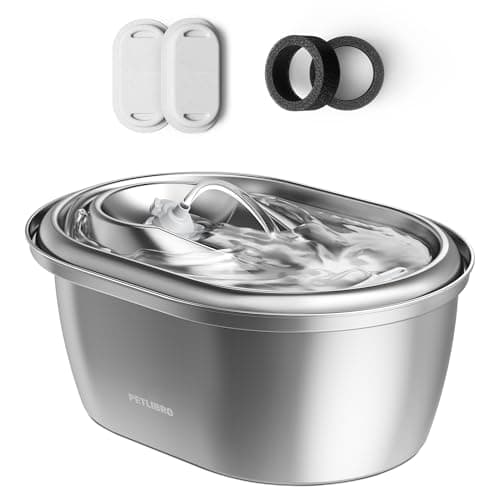
#ad Price as of October 19, 2026. Prices move; we check daily. How we're funded.
The only fountain here that publishes its adapter rating, its noise figure and its filter interval -- which is everything you need to cost a year of ownership before you buy.
Published specs
| Capacity | 3 L |
|---|---|
| Tank material | Stainless steel; PP water outlet |
| Power adapter | Input 100-240 V, output 5 V / 1 A (5 W ceiling) |
| Noise | Not more than 30 dB (published) |
| Filter interval | Every 2 weeks (PETLIBRO) |
| Filter price | $14.99 per 4-pack (PETLIBRO list) |
| Dimensions / weight | 10.8 x 8.1 x 4.7 in / 1.6 lb |
Source: PETLIBRO -- Stainless Steel Fountain 3 L product page and filter listing
Adapter output is 5 V x 1 A = 5 W, which is a nameplate ceiling, not a measurement. 5 W x 24 h x 365 = 43.8 kWh, x $0.1834 = $8.03. Filters at PETLIBRO's own $14.99 per 4-pack is $3.75 each, changed fortnightly = 26 a year = $97.44. The filters cost twelve times the electricity. Nobody puts that on the box.
What the specs favor
- Publishes the adapter rating, so running cost is computable rather than guessed
- Publishes a noise figure of 30 dB or less
- 304 stainless tank -- no plastic to scratch and harbor biofilm
- 3 L is enough for three cats between top-ups
What they don't
- Fortnightly filter changes are the real cost, at roughly $97 a year
- Plastic water outlet on an otherwise stainless fountain
- Small footprint means a determined cat can shove it around
You will not commit to a filter every two weeks. Run past the interval and a fountain is a warm, aerated, recirculating bacterial culture -- worse than a bowl you rinse daily.
How it scores
Scores are our editorial weighting of the published specs above, not a test result. They are deliberately kept out of this page's structured data.
Pioneer Pet Big Max Stainless Steel Fountain
Pioneer Pet · Water fountain · Our score 7.9/10
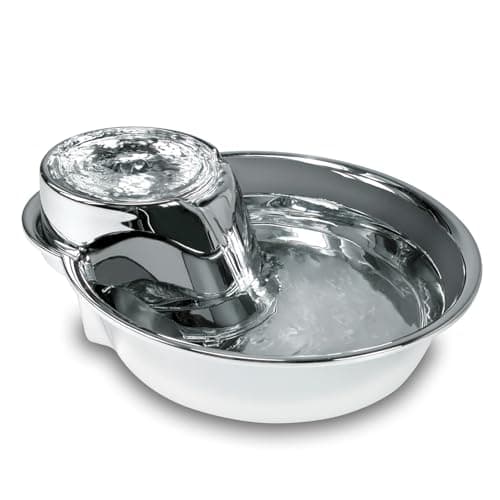
#ad Price as of October 19, 2026. Prices move; we check daily. How we're funded.
18/8 stainless at 128 oz and dishwasher safe -- the stainless fountain Pioneer still actually sells, and the one with room for three or four cats.
Published specs
| Capacity | 128 oz (3.78 L) |
|---|---|
| Material | 18/8 stainless steel |
| Dimensions | Footprint 13.75" x 12"; height published as 2.75" by one retailer and 4.25" by another -- they disagree |
| Weight | Not published |
| Filter | Replaceable charcoal; part numbers #3002 (3-pack) and #3014 (4-pack) |
| Filter interval | Every 2-4 weeks (Pioneer Pet) |
| Cleaning | Dishwasher safe; maker says clean weekly and strip the pump monthly |
| Power | Corded, low voltage; wattage not published |
Pioneer Pet gives an interval rather than a fixed number: every 2 to 4 weeks. That is 13 filters a year at the slow end and 26 at the fast end -- a two-fold spread in running cost that depends entirely on how many cats are using it. Makers who quote a single interval are quoting the single-cat case. Pioneer also publishes a maintenance schedule most makers skip: clean the fountain weekly and take the pump apart monthly.
What the specs favor
- 18/8 stainless, which cannot scratch into a surface that holds biofilm
- 128 oz is genuine multi-cat capacity rather than a daily top-up
- Filter interval published as a range, which is more honest than a single number
- Dishwasher safe, and Pioneer publishes a weekly-clean and monthly-pump schedule
- Named filter part numbers, so the consumable is findable rather than proprietary-mystery
What they don't
- Retailers disagree about its height (2.75 in against 4.25 in), so drinking posture cannot be checked before it arrives
- No published pump wattage, so electricity cannot be costed
- No published weight
- 13.75 by 12 inch footprint is a lot of counter for a fountain
- The most expensive fountain on this site by a clear margin
You have one cat and a small kitchen. 128 oz and a 13.75 by 12 inch footprint is capacity you will not use, and a smaller stainless fountain does the same job in less space.
How it scores
Scores are our editorial weighting of the published specs above, not a test result. They are deliberately kept out of this page's structured data.
Catit Flower Fountain, 3 L
Catit · Water fountain · Our score 7.1/10
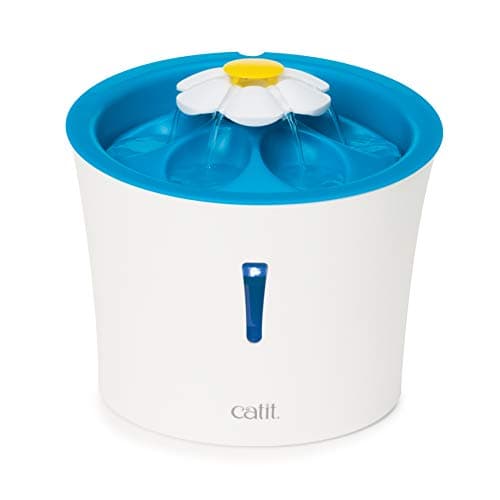
#ad Price as of October 19, 2026. Prices move; we check daily. How we're funded.
Three flow settings and a low price -- the sensible way to find out whether a fountain changes anything in your house before spending on stainless.
Published specs
| Capacity | 3 L |
|---|---|
| Power | 120 V, 12 VA, 60 Hz, 300 mA (North America) |
| Flow settings | Three (gentle, bubbling, calm) |
| Filtration | Triple-action filter |
| Material | Plastic |
Source: Catit -- Flower Fountain product page
Catit publishes 12 VA, which is apparent power at the adapter, not watts drawn -- so treat it as a hard ceiling. 12 W x 24 h x 365 = 105.1 kWh, x $0.1834 = $19.28. The real draw is lower, and Catit does not publish it. We are not going to pretend a VA rating is a wattage.
What the specs favor
- Three flow settings, so a cat that ignores one may take another
- Cheapest way to test the fountain question at all
- 3 L capacity matches the stainless models here
- Catit publishes an adapter rating, unlike PetSafe
What they don't
- Plastic, which scratches and then holds biofilm in the scratches
- 12 VA is apparent power, not a wattage -- the real draw is unpublished
- Many small parts to disassemble at cleaning time
Your cat has feline acne or a history of chin irritation. Plastic water and food vessels are the standard first thing to eliminate, and this fountain is entirely plastic.
How it scores
Scores are our editorial weighting of the published specs above, not a test result. They are deliberately kept out of this page's structured data.
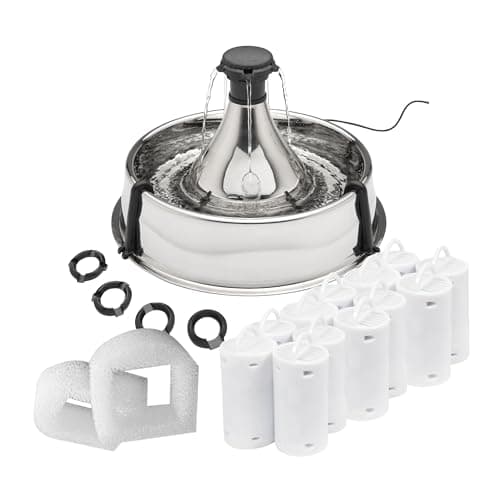
PetSafe Drinkwell 360 Stainless Steel
PetSafe · Water fountain · Our score 8.0/10
#ad Price as of October 19, 2026. Prices move; we check daily. How we're funded.
128 ounces and access from all sides -- the only fountain here designed so two cats can drink without one of them being cornered.
Published specs
| Capacity | 128 oz (3.8 L) |
|---|---|
| Streams | 5 interchangeable stream options |
| Access | 360 degrees, open bowl |
| Filtration | Charcoal plus foam pre-filter |
| Cleaning | Top-rack dishwasher safe |
| Pump | Submersible; wattage not published by PetSafe |
Source: PetSafe -- Drinkwell 360 Stainless Steel Pet Fountain product page
3.8 L divided three ways is 1.27 L a cat between refills -- far more than any cat drinks in a day, so the constraint is not capacity, it is how long water stays fresh. At fortnightly filter intervals the practical refill cycle is what governs, not the tank.
What the specs favor
- Largest capacity here at 128 oz
- 360-degree access removes the cornering problem in a multi-cat house
- Five stream options, so a fussy drinker has somewhere to go
- Top-rack dishwasher safe
What they don't
- PetSafe does not publish pump wattage, so electricity cannot be computed
- Two filter types to buy rather than one
- Big footprint for a water bowl
You want to know what it costs to run. PetSafe publishes no wattage for this pump, and we are not going to invent one.
How it scores
Scores are our editorial weighting of the published specs above, not a test result. They are deliberately kept out of this page's structured data.
Common questions
How much electricity does a cat water fountain use?
How much do cat fountain filters cost per year?
Can I run a cat fountain without a filter?
Which cat fountain is cheapest to run?
Is it cheaper to use a bowl?
Sources
- U.S. Energy Information Administration -- Electric Power Monthly, Table 5.3 (residential average 18.34 cents/kWh, June 2026)
- PETLIBRO -- Stainless Steel Fountain 3 L product page (5 V / 1 A, 30 dB, filter every 2 weeks)
- PETLIBRO -- Stainless Steel Fountain replacement filters (4-pack $14.99)
- Chewy -- Pioneer Pet Big Max Stainless Steel Fountain (128 oz, filter every 2-4 weeks)
- Catit -- Flower Fountain product page (120 V, 12 VA, 300 mA)
- PetSafe -- Drinkwell 360 Stainless Steel Pet Fountain (128 oz, 5 streams)
Read next
- Best Cat Fountain Filters (2026)
Fountain replacement filters compared on published construction and change interval, with the annual cost arithmetic.
- Best Cat Water Fountains (2026)
Four fountains compared on wattage, noise, filter interval and material -- and what each one costs across a year.
- Are Cat Water Fountains Worth It?
The fountain-versus-bowl trade laid out in a table, with the year-one running cost of doing it properly.
- What an Automatic Litter Box Actually Costs to Run
The full year-one and year-two running cost of every major automatic litter box, computed from published prices with the arithmetic shown.
- Ceramic vs Stainless vs Plastic Cat Fountains
Why the material debate is really about scratch resistance, and what that means for a fountain in a multi-cat house.
- Best Filterless Cat Water Fountains (2026)
Filterless water options compared: a separated-tank dispenser and two bowls, with the filter arithmetic that makes the question worth asking.