Litter & Litter Tech
How Many Litter Boxes Per Cat?
The rule is simple. The reason it works is about geography, not arithmetic, and that is the part most households get wrong.
Affiliate disclosure: we earn a commission if you buy through our links, at no extra cost to you. It never changes which product we rank first — here is how we're funded.
Everyone in this category says they tested twenty litter boxes. We have not tested any, and we say so. What we do instead: compile the published specs, read the manuals, and do the arithmetic on what this gear costs to run and how it behaves once there is more than one cat using it. Every spec is linked to the document it came from. Prices are checked daily — last verified October 19, 2026. Here is exactly how we pick.
The answer
That is the whole rule. What follows is why it exists, because understanding the reason is what stops people implementing it wrongly — and the most common implementation error cancels out the benefit entirely.
By household size
| Cats | Boxes | Minimum locations | Notes |
|---|---|---|---|
| 1 | 2 | 2 rooms | The spare matters most when the cat is unwell |
| 2 | 3 | 3 rooms | Never side by side; one per floor minimum |
| 3 | 4 | 3-4 rooms | Mix box types; at least one low-entry pan |
| 4 | 5 | 4-5 rooms | Spread across every floor |
| 5 | 6 | 5+ rooms | Expect differing preferences; mix high-sided and low pans |
Counts follow the Cornell Feline Health Center's n+1 guidance. Placement follows the Ohio State Indoor Pet Initiative's requirement for a box on each level of a multi-story home.
Why the extra box works
It is not about volume. Two cats do not produce more waste than a single box can hold. The extra box exists to guarantee choice, and choice matters in four specific situations that every multi-cat household eventually hits:
- The box is occupied. A cat that needs to go and finds another cat in the box needs somewhere else within a few seconds’ walk.
- The box is guarded. A confident cat sitting near the only box controls it. This is rarely dramatic — usually it is a stare from a doorway — and it is one of the most common causes of a cat toileting elsewhere.
- The box is unpleasant. Every box gets unpleasant between scoops. The spare buys you the margin.
- A cat is unwell. A cat with an urgent problem needs the nearest box, not the usual one. The Cornell Feline Health Center discusses litter box avoidance in the context of lower urinary tract disease — a sudden change in toileting is a reason to speak to a vet.
The mistake that cancels the rule
Four boxes in a row along one bathroom wall is not four resources. It is one resource with four doors, and a cat that wants to control it only has to sit in one place.
This is the single most common way households implement the count correctly and get none of the benefit. If the boxes are all in one room, a cat that is being blocked from the room is blocked from every box you own. Spread them:
- Different rooms, not different corners of the same room.
- Every floor of the house, per the Ohio State Indoor Pet Initiative guidance.
- Rooms with more than one way out, so a cat is never cornered while it is vulnerable.
- Away from the washing machine, the boiler and anything else that starts up without warning.
- Away from food and water.
What each of those boxes should be
The Ohio State Indoor Pet Initiative guidance is specific and most retail boxes fail at least one part of it: large enough for the cat to stand on all fours and turn around; uncovered, because cats generally prefer uncovered boxes and covered ones concentrate odor; filled with fine-grained, unscented litter about two inches deep; scooped daily and washed weekly with a mild dish detergent.
Which means the cheapest correct answer for most households is several plain open pans, not one clever box. Our multi-cat box roundup ranks the options on usable interior floor, which is the specification the listings hide.
The two objections we hear most
“I do not have room for four litter boxes”
Very few homes genuinely do not. What most people mean is that they do not have room for four boxes in the one room they currently keep boxes in — which is the placement problem, not a space problem. A plain jumbo pan is about 22 by 16 inches. Four of those, distributed, is less obtrusive than one 30-inch enclosure in a hallway.
“My cats already share fine”
Plenty do, and if nothing is going wrong there is nothing to fix today. The reason to close the gap anyway is that sharing works right up until it does not, and the moment it stops working is usually the moment one cat is unwell or something in the house has changed. Boxes are cheap insurance against a problem that is genuinely difficult to reverse once a cat has started toileting somewhere else.
The gear discussed here
Specs are the manufacturer's own, linked to the page they came from. Prices come from a live daily check; where we have no verified price we say so rather than print a stale one.
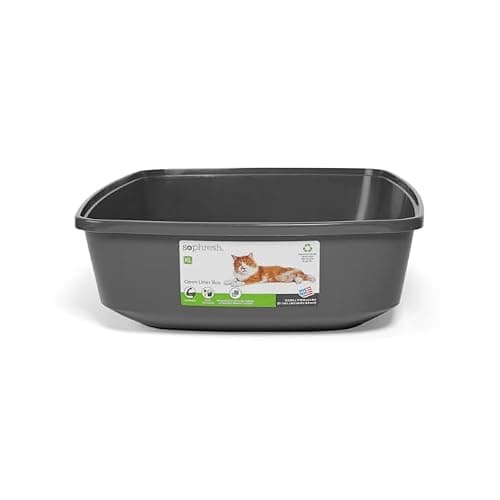
So Phresh Open Cat Litter Box, X-Large
So Phresh · Litter box · Our score 7.4/10
#ad Price as of October 19, 2026. Prices move; we check daily. How we're funded.
The plain plastic pan that lets you follow the one-box-per-cat-plus-one rule without spending like it -- 379 square inches of open floor for the price of a bag of litter.
Published specs
| External dimensions | 22.4" L x 16.9" W x 5.4" H |
|---|---|
| Wall height | 5.4" |
| Type | Open pan, no cover |
| Material | Plastic |
| Color | Charcoal |
| Litter type | Any |
| Published interior | Not published |
| Weight | Not published |
Cornell's guidance is one box more than you have cats. For three cats that is four boxes. The cheapest automatic box on this site is $269.99 -- four plain open pans is a fraction of one of those, and four boxes beat one clever one every time. At 22.4 x 16.9 inches each, four of these is 1,514 square inches of litter floor spread across four rooms, which is the thing a single automatic box cannot buy at any price.
What the specs favor
- Cheap enough to buy four without thinking about it
- 22.4 inches long, which is genuinely jumbo for a plain pan
- Open, uncovered, low -- the configuration cats prefer
- A 5.4 inch wall is an easy step for a kitten or an arthritic cat
- Nothing to break, nothing proprietary
What they don't
- A 5.4 inch wall will not contain a cat that sprays standing up, and it is lower than the 6.5 inch pans it replaces
- No scatter shield at all
- Thin plastic scratches, and scratched plastic holds odor
- No published interior dimension, so usable floor is smaller than the external figure
- No published weight
Odor or scatter is your actual complaint. This pan solves the count problem, not the containment problem -- pair it with a high-sided box rather than replacing one.
How it scores
Scores are our editorial weighting of the published specs above, not a test result. They are deliberately kept out of this page's structured data.
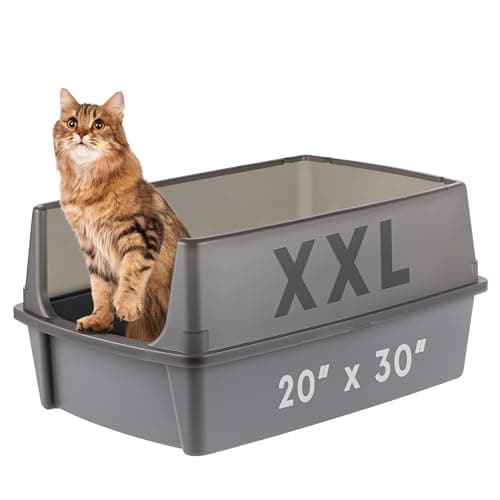
IRIS USA XX-Large Open Top Litter Box
IRIS USA · Litter box · Our score 8.7/10
#ad Price as of October 19, 2026. Prices move; we check daily. How we're funded.
At 30.18 by 20.13 inches this is the largest open-top pan in general retail, and floor area is the single spec that decides whether two cats will share a box.
Published specs
| External dimensions | 30.18" L x 20.13" W x 13.12" H |
|---|---|
| Type | Open top with scatter shield |
| Litter type | Any |
| Weight capacity | Not published |
Source: Amazon -- IRIS USA XX-Large open top litter box listing
30.18 x 20.13 = 607 sq inches of external footprint. Two cats sharing it get roughly 304 sq inches each -- still more than a whole standard jumbo pan gives one cat. That is why one very large box beats two small ones when floor space is tight.
What the specs favor
- Largest published open-top footprint here at 30.18 x 20.13 inches
- 13.12-inch walls with a scatter shield -- the combination that stops high sprayers
- Open top, the configuration cats are documented to prefer
- Takes any litter, no proprietary anything
What they don't
- 607 square inches of floor is a lot of floor to give up
- IRIS does not publish a weight capacity
- High walls make it a genuine step up for a senior cat
Your cat is elderly or arthritic. A 13-inch wall is a real climb, and a cat that starts avoiding the box because getting in hurts is a much worse problem than litter scatter.
How it scores
Scores are our editorial weighting of the published specs above, not a test result. They are deliberately kept out of this page's structured data.
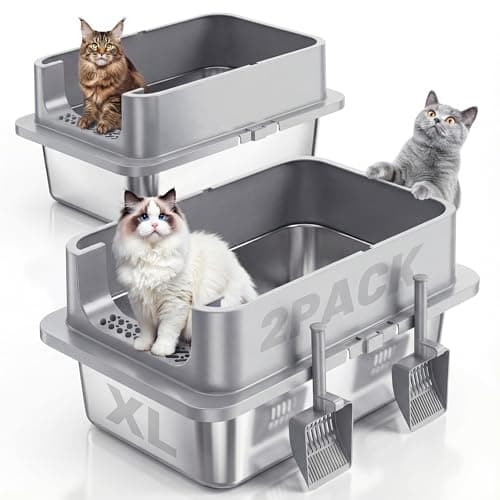
Frisco High-Sided Cat Litter Box, XL 24-in
Frisco · Litter box · Our score 7.6/10
#ad Price as of October 19, 2026. Prices move; we check daily. How we're funded.
Publishes its interior floor dimensions, not just the outside -- which is the only honest way to compare litter boxes and is rare enough to be a reason to buy.
Published specs
| External dimensions | 24" L x 18" W x 10" H |
|---|---|
| Internal floor | 19.75" L x 12.875" W |
| Wall height | 10" |
| Litter type | Any |
Source: Chewy -- Frisco High-Sided Cat Litter Box XL 24-in listing
24 x 18 = 432 sq inches outside. Frisco publishes the interior floor as 19.75 x 12.875 = 254 sq inches. You lose 41 percent of the footprint to sloped walls -- which is exactly why comparing boxes on external dimensions misleads you.
What the specs favor
- Publishes internal floor dimensions, which almost no maker does
- 10-inch walls contain a standing sprayer
- Cheapest way to get past 250 square inches of usable floor
- Open top
What they don't
- Loses 41 percent of its footprint to sloped walls
- No scatter shield, so litter still leaves with the cat
- 10-inch walls are still a climb for an old cat
You are buying one box for three cats. 254 square inches of usable floor is a single-cat box being asked to do a household's work.
How it scores
Scores are our editorial weighting of the published specs above, not a test result. They are deliberately kept out of this page's structured data.
Modkat XL Litter Box
Modkat · Litter box · Our score 7.2/10
#ad Price as of October 19, 2026. Prices move; we check daily. How we're funded.
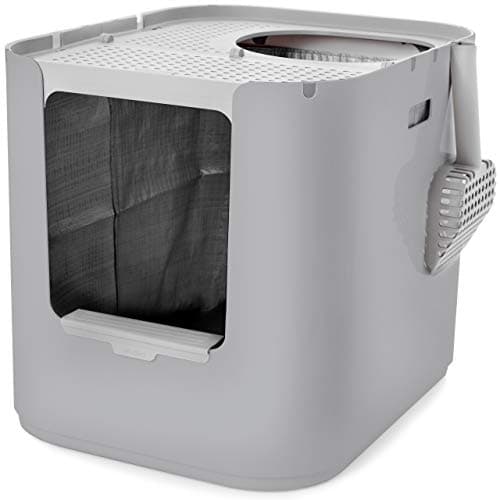
Configurable top or front entry from the same shell, with a reusable liner rated for three months instead of a disposable one.
Published specs
| External dimensions | 21" L x 16.3" W x 17" H |
|---|---|
| Liner interior | 20" x 16" x 15" H |
| Entry | Top or front, configurable |
| Liner life | Up to three months (Modkat) |
| Litter type | Any |
Source: Modkat -- XL liner specification pages
Modkat rates its reusable liner at up to three months, so four a year. A ScoopFree needs twelve disposable trays in the same period, and the Litter-Robot around 156 drawer liners. Reusable is not a green talking point here, it is the cheapest consumable model of the three.
What the specs favor
- Top or front entry from the same box -- you can change your mind after the cat has
- Reusable liner rated at three months, not a monthly disposable
- Tall 17-inch shell contains scatter and spray
- Smallest floor footprint here at 21 x 16.3 inches
What they don't
- Liner interior is 20 x 16 inches -- less usable floor than the IRIS or the Frisco
- Top entry excludes kittens and senior cats entirely
- Costs several times a plain pan of the same capacity
You have a kitten or an old cat. Configured top-entry it is unusable for them, and configured front-entry you have paid a premium for a normal covered box.
How it scores
Scores are our editorial weighting of the published specs above, not a test result. They are deliberately kept out of this page's structured data.
Common questions
How many litter boxes for 2 cats?
How many litter boxes for 3 cats?
How many litter boxes for 4 cats?
How many litter boxes for 5 cats?
Do I really need an extra litter box?
Can two cats share one litter box?
Sources
Read next
- Can Two Cats Share One Litter Box?
The honest answer on litter box sharing, what it costs, and the four situations where it breaks down.
- Litter Setup for Multiple Cats
Box counts, room-by-room placement, which box types to mix and why, for households with two or more cats.
- Best Litter Boxes for Multiple Cats (2026)
Four boxes compared on interior floor area, wall height and what each one actually solves. Cheap pans beat clever ones more often than you would expect.
- Why Your Litter Box Smells (and How to Fix It)
Ammonia smell diagnosed cause-first: what it means, the free fixes that solve most cases, and the products worth buying only if those fail.
- The Multi-Cat Household Guide
The pillar guide: resource counts by household size, why separation beats quantity, and the order to fix things in.
- Best Enzyme Cleaners for Cat Urine (2026)
Enzyme cleaners compared on published mechanism and sizes, with the UV torch that shows where the urine actually is.
- Where to Put a Litter Box
The placement rules from published feline guidance, plus what to do when the only spot you have is a bathroom corner.