Litter & Litter Tech
Where to Put a Litter Box
You can buy the best box on the market and site it somewhere a cat will not use. Placement is the cheapest fix in this hub and the one people skip.
Affiliate disclosure: we earn a commission if you buy through our links, at no extra cost to you. It never changes which product we rank first — here is how we're funded.
Everyone in this category says they tested twenty litter boxes. We have not tested any, and we say so. What we do instead: compile the published specs, read the manuals, and do the arithmetic on what this gear costs to run and how it behaves once there is more than one cat using it. Every spec is linked to the document it came from. Prices are checked daily — last verified September 25, 2026. Here is exactly how we pick.
Almost every litter question we get turns out to be a placement question wearing a different hat. The box is fine. Where it lives is not.
The published rules
The Ohio State Indoor Pet Initiative is unusually specific about siting, and its three points cover most failures we hear about:
- One on each level in a home with more than one story.
- Away from food and water, and away from appliances that could start unexpectedly -- a washing machine spinning up beside a box teaches a cat to use somewhere else.
- Sited so another animal cannot sneak up on the cat. That is the rule people miss, and it is the one that decides whether a nervous cat uses the box at all.
The dead-end test
Stand where the box is and look at it the way a cat does. Ask one question: if something came at me while I was in this box, could I leave without passing it?
A box in the middle of a wall passes. A box wedged in an alcove behind a door, or at the end of a narrow utility room, fails -- there is one approach, and it is also the only exit.
In a single-cat home the threat is a vacuum, a toddler or a dog. In a multi-cat home it is another cat, which is why our multi-cat litter setup page treats corridors and doorways as part of the litter plan.
Room by room
| Location | Works because | Watch out for |
|---|---|---|
| Bathroom | Hard floor, easy cleaning, usually quiet | Doors that get closed; noise if the washer shares the room |
| Spare bedroom | Quiet, out of the traffic route | Becoming a room nobody opens; keep the door wedged |
| Hallway or landing | Central, two ways out, one per floor | Smell in a small space -- scoop daily |
| Living room, in furniture | Keeps the box in a room the cat uses | Odor concentrating inside a cabinet |
| Basement or garage | Out of sight | Stairs for an older cat; cold; a door that latches |
| Beside the food bowls | Nothing | This is the classic mistake -- move one of them |
Compiled from the published placement guidance plus the failures readers report most often.
When there is only one spot
In a small apartment the honest answer is often that one corner of the bathroom is all you have. That is workable, and the shape of the box is how you make it work:
A triangular corner pan uses the one piece of floor a rectangle wastes, which is why our corner box page exists. If you have the floor for it, a large open box is still the better box -- cats prefer large, uncovered pans, and the scatter shield does the containment a hood would.
If the room is small enough that odor is the problem rather than space, a box-side air purifier is the last step rather than the first. Our smell guide works through the free fixes in order before anything gets plugged in.
Moving a box without breaking the habit
- Move it a few feet at a time, not across the house in one go.
- Or add the new box before removing the old one. Two boxes for a week costs nothing and lets the cat vote.
- Keep the litter identical while the location changes. One variable at a time.
- Watch the first week. A cat going beside the new spot is telling you the spot is wrong, not that it has forgotten.
The gear discussed here
Specs are the manufacturer's own, linked to the page they came from. Prices come from a live daily check; where we have no verified price we say so rather than print a stale one.
Van Ness Corner High-Sides Cat Litter Pan
Van Ness · Corner litter box · Our score 7.1/10
#ad No verified live price right now, so we show none rather than a stale one. How we're funded.
A triangular pan with 9 inch sides that tucks into a corner at 18 by 18 inches -- it uses the one piece of floor nothing else can.
Published specs
| Dimensions | 18" W x 18" D x 9" H |
|---|---|
| Shape | Triangular, fits a corner |
| Type | Open, high-sided |
| Interior floor | Not published |
Source: Van Ness Pets -- Corner High-Sides Cat Litter Pan product page (CP8HS, 18 W x 18 D x 9 H in)
Van Ness publishes 18 by 18 inches along the two walls. A triangle with two 18 inch sides covers half the 324 square inch square those walls describe, about 162 square inches, and the rounded front adds a little. That is small -- the point of a corner box is where it goes, not how much room it gives.
What the specs favor
- Fits a corner where a rectangle would stick out
- 9 inch sides for a cat that kicks litter
- Open, so no hood to push through
What they don't
- Well under half the floor of a jumbo pan
- Interior floor not published
- Too small to be the only box for a large cat
This is your cat's only box. A corner pan is a second box for a bathroom or a small room, not the main one.
How it scores
Scores are our editorial weighting of the published specs above, not a test result. They are deliberately kept out of this page's structured data.
IRIS USA XX-Large Open Top Litter Box
IRIS USA · Litter box · Our score 8.7/10
#ad Price as of September 25, 2026. Prices move; we check daily. How we're funded.
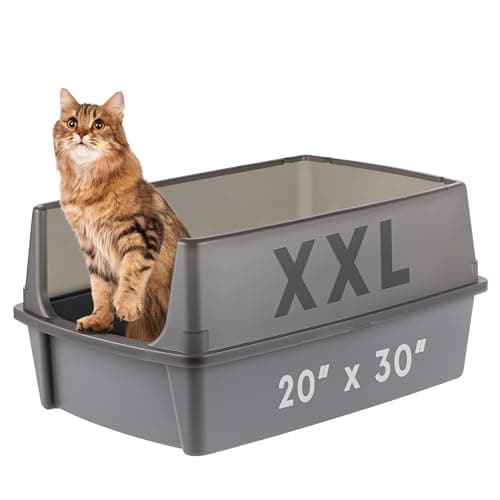
At 30.18 by 20.13 inches this is the largest open-top pan in general retail, and floor area is the single spec that decides whether two cats will share a box.
Published specs
| External dimensions | 30.18" L x 20.13" W x 13.12" H |
|---|---|
| Type | Open top with scatter shield |
| Litter type | Any |
| Weight capacity | Not published |
Source: Amazon -- IRIS USA XX-Large open top litter box listing
30.18 x 20.13 = 607 sq inches of external footprint. Two cats sharing it get roughly 304 sq inches each -- still more than a whole standard jumbo pan gives one cat. That is why one very large box beats two small ones when floor space is tight.
What the specs favor
- Largest published open-top footprint here at 30.18 x 20.13 inches
- 13.12-inch walls with a scatter shield -- the combination that stops high sprayers
- Open top, the configuration cats are documented to prefer
- Takes any litter, no proprietary anything
What they don't
- 607 square inches of floor is a lot of floor to give up
- IRIS does not publish a weight capacity
- High walls make it a genuine step up for a senior cat
Your cat is elderly or arthritic. A 13-inch wall is a real climb, and a cat that starts avoiding the box because getting in hurts is a much worse problem than litter scatter.
How it scores
Scores are our editorial weighting of the published specs above, not a test result. They are deliberately kept out of this page's structured data.
Purrified Air Litter Box Air Purifier
Purrified Air · Litter box air purifier · Our score 7.2/10
#ad Price as of September 25, 2026. Prices move; we check daily. How we're funded.
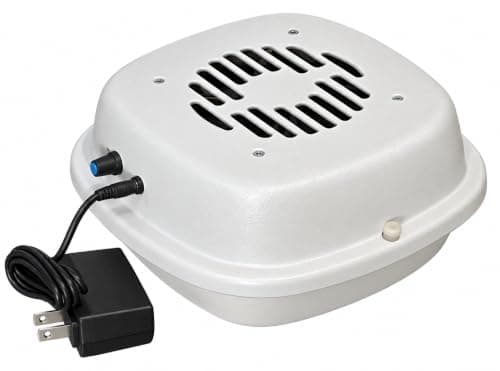
Publishes a filter media weight rather than a room-coverage figure, which is the more honest specification for a unit that sits on the box rather than in the room.
Published specs
| Filter media | 2+ pounds of media |
|---|---|
| Ozone | None |
| Fragrance | None |
| Media life | 4 to 7 months depending on usage |
| Targets | Odors, allergens and pet dander |
| Room coverage | Not published -- it treats the box, not the room |
Purrified publishes 4 to 7 months per media pack. That is 1.7 to 3 packs a year, which is the recurring cost nobody prices in when comparing this against a room air purifier. Filter media is the running cost of every odor appliance on this site -- the same pattern as fountain filters and disposable litter trays.
What the specs favor
- Publishes a media weight, which is the figure that actually governs capacity
- No ozone, stated plainly, which matters in a room with a cat in it
- No fragrance, so it does not add a scent a cat may reject
- Sits at the source rather than trying to clean a whole room
What they don't
- Proprietary media packs are a recurring cost
- No published CADR or coverage figure, so it cannot be compared with a room purifier
- Fan noise sits next to a litter box a cat has to be willing to use
Your box is scooped once every few days. An appliance that filters air above a neglected box is treating the symptom, and our smell guide's first three fixes are free.
How it scores
Scores are our editorial weighting of the published specs above, not a test result. They are deliberately kept out of this page's structured data.
Common questions
Where is the best place to put a litter box?
Can a litter box go in the bathroom?
Can I put the litter box next to the food bowl?
Do I need a litter box on every floor?
Is a hidden litter box a bad idea?
Sources
- Van Ness Pets -- Corner High-Sides Cat Litter Pan product page (CP8HS, 18 W x 18 D x 9 H in)
- Amazon -- IRIS USA XX-Large open top litter box listing
- Purrified Air -- Litter Box Air Purifier listing (2+ lb filter media, no ozone, no fragrance, media lasts 4-7 months)
- Ohio State University Indoor Pet Initiative -- Litter Boxes
Read next
- How Many Litter Boxes Per Cat?
The n+1 rule, its published source, a count-by-household table, and why four boxes in a row is really only one box.
- Litter Setup for Multiple Cats
Box counts, room-by-room placement, which box types to mix and why, for households with two or more cats.
- Best Litter Boxes for Small Apartments (2026)
Ranked on interior floor per square foot occupied, with a workable multi-box plan for a one-bedroom flat.
- Best Corner Litter Boxes (2026)
Corner litter boxes compared on published dimensions against a rectangular pan, with the floor-area arithmetic the shape costs you.
- Why Your Litter Box Smells (and How to Fix It)
Ammonia smell diagnosed cause-first: what it means, the free fixes that solve most cases, and the products worth buying only if those fail.