Litter & Litter Tech
Why Your Litter Box Smells (and How to Fix It)
Causes ranked by likelihood, fixes ranked by cost. The first three are free and they solve it for most households.
Affiliate disclosure: we earn a commission if you buy through our links, at no extra cost to you. It never changes which product we rank first — here is how we're funded.

Everyone in this category says they tested twenty litter boxes. We have not tested any, and we say so. What we do instead: compile the published specs, read the manuals, and do the arithmetic on what this gear costs to run and how it behaves once there is more than one cat using it. Every spec is linked to the document it came from. Prices are checked daily — last verified October 19, 2026. Here is exactly how we pick.
The short answer
The causes, ranked by how often they are the cause
1. Too few boxes (most common by a distance)
The Cornell Feline Health Center recommends one more box than you have cats. Most households with a smell problem are below that number, often well below. The arithmetic is unforgiving:
2. Scooping less often than daily
The Ohio State Indoor Pet Initiative standard is scooping daily and washing weekly. Every odor-control claim on every bag of litter is made against that standard. If you are scooping every second or third day, the litter is not underperforming — it is being asked to do something nobody promised it would do.
3. Urine in the plastic
This is the one that produces “it smells even after I clean it.” Plastic litter boxes get scratched by claws and by scooping, and urine wicks into the scratches where no scoop reaches. A weekly wash with mild dish detergent, per the Ohio State Indoor Pet Initiative guidance, keeps it under control; a box that is badly scratched after a few years is a box to replace rather than to keep scrubbing.
4. A covered box that is not immaculate
The Ohio State Indoor Pet Initiative notes that covered boxes concentrate odors and may be refused if they are not kept extremely clean. A hood does not remove smell, it concentrates it — pleasantly for you and unpleasantly for the cat standing inside it.
5. Litter the cat dislikes
A cat that finds a litter unpleasant covers less thoroughly and leaves sooner. Since most cats prefer fine-grained, unscented litter, a heavily scented product can quietly make the covering behavior worse while smelling better to you.
The fixes, cheapest first
- Free: scoop every box, every day, without exception. Give it a week before you judge anything else.
- Free: move a box. Out of the cupboard, away from the washing machine, into a room with two exits and some air.
- Free: take the hood off. If the cat uses it more happily uncovered, you have your answer.
- Cheap: buy the boxes you are missing to reach n+1. Ordinary pans are fine, and this is the intervention with the largest effect per dollar on this page.
- Cheap: wash every box weekly with mild dish detergent. Replace any box that is visibly scratched.
- Moderate: switch to a fine-grained unscented clumping litter, and transition over a week rather than all at once.
- Expensive, and last: an enclosed automatic box with a carbon filter, which genuinely does contain odor — see the picks and what it costs to run.
When it is not the box
If the smell is in the room but not in the box, a cat is going somewhere else — behind furniture, on a rug, against a wall. That is a different problem with the same first fix (more boxes, better placed), and it is also a reason to speak to a vet. The Cornell Feline Health Center discusses litter box avoidance in the context of feline lower urinary tract disease. We are not veterinarians and will not try to diagnose your cat; a sudden change in toileting behavior is a medical question first and a furniture question second.
What not to do
- Do not add fragrance as the first move. It risks the cat avoiding the box, which turns an odor problem into a carpet problem.
- Do not deep-fill the box. Two inches is the recommended depth; more litter does not absorb more urine, it just buries the clump where you will not find it.
- Do not move all the boxes at once. Change one thing at a time or you will not know what worked.
The gear discussed here
Specs are the manufacturer's own, linked to the page they came from. Prices come from a live daily check; where we have no verified price we say so rather than print a stale one.
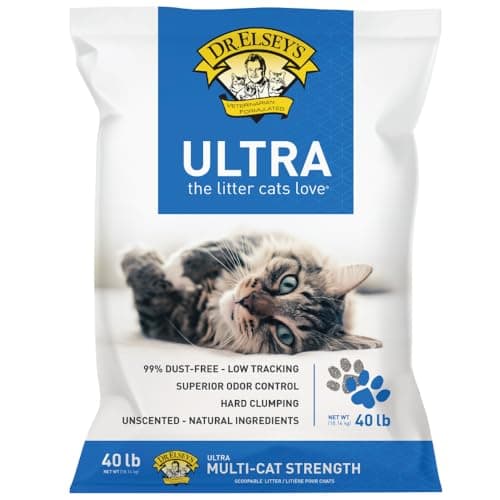
Dr. Elsey's Ultra Unscented Clumping Clay Litter
Dr. Elsey's · Cat litter · Our score 8.8/10
#ad Price as of October 19, 2026. Prices move; we check daily. How we're funded.
Unscented, medium-grain, 99.9 percent dust-free -- which is the exact specification the veterinary guidance on litter preference describes, rather than a marketing claim.
Published specs
| Material | Natural clay |
|---|---|
| Scent | None; no perfumes or deodorants |
| Dust | 99.9 percent dust-free (Dr. Elsey's) |
| Grain | Medium grain with heavier non-tracking granules |
| Bag size | 40 lb |
| Additives | Free of plant proteins, perfumes and deodorants |
Source: Dr. Elsey's -- Ultra Litter product page
The Ohio State Indoor Pet Initiative says most cats prefer fine-grained, unscented litter and are deterred by scented or deodorant products. This litter is unscented, deodorant-free and fine-to-medium grain -- it meets all three published criteria. Very few litters marketed for odor control do.
What the specs favor
- Unscented and deodorant-free, matching the documented feline preference
- 99.9 percent dust-free by the maker's own measure
- Heavier granules specifically to reduce tracking
- Hard clumping, so waste leaves the box intact
What they don't
- Clay, so it is heavy to carry and heavy to lift out
- No added fragrance means it does nothing to mask odor between scoops
- 40 lb bag is awkward to store in a flat
You want the litter to do the odor work for you. This one is deliberately inert -- it relies on you scooping daily, which is what the veterinary guidance asks for anyway.
How it scores
Scores are our editorial weighting of the published specs above, not a test result. They are deliberately kept out of this page's structured data.
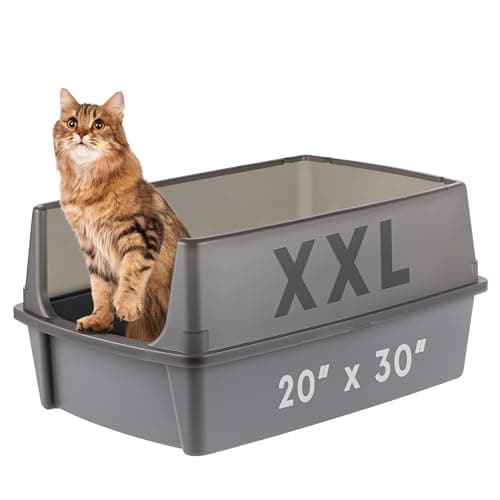
IRIS USA XX-Large Open Top Litter Box
IRIS USA · Litter box · Our score 8.7/10
#ad Price as of October 19, 2026. Prices move; we check daily. How we're funded.
At 30.18 by 20.13 inches this is the largest open-top pan in general retail, and floor area is the single spec that decides whether two cats will share a box.
Published specs
| External dimensions | 30.18" L x 20.13" W x 13.12" H |
|---|---|
| Type | Open top with scatter shield |
| Litter type | Any |
| Weight capacity | Not published |
Source: Amazon -- IRIS USA XX-Large open top litter box listing
30.18 x 20.13 = 607 sq inches of external footprint. Two cats sharing it get roughly 304 sq inches each -- still more than a whole standard jumbo pan gives one cat. That is why one very large box beats two small ones when floor space is tight.
What the specs favor
- Largest published open-top footprint here at 30.18 x 20.13 inches
- 13.12-inch walls with a scatter shield -- the combination that stops high sprayers
- Open top, the configuration cats are documented to prefer
- Takes any litter, no proprietary anything
What they don't
- 607 square inches of floor is a lot of floor to give up
- IRIS does not publish a weight capacity
- High walls make it a genuine step up for a senior cat
Your cat is elderly or arthritic. A 13-inch wall is a real climb, and a cat that starts avoiding the box because getting in hurts is a much worse problem than litter scatter.
How it scores
Scores are our editorial weighting of the published specs above, not a test result. They are deliberately kept out of this page's structured data.
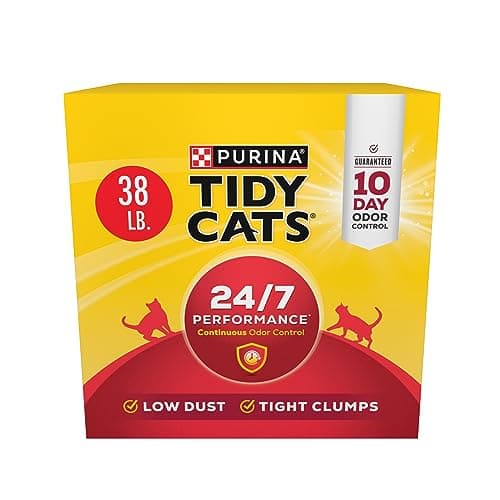
Purina Tidy Cats 24/7 Performance
Purina · Cat litter · Our score 7.9/10
#ad Price as of October 19, 2026. Prices move; we check daily. How we're funded.
Ten days is the longest odor guarantee any maker on this page will put in writing, and Purina is specific that it is a guarantee rather than a claim.
Published specs
| Odor claim | 10 days, guaranteed when used as directed |
|---|---|
| Material | Clay |
| Dust | 99.9 percent dust-free by airborne particles when pouring |
| Scent | Clean linen |
| Mechanism | Slow-release deodorizing system |
| Household | Formulated for multi-cat |
Source: Purina -- Tidy Cats 24/7 Performance Clumping Cat Litter product page
Purina 10 days, Arm & Hammer 7 days, Dr. Elsey's and World's Best publish no day count at all. Ranking litters on the only numbers the makers will commit to is the only ranking that is not opinion.
What the specs favor
- Longest published odor guarantee of any litter here at 10 days
- Explicitly formulated for multi-cat households
- 99.9 percent dust-free, measured by airborne particles when pouring
- Slow-release deodorizing rather than a single fragrance hit
What they don't
- Scented, against the documented feline preference for unscented
- Clay, so a heavy bag
- 'When used as directed' means daily scooping -- the guarantee is not a license to skip it
You have a cat with a respiratory condition or a strong preference for unscented. A ten-day guarantee is no use if the cat stops using the box.
How it scores
Scores are our editorial weighting of the published specs above, not a test result. They are deliberately kept out of this page's structured data.
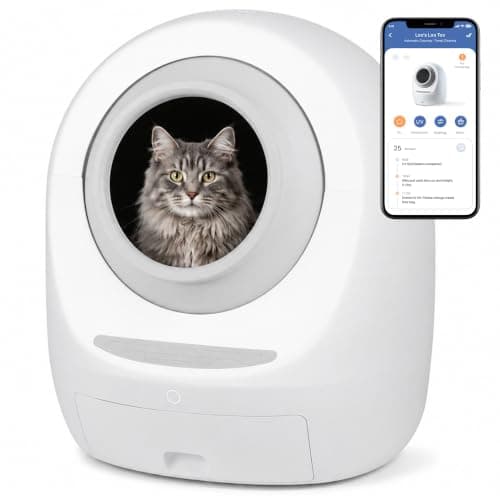
Casa Leo Leo's Loo Too
Casa Leo · Automatic litter box · Our score 7.9/10
#ad Price as of October 19, 2026. Prices move; we check daily. How we're funded.
Publishes both litter and waste capacity at 1.5 gallons each, which is more than Whisker will tell you about either of its units.
Published specs
| Litter capacity | 1.5 gal (6 L) |
|---|---|
| Waste drawer capacity | 1.5 gal (6 L) |
| Dimensions | 22" x 24" x 27.6" |
| Weight | 27.5 lb |
| Noise | About 30 dB (Casa Leo) |
| Weight sensors | Four, accurate to plus or minus 1 lb |
| Cat weight | 1-20 lb typical; 55 lb maximum load |
| Odor control | Bamboo carbon filter plus UV |
Published 6 L litter capacity. At the 2-inch depth the Ohio State Indoor Pet Initiative recommends, that is a full charge of litter every time you strip it -- roughly a 12 lb bag of clumping clay every two changes on package volumes.
What the specs favor
- Publishes litter AND waste capacity, both 1.5 gallons
- Four weight sensors with a published accuracy of plus or minus 1 lb
- Bamboo carbon filter is a standard consumable, not a proprietary tray
- Takes ordinary clumping litter
What they don't
- 27.6 inches tall and 27.5 lb -- awkward in a small bathroom
- Published cat range tops out around 20 lb for comfortable use
- 6 L waste drawer is smaller than the Neakasa M1's 11.23 L
You have a Maine Coon or a Ragdoll over 20 lb. The published comfortable range stops around 20 lb and a large cat in a rotating drum is not a place to find out where the limit is.
How it scores
Scores are our editorial weighting of the published specs above, not a test result. They are deliberately kept out of this page's structured data.
Common questions
Why does my litter box smell like ammonia?
Why does my litter box smell even after cleaning?
Does scented litter fix litter box smell?
How often should you completely change litter?
Will an air purifier fix litter box smell?
Can I use bleach to clean a litter box?
Sources
Read next
- Best Litter Box Air Purifiers (2026)
Litter box air purifiers compared on published filter media and running cost, with the free fixes that come first.
- How Many Litter Boxes Per Cat?
The n+1 rule, its published source, a count-by-household table, and why four boxes in a row is really only one box.
- Best Cat Litter for Odor Control (2026)
Ranked on the only two published odor guarantees in the category, against the documented feline preference for unscented litter.
- Best Litter Boxes for Multiple Cats (2026)
Four boxes compared on interior floor area, wall height and what each one actually solves. Cheap pans beat clever ones more often than you would expect.
- Litter Setup for Multiple Cats
Box counts, room-by-room placement, which box types to mix and why, for households with two or more cats.
- Best Stainless Steel Litter Boxes (2026)
Stainless steel litter boxes compared against a plastic benchmark on floor area, wall height and what the material actually buys.
- Where to Put a Litter Box
The placement rules from published feline guidance, plus what to do when the only spot you have is a bathroom corner.