Litter & Litter Tech
What an Automatic Litter Box Actually Costs to Run
Nobody publishes this, so we computed it from the manufacturers' own listed prices. The electricity is trivial. The consumables are not.
Affiliate disclosure: we earn a commission if you buy through our links, at no extra cost to you. It never changes which product we rank first — here is how we're funded.
Everyone in this category says they tested twenty litter boxes. We have not tested any, and we say so. What we do instead: compile the published specs, read the manuals, and do the arithmetic on what this gear costs to run and how it behaves once there is more than one cat using it. Every spec is linked to the document it came from. Prices are checked daily — last verified October 19, 2026. Here is exactly how we pick.
This is the page nobody in this category publishes, which is exactly why it exists. Every figure below comes from a manufacturer’s own listed price or published specification, on 3 September 2026, and every sum shows its inputs so you can substitute your own cat count and electricity rate.
The headline: electricity is irrelevant and consumables are everything. The spread between the cheapest and most expensive system to run is over $800 a year with three cats — more than the price of any single unit in the category.
Part one: electricity
Only one manufacturer here publishes anything you can compute with. Whisker states that a compatible Litter-Robot supply must be “15VDC regulated 400mA to 1000mA.” That gives a hard ceiling.
The rate used throughout is 18.34 cents per kilowatt-hour, the US average residential retail price for June 2026 from the EIA Electric Power Monthly, Table 5.3. Substitute your own — every sum above is one multiplication.
Part two: consumables, where the money goes
Litter-Robot 4 and 5
PetSafe ScoopFree Crystal
Neakasa M1 and Casa Leo Leo’s Loo Too
Neither has a proprietary consumable in the waste path. The M1 takes ordinary bin bags and ordinary clumping litter; Leo’s Loo Too takes ordinary clumping litter and a bamboo carbon filter. Their running cost is the litter you would be buying for a plain box anyway, plus a filter in the Casa Leo’s case. That is the whole reason the M1 leads our automatic box roundup.
Five years, three cats
| System | Purchase | Consumables x5 | Five-year total |
|---|---|---|---|
| Neakasa M1 | Check price | Bin bags only | Purchase + bags |
| PetSafe ScoopFree Crystal Smart | $269.99 | $4,410 | About $4,680 |
| Litter-Robot 4 | $699 | $1,140 | About $1,839 |
| Litter-Robot 5 | $799 | $1,140 | About $1,939 |
Consumables computed above from each manufacturer's own listed prices. Neakasa publishes no proprietary consumable, so there is no figure to add. Purchase prices are the manufacturers' listed 'from' prices at the time of writing and are not live -- our buy buttons show a live price where we have one, and say 'check price' where we do not.
The ScoopFree line is not a typo. A $269.99 box with a $24.50 monthly tray, used by three cats, is the most expensive automatic litter system on the market to own, by a factor of two and a half over the Litter-Robot and by far more over the Neakasa. Everything you need to work that out is on PetSafe’s own website; nobody puts the two numbers next to each other.
What to take from this
- Ignore electricity. The worst case in the category is $24 a year and the realistic figure is under $10.
- Price the consumable before the machine. Multiply the per-unit cost by the interval by your cat count, then by five years.
- Prefer systems that take ordinary supplies. A unit that works with any clumping litter and any bin bag cannot raise your running cost unilaterally.
- Remember the machine is one box. The Cornell Feline Health Center count still applies, and the other boxes still need litter.
The same arithmetic applied to water fountains produces an equally surprising answer — see what a cat fountain costs to run, where the filters cost roughly twelve times the electricity.
The gear discussed here
Specs are the manufacturer's own, linked to the page they came from. Prices come from a live daily check; where we have no verified price we say so rather than print a stale one.
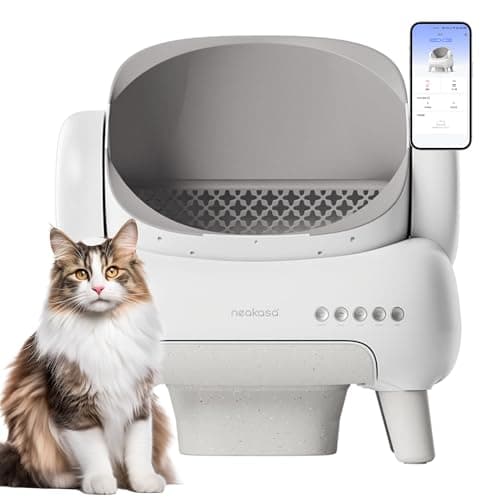
Neakasa M1 Open-Top Self-Cleaning Litter Box
Neakasa · Automatic litter box · Our score 8.6/10
#ad Price as of October 19, 2026. Prices move; we check daily. How we're funded.
The only automatic box here that publishes both its litter capacity and its noise figure, and the only open-top design -- which matters because cats prefer uncovered boxes.
Published specs
| Litter capacity | 7.17 L |
|---|---|
| Waste bin capacity | 11.23 L |
| Footprint / height | 23.26" x 20.67", 20.2" H |
| Entry height | 13.86" |
| Weight, empty | 22.81 lb |
| Cat weight range | 2.2-33 lb |
| Operating noise | Not more than 50 dB (published) |
Source: Neakasa -- M1 product page
11.23 L bin. Whisker's own guidance for its comparable drawer is emptying twice a week for two cats, i.e. roughly 3.5 days per two cats. Scale that to three and the bin needs emptying about every 4 days on published volumes -- an extrapolation from a competitor's published interval, not a measurement of this unit.
What the specs favor
- Publishes litter capacity (7.17 L) and waste bin capacity (11.23 L) -- almost nobody else does
- Publishes an operating noise figure of 50 dB or less
- Open top, which is the design cats are documented to prefer
- Takes ordinary clumping litter and ordinary bin bags -- no proprietary tray or liner
- Widest published cat weight range here at 2.2-33 lb
What they don't
- Open top means odor is not contained the way an enclosed drawer contains it
- 20.2 inches tall with a 13.86-inch entry -- a big step for an arthritic cat
- Bigger footprint than the enclosed units at 23.26 x 20.67 inches
Odor is your main problem. An open top vents into the room by design; if the smell is what you are trying to fix, an enclosed drawer with a carbon filter is the shape you want.
How it scores
Scores are our editorial weighting of the published specs above, not a test result. They are deliberately kept out of this page's structured data.
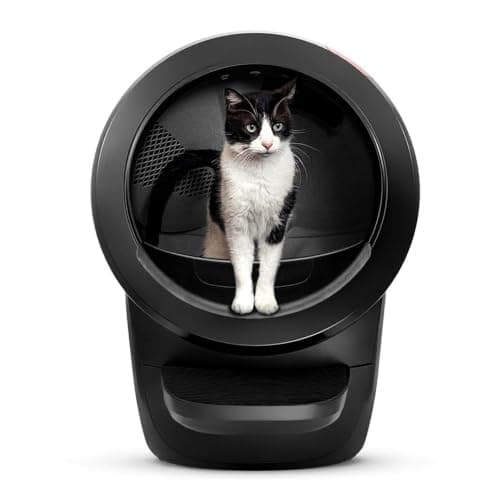
Whisker Litter-Robot 4
Whisker · Automatic litter box · Our score 8.1/10
#ad Price as of October 19, 2026. Prices move; we check daily. How we're funded.
The biggest entryway and the largest published cat-weight range of the enclosed units, and the only one whose maker publishes an actual power-supply spec you can cost out.
Published specs
| Entryway | 15.75" x 15.75" |
|---|---|
| Footprint / height | 22" W x 27" D x 29.5" H |
| Weight, empty | 24 lb |
| Cat weight range | 3-25 lb |
| Power supply | 15 V DC, 400-1000 mA (6-15 W) |
| Warranty | 1 year, 3-year plan optional |
| Globe / drawer capacity | Not published by Whisker |
Source: Whisker -- Litter-Robot 4 product page and power supply spec article
Whisker's own spec sheet accepts a 15 V supply between 0.4 A and 1.0 A. Take the 1.0 A ceiling: 15 W x 24 h x 365 = 131.4 kWh, x $0.1834 = $24.10. That assumes the motor runs flat out every hour of the year, which it does not -- so the real figure is well below this. The consumables are the actual cost.
What the specs favor
- Largest published entryway of the enclosed units here, at 15.75 inches square
- Whisker publishes a real power-supply rating, so running cost is computable
- Cat weight range published as 3-25 lb
- Three-year extended warranty available at purchase
What they don't
- Whisker does not publish globe or waste-drawer capacity, which is the number that actually decides how often you empty it with three cats
- Waste drawer liners are a proprietary consumable at $25 per 25-pack
- Carbon filter is a separate monthly consumable
- Whisker publishes no cat-count rating for this unit at all, so sizing it for a multi-cat house is guesswork
You have five cats. Whisker rates the newer Litter-Robot 5 for up to five and this one carries no published cat-count rating at all -- buying the older unit for a bigger household is guessing.
How it scores
Scores are our editorial weighting of the published specs above, not a test result. They are deliberately kept out of this page's structured data.
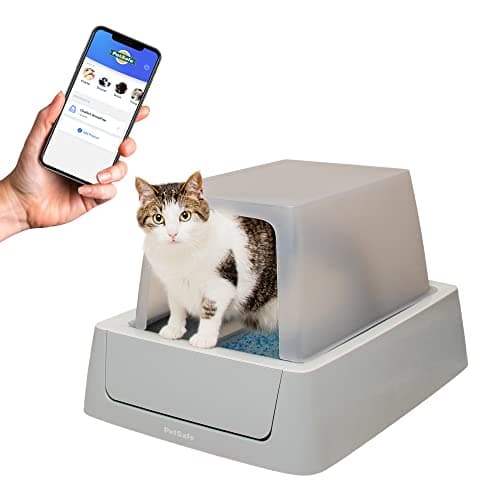
PetSafe ScoopFree Crystal Smart
PetSafe · Automatic litter box · Our score 6.2/10
#ad Price as of October 19, 2026. Prices move; we check daily. How we're funded.
The cheapest automatic box here at $269.99 and by a wide margin the most expensive to run, because the disposable tray is the entire consumable model.
Published specs
| Dimensions, uncovered | 27.6" x 19.1" x 6.2" |
|---|---|
| Dimensions, front-entry | 27.6" x 19.1" x 15.6" |
| Litter | ScoopFree crystal litter only |
| Tray life | Up to one month for a single cat (PetSafe) |
| Tray price | $73.49 per 3-pack (PetSafe list) |
| Power | Plug-in; wattage not published |
| Multi-cat guidance | PetSafe: "your mileage may vary" |
Source: PetSafe -- ScoopFree Crystal Smart product page and tray 3-pack listing
PetSafe lists the 3-pack at $73.49, so $24.50 a tray, and says one tray covers one cat for up to a month. Twelve trays a year is $294 -- more than the $269.99 box. With three cats the tray fills three times as fast, which is roughly $880 a year on the same arithmetic.
What the specs favor
- Lowest purchase price of the automatic boxes here
- Largest floor area of the automatic boxes at 27.6 x 19.1 inches
- Available uncovered, which is the shape cats prefer
- No scooping and no litter handling at all
What they don't
- Locked to PetSafe's own crystal litter -- no substitution
- Disposable trays cost more per year than the box costs to buy
- PetSafe publishes no wattage, so electricity cannot be computed
- PetSafe declines to give multi-cat guidance beyond 'mileage may vary'
You have more than one cat. The tray is the product, and with three cats the tray arithmetic runs to roughly $880 a year -- three or four times what a clumping-litter automatic box costs to feed.
How it scores
Scores are our editorial weighting of the published specs above, not a test result. They are deliberately kept out of this page's structured data.
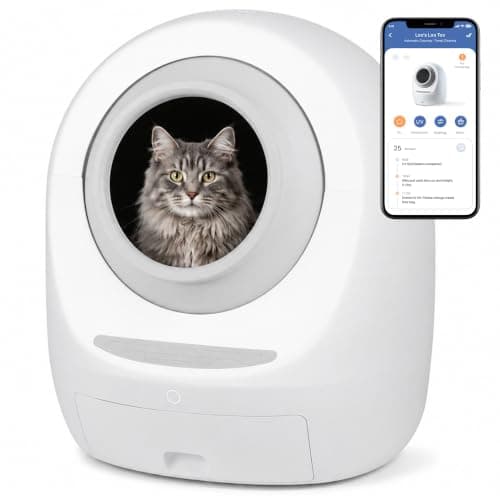
Casa Leo Leo's Loo Too
Casa Leo · Automatic litter box · Our score 7.9/10
#ad Price as of October 19, 2026. Prices move; we check daily. How we're funded.
Publishes both litter and waste capacity at 1.5 gallons each, which is more than Whisker will tell you about either of its units.
Published specs
| Litter capacity | 1.5 gal (6 L) |
|---|---|
| Waste drawer capacity | 1.5 gal (6 L) |
| Dimensions | 22" x 24" x 27.6" |
| Weight | 27.5 lb |
| Noise | About 30 dB (Casa Leo) |
| Weight sensors | Four, accurate to plus or minus 1 lb |
| Cat weight | 1-20 lb typical; 55 lb maximum load |
| Odor control | Bamboo carbon filter plus UV |
Published 6 L litter capacity. At the 2-inch depth the Ohio State Indoor Pet Initiative recommends, that is a full charge of litter every time you strip it -- roughly a 12 lb bag of clumping clay every two changes on package volumes.
What the specs favor
- Publishes litter AND waste capacity, both 1.5 gallons
- Four weight sensors with a published accuracy of plus or minus 1 lb
- Bamboo carbon filter is a standard consumable, not a proprietary tray
- Takes ordinary clumping litter
What they don't
- 27.6 inches tall and 27.5 lb -- awkward in a small bathroom
- Published cat range tops out around 20 lb for comfortable use
- 6 L waste drawer is smaller than the Neakasa M1's 11.23 L
You have a Maine Coon or a Ragdoll over 20 lb. The published comfortable range stops around 20 lb and a large cat in a rotating drum is not a place to find out where the limit is.
How it scores
Scores are our editorial weighting of the published specs above, not a test result. They are deliberately kept out of this page's structured data.
Common questions
How much electricity does an automatic litter box use?
How much do Litter-Robot liners and filters cost per year?
Are ScoopFree trays expensive?
Which automatic litter box is cheapest to run?
Do I need to buy the manufacturer's own litter?
Sources
- U.S. Energy Information Administration -- Electric Power Monthly, Table 5.3 (residential average 18.34 cents/kWh, June 2026)
- Whisker -- Litter-Robot power supply specifications
- Whisker -- Litter-Robot waste drawer liners, 25-pack
- Whisker -- Litter-Robot accessories (carbon filters, liners, ramps)
- PetSafe -- ScoopFree Crystal disposable litter trays, 3-pack
- PetSafe -- ScoopFree Crystal Smart self-cleaning litter box
- Neakasa -- M1 open-top self-cleaning litter box product page
- Whisker -- Litter-Robot 4 product page
Read next
- Best Automatic Litter Boxes for Multiple Cats (2026)
Five automatic boxes ranked on published litter and waste capacity, and on what a year of consumables actually costs with three cats.
- Are Automatic Litter Boxes Worth It?
Break-even arithmetic against ordinary boxes, worked from published prices, with a clear answer for one, two and three cat households.
- Litter-Robot 4 vs Litter-Robot 5
The $100 difference explained from Whisker's own spec sheets, with a clear verdict by household size.
- What a Cat Water Fountain Actually Costs to Run
Electricity and filters costed from published adapter ratings and manufacturers' own filter prices, with every sum shown.
- How we pick
The published method that replaces a testing claim.
- Litter-Robot 4 vs PetSafe ScoopFree
The rotating globe against the raking tray, on published specs and on what each one costs to keep running for a year.
- How to Clean an Automatic Litter Box
What a self-cleaning box still needs from you, on three clocks -- plus the consumable intervals the makers do publish, halved for a second cat.