Litter & Litter Tech
Are Automatic Litter Boxes Worth It?
The honest arithmetic, including the consumables the product pages leave out. For some households the answer is a clear no.
Affiliate disclosure: we earn a commission if you buy through our links, at no extra cost to you. It never changes which product we rank first — here is how we're funded.
Everyone in this category says they tested twenty litter boxes. We have not tested any, and we say so. What we do instead: compile the published specs, read the manuals, and do the arithmetic on what this gear costs to run and how it behaves once there is more than one cat using it. Every spec is linked to the document it came from. Prices are checked daily — last verified October 19, 2026. Here is exactly how we pick.
The honest answer is that it depends on your cat count, and the direction of the dependency surprises people: automatic boxes make more financial sense as you add cats, not less, even though the consumables get more expensive. Here is the arithmetic.
What you are actually comparing
Not “automatic box versus manual box.” The Cornell Feline Health Center recommends one more box than you have cats, so the real comparison is:
- Option A: n+1 plain boxes, all scooped daily.
- Option B: one automatic box plus n plain boxes, with the plain ones still scooped daily.
Option B does not eliminate scooping. It removes one box from your daily round. That is the honest framing, and it is why the value scales with cat count — the automatic box absorbs a larger share of a bigger workload.
Year one, three households
The consumable trap
The single biggest determinant of whether an automatic box is worth it is which consumable model it uses, and this is where the ScoopFree fails badly:
| System | Consumable | Annual cost, 3 cats | Substitutable? |
|---|---|---|---|
| Neakasa M1 | Ordinary litter and bin bags | Litter only | Yes |
| Litter-Robot 4 / 5 | Proprietary liners + carbon filters | About $228 | Partly |
| Casa Leo Leo's Loo Too | Ordinary litter + carbon filters | Filters only | Mostly |
| PetSafe ScoopFree Crystal | Proprietary disposable trays | About $882 | No |
Litter-Robot and ScoopFree figures are computed from Whisker's and PetSafe's own listed prices; the arithmetic is on our running-costs page. The three-cat ScoopFree figure is our extrapolation from PetSafe's one-cat-per-month statement, since PetSafe publishes no multi-cat guidance.
The ScoopFree is the cheapest automatic box to buy at $269.99 and by a wide margin the most expensive to own. With a single cat the trays cost more each year than the box did. That is not a criticism of how well it works — it is a statement about what you are signing up to, and PetSafe puts every number you need to work it out on its own website.
When the answer is yes
- Three or more cats. The workload is genuinely heavy and the machine absorbs a meaningful share of it.
- Scooping is being skipped. An automatic box that runs after every visit beats a plain box scooped every third day, and the Ohio State Indoor Pet Initiative standard is daily.
- Mobility or health reasons. If bending over four boxes a day is difficult, this is a genuinely different product for you than it is for everyone else.
- You want the data. Usage logging picks up a cat visiting far more often than usual, which is a thing worth noticing early.
When the answer is no
- One cat, and cost matters. The sums do not work, and they do not become close.
- A cat that is already avoiding boxes. Add boxes and simplify first; a machine is a new object to be suspicious of.
- A kitten, or a cat with mobility problems. Check the published entry height — the Neakasa M1’s is 13.86 inches.
- You want it to fix a smell. Start with the smell guide. The fix is usually free.
The option most people should take first
Buy the boxes you are missing. A three-cat household with two boxes is two boxes short of the published guidance, and closing that gap costs less than a tank of fuel. Live with four boxes for a month. If the household is still struggling, you now know the problem was not box count — and you can buy the machine knowing exactly what you are buying it for.
The gear discussed here
Specs are the manufacturer's own, linked to the page they came from. Prices come from a live daily check; where we have no verified price we say so rather than print a stale one.
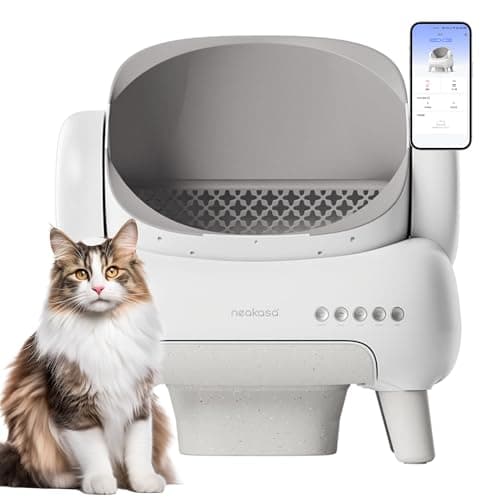
Neakasa M1 Open-Top Self-Cleaning Litter Box
Neakasa · Automatic litter box · Our score 8.6/10
#ad Price as of October 19, 2026. Prices move; we check daily. How we're funded.
The only automatic box here that publishes both its litter capacity and its noise figure, and the only open-top design -- which matters because cats prefer uncovered boxes.
Published specs
| Litter capacity | 7.17 L |
|---|---|
| Waste bin capacity | 11.23 L |
| Footprint / height | 23.26" x 20.67", 20.2" H |
| Entry height | 13.86" |
| Weight, empty | 22.81 lb |
| Cat weight range | 2.2-33 lb |
| Operating noise | Not more than 50 dB (published) |
Source: Neakasa -- M1 product page
11.23 L bin. Whisker's own guidance for its comparable drawer is emptying twice a week for two cats, i.e. roughly 3.5 days per two cats. Scale that to three and the bin needs emptying about every 4 days on published volumes -- an extrapolation from a competitor's published interval, not a measurement of this unit.
What the specs favor
- Publishes litter capacity (7.17 L) and waste bin capacity (11.23 L) -- almost nobody else does
- Publishes an operating noise figure of 50 dB or less
- Open top, which is the design cats are documented to prefer
- Takes ordinary clumping litter and ordinary bin bags -- no proprietary tray or liner
- Widest published cat weight range here at 2.2-33 lb
What they don't
- Open top means odor is not contained the way an enclosed drawer contains it
- 20.2 inches tall with a 13.86-inch entry -- a big step for an arthritic cat
- Bigger footprint than the enclosed units at 23.26 x 20.67 inches
Odor is your main problem. An open top vents into the room by design; if the smell is what you are trying to fix, an enclosed drawer with a carbon filter is the shape you want.
How it scores
Scores are our editorial weighting of the published specs above, not a test result. They are deliberately kept out of this page's structured data.
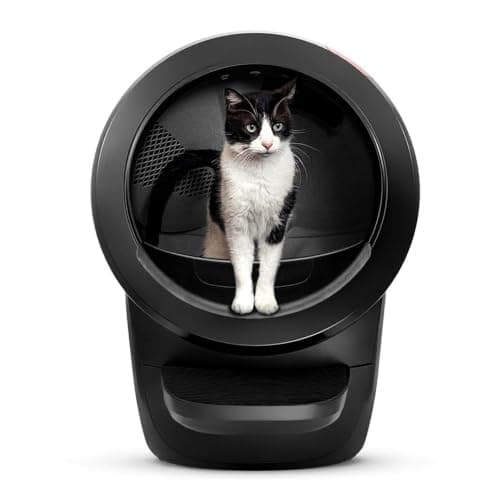
Whisker Litter-Robot 4
Whisker · Automatic litter box · Our score 8.1/10
#ad Price as of October 19, 2026. Prices move; we check daily. How we're funded.
The biggest entryway and the largest published cat-weight range of the enclosed units, and the only one whose maker publishes an actual power-supply spec you can cost out.
Published specs
| Entryway | 15.75" x 15.75" |
|---|---|
| Footprint / height | 22" W x 27" D x 29.5" H |
| Weight, empty | 24 lb |
| Cat weight range | 3-25 lb |
| Power supply | 15 V DC, 400-1000 mA (6-15 W) |
| Warranty | 1 year, 3-year plan optional |
| Globe / drawer capacity | Not published by Whisker |
Source: Whisker -- Litter-Robot 4 product page and power supply spec article
Whisker's own spec sheet accepts a 15 V supply between 0.4 A and 1.0 A. Take the 1.0 A ceiling: 15 W x 24 h x 365 = 131.4 kWh, x $0.1834 = $24.10. That assumes the motor runs flat out every hour of the year, which it does not -- so the real figure is well below this. The consumables are the actual cost.
What the specs favor
- Largest published entryway of the enclosed units here, at 15.75 inches square
- Whisker publishes a real power-supply rating, so running cost is computable
- Cat weight range published as 3-25 lb
- Three-year extended warranty available at purchase
What they don't
- Whisker does not publish globe or waste-drawer capacity, which is the number that actually decides how often you empty it with three cats
- Waste drawer liners are a proprietary consumable at $25 per 25-pack
- Carbon filter is a separate monthly consumable
- Whisker publishes no cat-count rating for this unit at all, so sizing it for a multi-cat house is guesswork
You have five cats. Whisker rates the newer Litter-Robot 5 for up to five and this one carries no published cat-count rating at all -- buying the older unit for a bigger household is guessing.
How it scores
Scores are our editorial weighting of the published specs above, not a test result. They are deliberately kept out of this page's structured data.
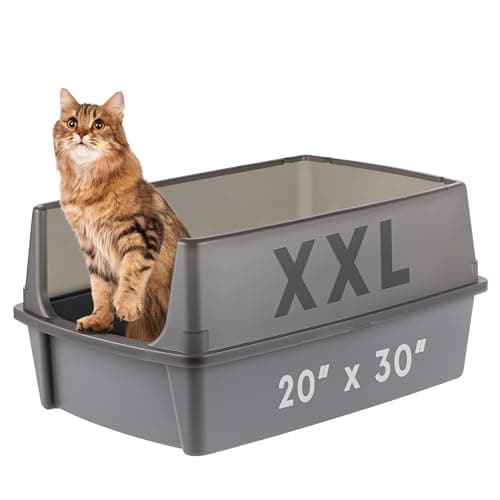
IRIS USA XX-Large Open Top Litter Box
IRIS USA · Litter box · Our score 8.7/10
#ad Price as of October 19, 2026. Prices move; we check daily. How we're funded.
At 30.18 by 20.13 inches this is the largest open-top pan in general retail, and floor area is the single spec that decides whether two cats will share a box.
Published specs
| External dimensions | 30.18" L x 20.13" W x 13.12" H |
|---|---|
| Type | Open top with scatter shield |
| Litter type | Any |
| Weight capacity | Not published |
Source: Amazon -- IRIS USA XX-Large open top litter box listing
30.18 x 20.13 = 607 sq inches of external footprint. Two cats sharing it get roughly 304 sq inches each -- still more than a whole standard jumbo pan gives one cat. That is why one very large box beats two small ones when floor space is tight.
What the specs favor
- Largest published open-top footprint here at 30.18 x 20.13 inches
- 13.12-inch walls with a scatter shield -- the combination that stops high sprayers
- Open top, the configuration cats are documented to prefer
- Takes any litter, no proprietary anything
What they don't
- 607 square inches of floor is a lot of floor to give up
- IRIS does not publish a weight capacity
- High walls make it a genuine step up for a senior cat
Your cat is elderly or arthritic. A 13-inch wall is a real climb, and a cat that starts avoiding the box because getting in hurts is a much worse problem than litter scatter.
How it scores
Scores are our editorial weighting of the published specs above, not a test result. They are deliberately kept out of this page's structured data.
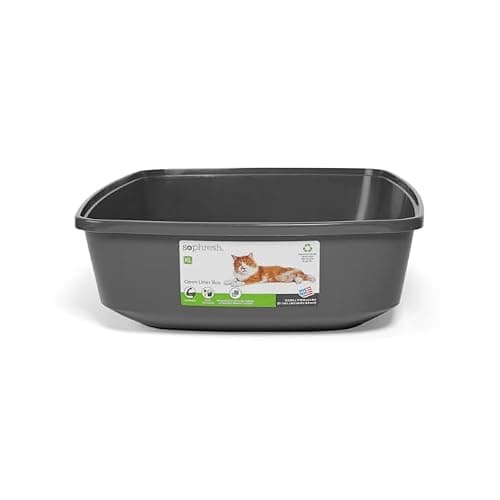
So Phresh Open Cat Litter Box, X-Large
So Phresh · Litter box · Our score 7.4/10
#ad Price as of October 19, 2026. Prices move; we check daily. How we're funded.
The plain plastic pan that lets you follow the one-box-per-cat-plus-one rule without spending like it -- 379 square inches of open floor for the price of a bag of litter.
Published specs
| External dimensions | 22.4" L x 16.9" W x 5.4" H |
|---|---|
| Wall height | 5.4" |
| Type | Open pan, no cover |
| Material | Plastic |
| Color | Charcoal |
| Litter type | Any |
| Published interior | Not published |
| Weight | Not published |
Cornell's guidance is one box more than you have cats. For three cats that is four boxes. The cheapest automatic box on this site is $269.99 -- four plain open pans is a fraction of one of those, and four boxes beat one clever one every time. At 22.4 x 16.9 inches each, four of these is 1,514 square inches of litter floor spread across four rooms, which is the thing a single automatic box cannot buy at any price.
What the specs favor
- Cheap enough to buy four without thinking about it
- 22.4 inches long, which is genuinely jumbo for a plain pan
- Open, uncovered, low -- the configuration cats prefer
- A 5.4 inch wall is an easy step for a kitten or an arthritic cat
- Nothing to break, nothing proprietary
What they don't
- A 5.4 inch wall will not contain a cat that sprays standing up, and it is lower than the 6.5 inch pans it replaces
- No scatter shield at all
- Thin plastic scratches, and scratched plastic holds odor
- No published interior dimension, so usable floor is smaller than the external figure
- No published weight
Odor or scatter is your actual complaint. This pan solves the count problem, not the containment problem -- pair it with a high-sided box rather than replacing one.
How it scores
Scores are our editorial weighting of the published specs above, not a test result. They are deliberately kept out of this page's structured data.
Common questions
Are automatic cat litter boxes worth it?
Is the Litter-Robot worth it for one cat?
Do automatic litter boxes reduce smell?
How long do automatic litter boxes last?
Can an automatic litter box replace all my litter boxes?
Sources
- Whisker -- Litter-Robot 4 product page
- Whisker -- Litter-Robot waste drawer liners, 25-pack
- Whisker -- Litter-Robot accessories (carbon filters, liners, ramps)
- PetSafe -- ScoopFree Crystal Smart self-cleaning litter box
- PetSafe -- ScoopFree Crystal disposable litter trays, 3-pack
- Neakasa -- M1 open-top self-cleaning litter box product page
- Cornell Feline Health Center -- Feline Lower Urinary Tract Disease
- Ohio State University Indoor Pet Initiative -- Litter Boxes
- U.S. Energy Information Administration -- Electric Power Monthly, Table 5.3 (residential average 18.34 cents/kWh, June 2026)
Read next
- Best Automatic Litter Boxes for Multiple Cats (2026)
Five automatic boxes ranked on published litter and waste capacity, and on what a year of consumables actually costs with three cats.
- What an Automatic Litter Box Actually Costs to Run
The full year-one and year-two running cost of every major automatic litter box, computed from published prices with the arithmetic shown.
- Best Litter Boxes for Multiple Cats (2026)
Four boxes compared on interior floor area, wall height and what each one actually solves. Cheap pans beat clever ones more often than you would expect.
- How Many Litter Boxes Per Cat?
The n+1 rule, its published source, a count-by-household table, and why four boxes in a row is really only one box.
- Litter-Robot 4 vs Litter-Robot 5
The $100 difference explained from Whisker's own spec sheets, with a clear verdict by household size.
- Litter-Robot 4 vs Leo's Loo Too
The two enclosed self-cleaners compared on what each maker actually publishes -- entryway and wattage against capacity, noise and footprint.