Litter & Litter Tech
How to Clean an Automatic Litter Box
The machine removes clumps. It does not wash anything, and the parts it leaves dirty are the ones that make it stop working.
Affiliate disclosure: we earn a commission if you buy through our links, at no extra cost to you. It never changes which product we rank first — here is how we're funded.
Everyone in this category says they tested twenty litter boxes. We have not tested any, and we say so. What we do instead: compile the published specs, read the manuals, and do the arithmetic on what this gear costs to run and how it behaves once there is more than one cat using it. Every spec is linked to the document it came from. Prices are checked daily — last verified September 27, 2026. Here is exactly how we pick.
An automatic box changes which jobs you do. It does not remove them, and the ones it leaves are the ones that decide whether the machine keeps working.
What the machine actually does
Every self-cleaning box on this site does one job: it separates clumps or solids from clean litter and moves them into a sealed container. That is it. Nothing in the mechanism washes a surface, and nothing in it empties the container.
Three things stay dirty by design — the waste drawer, the rim or step the cat touches on the way in, and the sensor windows that tell the unit whether a cat is inside. The first is a smell problem, the second is a hygiene problem, and the third is the reason people think their unit is broken.
What the makers publish
| Unit | Capacity figures | Consumable | Cat range |
|---|---|---|---|
| Litter-Robot 4 | 22" W x 27" D x 29.5" H; 24 lb empty | Any clumping litter; drawer liners optional | 3-25 lb |
| Neakasa M1 | 7.17 L litter, 11.23 L waste bin | Any clumping litter; bin liners | 2.2-33 lb |
| PetSafe ScoopFree Crystal Smart | 27.6" x 19.1"; 6.2" uncovered | Crystal trays, up to one month for one cat | Not published |
Manufacturers' published figures. Cleaning intervals below are ours; the makers publish consumable life, not a cleaning schedule.
The interval nobody tells you
PetSafe publishes tray life at up to one month for a single cat. That figure is per cat-load, not per calendar month: two cats using one unit reach the same saturation in about half the time, and three in a third.
The same correction applies to any waste container. Neakasa publishes an 11.23 L waste bin against a 7.17 L litter capacity — a generous ratio for one cat, and roughly a two-to-three-day drawer for two.
So the honest schedule is not “monthly”. It is monthly divided by the number of cats, which is the single correction most owners never make.
The three clocks
- Every two to three days: the drawer. Bag the waste, wipe the inside of the drawer with unscented soapy water, dry it and put it back. A carbon filter or a sealed pail like the Litter Genie Plus handles the smell between bin days.
- Weekly: the touch points and the eyes. Wipe the step or rim the cat stands on, and clean the sensor windows with a dry cloth. Dust on a sensor is the single most common cause of a cycle that stops halfway.
- Monthly: the strip. Unplug it. Remove the litter. Take out whatever your manual says is removable, wash it with warm unscented soapy water, rinse well and dry it completely. Wipe the housing with a damp cloth — never a wet one — and keep water away from the motor and the electronics entirely.
Litter choice changes the workload
A hard, fast-forming clump is what an automatic box is designed to lift. A litter that crumbles leaves residue on the rake and the floor of the globe, and that residue is what you end up scrubbing monthly. Our litter for automatic boxes page ranks on exactly that property.
Depth matters as much as brand. Every unit publishes a fill line for a reason: overfill it and litter rides over the edge during a cycle; underfill it and waste sticks to the floor of the chamber. Level it to the line each time you top up.
When cleaning is not the fix
- A cat that stops using a clean unit may be objecting to the noise or the motion, not the hygiene. Our worth-it page covers that failure mode honestly.
- Smell that survives a full strip is usually urine in the surround or the floor rather than in the machine.
- A change in how a cat uses the box — straining, going elsewhere, going more often — is a veterinary question first, not a cleaning one.
Read the guide
If you are still choosing a unit, our automatic litter box roundup ranks them on published figures, and the running costs page shows what the consumables cost over a year once you have made this correction for cat count.
The gear discussed here
Specs are the manufacturer's own, linked to the page they came from. Prices come from a live daily check; where we have no verified price we say so rather than print a stale one.
Whisker Litter-Robot 4
Whisker · Automatic litter box · Our score 8.1/10
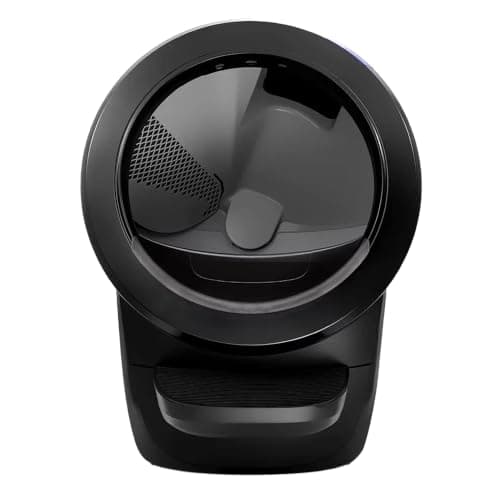
Reference link This one sells direct and we earn nothing on it. We link it anyway because it belongs in the comparison. How we're funded.
The biggest entryway and the largest published cat-weight range of the enclosed units, and the only one whose maker publishes an actual power-supply spec you can cost out.
Published specs
| Entryway | 15.75" x 15.75" |
|---|---|
| Footprint / height | 22" W x 27" D x 29.5" H |
| Weight, empty | 24 lb |
| Cat weight range | 3-25 lb |
| Power supply | 15 V DC, 400-1000 mA (6-15 W) |
| Warranty | 1 year, 3-year plan optional |
| Globe / drawer capacity | Not published by Whisker |
Source: Whisker -- Litter-Robot 4 product page and power supply spec article
Whisker's own spec sheet accepts a 15 V supply between 0.4 A and 1.0 A. Take the 1.0 A ceiling: 15 W x 24 h x 365 = 131.4 kWh, x $0.1834 = $24.10. That assumes the motor runs flat out every hour of the year, which it does not -- so the real figure is well below this. The consumables are the actual cost.
What the specs favor
- Largest published entryway of the enclosed units here, at 15.75 inches square
- Whisker publishes a real power-supply rating, so running cost is computable
- Cat weight range published as 3-25 lb
- Three-year extended warranty available at purchase
What they don't
- Whisker does not publish globe or waste-drawer capacity, which is the number that actually decides how often you empty it with three cats
- Waste drawer liners are a proprietary consumable at $25 per 25-pack
- Carbon filter is a separate monthly consumable
- Sells mainly direct, so there is no reliable Amazon price to track
You have five cats. Whisker rates the newer Litter-Robot 5 for up to five and this one carries no published cat-count rating at all -- buying the older unit for a bigger household is guessing.
How it scores
Scores are our editorial weighting of the published specs above, not a test result. They are deliberately kept out of this page's structured data.
Neakasa M1 Open-Top Self-Cleaning Litter Box
Neakasa · Automatic litter box · Our score 8.6/10
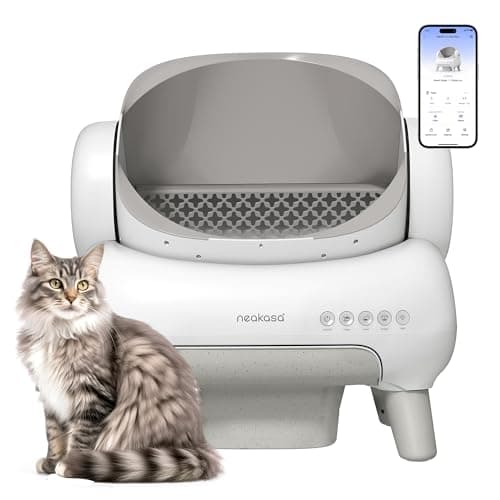
#ad Price as of September 27, 2026. Prices move; we check daily. How we're funded.
The only automatic box here that publishes both its litter capacity and its noise figure, and the only open-top design -- which matters because cats prefer uncovered boxes.
Published specs
| Litter capacity | 7.17 L |
|---|---|
| Waste bin capacity | 11.23 L |
| Footprint / height | 23.26" x 20.67", 20.2" H |
| Entry height | 13.86" |
| Weight, empty | 22.81 lb |
| Cat weight range | 2.2-33 lb |
| Operating noise | Not more than 50 dB (published) |
Source: Neakasa -- M1 product page
11.23 L bin. Whisker's own guidance for its comparable drawer is emptying twice a week for two cats, i.e. roughly 3.5 days per two cats. Scale that to three and the bin needs emptying about every 4 days on published volumes -- an extrapolation from a competitor's published interval, not a measurement of this unit.
What the specs favor
- Publishes litter capacity (7.17 L) and waste bin capacity (11.23 L) -- almost nobody else does
- Publishes an operating noise figure of 50 dB or less
- Open top, which is the design cats are documented to prefer
- Takes ordinary clumping litter and ordinary bin bags -- no proprietary tray or liner
- Widest published cat weight range here at 2.2-33 lb
What they don't
- Open top means odor is not contained the way an enclosed drawer contains it
- 20.2 inches tall with a 13.86-inch entry -- a big step for an arthritic cat
- Bigger footprint than the enclosed units at 23.26 x 20.67 inches
Odor is your main problem. An open top vents into the room by design; if the smell is what you are trying to fix, an enclosed drawer with a carbon filter is the shape you want.
How it scores
Scores are our editorial weighting of the published specs above, not a test result. They are deliberately kept out of this page's structured data.
PetSafe ScoopFree Crystal Smart
PetSafe · Automatic litter box · Our score 6.2/10
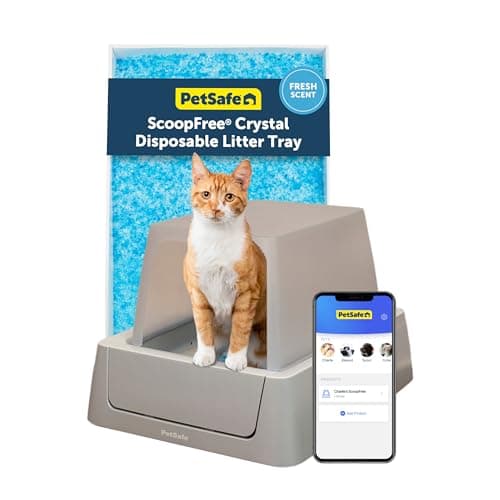
#ad Price as of September 27, 2026. Prices move; we check daily. How we're funded.
The cheapest automatic box here at $269.99 and by a wide margin the most expensive to run, because the disposable tray is the entire consumable model.
Published specs
| Dimensions, uncovered | 27.6" x 19.1" x 6.2" |
|---|---|
| Dimensions, front-entry | 27.6" x 19.1" x 15.6" |
| Litter | ScoopFree crystal litter only |
| Tray life | Up to one month for a single cat (PetSafe) |
| Tray price | $73.49 per 3-pack (PetSafe list) |
| Power | Plug-in; wattage not published |
| Multi-cat guidance | PetSafe: "your mileage may vary" |
Source: PetSafe -- ScoopFree Crystal Smart product page and tray 3-pack listing
PetSafe lists the 3-pack at $73.49, so $24.50 a tray, and says one tray covers one cat for up to a month. Twelve trays a year is $294 -- more than the $269.99 box. With three cats the tray fills three times as fast, which is roughly $880 a year on the same arithmetic.
What the specs favor
- Lowest purchase price of the automatic boxes here
- Largest floor area of the automatic boxes at 27.6 x 19.1 inches
- Available uncovered, which is the shape cats prefer
- No scooping and no litter handling at all
What they don't
- Locked to PetSafe's own crystal litter -- no substitution
- Disposable trays cost more per year than the box costs to buy
- PetSafe publishes no wattage, so electricity cannot be computed
- PetSafe declines to give multi-cat guidance beyond 'mileage may vary'
You have more than one cat. The tray is the product, and with three cats the tray arithmetic runs to roughly $880 a year -- three or four times what a clumping-litter automatic box costs to feed.
How it scores
Scores are our editorial weighting of the published specs above, not a test result. They are deliberately kept out of this page's structured data.
Common questions
How often do you empty an automatic litter box?
How often does an automatic litter box need a full clean?
Can you wash the globe or drum of an automatic litter box?
Why does my automatic litter box keep stopping mid-cycle?
Do crystal-tray units need cleaning too?
Sources
Read next
- Best Automatic Litter Boxes (2026)
The head-term roundup, ranked on published capacity and consumable model rather than app features.
- What an Automatic Litter Box Actually Costs to Run
The full year-one and year-two running cost of every major automatic litter box, computed from published prices with the arithmetic shown.
- How Often to Clean a Litter Box
The three separate cleaning jobs a litter box needs, on three different schedules, with the litter volume arithmetic per cat.
- Are Automatic Litter Boxes Worth It?
Break-even arithmetic against ordinary boxes, worked from published prices, with a clear answer for one, two and three cat households.
- Best Cat Litter for an Automatic Litter Box
Which litters survive a rotating or raking mechanism, which unit locks you to its own, and why clump hardness outranks odor claims here.