Litter & Litter Tech
How Often to Clean a Litter Box
Three different jobs on three different clocks. Most people do the first one and skip the other two, then blame the litter.
Affiliate disclosure: we earn a commission if you buy through our links, at no extra cost to you. It never changes which product we rank first — here is how we're funded.
Everyone in this category says they tested twenty litter boxes. We have not tested any, and we say so. What we do instead: compile the published specs, read the manuals, and do the arithmetic on what this gear costs to run and how it behaves once there is more than one cat using it. Every spec is linked to the document it came from. Prices are checked daily — last verified October 21, 2026. Here is exactly how we pick.
“Clean the litter box” is three different jobs with three different clocks. Conflating them is why a box that gets scooped every day can still be the reason a room smells.
The three jobs
| Job | What it is | One cat | Two or more cats |
|---|---|---|---|
| Scoop | Remove clumps and solids | Once a day, minimum | Twice a day |
| Top up | Restore depth to 3-4 inches | Every 2-3 days | Daily or every other day |
| Strip and wash | Empty completely, wash, refill | Every 3-4 weeks | Every 2-3 weeks |
These are our cadences, derived from the depth arithmetic below rather than taken from a manufacturer.
Why depth is the hidden variable
A clumping litter absorbs urine into a solid mass. Removing one clump removes the litter in it — roughly a quarter to a third of a cup per urination.
One cat urinating three times a day removes about three quarters of a cup of litter daily. Over a week that is roughly five cups of litter carried out in the scoop. A box filled to four inches and never topped up is under two inches within a week.
Below about two inches, urine reaches the base before the clump sets. It bonds to the plastic, and no amount of scooping lifts it. That is the smell.
So topping up is not tidiness, it is the mechanism that keeps clumps liftable. Any litter behaves badly at two inches, including the ones with the best clump strength.
How much litter a household actually gets through
Five cups removed per cat per week is about 0.31 cubic feet per cat per month once topping-up is included at typical clumping-litter density.
One cat: roughly a 20 lb bag every three to four weeks.
Two cats: roughly every two weeks.
Three cats: roughly every ten days, across the four boxes the Cornell guidance implies.
These are our figures from our own scoop arithmetic, not a manufacturer’s. Your cats will differ. The shape of the curve will not: consumption is close to linear in cat count, and box count does not change it.
Stripping and washing
- Empty completely. Bin the lot; do not try to save the clean part. Fines and residue are the point of the exercise.
- Hot water and unscented soap. Nothing containing ammonia — it reads as urine to a cat and marks the box as already used.
- Dry it fully. Fresh litter poured into a damp box clumps against the base immediately, which recreates the problem you just fixed.
- Refill to three or four inches. Measure the first few times. Almost everyone underfills.
- Check the plastic. Scratched plastic holds odor permanently. A box that smells on the day it was washed has reached the end of its life.
Multi-cat changes the clock, not the method
Cornell Feline Health Center recommends one more box than you have cats. Three cats means four boxes, and four boxes at twice-daily scooping is eight scooping events a day. It is worth being realistic about that before adding a cat.
The Ohio State Indoor Pet Initiative adds the placement half: boxes in different rooms, not lined up together, because four boxes in one row is one location as far as a cat under pressure is concerned. Our multi-cat litter setup goes through placement in detail.
What an automatic box changes
It automates job one and leaves jobs two and three alone. The rake or globe scoops, so the daily task goes away. The drawer still fills, the litter still leaves in the clumps, and the unit still needs stripping.
Our running costs page works through what that drawer holds against a real multi-cat load, and it is the number that decides whether an automatic box is a labor saving or a differently shaped chore.
The gear discussed here
Specs are the manufacturer's own, linked to the page they came from. Prices come from a live daily check; where we have no verified price we say so rather than print a stale one.
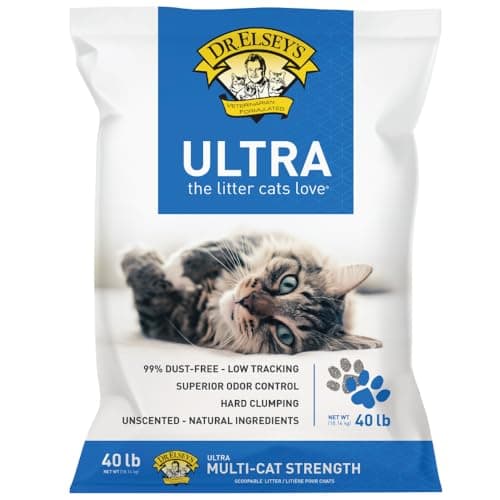
Dr. Elsey's Ultra Unscented Clumping Clay Litter
Dr. Elsey's · Cat litter · Our score 8.8/10
#ad Price as of October 21, 2026. Prices move; we check daily. How we're funded.
Unscented, medium-grain, 99.9 percent dust-free -- which is the exact specification the veterinary guidance on litter preference describes, rather than a marketing claim.
Published specs
| Material | Natural clay |
|---|---|
| Scent | None; no perfumes or deodorants |
| Dust | 99.9 percent dust-free (Dr. Elsey's) |
| Grain | Medium grain with heavier non-tracking granules |
| Bag size | 40 lb |
| Additives | Free of plant proteins, perfumes and deodorants |
Source: Dr. Elsey's -- Ultra Litter product page
The Ohio State Indoor Pet Initiative says most cats prefer fine-grained, unscented litter and are deterred by scented or deodorant products. This litter is unscented, deodorant-free and fine-to-medium grain -- it meets all three published criteria. Very few litters marketed for odor control do.
What the specs favor
- Unscented and deodorant-free, matching the documented feline preference
- 99.9 percent dust-free by the maker's own measure
- Heavier granules specifically to reduce tracking
- Hard clumping, so waste leaves the box intact
What they don't
- Clay, so it is heavy to carry and heavy to lift out
- No added fragrance means it does nothing to mask odor between scoops
- 40 lb bag is awkward to store in a flat
You want the litter to do the odor work for you. This one is deliberately inert -- it relies on you scooping daily, which is what the veterinary guidance asks for anyway.
How it scores
Scores are our editorial weighting of the published specs above, not a test result. They are deliberately kept out of this page's structured data.
Gorilla Grip Cat Litter Mat
Gorilla Grip · Litter mat · Our score 8.4/10
#ad Price as of October 21, 2026. Prices move; we check daily. How we're funded.
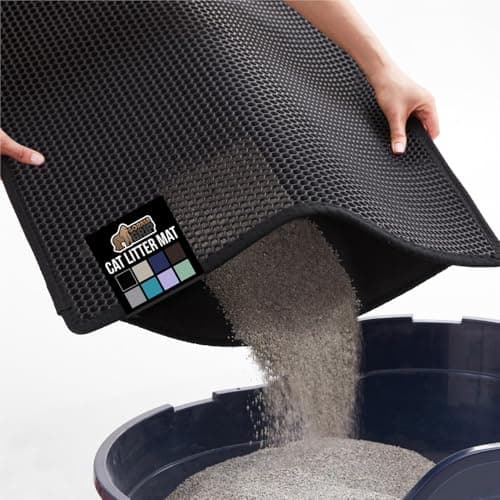
The biggest mat here at 35 by 24 inches, with a two-layer honeycomb that swallows litter rather than letting it sit on the surface to be kicked off again.
Published specs
| Sizes published | 24 x 15", 35 x 24", 47 x 35" jumbo |
|---|---|
| Weight, jumbo | 4.2 lb |
| Construction | Two-layer honeycomb, waterproof |
| Cleaning | Hand wash with mild detergent, air dry only |
| Litter compatibility | Any |
Source: Gorilla Grip -- Cat Litter Mat product page
35 x 24 = 840 sq inches. The IRIS XX-Large box footprint is 30.18 x 20.13 = 607 sq inches. The mat is larger than the box it sits under, which is the whole point -- a mat narrower than the box catches nothing at the corners where cats actually step off.
What the specs favor
- Largest published catch area of the mats here
- Two-layer honeycomb traps litter below the surface
- Waterproof, so a leaked box does not reach the floor
- Three published sizes, so it can be matched to the box
What they don't
- Hand wash and air dry only -- not a throw-it-in-the-machine mat
- Honeycomb holes need shaking or vacuuming, not just a wipe
- 840 square inches is a lot of visible floor covered
You want to hose it down and hang it up wet. The published care instruction is air dry only, and a mat that lives in a damp utility room will not get that.
How it scores
Scores are our editorial weighting of the published specs above, not a test result. They are deliberately kept out of this page's structured data.
IRIS USA Top Entry Cat Litter Box, Large
IRIS USA · Top-entry litter box · Our score 8.0/10
#ad Price as of October 21, 2026. Prices move; we check daily. How we're funded.
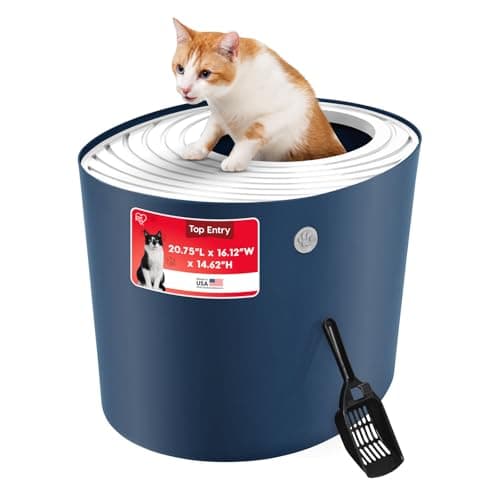
The largest published entry hole of any top-entry box we found at 9 by 10.5 inches, which is the spec that decides whether an average cat will use one at all.
Published specs
| Exterior | 20.75" L x 16.12" W x 14.62" H |
|---|---|
| Entry hole | 9" W x 10.5" H, set off-center |
| Lid | Grooved, catches litter from paws on the way out |
| Scoop | Included on most variants |
Source: IRIS USA -- Top Entry Cat Litter Box, Large listing (20.75 x 16.12 x 14.62 in, 9 x 10.5 in entry)
Large: 9 x 10.5 = 94.5 square inches. IRIS's own Premium square model publishes 7.9 x 7.9 = 62.4. The large gives half again as much aperture. A cat that refuses a top-entry box has usually been offered the smaller hole.
What the specs favor
- Published entry dimensions, which most top-entry listings omit
- Off-center hole leaves a landing platform inside
- Grooved lid does real work against tracking
- Enclosed sides stop nearly all kicked litter
What they don't
- 14.62 inches of height is a jump an arthritic cat may not make
- Interior dimensions not published, only the exterior
- Scooping means lifting the lid off every time
Your cat is elderly, arthritic or recovering from surgery. A top-entry box asks for a vertical jump on the way in and a controlled drop on the way out, twice a day, forever.
How it scores
Scores are our editorial weighting of the published specs above, not a test result. They are deliberately kept out of this page's structured data.
Common questions
How often should you scoop a litter box?
How often should you completely change cat litter?
How deep should cat litter be?
Do you need to wash a litter box?
Do automatic litter boxes need cleaning?
Sources
Read next
- Best Cat Litter Scoops (2026)
Litter scoops compared on construction and blade width, and why the bundled plastic one always breaks in the same place.
- Why Your Litter Box Smells (and How to Fix It)
Ammonia smell diagnosed cause-first: what it means, the free fixes that solve most cases, and the products worth buying only if those fail.
- How Many Litter Boxes Per Cat?
The n+1 rule, its published source, a count-by-household table, and why four boxes in a row is really only one box.
- Low Dust Cat Litter, Compared
Dust claims on the major clumping litters, what each is conditioned on, and the handling changes that reduce dust more than a brand switch.
- Best Top Entry Litter Boxes (2026)
Top-entry litter boxes ranked on published entry-hole area, with the arithmetic on which cats can actually use one.
- How to Get a Cat to Use the Litter Box
The vet check first, then box height, litter texture, placement and count -- the causes of box refusal in the order worth testing them.
- How Much Cat Litter Do You Need Per Month?
Box volume worked from published dimensions, why bag weight will not convert to a fill, and how the number moves with cats and litter type.