Litter & Litter Tech
Low Dust Cat Litter, Compared
Every litter says low dust. Only some say what they mean, and none of them publish a test method. Here is what is claimed and what you can change yourself.
Affiliate disclosure: we earn a commission if you buy through our links, at no extra cost to you. It never changes which product we rank first — here is how we're funded.

Everyone in this category says they tested twenty litter boxes. We have not tested any, and we say so. What we do instead: compile the published specs, read the manuals, and do the arithmetic on what this gear costs to run and how it behaves once there is more than one cat using it. Every spec is linked to the document it came from. Prices are checked daily — last verified October 21, 2026. Here is exactly how we pick.
Dust is the most-claimed and least-substantiated property in this category. No litter maker publishes a test method, and the phrases are not defined anywhere. So here is what each one actually claims, and the part you control.
What the labels claim
| Litter | Base material | Dust positioning | Test method published |
|---|---|---|---|
| Dr. Elsey's Ultra | Clay, sodium bentonite | Marketed on a low-dust formulation | No |
| World's Best Multiple Cat | Whole-kernel corn | Plant-based grain, marketed as low dust | No |
| Tidy Cats 24/7 Performance | Clay | Dust positioning varies by variant | No |
The right-hand column is the finding. Not one manufacturer in this category publishes the test its dust claim is based on, so no two claims are comparable.
That problem gets wider once you leave clay. Paper publishes 99.7 percent dust-free, wheat publishes 99.5 and crystal publishes 99 — three figures from three undisclosed methods. Our comparison of all seven litter types sets them side by side and explains why that ranking is not a ranking.
Where the dust actually comes from
Dust is not a chemical property, it is a mechanical one. Fine particles are produced when granules abrade against each other, and that happens in three places: in the bag during shipping, in the box as the cat digs, and in the air when you pour.
- Transport. A bag that has crossed the country has been shaking for days. Fines settle to the bottom, which is why the last third of a bag is the dustiest.
- Digging. Sodium bentonite clay granules shatter under load. Corn and wood litters deform instead, which is the honest structural reason plant-based litters tend to run cleaner.
- Pouring. The largest single dust event in the whole cycle, and entirely under your control.
The handling changes that beat a brand switch
Before spending money on a different litter, change how you handle the one you have. These are free and they address the largest source.
- Pour from two inches, not two feet. Airborne dust scales with drop height, because the fall is what separates fines from granules.
- Do not tip the bottom of the bag in. That is where the fines have collected. Pour the last portion slowly or bin it.
- Fill outdoors or over a bin. Costs nothing and removes the event from the room entirely.
- Scoop well and change less. Full changes are the dustiest operation. Diligent scooping means fewer of them — see our cleaning schedule for the cadence.
- Let it settle. Fill the box, then leave the room for ten minutes rather than standing over it.
Which litter, if you are switching anyway
World’s Best Multiple Cat is the structural answer: whole-kernel corn does not shatter into fines the way bentonite does, so the dust reduction comes from the material rather than from a process step. It is also lighter to carry, which matters at multi-cat volumes.
Dr. Elsey’s Ultra is the clay answer, and clay still wins on clump strength and on cost per pound. If you are not prepared to give up clumping performance, this is the trade.
Tidy Cats 24/7 is here as the widely stocked baseline. Its dust positioning varies by variant, which is itself worth knowing: within one brand, two bags on the same shelf can make different claims.
How to switch without causing a problem
In a multi-cat house, run the transition in one box first rather than all of them at once. That gives every cat an unchanged option while it makes up its mind, which is the same logic as the counts in our multi-cat litter setup.
The gear discussed here
Specs are the manufacturer's own, linked to the page they came from. Prices come from a live daily check; where we have no verified price we say so rather than print a stale one.
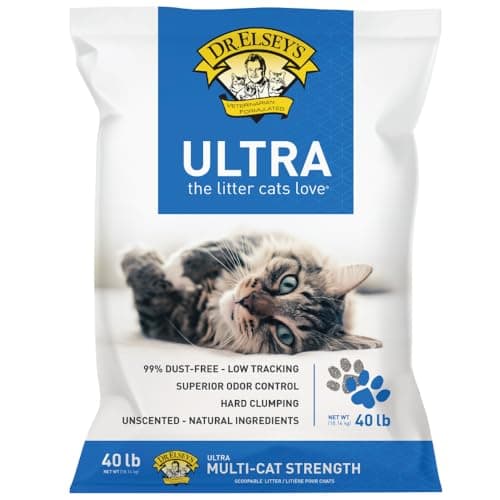
Dr. Elsey's Ultra Unscented Clumping Clay Litter
Dr. Elsey's · Cat litter · Our score 8.8/10
#ad Price as of October 21, 2026. Prices move; we check daily. How we're funded.
Unscented, medium-grain, 99.9 percent dust-free -- which is the exact specification the veterinary guidance on litter preference describes, rather than a marketing claim.
Published specs
| Material | Natural clay |
|---|---|
| Scent | None; no perfumes or deodorants |
| Dust | 99.9 percent dust-free (Dr. Elsey's) |
| Grain | Medium grain with heavier non-tracking granules |
| Bag size | 40 lb |
| Additives | Free of plant proteins, perfumes and deodorants |
Source: Dr. Elsey's -- Ultra Litter product page
The Ohio State Indoor Pet Initiative says most cats prefer fine-grained, unscented litter and are deterred by scented or deodorant products. This litter is unscented, deodorant-free and fine-to-medium grain -- it meets all three published criteria. Very few litters marketed for odor control do.
What the specs favor
- Unscented and deodorant-free, matching the documented feline preference
- 99.9 percent dust-free by the maker's own measure
- Heavier granules specifically to reduce tracking
- Hard clumping, so waste leaves the box intact
What they don't
- Clay, so it is heavy to carry and heavy to lift out
- No added fragrance means it does nothing to mask odor between scoops
- 40 lb bag is awkward to store in a flat
You want the litter to do the odor work for you. This one is deliberately inert -- it relies on you scooping daily, which is what the veterinary guidance asks for anyway.
How it scores
Scores are our editorial weighting of the published specs above, not a test result. They are deliberately kept out of this page's structured data.
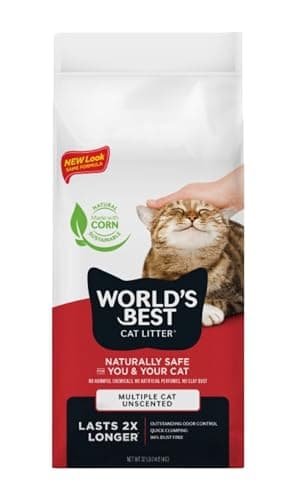
World's Best Cat Litter Multiple Cat Clumping Formula
World's Best Cat Litter · Cat litter · Our score 8.0/10
#ad Price as of October 21, 2026. Prices move; we check daily. How we're funded.
Whole-kernel corn rather than clay, which makes the bag light enough to carry up stairs and the litter light enough that a cat carries it out on its feet.
Published specs
| Material | Whole-kernel corn |
|---|---|
| Scent | Unscented |
| Form | Compressed granules |
| Dust | 99 percent dust-free (maker) |
| Formulation | Multi-cat, with an added plant derivative for odor |
| Clumping | Clumps on contact |
Source: Chewy -- World's Best Multi-Cat Unscented Clumping Corn Litter listing
The multi-cat corn formula ships in a 28 lb bag against Dr. Elsey's 40 lb clay. Same job, 12 lb less to carry, because corn is less dense than clay -- and less dense is also why it tracks further.
What the specs favor
- Unscented, matching the documented preference
- Corn base is markedly lighter than clay per bag
- Clumps on contact rather than needing time to set
- Multi-cat formulation with an added plant derivative for odor
What they don't
- Light granules track further through the house than clay
- Corn attracts pantry pests if the bag is left open in a warm room
- Costs more per pound than commodity clay
Tracking is already your worst problem. Lighter granules travel further, and this is a lighter granule than any clay on this page.
How it scores
Scores are our editorial weighting of the published specs above, not a test result. They are deliberately kept out of this page's structured data.
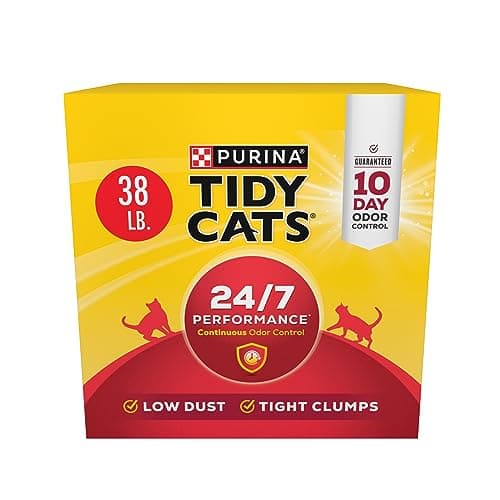
Purina Tidy Cats 24/7 Performance
Purina · Cat litter · Our score 7.9/10
#ad Price as of October 21, 2026. Prices move; we check daily. How we're funded.
Ten days is the longest odor guarantee any maker on this page will put in writing, and Purina is specific that it is a guarantee rather than a claim.
Published specs
| Odor claim | 10 days, guaranteed when used as directed |
|---|---|
| Material | Clay |
| Dust | 99.9 percent dust-free by airborne particles when pouring |
| Scent | Clean linen |
| Mechanism | Slow-release deodorizing system |
| Household | Formulated for multi-cat |
Source: Purina -- Tidy Cats 24/7 Performance Clumping Cat Litter product page
Purina 10 days, Arm & Hammer 7 days, Dr. Elsey's and World's Best publish no day count at all. Ranking litters on the only numbers the makers will commit to is the only ranking that is not opinion.
What the specs favor
- Longest published odor guarantee of any litter here at 10 days
- Explicitly formulated for multi-cat households
- 99.9 percent dust-free, measured by airborne particles when pouring
- Slow-release deodorizing rather than a single fragrance hit
What they don't
- Scented, against the documented feline preference for unscented
- Clay, so a heavy bag
- 'When used as directed' means daily scooping -- the guarantee is not a license to skip it
You have a cat with a respiratory condition or a strong preference for unscented. A ten-day guarantee is no use if the cat stops using the box.
How it scores
Scores are our editorial weighting of the published specs above, not a test result. They are deliberately kept out of this page's structured data.
Common questions
What is the lowest dust cat litter?
Is cat litter dust harmful?
Does clumping litter make more dust than non-clumping?
How do I reduce cat litter dust without changing litter?
Is dust-free cat litter really dust free?
Sources
Read next
- Cat Litter Types Compared
Clay, crystal, corn, wheat, pine, paper and tofu compared on published specifications, with an honest note on which figures are comparable.
- Clumping vs Non-Clumping Cat Litter
An attribute-by-attribute comparison of clumping and non-clumping litter, and why multi-cat homes almost always want clumping.
- Best Cat Litter for Multiple Cats (2026)
Why the best odor-control litter is often the wrong buy for three cats, and which specification to rank on instead.
- How Often to Clean a Litter Box
The three separate cleaning jobs a litter box needs, on three different schedules, with the litter volume arithmetic per cat.
- Best Cat Litter Mats (2026)
Mats compared on published catch area against real box footprints, plus the pour-back feature that returns litter instead of binning it.
- Best Unscented Cat Litter (2026)
Unscented litters compared on published dust, grain and clumping, with the published guidance on what cats prefer underfoot.