Litter & Litter Tech
Clumping vs Non-Clumping Cat Litter
Two genuinely different products solving the same problem in opposite ways. In a multi-cat house one of them is a much better fit.
Affiliate disclosure: we earn a commission if you buy through our links, at no extra cost to you. It never changes which product we rank first — here is how we're funded.

Everyone in this category says they tested twenty litter boxes. We have not tested any, and we say so. What we do instead: compile the published specs, read the manuals, and do the arithmetic on what this gear costs to run and how it behaves once there is more than one cat using it. Every spec is linked to the document it came from. Prices are checked daily — last verified October 19, 2026. Here is exactly how we pick.
The short answer
Attribute by attribute
| Attribute | Clumping (clay or corn) | Non-clumping (crystal, pellet) |
|---|---|---|
| Urine removal | Lifted out daily as a solid clump | Absorbed; stays in the box until a full change |
| Odor over a week | Stays flat if scooped daily | Good at first, degrades as it saturates |
| Dust | Best products claim 99-99.9% dust-free | Crystal is typically low dust; PetSafe claims 99% dust-free |
| Tracking | Depends on granule weight; corn tracks most | Crystal is low-tracking by design |
| Full changes needed | Less often -- top up between washes | Regular full changes by design |
| Automatic box compatibility | Litter-Robot, Neakasa M1, Leo's Loo Too | Required by PetSafe ScoopFree Crystal |
| Cost model | Buy litter, scoop daily | Buy litter or trays, replace on a schedule |
Dust and tracking claims are the manufacturers' own, cited in Sources. The behavioral comparisons are structural rather than tested -- we have not run either litter type in a household.
Why multi-cat households want clumping
It comes down to load. A box in a three-cat house is receiving roughly three times the urine of a box in a single-cat house between scoops. Non-clumping litter has a fixed absorption capacity: once the substrate is saturated the next cat is standing in it, regardless of how good the product was on day one. Clumping litter resets to near-zero every time you scoop.
Where non-clumping genuinely wins
- Tracking. Crystal granules are large and light and are designed not to stick to paws. If your floors are the battle you are losing, this is a real advantage.
- Effort per week. With one cat, a crystal tray changed monthly is genuinely less work than scooping daily. That is what PetSafe’s ScoopFree system is selling, and for a single cat it delivers it.
- It is mandatory in some systems. If you own a ScoopFree Crystal, this comparison is academic — PetSafe’s trays are the only supported option.
What it costs you is money. PetSafe’s own listed tray price works out at $294 a year for one cat, and roughly $882 for three — the full arithmetic is on the running-costs page.
Choosing within clumping: clay or corn
| Attribute | Clay (Dr. Elsey's Ultra) | Corn (World's Best Multiple Cat) |
|---|---|---|
| Clump strength | Hard clumping | Clumps on contact |
| Granule weight | Heavier, specifically to reduce tracking | Light |
| Bag weight for the same job | 40 lb | 28 lb |
| Dust claim | 99.9% dust-free | 99% dust-free |
| Scent | Unscented | Unscented |
| Storage caution | None | Corn attracts pantry pests if left open |
All attributes as published by each maker. See our multi-cat litter roundup for the full write-ups.
In an automatic box, prefer hard-clumping clay. A soft clump that breaks apart in a rotating drum ends up back in the litter bed, which defeats the machine. Outside an automatic box, the choice is mostly about whether you would rather carry less weight or sweep less floor.
The thing that matters more than either
Both litter types are fine-grained and unscented in their best forms, which is what the Ohio State Indoor Pet Initiative says most cats prefer. Both fail in a box that is overloaded, badly placed or scooped every third day. If you are choosing between litter types because the box smells, read the smell guide first — the fix is usually free and it is usually not the litter.
The gear discussed here
Specs are the manufacturer's own, linked to the page they came from. Prices come from a live daily check; where we have no verified price we say so rather than print a stale one.
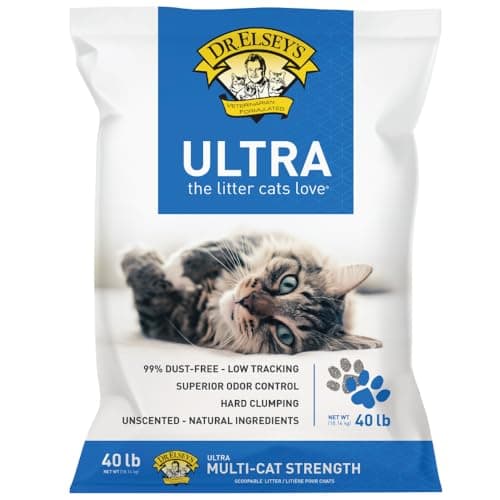
Dr. Elsey's Ultra Unscented Clumping Clay Litter
Dr. Elsey's · Cat litter · Our score 8.8/10
#ad Price as of October 19, 2026. Prices move; we check daily. How we're funded.
Unscented, medium-grain, 99.9 percent dust-free -- which is the exact specification the veterinary guidance on litter preference describes, rather than a marketing claim.
Published specs
| Material | Natural clay |
|---|---|
| Scent | None; no perfumes or deodorants |
| Dust | 99.9 percent dust-free (Dr. Elsey's) |
| Grain | Medium grain with heavier non-tracking granules |
| Bag size | 40 lb |
| Additives | Free of plant proteins, perfumes and deodorants |
Source: Dr. Elsey's -- Ultra Litter product page
The Ohio State Indoor Pet Initiative says most cats prefer fine-grained, unscented litter and are deterred by scented or deodorant products. This litter is unscented, deodorant-free and fine-to-medium grain -- it meets all three published criteria. Very few litters marketed for odor control do.
What the specs favor
- Unscented and deodorant-free, matching the documented feline preference
- 99.9 percent dust-free by the maker's own measure
- Heavier granules specifically to reduce tracking
- Hard clumping, so waste leaves the box intact
What they don't
- Clay, so it is heavy to carry and heavy to lift out
- No added fragrance means it does nothing to mask odor between scoops
- 40 lb bag is awkward to store in a flat
You want the litter to do the odor work for you. This one is deliberately inert -- it relies on you scooping daily, which is what the veterinary guidance asks for anyway.
How it scores
Scores are our editorial weighting of the published specs above, not a test result. They are deliberately kept out of this page's structured data.
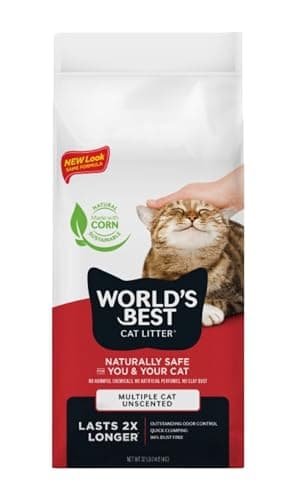
World's Best Cat Litter Multiple Cat Clumping Formula
World's Best Cat Litter · Cat litter · Our score 8.0/10
#ad Price as of October 19, 2026. Prices move; we check daily. How we're funded.
Whole-kernel corn rather than clay, which makes the bag light enough to carry up stairs and the litter light enough that a cat carries it out on its feet.
Published specs
| Material | Whole-kernel corn |
|---|---|
| Scent | Unscented |
| Form | Compressed granules |
| Dust | 99 percent dust-free (maker) |
| Formulation | Multi-cat, with an added plant derivative for odor |
| Clumping | Clumps on contact |
Source: Chewy -- World's Best Multi-Cat Unscented Clumping Corn Litter listing
The multi-cat corn formula ships in a 28 lb bag against Dr. Elsey's 40 lb clay. Same job, 12 lb less to carry, because corn is less dense than clay -- and less dense is also why it tracks further.
What the specs favor
- Unscented, matching the documented preference
- Corn base is markedly lighter than clay per bag
- Clumps on contact rather than needing time to set
- Multi-cat formulation with an added plant derivative for odor
What they don't
- Light granules track further through the house than clay
- Corn attracts pantry pests if the bag is left open in a warm room
- Costs more per pound than commodity clay
Tracking is already your worst problem. Lighter granules travel further, and this is a lighter granule than any clay on this page.
How it scores
Scores are our editorial weighting of the published specs above, not a test result. They are deliberately kept out of this page's structured data.
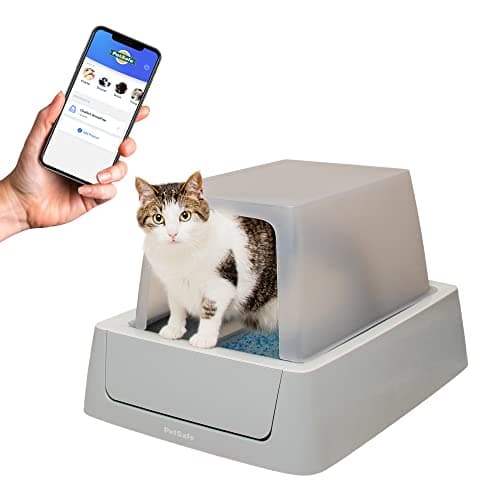
PetSafe ScoopFree Crystal Smart
PetSafe · Automatic litter box · Our score 6.2/10
#ad Price as of October 19, 2026. Prices move; we check daily. How we're funded.
The cheapest automatic box here at $269.99 and by a wide margin the most expensive to run, because the disposable tray is the entire consumable model.
Published specs
| Dimensions, uncovered | 27.6" x 19.1" x 6.2" |
|---|---|
| Dimensions, front-entry | 27.6" x 19.1" x 15.6" |
| Litter | ScoopFree crystal litter only |
| Tray life | Up to one month for a single cat (PetSafe) |
| Tray price | $73.49 per 3-pack (PetSafe list) |
| Power | Plug-in; wattage not published |
| Multi-cat guidance | PetSafe: "your mileage may vary" |
Source: PetSafe -- ScoopFree Crystal Smart product page and tray 3-pack listing
PetSafe lists the 3-pack at $73.49, so $24.50 a tray, and says one tray covers one cat for up to a month. Twelve trays a year is $294 -- more than the $269.99 box. With three cats the tray fills three times as fast, which is roughly $880 a year on the same arithmetic.
What the specs favor
- Lowest purchase price of the automatic boxes here
- Largest floor area of the automatic boxes at 27.6 x 19.1 inches
- Available uncovered, which is the shape cats prefer
- No scooping and no litter handling at all
What they don't
- Locked to PetSafe's own crystal litter -- no substitution
- Disposable trays cost more per year than the box costs to buy
- PetSafe publishes no wattage, so electricity cannot be computed
- PetSafe declines to give multi-cat guidance beyond 'mileage may vary'
You have more than one cat. The tray is the product, and with three cats the tray arithmetic runs to roughly $880 a year -- three or four times what a clumping-litter automatic box costs to feed.
How it scores
Scores are our editorial weighting of the published specs above, not a test result. They are deliberately kept out of this page's structured data.
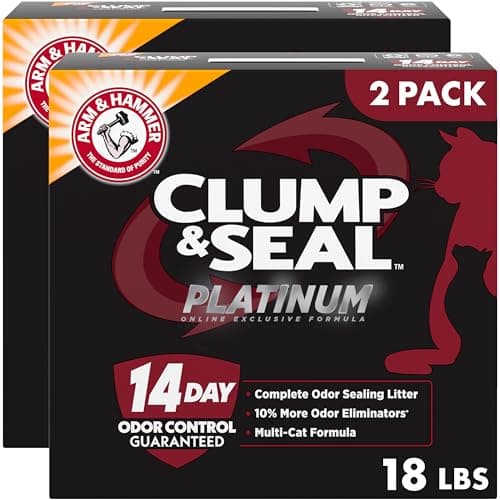
Arm & Hammer Clump & Seal Multi-Cat
Arm & Hammer · Cat litter · Our score 7.7/10
#ad Price as of October 19, 2026. Prices move; we check daily. How we're funded.
One of only two litters here whose maker puts a number on the odor claim -- seven days -- which at least makes the claim checkable.
Published specs
| Odor claim | 7 days, guaranteed by the maker |
|---|---|
| Material | Clay with baking soda and plant-derived particles |
| Dust | 99.9 percent dust-free (maker) |
| Scent | Scented |
| Bag size | 19 lb multi-cat |
| Mechanism | Moisture-activated micro-granules seal around waste |
Source: Arm & Hammer -- Clump & Seal Multi-Cat 19 lb product page
Arm & Hammer guarantees 7 days; Purina guarantees 10 on Tidy Cats 24/7 Performance. Those are the only two published numbers in this category, so they are the only two you can hold a maker to. Everything else is adjectives.
What the specs favor
- Publishes a specific 7-day odor guarantee
- 99.9 percent dust-free by the maker's measure
- Baking soda plus a sealing micro-granule, two mechanisms rather than fragrance alone
- Widely stocked, so the price stays honest
What they don't
- Scented, which the published guidance says many cats are deterred by
- Clay, so heavy
- The guarantee is per household use, not per cat -- three cats will not get seven days
Your cat has already started going outside the box. Adding fragrance to a litter a cat is avoiding is the wrong direction; strip back to unscented first.
How it scores
Scores are our editorial weighting of the published specs above, not a test result. They are deliberately kept out of this page's structured data.
Common questions
Which is better, clumping or non-clumping litter?
Is clumping litter safe for kittens?
Does crystal litter control odor better?
Which litter works in an automatic litter box?
Can you mix clumping and non-clumping litter?
Sources
Read next
- Cat Litter Types Compared
Clay, crystal, corn, wheat, pine, paper and tofu compared on published specifications, with an honest note on which figures are comparable.
- Best Cat Litter for Multiple Cats (2026)
Why the best odor-control litter is often the wrong buy for three cats, and which specification to rank on instead.
- Best Cat Litter for Odor Control (2026)
Ranked on the only two published odor guarantees in the category, against the documented feline preference for unscented litter.
- Why Your Litter Box Smells (and How to Fix It)
Ammonia smell diagnosed cause-first: what it means, the free fixes that solve most cases, and the products worth buying only if those fail.
- Best Automatic Litter Boxes for Multiple Cats (2026)
Five automatic boxes ranked on published litter and waste capacity, and on what a year of consumables actually costs with three cats.
- Best Sifting Litter Box Systems (2026)
Three sifting mechanisms compared -- pellet and pad, nested pans and a powered globe -- with the running cost each one swaps for the scoop.
- How to Switch Cat Litter
The gradual mix, the two-box method and the rule that keeps a failed switch diagnosable -- plus which litters cats accept most readily.