Feeders, Fountains & Bowls
Best Cat Fountain Filters (2026)
Filters are the dominant running cost of owning a fountain -- roughly twelve times the electricity. The published interval is where the money is.
Affiliate disclosure: we earn a commission if you buy through our links, at no extra cost to you. It never changes which product we rank first — here is how we're funded.
Everyone in this category says they tested twenty litter boxes. We have not tested any, and we say so. What we do instead: compile the published specs, read the manuals, and do the arithmetic on what this gear costs to run and how it behaves once there is more than one cat using it. Every spec is linked to the document it came from. Prices are checked daily — last verified September 25, 2026. Here is exactly how we pick.
Quick picks
Ranked on the published specs and the arithmetic below. Tap any row to jump to the full write-up. We have not tested these — here is exactly how we pick.
| # | Product | Best for | Score | Price |
|---|---|---|---|---|
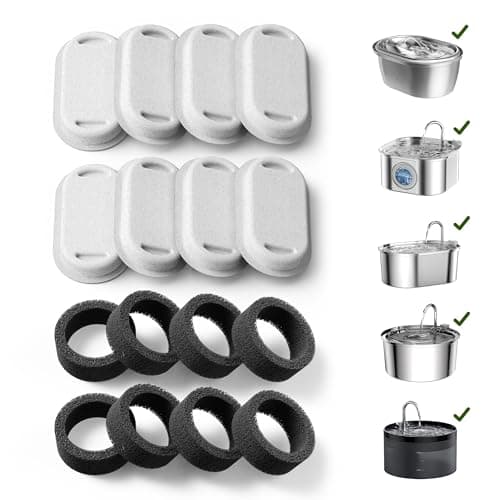
| 1 | PETLIBRO Stainless Steel Fountain Replacement Filters Publishes its three-layer construction and two different change intervals, which is unusual candour for a consumable -- and the gap between those two intervals is worth money. | The consumable that costs more than the fountain | 7.1 | |
| 2 | 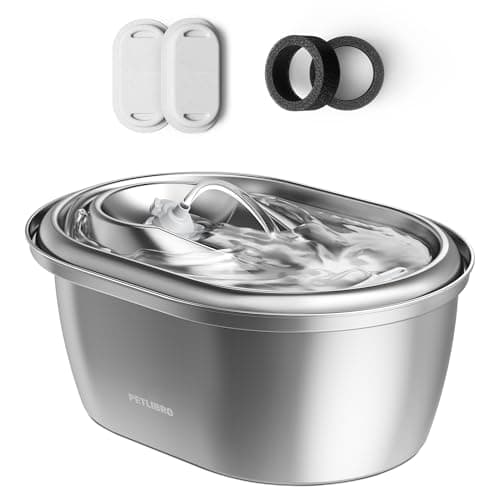 PETLIBRO Stainless Steel Fountain, 3 L The only fountain here that publishes its adapter rating, its noise figure and its filter interval -- which is everything you need to cost a year of ownership before you buy. | Knowing exactly what it costs to run | 8.7 | |
| 3 | 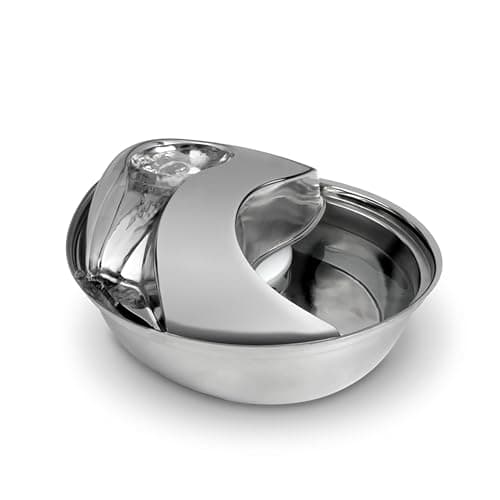 Pioneer Pet Raindrop Stainless Steel Fountain 18/8 stainless throughout and dishwasher safe as a whole unit -- the shape with the fewest places for biofilm to hide. | The easiest one to actually clean | 8.2 |
#ad Buy links are affiliate links. Prices come from a live daily check; where we have no verified price we say "check price" rather than print a stale one.
Our fountain running-costs page found that filters cost roughly twelve times what the pump costs in electricity. That makes the filter, not the fountain, the thing worth thinking about carefully.
The interval is the whole cost
PETLIBRO's official site recommends replacing every 2 weeks. Its own product listing says every 2 to 4 weeks depending on drinking frequency and the number of pets.
Two weeks: 26 filters a year. Four weeks: 13 filters a year. Same filter, same manufacturer, double the cost.
For scale, our running costs page puts the pump at about $8.03 a year in electricity at the EIA residential average of 18.34 cents per kWh, against roughly $97.44 in filters at the two-week interval. The electricity is a rounding error. The interval is the decision.
What is actually in one
| Fountain | Filter construction | Published interval | Sponges included |
|---|---|---|---|
| PETLIBRO Stainless 3 L | Cotton layer, activated carbon, ion exchange resin | 2 weeks (official) / 2-4 weeks (listing) | Yes, 4 with a 4-pack |
| Pioneer Pet Raindrop | Not published in layers | 2 to 4 weeks | Not published |
PETLIBRO is the only fountain maker we track that publishes what its filter is made of rather than just calling it a carbon filter.
The three layers do three jobs. Cotton catches hair and grit, which is what stops the pump. Carbon addresses taste and odor. Ion exchange resin targets dissolved minerals, which is the layer that matters in a hard-water area and the reason a filter in one house exhausts faster than the same filter in another.
Compatibility is not optional
Fountain filters are model-specific, and the failure mode is silent. A filter that is slightly small does not block water — it lets water pass around the edge, so the pump runs, the bowl fills, and nothing is being filtered.
- Match the model code, not the brand. PETLIBRO alone has several incompatible filter families across its ranges.
- Check the sponge is included. Some fountains use a separate pre-filter sponge that also needs replacing.
- Soak before first use. PETLIBRO publishes 15 minutes and a rinse; skipping it puts carbon dust in the water.
A filter is not a cleaning schedule
This is the most common misunderstanding in the category. A filter polishes the water that passes through it. It does nothing about the biofilm that forms inside the pump housing, where no cloth reaches and no water filter is positioned.
A stainless fountain keeps a smooth surface for years, which helps — but our fountain cleaning guide still calls for a weekly pump strip-down and a monthly descale. A cat that has stopped using a fountain has almost always been given a pump problem rather than a filter problem.
Pioneer Pet's Raindrop publishes a 2 to 4 week interval and no plastic in the water path, which is a different way of attacking the same longevity question — our stainless page compares the water paths properly.
When to stop buying filters altogether
If your cat drinks the same from a bowl as from a fountain, the filter subscription is buying nothing. Cornell Feline Health Center links water intake to lower urinary tract disease, and the intervention that matters is intake — not the mechanism.
Our water bowls page makes that case with the numbers. Several bowls in several rooms cost nothing to run, and the Ohio State Indoor Pet Initiative treats distributed resources as the multi-cat default anyway.
The picks in full
Specs are the manufacturer's own, linked to the page they came from. Prices come from a live daily check; where we have no verified price we say so rather than print a stale one.
PETLIBRO Stainless Steel Fountain Replacement Filters
PETLIBRO · Fountain filter · Our score 7.1/10
#ad Price as of September 25, 2026. Prices move; we check daily. How we're funded.
Publishes its three-layer construction and two different change intervals, which is unusual candour for a consumable -- and the gap between those two intervals is worth money.
Published specs
| Pack | 4 filters and 4 sponges |
|---|---|
| Construction | Cotton layer, activated carbon, ion exchange resin |
| Maker's interval | Every 2 weeks (PETLIBRO official) |
| Listing interval | Every 2 to 4 weeks depending on pets and use |
| Before first use | Soak 15 minutes and rinse to shed carbon dust |
At the official two-week interval you use 26 filters a year. At the listing's four-week upper bound you use 13. That is a two-to-one difference in the dominant running cost of owning a fountain -- and our fountain running-costs page puts filters at roughly twelve times the electricity.
What the specs favor
- Publishes the actual filter construction rather than just 'carbon filter'
- Sponges included, which are a separate purchase on some fountains
- Publishes a pre-soak instruction, which prevents carbon dust in the bowl
What they don't
- Two different published intervals from the same manufacturer
- Proprietary to PETLIBRO fountains
- The filter polishes water; it does not clean the fountain
You do not own the fountain these fit. Fountain filters are not cross-compatible, and a third-party filter that does not seat properly bypasses entirely.
How it scores
Scores are our editorial weighting of the published specs above, not a test result. They are deliberately kept out of this page's structured data.
PETLIBRO Stainless Steel Fountain, 3 L
PETLIBRO · Water fountain · Our score 8.7/10
#ad Price as of September 25, 2026. Prices move; we check daily. How we're funded.
The only fountain here that publishes its adapter rating, its noise figure and its filter interval -- which is everything you need to cost a year of ownership before you buy.
Published specs
| Capacity | 3 L |
|---|---|
| Tank material | Stainless steel; PP water outlet |
| Power adapter | Input 100-240 V, output 5 V / 1 A (5 W ceiling) |
| Noise | Not more than 30 dB (published) |
| Filter interval | Every 2 weeks (PETLIBRO) |
| Filter price | $14.99 per 4-pack (PETLIBRO list) |
| Dimensions / weight | 10.8 x 8.1 x 4.7 in / 1.6 lb |
Source: PETLIBRO -- Stainless Steel Fountain 3 L product page and filter listing
Adapter output is 5 V x 1 A = 5 W, which is a nameplate ceiling, not a measurement. 5 W x 24 h x 365 = 43.8 kWh, x $0.1834 = $8.03. Filters at PETLIBRO's own $14.99 per 4-pack is $3.75 each, changed fortnightly = 26 a year = $97.44. The filters cost twelve times the electricity. Nobody puts that on the box.
What the specs favor
- Publishes the adapter rating, so running cost is computable rather than guessed
- Publishes a noise figure of 30 dB or less
- 304 stainless tank -- no plastic to scratch and harbor biofilm
- 3 L is enough for three cats between top-ups
What they don't
- Fortnightly filter changes are the real cost, at roughly $97 a year
- Plastic water outlet on an otherwise stainless fountain
- Small footprint means a determined cat can shove it around
You will not commit to a filter every two weeks. Run past the interval and a fountain is a warm, aerated, recirculating bacterial culture -- worse than a bowl you rinse daily.
How it scores
Scores are our editorial weighting of the published specs above, not a test result. They are deliberately kept out of this page's structured data.
Pioneer Pet Raindrop Stainless Steel Fountain
Pioneer Pet · Water fountain · Our score 8.2/10
#ad Price as of September 25, 2026. Prices move; we check daily. How we're funded.
18/8 stainless throughout and dishwasher safe as a whole unit -- the shape with the fewest places for biofilm to hide.
Published specs
| Capacity | 60 oz |
|---|---|
| Material | 18/8 stainless steel |
| Dimensions | 11.75" L x 9.75" W x 4.25" H |
| Weight | 2.5 lb |
| Filter interval | Every 2-4 weeks (Pioneer Pet) |
| Cleaning | Dishwasher safe |
| Pump wattage | Not published |
Source: Chewy -- Pioneer Pet Stainless Steel Raindrop Fountain listing
Pioneer Pet gives an interval rather than a fixed number: every 2 to 4 weeks. That is 13 filters a year at the slow end and 26 at the fast end -- a two-fold spread in running cost that depends entirely on how many cats are using it. Makers who quote a single interval are quoting the single-cat case.
What the specs favor
- 18/8 stainless with no plastic in the water path
- Low 4.25-inch profile -- a cat drinks in a natural posture, not head-down in a well
- Filter interval published as a range, which is more honest than a single number
- Dishwasher safe
What they don't
- 60 oz is the smallest capacity here
- No published pump wattage
- Wide 11.75-inch footprint for the water it holds
You have four cats. 60 oz is a top-up-daily fountain in a house that size, and the point of a fountain is that you are not standing over it.
How it scores
Scores are our editorial weighting of the published specs above, not a test result. They are deliberately kept out of this page's structured data.
Common questions
How often should you change a cat fountain filter?
What is in a cat fountain filter?
Do you have to use the brand's own fountain filters?
Do you need to soak a new fountain filter?
Do fountain filters clean the fountain?
Sources
- PETLIBRO -- Stainless Steel Fountain Replacement Filters 4-pack (cotton, activated carbon, ion exchange resin; change every 2 weeks)
- PETLIBRO -- Stainless Steel Fountain 3 L product page (5 V / 1 A, 30 dB)
- Chewy -- Pioneer Pet Stainless Steel Raindrop Fountain listing (filter every 2-4 weeks)
- U.S. Energy Information Administration -- Electric Power Monthly, Table 5.3 (residential average 18.34 cents/kWh, June 2026)
- Cornell Feline Health Center -- Feline Lower Urinary Tract Disease
Read next
- What a Cat Water Fountain Actually Costs to Run
Electricity and filters costed from published adapter ratings and manufacturers' own filter prices, with every sum shown.
- How to Clean a Cat Water Fountain
A cat fountain cleaning routine built around published filter intervals, including the pump strip-down that decides whether the fountain gets refused.
- Best Cat Water Bowls (2026)
Plain water bowls compared on width, material and stability, with the running-cost case against a fountain.
- Best Quiet Cat Water Fountains (2026)
Which cat fountains publish a noise figure, and why most fountain noise is a water-level or maintenance problem rather than a model problem.
- Easiest Cat Water Fountains to Clean (2026)
Ranked on part count, dishwasher safety and filter interval -- the three things that decide whether a fountain gets maintained.