Feeders, Fountains & Bowls
Best Quiet Cat Water Fountains (2026)
Exactly one fountain here publishes a decibel figure. The other reason fountains are loud is not the model you bought.
Affiliate disclosure: we earn a commission if you buy through our links, at no extra cost to you. It never changes which product we rank first — here is how we're funded.
Everyone in this category says they tested twenty litter boxes. We have not tested any, and we say so. What we do instead: compile the published specs, read the manuals, and do the arithmetic on what this gear costs to run and how it behaves once there is more than one cat using it. Every spec is linked to the document it came from. Prices are checked daily — last verified October 22, 2026. Here is exactly how we pick.
Quick picks
Ranked on the published specs and the arithmetic below. Tap any row to jump to the full write-up. We have not tested these — here is exactly how we pick.
| # | Product | Best for | Score | Price |
|---|---|---|---|---|
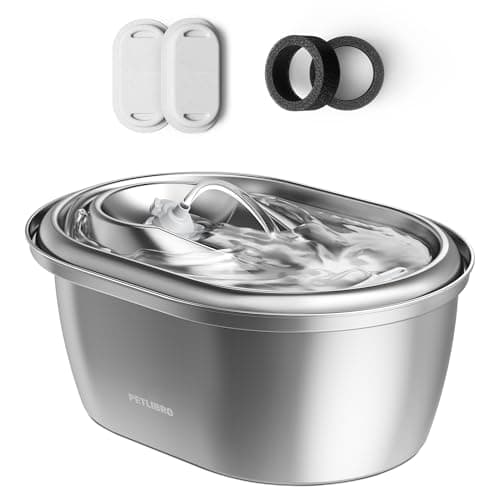
| 1 | PETLIBRO Stainless Steel Fountain, 3 L The only fountain here that publishes its adapter rating, its noise figure and its filter interval -- which is everything you need to cost a year of ownership before you buy. | Knowing exactly what it costs to run | 8.7 | |
| 2 | 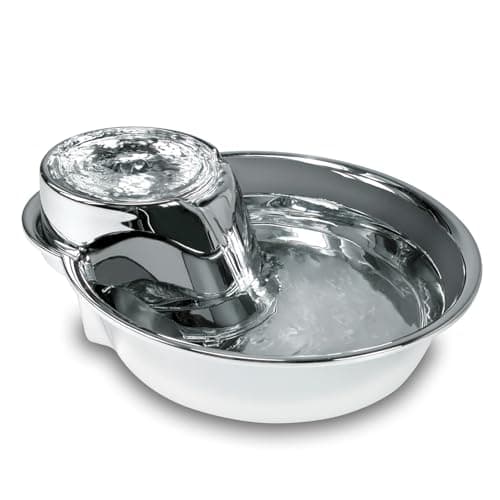 Pioneer Pet Big Max Stainless Steel Fountain 18/8 stainless at 128 oz and dishwasher safe -- the stainless fountain Pioneer still actually sells, and the one with room for three or four cats. | Stainless capacity for a multi-cat house | 7.9 | |
| 3 | 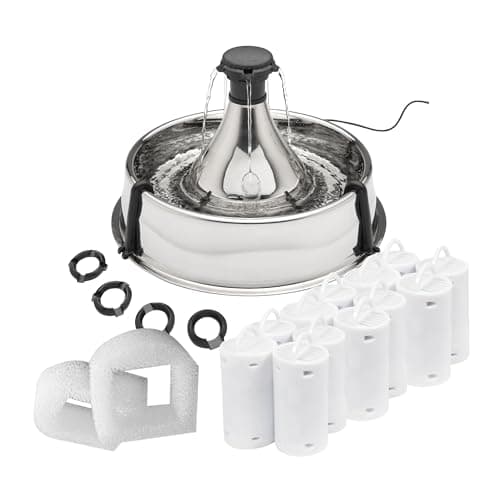 PetSafe Drinkwell 360 Stainless Steel 128 ounces and access from all sides -- the only fountain here designed so two cats can drink without one of them being cornered. | Three or more cats drinking at once | 8.0 |
#ad Buy links are affiliate links. Prices come from a live daily check; where we have no verified price we say "check price" rather than print a stale one.
Fountain noise is the most common complaint in this category and the most commonly misattributed. Very little of it is a property of the model you bought.
Who publishes a number
| Fountain | Published noise | Pump spec published |
|---|---|---|
| PETLIBRO Stainless 3 L | 30 dB | 5 V / 1 A |
| Pioneer Pet Big Max | Not published | Not published |
| PetSafe Drinkwell 360 | Not published | Not published |
| Catit Flower Fountain | Not published | 120 V, 12 VA, 300 mA |
The blanks are the finding. In a category where noise is the number one complaint, one manufacturer of four will state a figure.
The real cause is the water level
A submersible pump is designed to run fully immersed. As the reservoir drops, the intake gets nearer the surface, and at some point the pump starts drawing air with the water.
Air in an impeller housing is what produces the buzzing, rattling or gurgling people describe as a faulty pump. It is almost never faulty. It is thirsty.
A 3 L fountain in a two-cat household drops noticeably within a few days through drinking and evaporation together — which is why fountains get louder towards the end of the week and quiet again after a refill.
The second cause is scale
Hard water plates calcium carbonate onto the impeller and the housing. A scaled impeller runs out of balance, and an out-of-balance rotor is audibly louder. That is a cleaning problem, and our fountain cleaning guide covers the weekly strip-down and the monthly descale that fix it.
If you are buying anyway
PETLIBRO’s stainless 3 L leads on the published 30 dB figure and a 5 V / 1 A pump spec you can cost out. Be aware of the trade our stainless page flags: the tank is stainless, the water outlet is polypropylene.
Pioneer Pet’s Big Max has no plastic in the water path and a low fall height, which is the design factor that matters after the pump — water dropping a short distance into water makes less noise than water dropping a long one.
The Drinkwell 360 publishes 128 oz and five streams. More streams and more capacity is a genuinely good multi-cat answer, and it is the loudest arrangement on this page by the same physics.
Four free things to try first
- Top it up. Weekly is not often enough for two cats.
- Strip the pump. Weekly, including the impeller cavity.
- Descale monthly. Diluted white vinegar, then rinse thoroughly.
- Put it on a mat. A hard floor transmits pump vibration through the room; a mat stops it at the source.
The picks in full
Specs are the manufacturer's own, linked to the page they came from. Prices come from a live daily check; where we have no verified price we say so rather than print a stale one.
PETLIBRO Stainless Steel Fountain, 3 L
PETLIBRO · Water fountain · Our score 8.7/10
#ad Price as of October 22, 2026. Prices move; we check daily. How we're funded.
The only fountain here that publishes its adapter rating, its noise figure and its filter interval -- which is everything you need to cost a year of ownership before you buy.
Published specs
| Capacity | 3 L |
|---|---|
| Tank material | Stainless steel; PP water outlet |
| Power adapter | Input 100-240 V, output 5 V / 1 A (5 W ceiling) |
| Noise | Not more than 30 dB (published) |
| Filter interval | Every 2 weeks (PETLIBRO) |
| Filter price | $14.99 per 4-pack (PETLIBRO list) |
| Dimensions / weight | 10.8 x 8.1 x 4.7 in / 1.6 lb |
Source: PETLIBRO -- Stainless Steel Fountain 3 L product page and filter listing
Adapter output is 5 V x 1 A = 5 W, which is a nameplate ceiling, not a measurement. 5 W x 24 h x 365 = 43.8 kWh, x $0.1834 = $8.03. Filters at PETLIBRO's own $14.99 per 4-pack is $3.75 each, changed fortnightly = 26 a year = $97.44. The filters cost twelve times the electricity. Nobody puts that on the box.
What the specs favor
- Publishes the adapter rating, so running cost is computable rather than guessed
- Publishes a noise figure of 30 dB or less
- 304 stainless tank -- no plastic to scratch and harbor biofilm
- 3 L is enough for three cats between top-ups
What they don't
- Fortnightly filter changes are the real cost, at roughly $97 a year
- Plastic water outlet on an otherwise stainless fountain
- Small footprint means a determined cat can shove it around
You will not commit to a filter every two weeks. Run past the interval and a fountain is a warm, aerated, recirculating bacterial culture -- worse than a bowl you rinse daily.
How it scores
Scores are our editorial weighting of the published specs above, not a test result. They are deliberately kept out of this page's structured data.
Pioneer Pet Big Max Stainless Steel Fountain
Pioneer Pet · Water fountain · Our score 7.9/10
#ad Price as of October 22, 2026. Prices move; we check daily. How we're funded.
18/8 stainless at 128 oz and dishwasher safe -- the stainless fountain Pioneer still actually sells, and the one with room for three or four cats.
Published specs
| Capacity | 128 oz (3.78 L) |
|---|---|
| Material | 18/8 stainless steel |
| Dimensions | Footprint 13.75" x 12"; height published as 2.75" by one retailer and 4.25" by another -- they disagree |
| Weight | Not published |
| Filter | Replaceable charcoal; part numbers #3002 (3-pack) and #3014 (4-pack) |
| Filter interval | Every 2-4 weeks (Pioneer Pet) |
| Cleaning | Dishwasher safe; maker says clean weekly and strip the pump monthly |
| Power | Corded, low voltage; wattage not published |
Pioneer Pet gives an interval rather than a fixed number: every 2 to 4 weeks. That is 13 filters a year at the slow end and 26 at the fast end -- a two-fold spread in running cost that depends entirely on how many cats are using it. Makers who quote a single interval are quoting the single-cat case. Pioneer also publishes a maintenance schedule most makers skip: clean the fountain weekly and take the pump apart monthly.
What the specs favor
- 18/8 stainless, which cannot scratch into a surface that holds biofilm
- 128 oz is genuine multi-cat capacity rather than a daily top-up
- Filter interval published as a range, which is more honest than a single number
- Dishwasher safe, and Pioneer publishes a weekly-clean and monthly-pump schedule
- Named filter part numbers, so the consumable is findable rather than proprietary-mystery
What they don't
- Retailers disagree about its height (2.75 in against 4.25 in), so drinking posture cannot be checked before it arrives
- No published pump wattage, so electricity cannot be costed
- No published weight
- 13.75 by 12 inch footprint is a lot of counter for a fountain
- The most expensive fountain on this site by a clear margin
You have one cat and a small kitchen. 128 oz and a 13.75 by 12 inch footprint is capacity you will not use, and a smaller stainless fountain does the same job in less space.
How it scores
Scores are our editorial weighting of the published specs above, not a test result. They are deliberately kept out of this page's structured data.
PetSafe Drinkwell 360 Stainless Steel
PetSafe · Water fountain · Our score 8.0/10
#ad Price as of October 22, 2026. Prices move; we check daily. How we're funded.
128 ounces and access from all sides -- the only fountain here designed so two cats can drink without one of them being cornered.
Published specs
| Capacity | 128 oz (3.8 L) |
|---|---|
| Streams | 5 interchangeable stream options |
| Access | 360 degrees, open bowl |
| Filtration | Charcoal plus foam pre-filter |
| Cleaning | Top-rack dishwasher safe |
| Pump | Submersible; wattage not published by PetSafe |
Source: PetSafe -- Drinkwell 360 Stainless Steel Pet Fountain product page
3.8 L divided three ways is 1.27 L a cat between refills -- far more than any cat drinks in a day, so the constraint is not capacity, it is how long water stays fresh. At fortnightly filter intervals the practical refill cycle is what governs, not the tank.
What the specs favor
- Largest capacity here at 128 oz
- 360-degree access removes the cornering problem in a multi-cat house
- Five stream options, so a fussy drinker has somewhere to go
- Top-rack dishwasher safe
What they don't
- PetSafe does not publish pump wattage, so electricity cannot be computed
- Two filter types to buy rather than one
- Big footprint for a water bowl
You want to know what it costs to run. PetSafe publishes no wattage for this pump, and we are not going to invent one.
How it scores
Scores are our editorial weighting of the published specs above, not a test result. They are deliberately kept out of this page's structured data.
Common questions
What is the quietest cat water fountain?
Why is my cat fountain so loud?
Do cats mind fountain noise?
Are stainless steel fountains quieter than plastic?
How do I make my cat fountain quieter?
Sources
- PETLIBRO -- Stainless Steel Fountain 3 L product page and filter listing
- Chewy -- Pioneer Pet Big Max Stainless Steel Fountain listing (128 oz)
- PetSafe -- Drinkwell 360 Stainless Steel Pet Fountain product page
- Catit -- Flower Fountain product page (120 V, 12 VA, 300 mA)
- U.S. Energy Information Administration -- Electric Power Monthly, Table 5.3 (residential average 18.34 cents/kWh, June 2026)
Read next
- Best Cat Water Fountains (2026)
Four fountains compared on wattage, noise, filter interval and material -- and what each one costs across a year.
- How to Clean a Cat Water Fountain
A cat fountain cleaning routine built around published filter intervals, including the pump strip-down that decides whether the fountain gets refused.
- Best Stainless Steel Cat Water Fountains (2026)
Which stainless fountains are stainless throughout the water path, and what a year of filters costs on each.
- What a Cat Water Fountain Actually Costs to Run
Electricity and filters costed from published adapter ratings and manufacturers' own filter prices, with every sum shown.
- Best Cat Water Bowls (2026)
Plain water bowls compared on width, material and stability, with the running-cost case against a fountain.
- Best Wireless Cat Fountains (2026)
Battery-powered fountains compared on published battery life, capacity and noise, with what the charging cycle looks like at three cats.