Feeders, Fountains & Bowls
How to Clean a Cat Water Fountain
Rinsing the bowl is not cleaning the fountain. The biofilm that makes a cat refuse it lives in the pump, and the pump comes apart.
Affiliate disclosure: we earn a commission if you buy through our links, at no extra cost to you. It never changes which product we rank first — here is how we're funded.
Everyone in this category says they tested twenty litter boxes. We have not tested any, and we say so. What we do instead: compile the published specs, read the manuals, and do the arithmetic on what this gear costs to run and how it behaves once there is more than one cat using it. Every spec is linked to the document it came from. Prices are checked daily — last verified October 21, 2026. Here is exactly how we pick.
A fountain that has stopped being used is almost never a broken fountain. It is a fountain with a biofilm in the pump, and the pump is the part of the routine people do not know exists.
The schedule
| Job | Frequency | Takes | Why |
|---|---|---|---|
| Rinse and refill | Every 2-3 days | 2 minutes | Removes hair, saliva and dust from the surface |
| Strip the pump | Weekly | 10 minutes | The only way to reach the impeller cavity |
| Change the filter | Per the maker's published interval | 1 minute | PETLIBRO says 2 weeks, Pioneer Pet says 2-4 |
| Descale | Monthly | 30 minutes, mostly soaking | Hard-water scale gives biofilm somewhere to anchor |
Filter intervals are the manufacturers' published figures. The other three cadences are ours, from how quickly biofilm establishes on a permanently wet surface.
Stripping the pump
- Unplug it. Always, and before it comes out of the water.
- Lift the pump out and remove the cover. Nearly every pump in this category has a cover that unclips or twists off.
- Pull the impeller. It is a small magnetic rotor that lifts straight out. This is the part you have never cleaned.
- Brush the cavity. A cotton bud or a small bottle brush. The film is on the inside walls, not on the impeller itself.
- Rinse thoroughly and reassemble dry-handed. The impeller only goes in one way round.
Filters are a published interval, not a judgment call
PETLIBRO specifies a filter change every two weeks. Pioneer Pet specifies every two to four. Those are the makers’ own numbers, and they are also the dominant running cost of owning a fountain — roughly twelve times what the pump costs in electricity, which we work through in fountain running costs.
Two things people get wrong about filters. They do not clean the fountain — they polish the water, and a filter in a dirty fountain is just a wet sponge in a dirty fountain. And they are not optional in hard water, because a spent filter stops trapping the mineral load that then plates out inside the pump.
The monthly descale
Hard water leaves calcium carbonate on every wet surface. It is chalky and rough, and roughness is the whole problem: a scaled surface has far more area and far more shelter than a smooth one, so biofilm establishes faster and wipes off less completely.
This is the same argument our materials page makes about scratched plastic. Scale does to stainless steel what claws do to plastic.
The method: disassemble fully, soak the non-electrical parts in one part white vinegar to three parts warm water for twenty to thirty minutes, brush, then rinse until there is no vinegar smell at all. That last step is not optional — cats detect residue easily and a vinegar-scented fountain is a refused fountain.
Material changes the work, not the schedule
Stainless steel does not scratch the way plastic does, so a stainless fountain keeps a smooth surface for years and each clean gets closer to actually clean. It does not clean itself. The Catit Flower Fountain is plastic and popular and works fine — it simply reaches the point where scratches hold film sooner, which is a replacement-interval question rather than a cleaning-frequency one.
If your cat has stopped using it
- Strip the pump. Nine times out of ten in our reading of this category, this is it.
- Check for detergent residue. Rinse three times more than feels necessary after any soap.
- Listen to it. A pump running dry or with a scaled impeller is audibly louder, and PETLIBRO publishes a 30 dB figure precisely because noise matters to cats.
- Put a plain bowl out as well. Always, in every house. Cornell Feline Health Center links water intake to urinary tract disease, so a cat refusing its only water source is not a preference to wait out.
The gear discussed here
Specs are the manufacturer's own, linked to the page they came from. Prices come from a live daily check; where we have no verified price we say so rather than print a stale one.
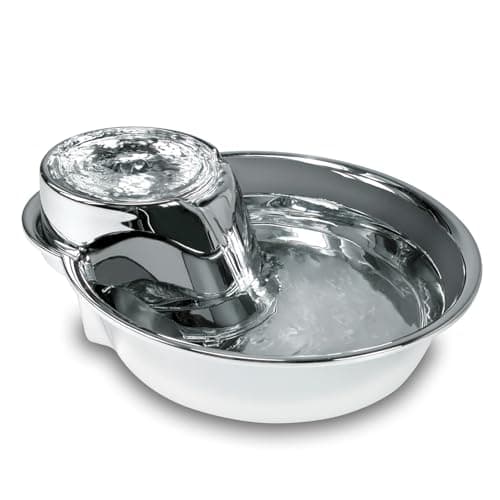
Pioneer Pet Big Max Stainless Steel Fountain
Pioneer Pet · Water fountain · Our score 7.9/10
#ad Price as of October 21, 2026. Prices move; we check daily. How we're funded.
18/8 stainless at 128 oz and dishwasher safe -- the stainless fountain Pioneer still actually sells, and the one with room for three or four cats.
Published specs
| Capacity | 128 oz (3.78 L) |
|---|---|
| Material | 18/8 stainless steel |
| Dimensions | Footprint 13.75" x 12"; height published as 2.75" by one retailer and 4.25" by another -- they disagree |
| Weight | Not published |
| Filter | Replaceable charcoal; part numbers #3002 (3-pack) and #3014 (4-pack) |
| Filter interval | Every 2-4 weeks (Pioneer Pet) |
| Cleaning | Dishwasher safe; maker says clean weekly and strip the pump monthly |
| Power | Corded, low voltage; wattage not published |
Pioneer Pet gives an interval rather than a fixed number: every 2 to 4 weeks. That is 13 filters a year at the slow end and 26 at the fast end -- a two-fold spread in running cost that depends entirely on how many cats are using it. Makers who quote a single interval are quoting the single-cat case. Pioneer also publishes a maintenance schedule most makers skip: clean the fountain weekly and take the pump apart monthly.
What the specs favor
- 18/8 stainless, which cannot scratch into a surface that holds biofilm
- 128 oz is genuine multi-cat capacity rather than a daily top-up
- Filter interval published as a range, which is more honest than a single number
- Dishwasher safe, and Pioneer publishes a weekly-clean and monthly-pump schedule
- Named filter part numbers, so the consumable is findable rather than proprietary-mystery
What they don't
- Retailers disagree about its height (2.75 in against 4.25 in), so drinking posture cannot be checked before it arrives
- No published pump wattage, so electricity cannot be costed
- No published weight
- 13.75 by 12 inch footprint is a lot of counter for a fountain
- The most expensive fountain on this site by a clear margin
You have one cat and a small kitchen. 128 oz and a 13.75 by 12 inch footprint is capacity you will not use, and a smaller stainless fountain does the same job in less space.
How it scores
Scores are our editorial weighting of the published specs above, not a test result. They are deliberately kept out of this page's structured data.
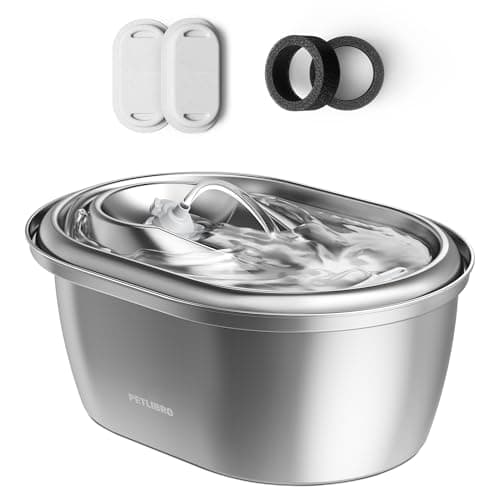
PETLIBRO Stainless Steel Fountain, 3 L
PETLIBRO · Water fountain · Our score 8.7/10
#ad Price as of October 21, 2026. Prices move; we check daily. How we're funded.
The only fountain here that publishes its adapter rating, its noise figure and its filter interval -- which is everything you need to cost a year of ownership before you buy.
Published specs
| Capacity | 3 L |
|---|---|
| Tank material | Stainless steel; PP water outlet |
| Power adapter | Input 100-240 V, output 5 V / 1 A (5 W ceiling) |
| Noise | Not more than 30 dB (published) |
| Filter interval | Every 2 weeks (PETLIBRO) |
| Filter price | $14.99 per 4-pack (PETLIBRO list) |
| Dimensions / weight | 10.8 x 8.1 x 4.7 in / 1.6 lb |
Source: PETLIBRO -- Stainless Steel Fountain 3 L product page and filter listing
Adapter output is 5 V x 1 A = 5 W, which is a nameplate ceiling, not a measurement. 5 W x 24 h x 365 = 43.8 kWh, x $0.1834 = $8.03. Filters at PETLIBRO's own $14.99 per 4-pack is $3.75 each, changed fortnightly = 26 a year = $97.44. The filters cost twelve times the electricity. Nobody puts that on the box.
What the specs favor
- Publishes the adapter rating, so running cost is computable rather than guessed
- Publishes a noise figure of 30 dB or less
- 304 stainless tank -- no plastic to scratch and harbor biofilm
- 3 L is enough for three cats between top-ups
What they don't
- Fortnightly filter changes are the real cost, at roughly $97 a year
- Plastic water outlet on an otherwise stainless fountain
- Small footprint means a determined cat can shove it around
You will not commit to a filter every two weeks. Run past the interval and a fountain is a warm, aerated, recirculating bacterial culture -- worse than a bowl you rinse daily.
How it scores
Scores are our editorial weighting of the published specs above, not a test result. They are deliberately kept out of this page's structured data.
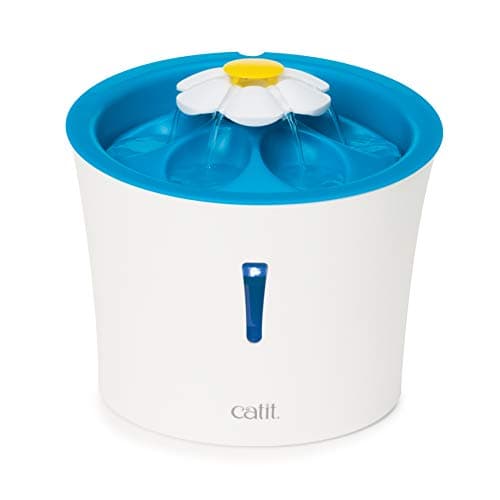
Catit Flower Fountain, 3 L
Catit · Water fountain · Our score 7.1/10
#ad Price as of October 21, 2026. Prices move; we check daily. How we're funded.
Three flow settings and a low price -- the sensible way to find out whether a fountain changes anything in your house before spending on stainless.
Published specs
| Capacity | 3 L |
|---|---|
| Power | 120 V, 12 VA, 60 Hz, 300 mA (North America) |
| Flow settings | Three (gentle, bubbling, calm) |
| Filtration | Triple-action filter |
| Material | Plastic |
Source: Catit -- Flower Fountain product page
Catit publishes 12 VA, which is apparent power at the adapter, not watts drawn -- so treat it as a hard ceiling. 12 W x 24 h x 365 = 105.1 kWh, x $0.1834 = $19.28. The real draw is lower, and Catit does not publish it. We are not going to pretend a VA rating is a wattage.
What the specs favor
- Three flow settings, so a cat that ignores one may take another
- Cheapest way to test the fountain question at all
- 3 L capacity matches the stainless models here
- Catit publishes an adapter rating, unlike PetSafe
What they don't
- Plastic, which scratches and then holds biofilm in the scratches
- 12 VA is apparent power, not a wattage -- the real draw is unpublished
- Many small parts to disassemble at cleaning time
Your cat has feline acne or a history of chin irritation. Plastic water and food vessels are the standard first thing to eliminate, and this fountain is entirely plastic.
How it scores
Scores are our editorial weighting of the published specs above, not a test result. They are deliberately kept out of this page's structured data.
Common questions
How often should you clean a cat water fountain?
Why does my cat's fountain get slimy?
Do you need to take a fountain pump apart to clean it?
Can you put a cat fountain in the dishwasher?
What should you clean a cat fountain with?
Sources
Read next
- Easiest Cat Water Fountains to Clean (2026)
Ranked on part count, dishwasher safety and filter interval -- the three things that decide whether a fountain gets maintained.
- What a Cat Water Fountain Actually Costs to Run
Electricity and filters costed from published adapter ratings and manufacturers' own filter prices, with every sum shown.
- Ceramic vs Stainless vs Plastic Cat Fountains
Why the material debate is really about scratch resistance, and what that means for a fountain in a multi-cat house.
- Best Stainless Steel Cat Water Fountains (2026)
Which stainless fountains are stainless throughout the water path, and what a year of filters costs on each.
- Cat Hydration: Setup, Not Medicine
Water station counts and placement for multi-cat homes, plus a clear line on which questions belong to a vet.
- Best Ceramic Cat Fountains (2026)
Ceramic fountains compared on published capacity, with the same-capacity steel twin that isolates what the material actually changes.