Feeders, Fountains & Bowls
Cat Hydration: Setup, Not Medicine
We can tell you how to arrange water in a multi-cat house. We cannot tell you about your cat's kidneys, and we are not going to pretend otherwise.
Affiliate disclosure: we earn a commission if you buy through our links, at no extra cost to you. It never changes which product we rank first — here is how we're funded.
Everyone in this category says they tested twenty litter boxes. We have not tested any, and we say so. What we do instead: compile the published specs, read the manuals, and do the arithmetic on what this gear costs to run and how it behaves once there is more than one cat using it. Every spec is linked to the document it came from. Prices are checked daily — last verified October 19, 2026. Here is exactly how we pick.
There are two hydration questions and they belong to different people. How much water your cat needs, and what a change in drinking means, is a veterinary question. How to arrange water in a house with three cats so that all three can reach it is a setup question, and that one we can answer properly.
Think in stations, not bowls
The useful unit is a water station: a place in the house where a cat can drink without having to negotiate with another cat. One enormous fountain in the kitchen is one station. Three modest bowls in three rooms are three stations, and in a multi-cat house three stations beat one fountain comfortably.
| Cats | Stations | Suggested mix |
|---|---|---|
| 1 | 2 | One bowl, one anywhere else |
| 2 | 2-3 | One fountain, one or two bowls in other rooms |
| 3 | 3 | One multi-side fountain plus two bowls |
| 4 | 4 | One or two fountains plus bowls on every floor |
These counts are OURS, extending the same one-per-cat-plus-one logic that the Cornell Feline Health Center publishes for litter boxes. They are not a published veterinary recommendation and we are not going to dress them up as one.
That footnote matters. The n+1 rule is published guidance for litter boxes specifically. Applying the same shape to water is a reasonable extension and we think it is a good one, but it is our reasoning, not somebody else’s authority, and we are not going to launder it.
Placement, which is most of it
- Away from food. Cats routinely drink away from where they eat.
- Well away from litter boxes. This one is not negotiable for most cats.
- More than one exit. A cat drinking has its head down and its back turned; a dead-end corner is where a shy cat stops going.
- On every floor. The same logic the Cornell Feline Health Center sources apply to litter boxes applies here — a resource on another floor is not available to a cat that has settled upstairs.
- Not next to a noisy appliance. A fridge that cycles or a boiler that fires is a reason to leave and not come back.
The vessel
Wide, shallow and not plastic. Width reduces contact between a cat’s whiskers and the sides of the bowl; shallow keeps the water surface easy to reach; non-plastic avoids the scratched surfaces that hold residue. Stainless and glazed ceramic both satisfy all three, and both cost very little.
If you are adding a fountain, the multi-cat argument is about geometry rather than capacity — a fountain with access from several sides lets two cats drink without one being cornered. That is the reasoning behind the ranking in the multi-cat fountain picks, and the honest cost of running one is on the running-costs page.
A cheap experiment before you spend
Put a second water source somewhere you currently have none — the bedroom, the landing, the far end of the house — and watch it for a week. If it gets used, you have learned something real about your household for the price of a bowl: the constraint was access, not palatability, and a more expensive fountain in the same old place would not have fixed it.
That is the whole method here. Change one variable, watch, then buy. It is also, roughly, what we do instead of testing gear ourselves.
The gear discussed here
Specs are the manufacturer's own, linked to the page they came from. Prices come from a live daily check; where we have no verified price we say so rather than print a stale one.
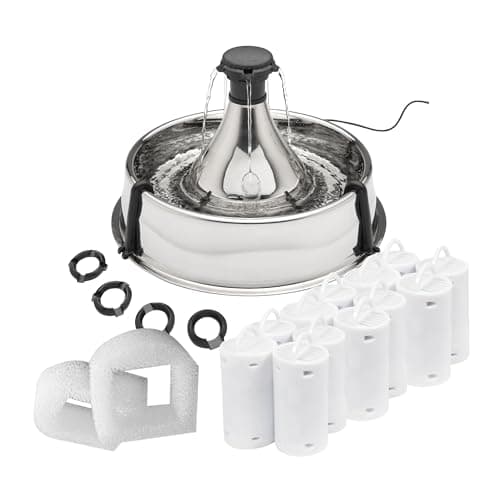
PetSafe Drinkwell 360 Stainless Steel
PetSafe · Water fountain · Our score 8.0/10
#ad Price as of October 19, 2026. Prices move; we check daily. How we're funded.
128 ounces and access from all sides -- the only fountain here designed so two cats can drink without one of them being cornered.
Published specs
| Capacity | 128 oz (3.8 L) |
|---|---|
| Streams | 5 interchangeable stream options |
| Access | 360 degrees, open bowl |
| Filtration | Charcoal plus foam pre-filter |
| Cleaning | Top-rack dishwasher safe |
| Pump | Submersible; wattage not published by PetSafe |
Source: PetSafe -- Drinkwell 360 Stainless Steel Pet Fountain product page
3.8 L divided three ways is 1.27 L a cat between refills -- far more than any cat drinks in a day, so the constraint is not capacity, it is how long water stays fresh. At fortnightly filter intervals the practical refill cycle is what governs, not the tank.
What the specs favor
- Largest capacity here at 128 oz
- 360-degree access removes the cornering problem in a multi-cat house
- Five stream options, so a fussy drinker has somewhere to go
- Top-rack dishwasher safe
What they don't
- PetSafe does not publish pump wattage, so electricity cannot be computed
- Two filter types to buy rather than one
- Big footprint for a water bowl
You want to know what it costs to run. PetSafe publishes no wattage for this pump, and we are not going to invent one.
How it scores
Scores are our editorial weighting of the published specs above, not a test result. They are deliberately kept out of this page's structured data.
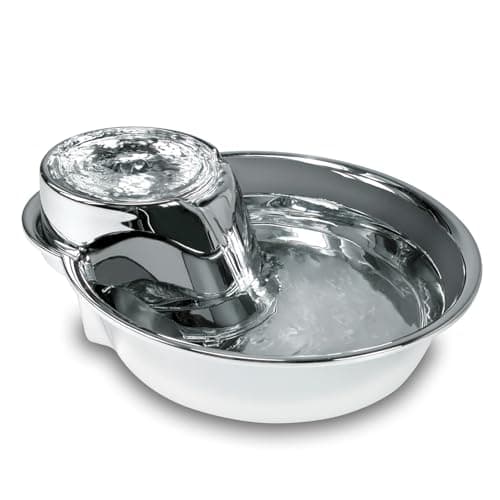
Pioneer Pet Big Max Stainless Steel Fountain
Pioneer Pet · Water fountain · Our score 7.9/10
#ad Price as of October 19, 2026. Prices move; we check daily. How we're funded.
18/8 stainless at 128 oz and dishwasher safe -- the stainless fountain Pioneer still actually sells, and the one with room for three or four cats.
Published specs
| Capacity | 128 oz (3.78 L) |
|---|---|
| Material | 18/8 stainless steel |
| Dimensions | Footprint 13.75" x 12"; height published as 2.75" by one retailer and 4.25" by another -- they disagree |
| Weight | Not published |
| Filter | Replaceable charcoal; part numbers #3002 (3-pack) and #3014 (4-pack) |
| Filter interval | Every 2-4 weeks (Pioneer Pet) |
| Cleaning | Dishwasher safe; maker says clean weekly and strip the pump monthly |
| Power | Corded, low voltage; wattage not published |
Pioneer Pet gives an interval rather than a fixed number: every 2 to 4 weeks. That is 13 filters a year at the slow end and 26 at the fast end -- a two-fold spread in running cost that depends entirely on how many cats are using it. Makers who quote a single interval are quoting the single-cat case. Pioneer also publishes a maintenance schedule most makers skip: clean the fountain weekly and take the pump apart monthly.
What the specs favor
- 18/8 stainless, which cannot scratch into a surface that holds biofilm
- 128 oz is genuine multi-cat capacity rather than a daily top-up
- Filter interval published as a range, which is more honest than a single number
- Dishwasher safe, and Pioneer publishes a weekly-clean and monthly-pump schedule
- Named filter part numbers, so the consumable is findable rather than proprietary-mystery
What they don't
- Retailers disagree about its height (2.75 in against 4.25 in), so drinking posture cannot be checked before it arrives
- No published pump wattage, so electricity cannot be costed
- No published weight
- 13.75 by 12 inch footprint is a lot of counter for a fountain
- The most expensive fountain on this site by a clear margin
You have one cat and a small kitchen. 128 oz and a 13.75 by 12 inch footprint is capacity you will not use, and a smaller stainless fountain does the same job in less space.
How it scores
Scores are our editorial weighting of the published specs above, not a test result. They are deliberately kept out of this page's structured data.
Dr. Catsby's Food Bowl for Whisker Relief
Dr. Catsby · Cat bowl · Our score 8.2/10
#ad No verified live price right now, so we show none rather than a stale one. How we're funded.
A single piece of stainless 7.08 inches across and only 1.25 inches deep -- the shallow-and-wide geometry the whisker-fatigue argument actually calls for.
Published specs
| Diameter | 7.08" |
|---|---|
| Depth | 1.25" |
| Weight | 14.1 oz |
| Capacity | Holds a 5 oz can of wet food |
| Material | Stainless steel, one piece |
| Included | Silicone non-slip mat for the base |
| Cleaning | Dishwasher safe |
Source: Amazon -- Dr. Catsby's Food Bowl for Whisker Relief listing
7.08 inches wide divided by 1.25 inches deep = 5.7. A typical deep ceramic cat dish is nearer 2:1. That ratio is the entire whisker-fatigue argument expressed as a number you can check on any bowl before buying -- and almost no listing publishes both figures.
What the specs favor
- Published width and depth, so the ratio above is checkable
- One piece of stainless -- nothing to scratch and harbor residue
- Silicone mat included rather than sold separately
- Dishwasher safe
What they don't
- 1.25 inches deep is shallow for a large dry-food portion
- Stainless is light enough that a determined cat can move it
- One bowl per cat gets expensive in a multi-cat house
You free-feed a big daily ration of dry food. A 1.25-inch dish is sized around a 5 oz can, not around a cup of kibble.
How it scores
Scores are our editorial weighting of the published specs above, not a test result. They are deliberately kept out of this page's structured data.
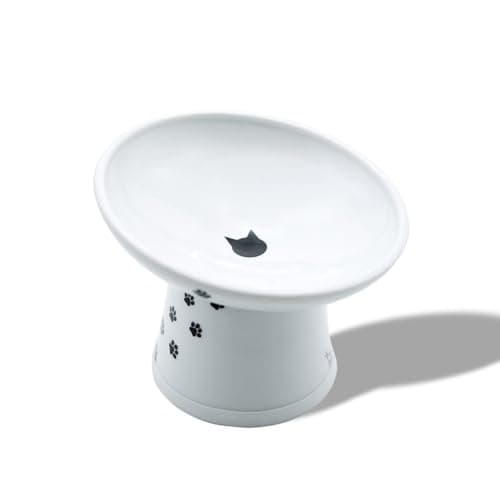
Necoichi Raised Cat Food Bowl
Necoichi · Cat bowl · Our score 8.3/10
#ad Price as of October 19, 2026. Prices move; we check daily. How we're funded.
Elevated porcelain on a 2.75-inch leg with a published lead-and-cadmium-free glaze -- the one bowl here that addresses neck posture as well as whisker clearance.
Published specs
| Extra-wide dimensions | 6.1" W x 4.13" L x 1.18" D |
|---|---|
| Leg height | 2.75" |
| Base width | 4.17" |
| Weight | 1.2 lb |
| Material | Porcelain, free from lead and cadmium |
| Cleaning | Dishwasher and microwave safe |
| Included | Removable non-slip silicone ring |
Source: Chewy -- Necoichi Extra Wide Raised Cat Food Bowl listing
1.2 lb of porcelain against 14.1 oz (0.88 lb) for the stainless Dr. Catsby, plus a wider 4.17-inch base. Roughly 36 percent more mass on a wider footprint is why a ceramic bowl stays where you put it and a light stainless one travels across the kitchen.
What the specs favor
- Raised 2.75 inches, which changes eating posture as well as whisker contact
- Published lead-free and cadmium-free porcelain
- Heaviest bowl here, on the widest base -- it does not slide
- Dishwasher and microwave safe
What they don't
- Porcelain chips if it is dropped; stainless does not
- 1.18 inches deep in the extra-wide version is shallow for dry food
- Costs more than a plain dish
Your cat is a kitten or has mobility problems that make reaching up awkward. Elevation helps some cats and is simply an obstacle for others.
How it scores
Scores are our editorial weighting of the published specs above, not a test result. They are deliberately kept out of this page's structured data.
Common questions
How many water bowls should a multi-cat house have?
Where should a cat's water bowl go?
Does wet food help with hydration?
What is the best water bowl for cats?
How do I know if my cat is drinking enough?
Sources
Read next
- Are Cat Water Fountains Worth It?
The fountain-versus-bowl trade laid out in a table, with the year-one running cost of doing it properly.
- Best Cat Water Fountains for Multiple Cats (2026)
Fountains ranked for households with more than one cat: capacity, 360-degree access, and what a year of filters costs each one.
- Ceramic vs Stainless vs Plastic Cat Fountains
Why the material debate is really about scratch resistance, and what that means for a fountain in a multi-cat house.
- Resource Competition Between Cats
How to recognize resource guarding, why it rarely looks like fighting, and the environmental changes that reduce it.
- What a Cat Water Fountain Actually Costs to Run
Electricity and filters costed from published adapter ratings and manufacturers' own filter prices, with every sum shown.
- Best Cat Cooling Mats (2026)
Gel and water cooling pads compared on published sizes and mechanism, with the water station that matters more in a heatwave.