Multi-Cat Households
Resource Competition Between Cats
Most of what gets called aggression is one cat controlling access to something. That is fixable with furniture.
Affiliate disclosure: we earn a commission if you buy through our links, at no extra cost to you. It never changes which product we rank first — here is how we're funded.
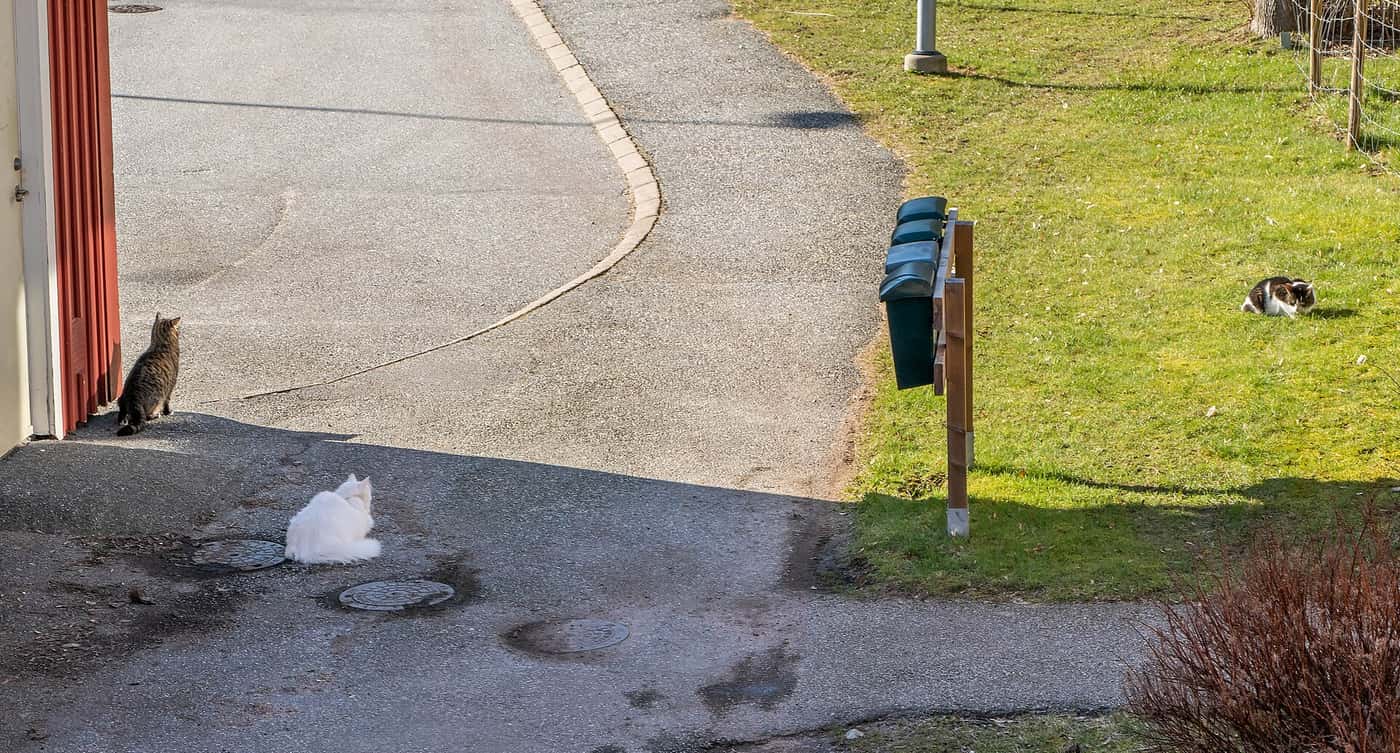
Everyone in this category says they tested twenty litter boxes. We have not tested any, and we say so. What we do instead: compile the published specs, read the manuals, and do the arithmetic on what this gear costs to run and how it behaves once there is more than one cat using it. Every spec is linked to the document it came from. Prices are checked daily — last verified October 19, 2026. Here is exactly how we pick.
What competition actually looks like
Almost never a fight. In most households resource competition is quiet enough that it goes unrecognized for months:
- One cat sits in a doorway while another wants to pass.
- A sustained stare as another cat approaches the food.
- One cat occupying the single high place, permanently, from mid-morning onwards.
- A cat waiting at the far end of a corridor and then walking away when the other retreats.
- One cat eating fast and then standing over the other’s bowl.
- Ambushes on stairs, which is a controlled bottleneck.
The household reads none of this as conflict, because nothing dramatic happens. What it notices is the consequence: a cat that has started toileting behind the sofa, or one that has stopped coming downstairs in the evening, or one that is losing weight.
Bottlenecks are the mechanism
Competition needs a chokepoint. Remove the chokepoints and there is nothing to control:
| Bottleneck | What it controls | Fix |
|---|---|---|
| One litter box, or all boxes in one room | Toileting | n+1 boxes in separate rooms and on every floor |
| One food bowl or one feeding spot | Eating | Separate stations, out of sight of each other |
| One water source | Drinking | Two or three stations in different rooms |
| One cat tree | The best resting place | More high places -- shelves, perches, a second tree |
| A narrow corridor or stairs | Movement | A second route where possible; vertical bypass with shelves |
| A single hiding place | Withdrawal | A box in every room |
The litter row follows the Cornell and Ohio State guidance. The others are our application of the same principle to other resource types, and are labeled as such.
The principle, in one line
Vertical space does the most
In our view the single highest-value change in a tense multi-cat house is adding vertical territory. It works because it changes the geometry of the house rather than the rules:
- A cat that can go up has somewhere to be that is not through another cat.
- High places let cats maintain distance in the same room, which is how cats share space when they have the option.
- Shelves can create a route over a bottleneck rather than through it.
- More separate resting places means fewer that are worth controlling.
Wall shelves are usually the practical answer because they add territory with no floor cost — the comparison against a tree is in cat tree versus wall shelves, and the fixing detail, which is the part that matters, is in mounting cat shelves safely.
Feeding is the easiest thing to fix today
Two bowls in two rooms, out of sight of each other, costs nothing and removes the most predictable daily flashpoint in the house. A scheduled feeder makes this worse rather than better if it dispenses into one bowl — it creates a high-value event at exactly the same time and place every day.
If one cat is on a prescription or weight-management diet, separation is not optional and no timer solves it. A microchip feeder is the only product type that does — see the multi-cat feeder picks.
When it is not competition
Two things to rule out before rearranging the house:
- Pain or illness. A cat that has suddenly become intolerant of another cat may be uncomfortable. This goes to a vet first.
- Under-stimulation. Bored cats redirect at each other, and what looks like a relationship problem can be a stimulation problem in disguise. See signs your cat is bored.
And if there is genuine fighting with injuries, that is beyond furniture and beyond us. Speak to your vet about a referral.
The gear discussed here
Specs are the manufacturer's own, linked to the page they came from. Prices come from a live daily check; where we have no verified price we say so rather than print a stale one.
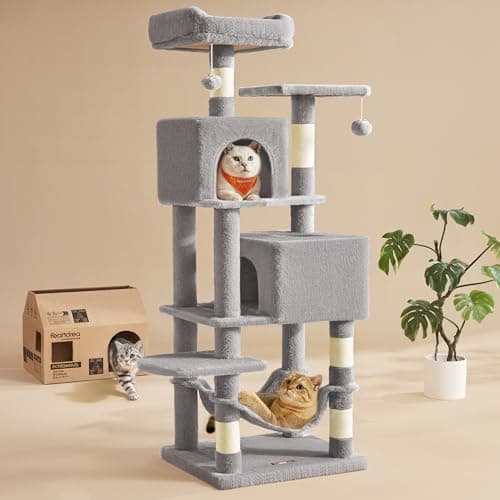
FEANDREA 67-inch Multi-Level Cat Tree
FEANDREA · Cat tree · Our score 8.6/10
#ad Price as of October 19, 2026. Prices move; we check daily. How we're funded.
The best base-to-height ratio of any tree here, and base-to-height is the only spec that predicts whether a tree rocks when a 15 lb cat lands on the top perch.
Published specs
| Dimensions | 24" L x 19.3" W x 67" H |
|---|---|
| Assembled weight | 57.5 lb |
| Materials | Particleboard, plush, sisal rope |
| Post diameter | 3.4" sisal-wrapped |
| Per-platform rating | Not published in the retail listing |
Source: Chewy -- FEANDREA 67-in Multi-Level Cat Tree listing
Our figure, not the maker's: shortest base dimension divided by height, multiplied by assembled weight. 19.3 / 67 = 0.288, x 57.5 lb = 16.5. The Yaheetech 72-inch scores 8.7 on the same sum and the Go Pet Club F2081 scores 15.9. Higher is harder to tip. Redo it yourself on any tree from two published numbers.
What the specs favor
- Heaviest tree here at 57.5 lb, and weight is what resists tipping
- Widest base relative to height of the three trees on this page
- 3.4-inch sisal posts are thick enough for a large cat to actually pull against
- Multiple platforms so two cats are not forced to share one
What they don't
- Particleboard, so it does not survive being moved often
- 57.5 lb is a two-person assembly
- FEANDREA does not publish a per-platform weight rating in the retail listing
You move house often or rearrange furniture. Particleboard trees come apart badly and go back together worse.
How it scores
Scores are our editorial weighting of the published specs above, not a test result. They are deliberately kept out of this page's structured data.
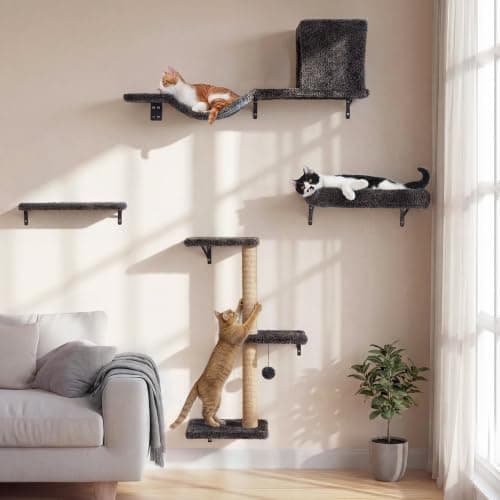
FUKUMARU 4-in-1 Cat Wall Shelves Set
FUKUMARU · Wall shelves · Our score 8.2/10
#ad Price as of October 19, 2026. Prices move; we check daily. How we're funded.
Rated to 40 lb per the maker and takes no floor at all -- the answer when a household needs more vertical territory than the room has square feet.
Published specs
| Weight rating | Up to 40 lb (18 kg), per FUKUMARU |
|---|---|
| Set | 4-in-1: shelves, perch, hammock elements |
| Material | Solid rubber wood |
| Mounting | Wall-mounted; fixings depend on your wall |
| Floor footprint | None |
Source: Chewy -- FUKUMARU 4-in-1 Wall Mounted Cat Wall Shelves Set listing
The Go Pet Club F2081 occupies 22 x 33 inches = 726 sq inches, just over 5 square feet. Wall shelves at the same height occupy none of it. In a one-bedroom flat that is the difference between having a cat tree and having a walkable room.
What the specs favor
- 40 lb published weight rating -- higher than most tree platforms
- Zero floor footprint
- Solid rubber wood rather than particleboard
- Height is limited by your wall, not by the product
What they don't
- Only as strong as what you screw it into -- studs, or nothing
- No good for a cat that cannot jump the gaps
- Wrong fixings in drywall is a serious failure mode
You rent and cannot drill, or you have a senior cat. Shelves demand a jump every time; a tree with stepped platforms does not.
How it scores
Scores are our editorial weighting of the published specs above, not a test result. They are deliberately kept out of this page's structured data.
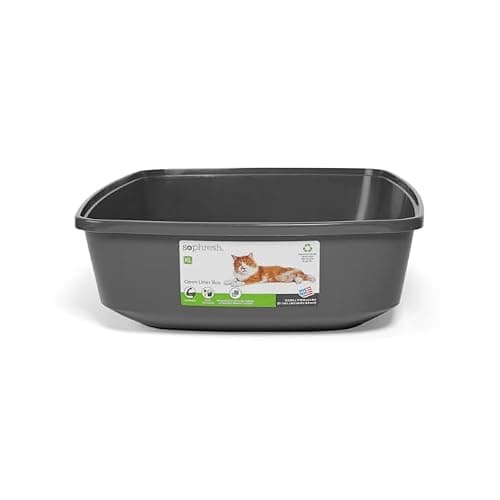
So Phresh Open Cat Litter Box, X-Large
So Phresh · Litter box · Our score 7.4/10
#ad Price as of October 19, 2026. Prices move; we check daily. How we're funded.
The plain plastic pan that lets you follow the one-box-per-cat-plus-one rule without spending like it -- 379 square inches of open floor for the price of a bag of litter.
Published specs
| External dimensions | 22.4" L x 16.9" W x 5.4" H |
|---|---|
| Wall height | 5.4" |
| Type | Open pan, no cover |
| Material | Plastic |
| Color | Charcoal |
| Litter type | Any |
| Published interior | Not published |
| Weight | Not published |
Cornell's guidance is one box more than you have cats. For three cats that is four boxes. The cheapest automatic box on this site is $269.99 -- four plain open pans is a fraction of one of those, and four boxes beat one clever one every time. At 22.4 x 16.9 inches each, four of these is 1,514 square inches of litter floor spread across four rooms, which is the thing a single automatic box cannot buy at any price.
What the specs favor
- Cheap enough to buy four without thinking about it
- 22.4 inches long, which is genuinely jumbo for a plain pan
- Open, uncovered, low -- the configuration cats prefer
- A 5.4 inch wall is an easy step for a kitten or an arthritic cat
- Nothing to break, nothing proprietary
What they don't
- A 5.4 inch wall will not contain a cat that sprays standing up, and it is lower than the 6.5 inch pans it replaces
- No scatter shield at all
- Thin plastic scratches, and scratched plastic holds odor
- No published interior dimension, so usable floor is smaller than the external figure
- No published weight
Odor or scatter is your actual complaint. This pan solves the count problem, not the containment problem -- pair it with a high-sided box rather than replacing one.
How it scores
Scores are our editorial weighting of the published specs above, not a test result. They are deliberately kept out of this page's structured data.
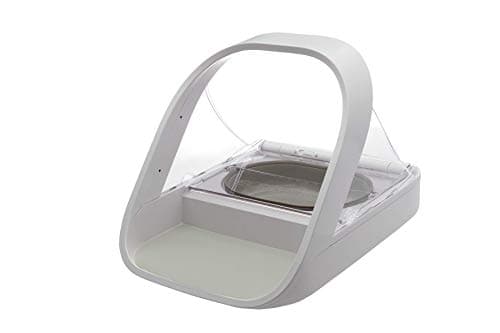
SureFeed Microchip Pet Feeder
Sure Petcare · Microchip feeder · Our score 8.5/10
#ad Price as of October 19, 2026. Prices move; we check daily. How we're funded.
The only feeder here that solves the actual multi-cat feeding problem, which is not portioning -- it is one cat eating another cat's food.
Published specs
| Bowl capacity | 400 ml, or two pouches of wet food |
|---|---|
| Pets stored | Up to 32 identities |
| Food types | Wet and dry |
| Power | 4 x C cells, 6-month stated battery life |
| Warranty | 3 years from date of purchase |
| Opens for | Registered microchips or a collar tag |
Source: Sure Petcare -- SureFeed Microchip Pet Feeder product page
Sure Petcare states 6 months from a set of 4 C cells, so 8 cells a year per feeder. In a three-cat house you need one feeder per cat on a controlled diet -- 24 cells a year for three. That is the running cost nobody mentions.
What the specs favor
- Stores up to 32 pet identities -- more than any household needs
- Works with an existing microchip, no new collar required
- Takes wet food, which almost no automatic feeder does
- Three-year warranty, the longest here
What they don't
- Battery only -- 8 C cells a year, per feeder
- One feeder feeds one cat, so a three-cat house needs three
- 400 ml bowl is a meal, not a hopper -- it does not solve holidays
Your problem is being out all day rather than food stealing. This is a lid that opens for the right cat, not a scheduled dispenser -- it will not feed anyone at 6pm on its own.
How it scores
Scores are our editorial weighting of the published specs above, not a test result. They are deliberately kept out of this page's structured data.
Common questions
What is resource guarding in cats?
Why is one of my cats blocking the other?
How do I stop my cats fighting over food?
Do cats need their own space?
Should I get a behaviorist for cat conflict?
Sources
Read next
- Best Cat Calming Diffusers (2026)
Pheromone diffusers compared on published coverage and refill intervals, with the environmental fixes that come first.
- The Multi-Cat Household Guide
The pillar guide: resource counts by household size, why separation beats quantity, and the order to fix things in.
- Litter Setup for Multiple Cats
Box counts, room-by-room placement, which box types to mix and why, for households with two or more cats.
- Best Cat Trees for Multiple Cats (2026)
Trees ranked on a stability index computed from published base, height and weight, with vertical alternatives for homes short on floor.
- Best Automatic Cat Feeders for Multiple Cats (2026)
Ranked on whether a feeder can actually separate two cats' food, plus the battery and hopper arithmetic nobody publishes.
- How to Stop Cats Fighting Over Food
Why side-by-side bowls create conflict, the separation rules that fix most of it, and how to find out who is actually stealing from whom.