Cat Trees, Shelves & Perches
Mounting Cat Shelves Safely
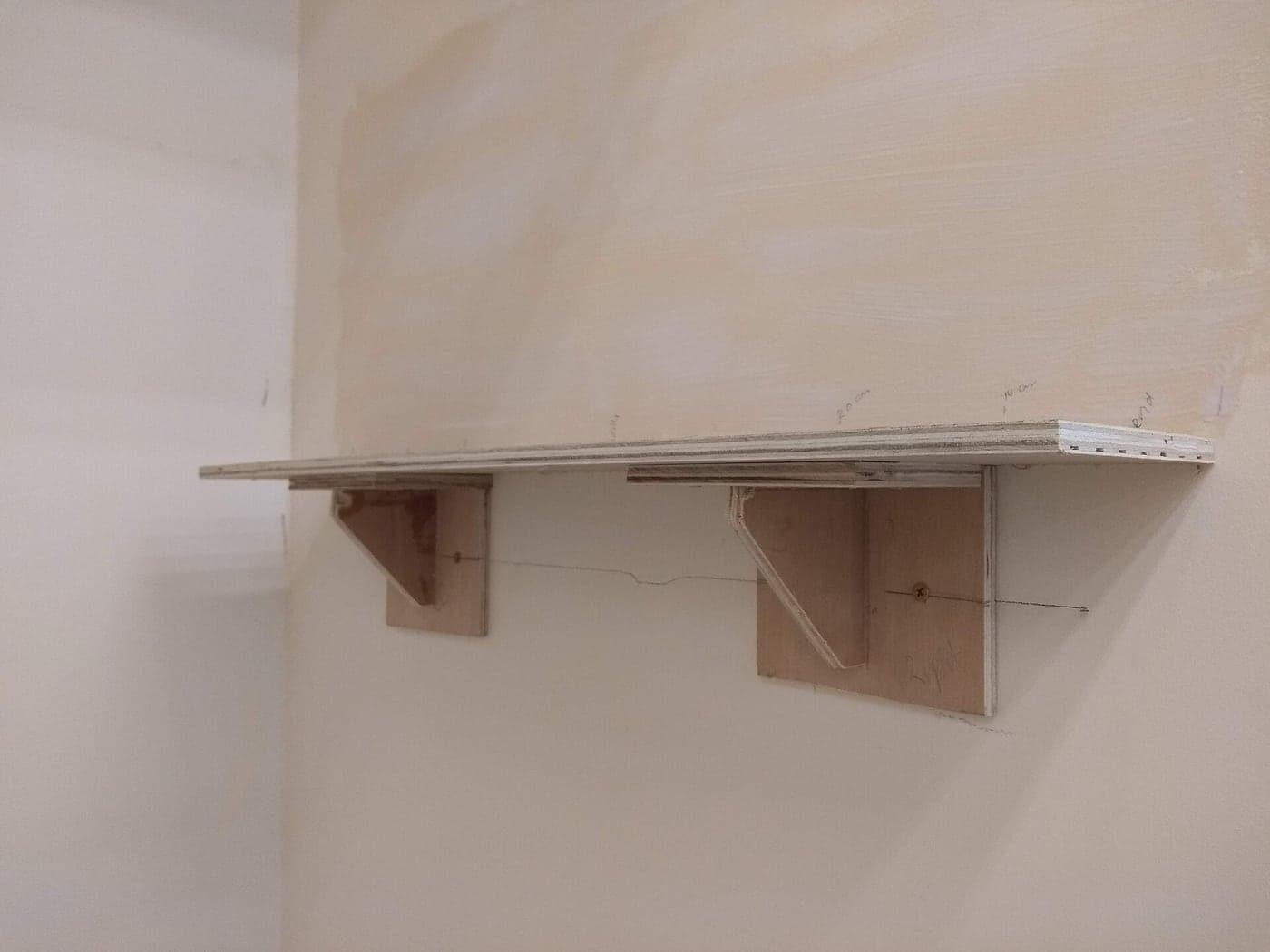
A shelf rated to 40 pounds screwed into plasterboard is not a 40-pound shelf. The fixing is the whole product.
Affiliate disclosure: we earn a commission if you buy through our links, at no extra cost to you. It never changes which product we rank first — here is how we're funded.
Everyone in this category says they tested twenty litter boxes. We have not tested any, and we say so. What we do instead: compile the published specs, read the manuals, and do the arithmetic on what this gear costs to run and how it behaves once there is more than one cat using it. Every spec is linked to the document it came from. Prices are checked daily — last verified October 19, 2026. Here is exactly how we pick.
Every cat shelf on the market is stronger than the wall you are about to attach it to. FUKUMARU publishes a 40 lb rating on its sets; the plastic plug in a sheet of plasterboard holding it up is not rated for anything like that. The shelf is not the product. The fixing is.
Find the stud, always
A screw into a timber stud is doing something completely different from a screw into plasterboard. The stud carries load through the structure of the wall; the plasterboard is a sheet of compressed gypsum that crumbles under a sustained pull.
- Use a stud detector, then confirm by tapping — the sound changes from hollow to solid.
- Mark the center, not the edge. A screw at the edge of a stud has a fraction of the grip.
- Studs are usually regularly spaced, so once you have found one you can predict the next. Confirm each one rather than assuming.
- Design the run around the studs rather than deciding the layout first and hoping. This is the step people skip.
If there is genuinely no stud
Use a heavy-duty toggle-type anchor rated well above the load, not the small plastic expanding plugs supplied in most flat-pack boxes. Those plugs are sized for a picture frame.
And derate hard. A cat does not apply a static load — it lands, which is a shock load several times its body weight, repeatedly, for years. Choose fixings with a lot of margin over your cat’s weight, and treat the published shelf rating as an upper bound you will never approach rather than a target.
Geometry: build a staircase, not a ladder
| Young, agile cat | Older or heavy cat | |
|---|---|---|
| Rise between levels | Can be generous | Short -- step, do not leap |
| Horizontal overlap | Optional | Generous, so the cat can see the next step |
| Starting point | Floor is fine | From furniture the cat already uses |
| Escape route | Two ways off each shelf | Two ways off each shelf |
| Surface | Smooth acceptable | Grippy -- carpet pad or sisal |
These are design principles rather than published specifications. The consistent one across both columns is two ways off every shelf.
The two-exits rule matters more than it sounds in a multi-cat house. A shelf with one approach is a dead end, and a cat cornered on a dead-end shelf by another cat has nowhere to go. Design the run as a loop or a traverse, not as a series of cul-de-sacs.
Depth and surface
A shelf a cat can only perch on gets used for a minute. A shelf a cat can turn around and lie down on becomes a place it sleeps. Check individual piece dimensions on the listing against your cat’s body length rather than buying on the total number of pieces in the set.
On surface: bare varnished wood is slippery, and a cat that has slipped once on a landing is reluctant to repeat it. A carpet pad, a stuck-down offcut, or sisal on the landing shelves solves it. Note the trade-off from carpet versus sisal: carpet is right on horizontal landing surfaces and wrong on vertical scratching ones.
Test it before the cat does
- Hang your own weight off each shelf — carefully, and expecting it to hold. If it moves at all, stop and fix the fixing.
- Push each shelf up as well as down. Cats jump off, which loads a shelf upward at the front edge.
- Re-check every fixing after a month of real use, then annually.
- Watch the first few climbs. Where a cat hesitates is where the spacing is wrong, and it is far easier to move a shelf in week one than in year two.
If you cannot drill
A suction window perch is the honest alternative: the K&H EZ Mount publishes a 50 lb suction rating, mounts in five minutes and leaves nothing behind. It is one high spot rather than a run, but a window is the single most valuable vertical position in most homes anyway, and it costs a fraction of a shelf set. The comparison against a full tree is in cat tree versus wall shelves.
The gear discussed here
Specs are the manufacturer's own, linked to the page they came from. Prices come from a live daily check; where we have no verified price we say so rather than print a stale one.
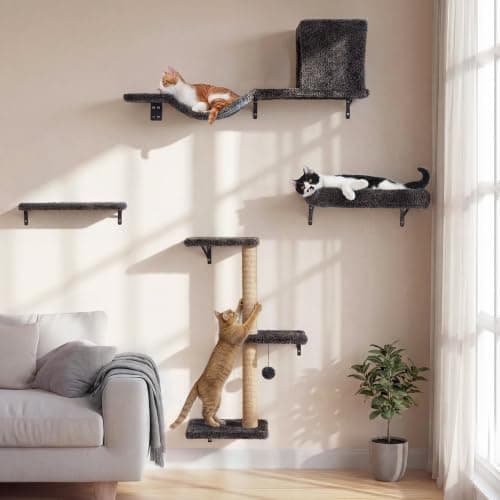
FUKUMARU 4-in-1 Cat Wall Shelves Set
FUKUMARU · Wall shelves · Our score 8.2/10
#ad Price as of October 19, 2026. Prices move; we check daily. How we're funded.
Rated to 40 lb per the maker and takes no floor at all -- the answer when a household needs more vertical territory than the room has square feet.
Published specs
| Weight rating | Up to 40 lb (18 kg), per FUKUMARU |
|---|---|
| Set | 4-in-1: shelves, perch, hammock elements |
| Material | Solid rubber wood |
| Mounting | Wall-mounted; fixings depend on your wall |
| Floor footprint | None |
Source: Chewy -- FUKUMARU 4-in-1 Wall Mounted Cat Wall Shelves Set listing
The Go Pet Club F2081 occupies 22 x 33 inches = 726 sq inches, just over 5 square feet. Wall shelves at the same height occupy none of it. In a one-bedroom flat that is the difference between having a cat tree and having a walkable room.
What the specs favor
- 40 lb published weight rating -- higher than most tree platforms
- Zero floor footprint
- Solid rubber wood rather than particleboard
- Height is limited by your wall, not by the product
What they don't
- Only as strong as what you screw it into -- studs, or nothing
- No good for a cat that cannot jump the gaps
- Wrong fixings in drywall is a serious failure mode
You rent and cannot drill, or you have a senior cat. Shelves demand a jump every time; a tree with stepped platforms does not.
How it scores
Scores are our editorial weighting of the published specs above, not a test result. They are deliberately kept out of this page's structured data.
K&H EZ Mount Window Perch
K&H Pet Products · Window perch · Our score 7.5/10
#ad No verified live price right now, so we show none rather than a stale one. How we're funded.
Suction cups rated to 50 lb and 27 inches of ledge -- the cheapest square foot of territory you can add to a multi-cat house.
Published specs
| Dimensions | 27" L x 11" W x 6" H |
|---|---|
| Suction cup rating | Up to 50 lb, per K&H |
| Mounting | Suction to glass or a smooth door |
| Floor footprint | None |
Source: Amazon -- K&H Pet Products EZ Mount Cat Window Perch listing
27 inches of ledge split two ways is 13.5 inches each -- less than a cat's body length. Two cats will not share this; in a multi-cat house it is one perch per window, not one perch for the household.
What the specs favor
- 50 lb published suction rating, well beyond any cat's weight
- No drilling, so it works in a rental
- Puts a cat at a window, which is the enrichment that costs nothing to run
- Moves to another window in five minutes
What they don't
- Suction fails on textured, dirty or very cold glass
- 27 inches is a one-cat ledge
- No good on a window with a deep recessed frame
Your two cats already compete over resting spots. One perch at one window is a new thing to compete over, not a solution -- buy two, at two windows.
How it scores
Scores are our editorial weighting of the published specs above, not a test result. They are deliberately kept out of this page's structured data.
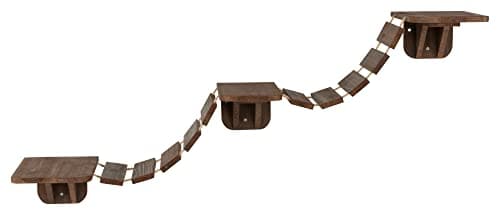
TRIXIE Lounger Wall-Mounted Cat Shelves
TRIXIE · Wall shelves · Our score 7.0/10
#ad Price as of October 19, 2026. Prices move; we check daily. How we're funded.
Two steps, a hammock and a covered condo sold as one set, so the staircase geometry is designed rather than improvised -- but the published 12 lb rating rules out a lot of cats.
Published specs
| Weight rating | Up to 12 lb (TRIXIE) |
|---|---|
| Set contents | 2 steps, hammock, plush-lined condo |
| Condo cushion | Removable |
| Mounting | Wall-mounted; fixings depend on your wall |
| Floor footprint | None |
Source: Chewy -- TRIXIE Lounger Wall Mounted Cat Shelves listing
TRIXIE publishes 12 lb. FUKUMARU publishes up to 40 lb for its sets. Both are honest numbers and they buy different things: TRIXIE sells you a designed route with a condo at the top, FUKUMARU sells you headroom. For a cat over 12 lb the arithmetic makes the choice for you.
What the specs favor
- Publishes a weight rating at all, which many shelf sets do not
- Steps, hammock and condo designed as one route rather than assembled by guesswork
- Removable, washable condo cushion
- No floor footprint
What they don't
- 12 lb published rating excludes many adult cats and every large breed
- Plush surfaces on a wall are harder to clean than wood
- Still only as strong as the fixing behind it
Your cat weighs more than 12 lb. That is the maker's own published figure, and it is the whole decision -- go to a set rated higher.
How it scores
Scores are our editorial weighting of the published specs above, not a test result. They are deliberately kept out of this page's structured data.
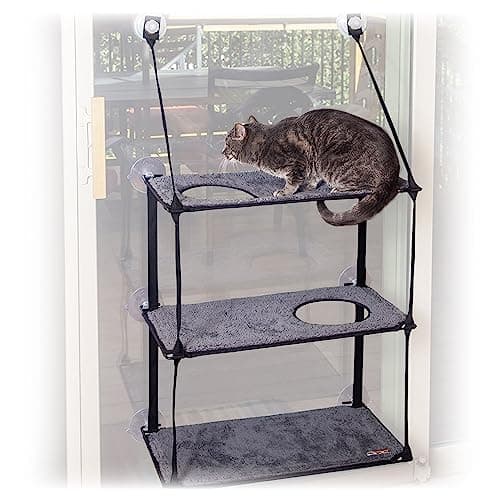
K&H EZ Mount Double Stack Window Perch
K&H Pet Products · Window perch · Our score 8.1/10
#ad Price as of October 19, 2026. Prices move; we check daily. How we're funded.
Two 23 by 12 inch levels on the same 50 lb suction rating -- the answer to the single-ledge problem that makes one perch a thing for two cats to argue over.
Published specs
| Levels | Two, each 23 x 12 in fleece |
|---|---|
| Dimensions | 12 x 23 x 1.75 in |
| Suction rating | Up to 50 lb (K&H) |
| Weight | 3.8 lb |
| Glass needed | 27" W x 31" H or larger |
| Frame | Steel |
| Covers | Two washable shelf covers |
Source: K&H Pet Products -- EZ Mount Window Kitty Sill Double Stack product page
The single-level EZ Mount gives 27 inches split two ways -- 13.5 inches each, less than a cat's body length, so in practice one cat gets it. The double stack gives each cat a full 23-inch level at a different height, which is how cats share space when they have the option.
What the specs favor
- Two separate levels at different heights, not one shared ledge
- Same published 50 lb suction rating as the single
- Steel frame rather than plastic
- Both covers are washable, which matters where cats sleep
What they don't
- Needs a large window -- 27" x 31" of glass minimum
- Suction fails on textured, dirty or very cold glass
- 3.8 lb hanging off suction cups is a lot of trust
Your windows are small or heavily framed. The published glass requirement is a hard constraint, and a perch that will not fit is not a perch.
How it scores
Scores are our editorial weighting of the published specs above, not a test result. They are deliberately kept out of this page's structured data.
Common questions
What anchors do you use for cat shelves?
How deep should cat shelves be?
How far apart should cat shelves be?
How much weight can a cat shelf hold?
Can I put cat shelves up without drilling?
Sources
Read next
- Cat Tree vs Wall Shelves
Floor cost, published ratings and access compared, with a clear recommendation for small flats and for older cats.
- Best Cat Trees (2026)
The whole vertical category ranked together -- trees, wall shelves and window perches -- on the specs each maker publishes.
- How to Tell if a Cat Tree Is Stable (Before You Buy)
The stability index explained: how to compute it in a shop, what the numbers mean, and when to wall-anchor regardless.
- Where to Put a Cat Tree
Windows, sightlines, escape routes and traffic -- how to place a tree so it actually gets used, in a house with more than one cat.
- The Multi-Cat Household Guide
The pillar guide: resource counts by household size, why separation beats quantity, and the order to fix things in.