Cat Trees, Shelves & Perches
How to Tell if a Cat Tree Is Stable (Before You Buy)
Three numbers on the listing tell you most of what you need. Here is the sum, and here is what the answers mean.
Affiliate disclosure: we earn a commission if you buy through our links, at no extra cost to you. It never changes which product we rank first — here is how we're funded.
Everyone in this category says they tested twenty litter boxes. We have not tested any, and we say so. What we do instead: compile the published specs, read the manuals, and do the arithmetic on what this gear costs to run and how it behaves once there is more than one cat using it. Every spec is linked to the document it came from. Prices are checked daily — last verified October 19, 2026. Here is exactly how we pick.
There is no published tip-resistance figure for cat trees, no standard test, and no independent lab doing this work. What there is, on every listing, are three numbers — base dimensions, height, assembled weight — and those three tell you most of what you need.
The sum
The reasoning: a tree tips when the load moves outside the base. How far the base extends relative to the height governs how much of a lean it takes to get there, and how heavy the tree is governs how much force it takes to move it at all. Multiplying the two combines both effects into one comparable number.
What the bands mean
| Index | Reading | What to do |
|---|---|---|
| Above 15 | Wide-based and heavy for its height | Buy with confidence |
| 10-15 | Acceptable for an average cat | Fine; anchor if you have a large or very active cat |
| Below 10 | Tall, narrow or light | Wall-anchor, or choose differently |
| No published weight | Cannot be assessed | Treat as below 10 until proven otherwise |
Bands are ours, calibrated against the products we have compared. They are a rule of thumb for shopping, not a safety standard.
What the index cannot see
- Where the mass sits. A tree with a heavy base and light top is far more stable than the same weight distributed evenly. The index cannot tell the difference.
- Joint rigidity. A tree that flexes at the joints feels unstable even when it will not tip, and cats respond to the feel.
- Cantilevered platforms. A perch sticking well out from the column concentrates load at the worst possible place.
- Floor surface. A tree on deep pile carpet has a compliant, uneven base. Hard floors are better for stability, worse for noise.
Checking a tree you can touch
- Push the top platform sideways with about the force a cat landing would apply. It should barely move.
- Look at where the column meets the base. A single bolt through particleboard is the standard failure point.
- Check the platform sizes, not just the count. A large cat needs to lie down, not perch.
- Press a post. If it flexes under hand pressure it will flex under a bracing cat, and a flexing post gets abandoned.
After it is built
Flat-pack trees loosen. Bolts through particleboard bed in over the first few weeks of real use, and a tree that felt solid on day one can develop a noticeable wobble by week three. Re-tighten everything after a fortnight and again after a couple of months, then annually. That single habit fixes most “my cat tree has gone wobbly” problems without buying anything.
If the geometry is the problem rather than the fixings, anchor it. The same rules about finding a stud that apply to shelves apply here — mounting cat shelves safely covers the fixings in detail, and they are the part that fails.
The gear discussed here
Specs are the manufacturer's own, linked to the page they came from. Prices come from a live daily check; where we have no verified price we say so rather than print a stale one.
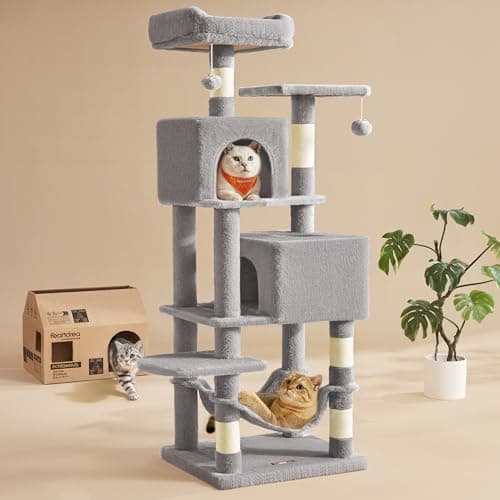
FEANDREA 67-inch Multi-Level Cat Tree
FEANDREA · Cat tree · Our score 8.6/10
#ad Price as of October 19, 2026. Prices move; we check daily. How we're funded.
The best base-to-height ratio of any tree here, and base-to-height is the only spec that predicts whether a tree rocks when a 15 lb cat lands on the top perch.
Published specs
| Dimensions | 24" L x 19.3" W x 67" H |
|---|---|
| Assembled weight | 57.5 lb |
| Materials | Particleboard, plush, sisal rope |
| Post diameter | 3.4" sisal-wrapped |
| Per-platform rating | Not published in the retail listing |
Source: Chewy -- FEANDREA 67-in Multi-Level Cat Tree listing
Our figure, not the maker's: shortest base dimension divided by height, multiplied by assembled weight. 19.3 / 67 = 0.288, x 57.5 lb = 16.5. The Yaheetech 72-inch scores 8.7 on the same sum and the Go Pet Club F2081 scores 15.9. Higher is harder to tip. Redo it yourself on any tree from two published numbers.
What the specs favor
- Heaviest tree here at 57.5 lb, and weight is what resists tipping
- Widest base relative to height of the three trees on this page
- 3.4-inch sisal posts are thick enough for a large cat to actually pull against
- Multiple platforms so two cats are not forced to share one
What they don't
- Particleboard, so it does not survive being moved often
- 57.5 lb is a two-person assembly
- FEANDREA does not publish a per-platform weight rating in the retail listing
You move house often or rearrange furniture. Particleboard trees come apart badly and go back together worse.
How it scores
Scores are our editorial weighting of the published specs above, not a test result. They are deliberately kept out of this page's structured data.
Go Pet Club 72-inch Cat Tree (F2081)
Go Pet Club · Cat tree · Our score 8.3/10
#ad Price as of October 19, 2026. Prices move; we check daily. How we're funded.
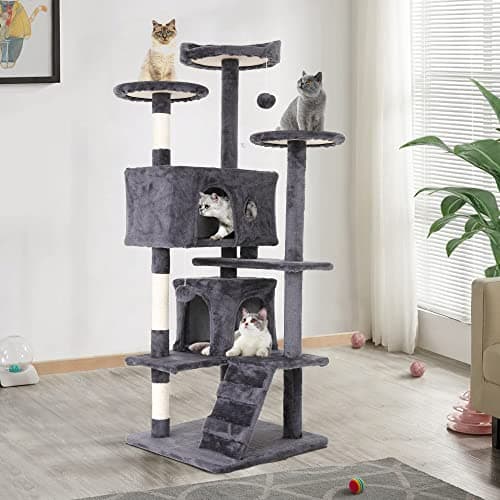
72 inches on a 22 by 33 inch base at 52 lb -- the only tree here that gets full height without giving up the footprint that keeps it upright.
Published specs
| Dimensions | 22" x 33" x 72" |
|---|---|
| Assembled weight | 52 lb |
| Materials | Compressed wood, faux fur, sisal posts |
| Per-platform rating | Not published |
Source: Amazon -- Go Pet Club 72-inch Cat Tree F2081 listing
Shortest base dimension 22 / 72 = 0.306, x 52 lb = 15.9. Nearly the FEANDREA's 16.5 but 5 inches taller, which is the trade a household with a climber wants. The Yaheetech at the same height scores 8.7.
What the specs favor
- Full 72 inches with a 22 x 33 inch base -- the rare combination
- 52 lb assembled, heavy enough to resist a hard landing
- Multiple condos and perches for a multi-cat house
What they don't
- 33 inches across is a lot of floor
- No published per-platform weight rating
- Compressed wood, so it is a one-location purchase
You live in a small flat. This is 5 square feet of floor before a cat sets foot on it -- wall shelves do the same job with none of the footprint.
How it scores
Scores are our editorial weighting of the published specs above, not a test result. They are deliberately kept out of this page's structured data.
Yaheetech 72-inch Cat Tree Tower
Yaheetech · Cat tree · Our score 6.8/10
#ad Price as of October 19, 2026. Prices move; we check daily. How we're funded.
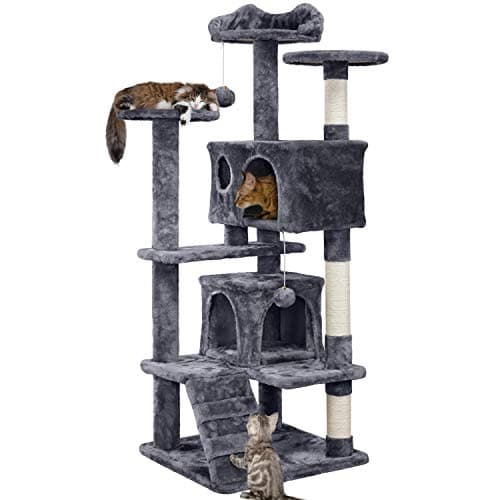
One of the very few trees whose maker publishes a per-platform weight limit -- 11 lb on a platform, 22 lb in a condo. Read those numbers before you buy for a big cat.
Published specs
| Dimensions | 19" L x 19" W x 72" H |
|---|---|
| Top platform | 13.6" x 12" |
| Condo rating | 22 lb (10 kg) |
| Platform rating | 11 lb (5 kg) |
| Assembled weight | 33.1 lb |
Source: Yaheetech -- 72-inch Height Cat Tree Tower product page
19 / 72 = 0.264, x 33.1 lb = 8.7 -- about half the FEANDREA's 16.5 on the same sum. Taller, narrower and 24 lb lighter is the worst combination for tipping. If you buy this one, wall-anchor it.
What the specs favor
- Publishes per-platform and per-condo weight ratings, which almost no maker does
- 72 inches of height in a 19-inch square footprint
- Fits a corner where a wider tree will not
What they don't
- Stability index of 8.7 -- the least stable tree on this page by our own sum
- 11 lb platform rating rules it out for most large breeds
- Top platform is only 13.6 x 12 inches
Your cat is over 11 lb. Yaheetech's own published platform rating is 11 lb, and a 16 lb Maine Coon on an 11 lb platform is the maker telling you not to.
How it scores
Scores are our editorial weighting of the published specs above, not a test result. They are deliberately kept out of this page's structured data.
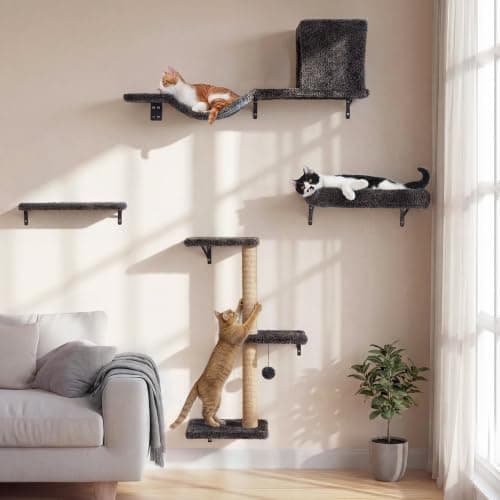
FUKUMARU 4-in-1 Cat Wall Shelves Set
FUKUMARU · Wall shelves · Our score 8.2/10
#ad Price as of October 19, 2026. Prices move; we check daily. How we're funded.
Rated to 40 lb per the maker and takes no floor at all -- the answer when a household needs more vertical territory than the room has square feet.
Published specs
| Weight rating | Up to 40 lb (18 kg), per FUKUMARU |
|---|---|
| Set | 4-in-1: shelves, perch, hammock elements |
| Material | Solid rubber wood |
| Mounting | Wall-mounted; fixings depend on your wall |
| Floor footprint | None |
Source: Chewy -- FUKUMARU 4-in-1 Wall Mounted Cat Wall Shelves Set listing
The Go Pet Club F2081 occupies 22 x 33 inches = 726 sq inches, just over 5 square feet. Wall shelves at the same height occupy none of it. In a one-bedroom flat that is the difference between having a cat tree and having a walkable room.
What the specs favor
- 40 lb published weight rating -- higher than most tree platforms
- Zero floor footprint
- Solid rubber wood rather than particleboard
- Height is limited by your wall, not by the product
What they don't
- Only as strong as what you screw it into -- studs, or nothing
- No good for a cat that cannot jump the gaps
- Wrong fixings in drywall is a serious failure mode
You rent and cannot drill, or you have a senior cat. Shelves demand a jump every time; a tree with stepped platforms does not.
How it scores
Scores are our editorial weighting of the published specs above, not a test result. They are deliberately kept out of this page's structured data.
Common questions
How do I know if a cat tree is sturdy?
Why does my cat tree wobble?
Should I bolt a cat tree to the wall?
Does a heavier cat tree mean a better cat tree?
Is a cat tree with a wide base always better?
Sources
Read next
- Best Cat Trees (2026)
The whole vertical category ranked together -- trees, wall shelves and window perches -- on the specs each maker publishes.
- Best Cat Trees for Large Cats (2026)
Trees filtered on published weight ratings and platform dimensions for Maine Coons, Ragdolls and other large breeds.
- Mounting Cat Shelves Safely
Studs, anchors, shelf depth and rise spacing -- the practical detail that decides whether a shelf run is safe and whether an old cat will use it.
- Best Cat Trees for Multiple Cats (2026)
Trees ranked on a stability index computed from published base, height and weight, with vertical alternatives for homes short on floor.
- How we pick
The published method that replaces a testing claim.
- How to Choose a Cat Tree
The five published numbers that decide a cat tree, in the order to check them, with our stability index worked on three real towers.
- How Tall Should a Cat Tree Be?
Height chosen against the rise between levels, the ceiling, and our stability index -- with the arithmetic for two 6-foot towers that score very differently.