Cat Trees, Shelves & Perches
How Tall Should a Cat Tree Be?
Every extra inch of height is sold as a benefit. It is also a cost, paid in stability and in whether an older cat can still get to the top.
Affiliate disclosure: we earn a commission if you buy through our links, at no extra cost to you. It never changes which product we rank first — here is how we're funded.
Everyone in this category says they tested twenty litter boxes. We have not tested any, and we say so. What we do instead: compile the published specs, read the manuals, and do the arithmetic on what this gear costs to run and how it behaves once there is more than one cat using it. Every spec is linked to the document it came from. Prices are checked daily — last verified September 27, 2026. Here is exactly how we pick.
Height is the specification that sells cat trees and the one most likely to be wrong for your cat. Two numbers decide it, and neither of them is the advertised height.
The two numbers that matter
- The rise between levels. A cat gets to the top by stepping, not by teleporting. If the gaps are too big, the top platform is decoration.
- Stability at that height. A tree that shifts when a cat lands teaches the cat not to use it, and no amount of height fixes that.
Two six-foot towers, two different objects
| Product | Base | Height | Assembled weight | Published ratings |
|---|---|---|---|---|
| Yaheetech 72-inch | 19" x 19" | 72" | 33.1 lb | 22 lb condo; 11 lb platform |
| FEANDREA 67-inch | 24" x 19.3" | 67" | 57.5 lb | Per-platform rating not published |
| TRIXIE Santander pole | 15.5" x 15.5" | 96.25" to 108.25" | Not published | Ceiling tension, no screws |
Manufacturers' published figures. Yaheetech is unusual in publishing per-platform ratings at all.
What an extra five inches costs
Yaheetech 72: 19 / 72 x 33.1 lb = 8.7.
FEANDREA 67: 19.3 / 67 x 57.5 lb = 16.6.
Five inches shorter, a base barely wider — and nearly twice the index, because it weighs 24 lb more. Weight is doing most of the work here, which is why “how tall” cannot be answered without asking “on what base, at what weight”.
Anything under about 10 on this index is a tree we would anchor to the wall before letting a cat use the top of it.
Match the height to the cat
- Kitten: lower, with closely spaced levels and a soft landing. Our kitten tree page covers the sizing that still works when the kitten is grown.
- Adult, confident, small home: go tall and narrow. This is where a 72 inch tower or a tension pole earns its footprint.
- Large or heavy cat: prioritize published platform ratings and base width over height. Our large cat page filters on exactly those figures.
- Senior: shorter with more steps, or a ramp. Height the cat cannot reach is not height it owns.
- Several cats: more platforms at more heights beats one very tall platform, because the point is that two cats can be up at once without negotiating.
When to stop buying height and buy a pole
Past about 70 inches, freestanding towers start needing wide bases and serious weight to stay honest, and both of those eat the floor space you were trying to save. A floor-to-ceiling tension pole sidesteps the problem: the TRIXIE Santander publishes an adjustable range of 96.25 to 108.25 inches on a 15.5 inch square footprint, fixed by spring pressure against the ceiling rather than by mass.
The trade is that a pole depends on a solid ceiling and on you re-checking the tension. Our pole roundup covers that category, and where to put a cat tree matters more than any of this once you have chosen — a tall tree in a dead corner gets used less than a short one at a window.
Read the guide
Our how to choose a cat tree guide runs the full five-number check in order, and the stability guide shows how the index on this page is built and where it stops being useful.
The gear discussed here
Specs are the manufacturer's own, linked to the page they came from. Prices come from a live daily check; where we have no verified price we say so rather than print a stale one.
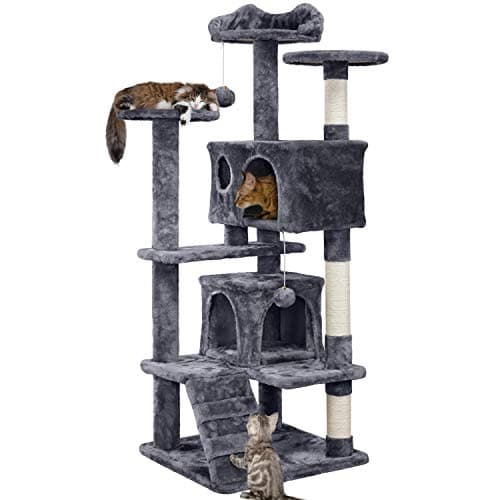
Yaheetech 72-inch Cat Tree Tower
Yaheetech · Cat tree · Our score 6.8/10
#ad Price as of September 27, 2026. Prices move; we check daily. How we're funded.
One of the very few trees whose maker publishes a per-platform weight limit -- 11 lb on a platform, 22 lb in a condo. Read those numbers before you buy for a big cat.
Published specs
| Dimensions | 19" L x 19" W x 72" H |
|---|---|
| Top platform | 13.6" x 12" |
| Condo rating | 22 lb (10 kg) |
| Platform rating | 11 lb (5 kg) |
| Assembled weight | 33.1 lb |
Source: Yaheetech -- 72-inch Height Cat Tree Tower product page
19 / 72 = 0.264, x 33.1 lb = 8.7 -- about half the FEANDREA's 16.5 on the same sum. Taller, narrower and 24 lb lighter is the worst combination for tipping. If you buy this one, wall-anchor it.
What the specs favor
- Publishes per-platform and per-condo weight ratings, which almost no maker does
- 72 inches of height in a 19-inch square footprint
- Fits a corner where a wider tree will not
What they don't
- Stability index of 8.7 -- the least stable tree on this page by our own sum
- 11 lb platform rating rules it out for most large breeds
- Top platform is only 13.6 x 12 inches
Your cat is over 11 lb. Yaheetech's own published platform rating is 11 lb, and a 16 lb Maine Coon on an 11 lb platform is the maker telling you not to.
How it scores
Scores are our editorial weighting of the published specs above, not a test result. They are deliberately kept out of this page's structured data.
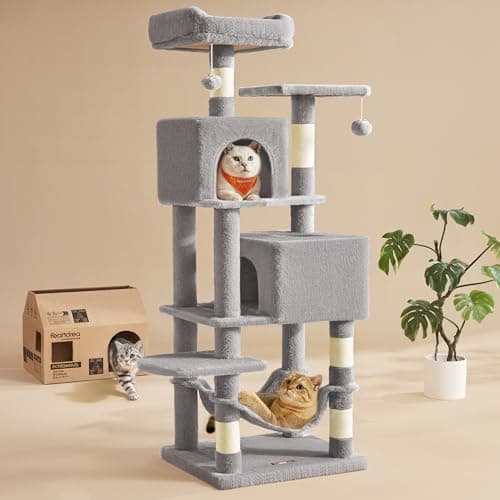
FEANDREA 67-inch Multi-Level Cat Tree
FEANDREA · Cat tree · Our score 8.6/10
#ad Price as of September 27, 2026. Prices move; we check daily. How we're funded.
The best base-to-height ratio of any tree here, and base-to-height is the only spec that predicts whether a tree rocks when a 15 lb cat lands on the top perch.
Published specs
| Dimensions | 24" L x 19.3" W x 67" H |
|---|---|
| Assembled weight | 57.5 lb |
| Materials | Particleboard, plush, sisal rope |
| Post diameter | 3.4" sisal-wrapped |
| Per-platform rating | Not published in the retail listing |
Source: Chewy -- FEANDREA 67-in Multi-Level Cat Tree listing
Our figure, not the maker's: shortest base dimension divided by height, multiplied by assembled weight. 19.3 / 67 = 0.288, x 57.5 lb = 16.5. The Yaheetech 72-inch scores 8.7 on the same sum and the Go Pet Club F2081 scores 15.9. Higher is harder to tip. Redo it yourself on any tree from two published numbers.
What the specs favor
- Heaviest tree here at 57.5 lb, and weight is what resists tipping
- Widest base relative to height of the three trees on this page
- 3.4-inch sisal posts are thick enough for a large cat to actually pull against
- Multiple platforms so two cats are not forced to share one
What they don't
- Particleboard, so it does not survive being moved often
- 57.5 lb is a two-person assembly
- FEANDREA does not publish a per-platform weight rating in the retail listing
You move house often or rearrange furniture. Particleboard trees come apart badly and go back together worse.
How it scores
Scores are our editorial weighting of the published specs above, not a test result. They are deliberately kept out of this page's structured data.
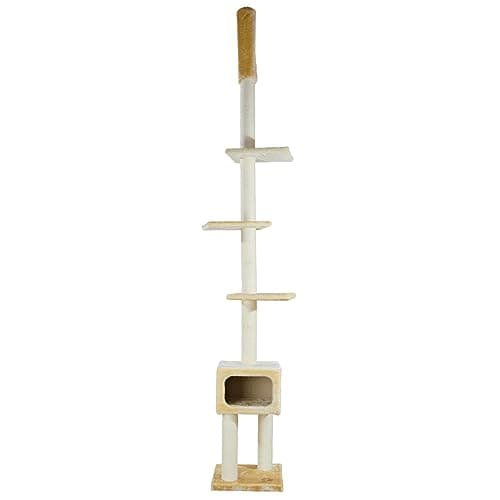
TRIXIE Santander Floor-to-Ceiling Cat Tree
TRIXIE · Floor-to-ceiling cat tree · Our score 8.0/10
#ad Price as of September 27, 2026. Prices move; we check daily. How we're funded.
A 15.5 inch square footprint that reaches 108 inches, because the ceiling does the work a wide base would otherwise have to do.
Published specs
| Footprint | 15.5" L x 15.5" W |
|---|---|
| Height range | 96.25" to 108.25", adjustable |
| Fixing | Spring-activated ceiling attachment, no screws or nails |
| Condo | 14" x 14" x 10" |
| Platforms | 3, each 14" x 14" |
| Posts | 3.5" diameter |
15.5 x 15.5 = 240 square inches = 1.67 square feet of floor. At 108 inches of height that is 65 inches of climbable height per square foot given up. A conventional 72 inch tree on a 22 x 33 inch base gives about 14. This is the most floor-efficient vertical product we track by a factor of four.
What the specs favor
- Most vertical height per square foot of any product on the site
- No screws or nails, so it survives a tenancy agreement
- Adjustable through a full foot of ceiling height
- Published condo and platform dimensions, not just an overall height
What they don't
- Tension fixing depends on your ceiling being solid and flat
- 14 inch platforms are small for a large cat to turn on
- Needs re-tensioning as the building and the pole settle
You have a suspended, textured or sloped ceiling. A tension pole transfers real load upward, and it needs something solid to push against.
How it scores
Scores are our editorial weighting of the published specs above, not a test result. They are deliberately kept out of this page's structured data.
Common questions
How tall should a cat tree be?
Is a taller cat tree always better?
How far apart should cat tree platforms be?
What height suits a senior cat?
Do I need to anchor a tall cat tree to the wall?
Sources
- Yaheetech -- 72-inch Height Cat Tree Tower product page
- Chewy -- FEANDREA 67-in Multi-Level Cat Tree listing
- TRIXIE -- Santander Floor-to-Ceiling Cat Tree listing (15.5 x 15.5 in footprint, 96.25-108.25 in adjustable, spring ceiling attachment)
- Ohio State University Indoor Pet Initiative -- For Cat Owners
Read next
- How to Choose a Cat Tree
The five published numbers that decide a cat tree, in the order to check them, with our stability index worked on three real towers.
- How to Tell if a Cat Tree Is Stable (Before You Buy)
The stability index explained: how to compute it in a shop, what the numbers mean, and when to wall-anchor regardless.
- Best Floor to Ceiling Cat Trees (2026)
Floor-to-ceiling tension-pole trees compared with conventional towers on climbable height per square foot of floor given up.
- Best Cat Trees for Senior Cats (2026)
Why rise height beats total height for an older cat, which trees step gently, and how to retrofit one you already own.
- Where to Put a Cat Tree
Windows, sightlines, escape routes and traffic -- how to place a tree so it actually gets used, in a house with more than one cat.