Multi-Cat Households
How to Stop Cats Fighting Over Food
Two bowls side by side is not two feeding stations. Most food tension in a multi-cat house is built into the floor plan.
Affiliate disclosure: we earn a commission if you buy through our links, at no extra cost to you. It never changes which product we rank first — here is how we're funded.
Everyone in this category says they tested twenty litter boxes. We have not tested any, and we say so. What we do instead: compile the published specs, read the manuals, and do the arithmetic on what this gear costs to run and how it behaves once there is more than one cat using it. Every spec is linked to the document it came from. Prices are checked daily — last verified September 27, 2026. Here is exactly how we pick.
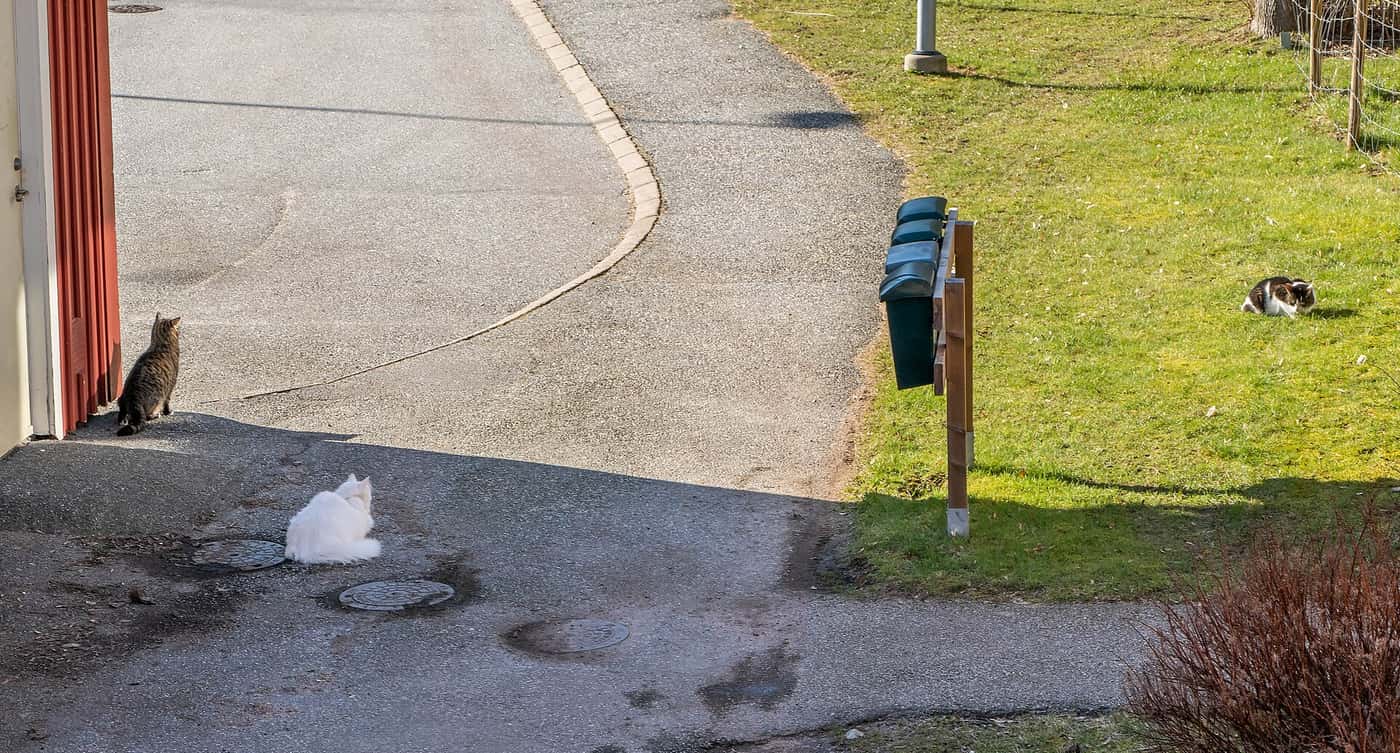
People usually describe this as one cat being greedy. It is more often a floor plan that forces two cats into the same three square feet twice a day.
Why side-by-side bowls cause it
The Ohio State Indoor Pet Initiative treats separate feeding stations as a basic requirement in a multi-cat home, not a refinement. Cats are solitary hunters and eaters; sharing a mealtime space is a human idea imposed on them.
Two bowls next to each other create a single contested zone. The more confident cat controls it. The other cat eats fast, eats less, or waits until the room is empty — which is how weight problems begin without anyone noticing a fight.
The separation rules
- Different rooms if you have them. This is the whole fix in most houses.
- Out of sight of each other if you do not — around a corner, behind furniture, or one station on a surface and one on the floor.
- Two escape routes from each station. A cat eating in a dead-end corner is a cat that can be pinned.
- Water away from both. Cats generally prefer water at a distance from food, and a separate water station is one less place to queue.
- Same time, every time. Predictability lowers the incentive to guard, and our scheduled versus free feeding page covers the trade-off.
Find out what is actually happening
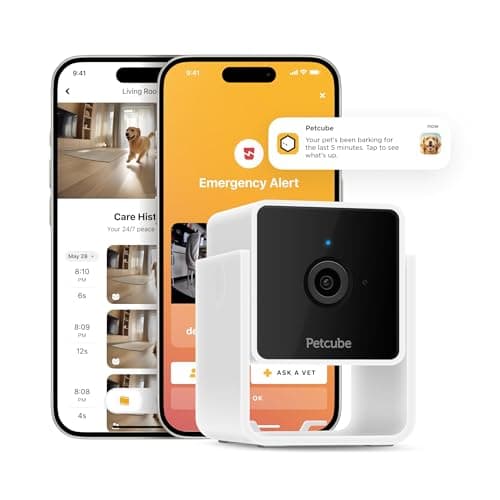
Most food theft happens when nobody is watching, which is why owners so often describe the wrong cat as the problem. A camera answers it cheaply: the Petcube Cam publishes 1080p at a 110-degree field of view with night vision to about 30 ft.
Point it at the stations for three days before buying anything else. Two questions get answered: who eats first, and who returns to the other bowl after the room clears.
That is also the evidence your vet will want if one cat turns out to be eating far more or far less than you assumed.
When hardware is the answer
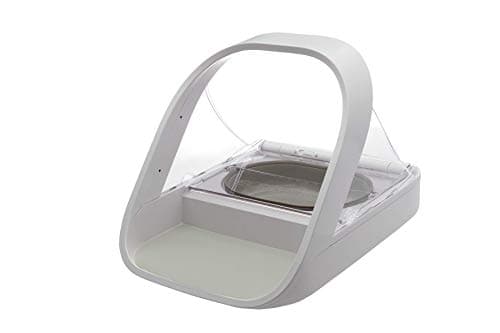
The SureFeed microchip feeder opens only for a registered chip or collar tag, takes wet or dry food in a 400 ml bowl, and stores up to 32 identities. It is the one product that makes a bowl belong to a specific cat.
The thing to plan for is that a unit is a bowl, not a household solution: separating two diets means one unit per cat. Our microchip against automatic feeder comparison works through that arithmetic, and feeding cats different diets covers the medical-diet case specifically.
A feeding mat at 18 by 12 inches does a smaller but real job: it marks a station as a distinct place, and it contains the mess of a cat that pulls food out of the bowl to eat it.
Read the guide
Our resource competition guide applies the same separation logic to litter, water, resting places and doorways — food is usually just the first place it shows up.
The gear discussed here
Specs are the manufacturer's own, linked to the page they came from. Prices come from a live daily check; where we have no verified price we say so rather than print a stale one.
SureFeed Microchip Pet Feeder
Sure Petcare · Microchip feeder · Our score 8.5/10
#ad Price as of September 27, 2026. Prices move; we check daily. How we're funded.
The only feeder here that solves the actual multi-cat feeding problem, which is not portioning -- it is one cat eating another cat's food.
Published specs
| Bowl capacity | 400 ml, or two pouches of wet food |
|---|---|
| Pets stored | Up to 32 identities |
| Food types | Wet and dry |
| Power | 4 x C cells, 6-month stated battery life |
| Warranty | 3 years from date of purchase |
| Opens for | Registered microchips or a collar tag |
Source: Sure Petcare -- SureFeed Microchip Pet Feeder product page
Sure Petcare states 6 months from a set of 4 C cells, so 8 cells a year per feeder. In a three-cat house you need one feeder per cat on a controlled diet -- 24 cells a year for three. That is the running cost nobody mentions.
What the specs favor
- Stores up to 32 pet identities -- more than any household needs
- Works with an existing microchip, no new collar required
- Takes wet food, which almost no automatic feeder does
- Three-year warranty, the longest here
What they don't
- Battery only -- 8 C cells a year, per feeder
- One feeder feeds one cat, so a three-cat house needs three
- 400 ml bowl is a meal, not a hopper -- it does not solve holidays
Your problem is being out all day rather than food stealing. This is a lid that opens for the right cat, not a scheduled dispenser -- it will not feed anyone at 6pm on its own.
How it scores
Scores are our editorial weighting of the published specs above, not a test result. They are deliberately kept out of this page's structured data.
Petcube Cam
Petcube · Pet camera · Our score 7.8/10
#ad Price as of September 27, 2026. Prices move; we check daily. How we're funded.
1080p over a 110 degree field of view with 30 feet of night vision -- and the recording history sits behind an optional subscription, which is the specification to read first.
Published specs
| Video | 1080p |
|---|---|
| Field of view | 110 degrees |
| Night vision | Up to 30 ft |
| Audio | Two-way |
| Zoom | 8x digital |
| Wi-Fi | 2.4 GHz, 802.11 b/g/n |
| Subscription | Optional Petcube Care; up to 90 days of history |
Live viewing works without a plan. Going back to see what happened at 2pm -- which is the reason most multi-cat households want a camera -- is what the subscription unlocks. A camera watched live is a novelty; a camera you can scrub back through is a diagnostic tool.
What the specs favor
- Published resolution, field of view and night-vision range
- Two-way audio
- Live view works without a subscription
- 110 degree view covers most of a room from a corner
What they don't
- Recorded history is behind a subscription
- 2.4 GHz only, which some home networks are moving away from
- Two-way audio can startle a cat rather than reassure it
You only want to check the cats are fine. A live view is enough for that, and a subscription for recorded history is only worth it if you are actually investigating something.
How it scores
Scores are our editorial weighting of the published specs above, not a test result. They are deliberately kept out of this page's structured data.
Silicone Pet Feeding Mat with Raised Edges
FEELNEEDY · Feeding mat · Our score 7.9/10
#ad No verified live price right now, so we show none rather than a stale one. How we're funded.
The published raised-edge height is the whole product, and it is the one dimension most feeding mats leave off the listing.
Published specs
| Dimensions | 18" x 12" x 0.5" |
|---|---|
| Material | Food-grade silicone |
| Edge | Raised lip for leakage protection |
| Base | Non-slip |
| Cleaning | Wipe, hand wash or dishwasher |
| Waterproof | Yes |
18 x 12 = 216 square inches. Two 6 inch bowls occupy about 56 square inches between them, leaving roughly 160 for the mess -- which is the point. A mat sized only to the bowls catches nothing, exactly like an undersized litter mat.
What the specs favor
- Publishes a thickness and an edge height rather than only a footprint
- Food-grade silicone named on the spec, not just 'silicone'
- Dishwasher safe, which a wet-food mat needs to be
- Rolls up, so it travels
What they don't
- Silicone attracts hair and dust between washes
- A raised lip is a trip hazard for an unsteady older cat stepping onto it
- Thin mats curl at the corners after a dishwasher cycle
Your cat already dislikes stepping onto a new surface to eat. Some cats refuse a raised-edge mat outright, and a refused mat moves the feeding station rather than protecting the floor.
How it scores
Scores are our editorial weighting of the published specs above, not a test result. They are deliberately kept out of this page's structured data.
Common questions
Why do my cats fight over food when there is plenty?
How far apart should cat feeding stations be?
One cat eats the other's food -- what actually stops it?
Should I feed cats at set times or leave food down?
When is food aggression a health question?
Sources
- Sure Petcare -- SureFeed Microchip Pet Feeder product page
- Petcube -- Cam product page and specifications (1080p, 110 degree field of view, 30 ft night vision, two-way audio, optional Petcube Care)
- FEELNEEDY -- Silicone Cat and Dog Food Mat listing (18 x 12 x 0.5 in, food-grade silicone, raised edges, non-slip, easy clean)
- Ohio State University Indoor Pet Initiative -- For Cat Owners
Read next
- Feeding Cats on Different Diets
Four ways to feed cats different diets in one household, ranked by whether they still work when nobody is home.
- Best Microchip Cat Feeders (2026)
Selective-access feeders compared against timed and hopper feeders, and which one solves the problem you actually have.
- Resource Competition Between Cats
How to recognize resource guarding, why it rarely looks like fighting, and the environmental changes that reduce it.
- Best Automatic Cat Feeders for Multiple Cats (2026)
Ranked on whether a feeder can actually separate two cats' food, plus the battery and hopper arithmetic nobody publishes.
- Signs of Tension Between Cats
The quiet signals of multi-cat tension -- blocking, route changes, resource avoidance -- and what each one tells you to change.