Multi-Cat Households
Signs of Tension Between Cats
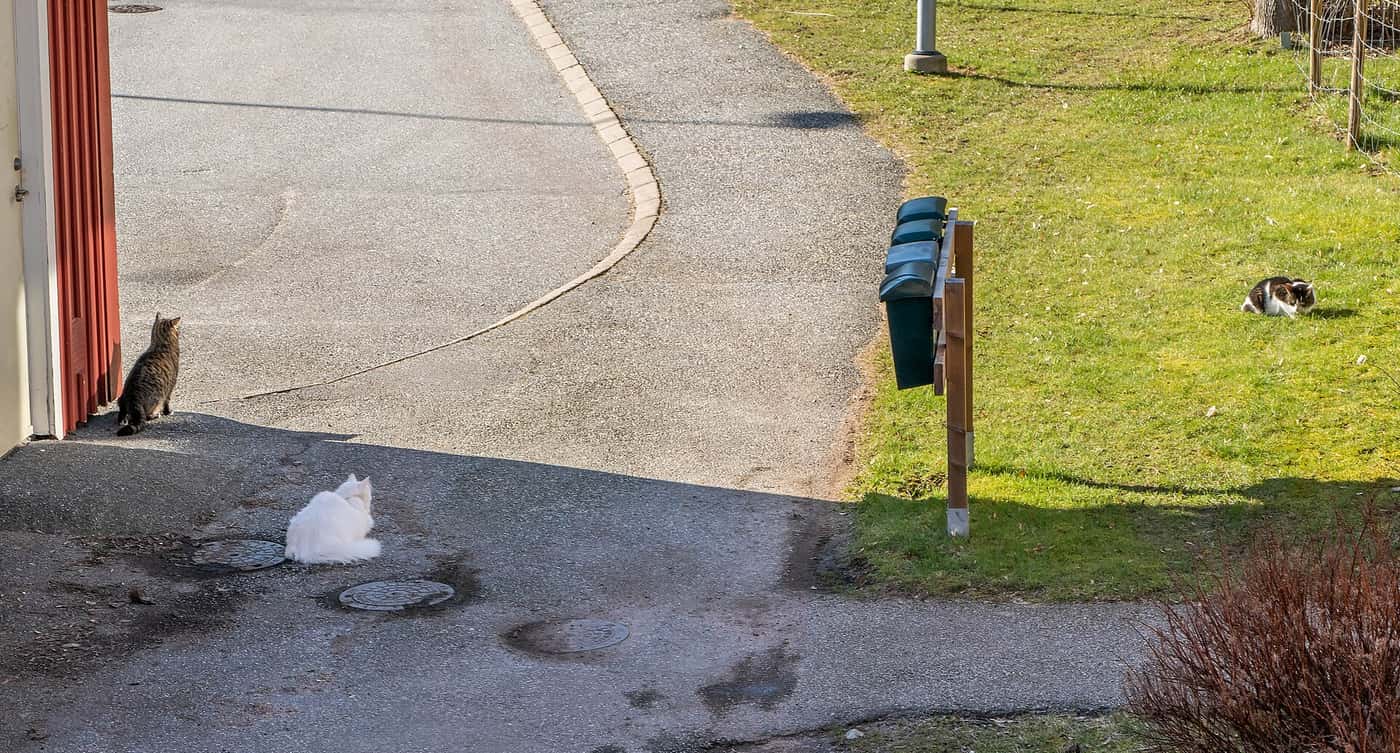
By the time there is hissing, you have missed weeks of quieter signals. Almost all of them are about geography.
Affiliate disclosure: we earn a commission if you buy through our links, at no extra cost to you. It never changes which product we rank first — here is how we're funded.
Everyone in this category says they tested twenty litter boxes. We have not tested any, and we say so. What we do instead: compile the published specs, read the manuals, and do the arithmetic on what this gear costs to run and how it behaves once there is more than one cat using it. Every spec is linked to the document it came from. Prices are checked daily — last verified October 22, 2026. Here is exactly how we pick.
Cats that do not get along rarely fight. They negotiate, and the negotiation is conducted in positions and routes rather than in noise.
Read the geography
The Ohio State Indoor Pet Initiative frames multi-cat friction as competition over resources and territory. That means the earliest evidence is spatial: who is where, who goes around, who has stopped going somewhere at all.
- Blocking. One cat sitting in a doorway, on the stairs, or beside a litter box or feeding station. It looks like resting. It is not.
- Route changes. A cat that used to cross the middle of a room now goes around the edge, or waits at the threshold before entering.
- Resource abandonment. A cat that has stopped using a bed, a box or a bowl it used to use. Nothing about the object changed.
- Time-sharing. Two cats using the same space at reliably different times. That is not friendship, it is a schedule negotiated to avoid contact.
- Staring. A long, still look across a room, with no movement. It is a complete interaction, and the other cat has received it.
Play or fight
| Play | Conflict | |
|---|---|---|
| Noise | Mostly silent | Yowling, hissing, screaming |
| Turn-taking | Roles swap; both chase and are chased | One cat always chases, one always flees |
| Pauses | Frequent breaks, both reset | Continuous until one escapes |
| Ears and body | Ears forward, loose posture | Ears flat, hair up, tense |
| Afterward | Both settle nearby | One cat leaves and stays away |
Our summary of what to watch. The turn-taking row is the most reliable single test.
The physical signs
Cats hide stress, so some of the clearest evidence is not behavioral at all:
- Overgrooming, often on the belly or inner legs, producing thin or bald patches.
- Changed litter box habits — going outside the box, or going more often.
- Appetite changes in either direction.
- Increased scratching in new places, particularly near doorways and windows — marking rises with perceived threat, as our scratching page explains.
What each signal tells you to change
| What you see | What it means | What to change |
|---|---|---|
| Blocking a doorway | A route is controllable | Second route, or a selective interior door |
| Avoiding the litter box | The box is contested or hard to reach | More boxes, in more rooms |
| Eating fast or not finishing | Feeding is contested | Separate stations, out of sight of each other |
| Hiding under furniture | No safe elevated refuge | Vertical territory with two exits |
Our mapping. Every intervention in the right-hand column is environmental rather than behavioral, which is deliberate.
A selective interior door gives one cat a room another cannot follow it into. A window perch gives a refuge that is not under the bed. Another litter box in another room removes the choke point. All three change the environment rather than asking a cat to change.
Our resource competition guide works through the full fix order, and the vertical space plan covers the refuge half.
The gear discussed here
Specs are the manufacturer's own, linked to the page they came from. Prices come from a live daily check; where we have no verified price we say so rather than print a stale one.
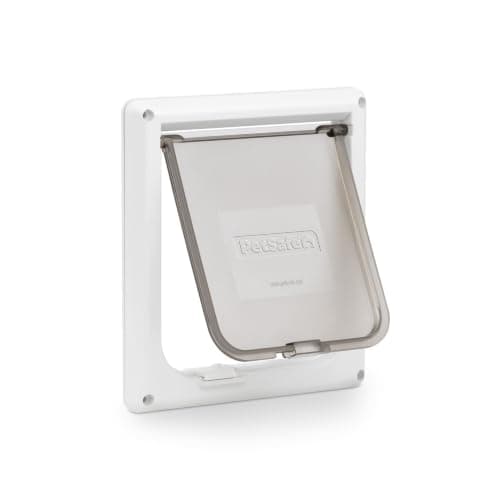
PetSafe Interior 2-Way Locking Cat Door
PetSafe · Interior cat door · Our score 7.9/10
#ad Price as of October 22, 2026. Prices move; we check daily. How we're funded.
No electronics, no batteries and no chip -- a latch and a flap, which is all an interior door between two rooms in the same house actually needs.
Published specs
| Flap opening | 5 3/4" x 5 3/4" |
|---|---|
| Frame | 7 1/2" x 7 7/8" |
| Cut-out | 6 9/16" x 6 13/16" |
| Published pet weight | Cats or dogs up to 15 lb |
| Door thickness | 1/2" to 2" |
| Locking | 2-way manual lock |
| Included | Foam tape, screws, cutting template, manual |
PetSafe publishes a 5.75 inch square opening. SureFlap publishes 4.75 inches of height. A full inch more headroom, on the cheapest door here, because it has no reader hardware to fit around the aperture.
What the specs favor
- Largest flap opening in this comparison, and no reader hardware crowding it
- No batteries, so it cannot fail locked
- Cutting template and hardware included
- Published door thickness range of half an inch to two inches
What they don't
- No selectivity at all -- every cat under 15 lb goes through
- Manual lock means someone has to set it
- Interior only; not weather-sealed for an exterior door
The problem you are solving is one cat eating another cat's food. Without selectivity this door does not solve it, and a microchip door or microchip feeder does.
How it scores
Scores are our editorial weighting of the published specs above, not a test result. They are deliberately kept out of this page's structured data.
K&H EZ Mount Window Perch
K&H Pet Products · Window perch · Our score 7.5/10
#ad No verified live price right now, so we show none rather than a stale one. How we're funded.
Suction cups rated to 50 lb and 27 inches of ledge -- the cheapest square foot of territory you can add to a multi-cat house.
Published specs
| Dimensions | 27" L x 11" W x 6" H |
|---|---|
| Suction cup rating | Up to 50 lb, per K&H |
| Mounting | Suction to glass or a smooth door |
| Floor footprint | None |
Source: Amazon -- K&H Pet Products EZ Mount Cat Window Perch listing
27 inches of ledge split two ways is 13.5 inches each -- less than a cat's body length. Two cats will not share this; in a multi-cat house it is one perch per window, not one perch for the household.
What the specs favor
- 50 lb published suction rating, well beyond any cat's weight
- No drilling, so it works in a rental
- Puts a cat at a window, which is the enrichment that costs nothing to run
- Moves to another window in five minutes
What they don't
- Suction fails on textured, dirty or very cold glass
- 27 inches is a one-cat ledge
- No good on a window with a deep recessed frame
Your two cats already compete over resting spots. One perch at one window is a new thing to compete over, not a solution -- buy two, at two windows.
How it scores
Scores are our editorial weighting of the published specs above, not a test result. They are deliberately kept out of this page's structured data.
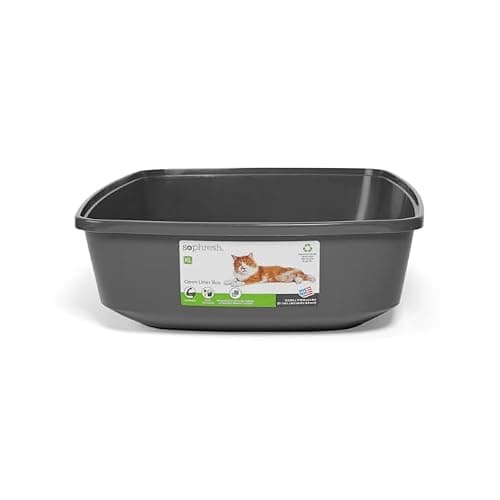
So Phresh Open Cat Litter Box, X-Large
So Phresh · Litter box · Our score 7.4/10
#ad Price as of October 22, 2026. Prices move; we check daily. How we're funded.
The plain plastic pan that lets you follow the one-box-per-cat-plus-one rule without spending like it -- 379 square inches of open floor for the price of a bag of litter.
Published specs
| External dimensions | 22.4" L x 16.9" W x 5.4" H |
|---|---|
| Wall height | 5.4" |
| Type | Open pan, no cover |
| Material | Plastic |
| Color | Charcoal |
| Litter type | Any |
| Published interior | Not published |
| Weight | Not published |
Cornell's guidance is one box more than you have cats. For three cats that is four boxes. The cheapest automatic box on this site is $269.99 -- four plain open pans is a fraction of one of those, and four boxes beat one clever one every time. At 22.4 x 16.9 inches each, four of these is 1,514 square inches of litter floor spread across four rooms, which is the thing a single automatic box cannot buy at any price.
What the specs favor
- Cheap enough to buy four without thinking about it
- 22.4 inches long, which is genuinely jumbo for a plain pan
- Open, uncovered, low -- the configuration cats prefer
- A 5.4 inch wall is an easy step for a kitten or an arthritic cat
- Nothing to break, nothing proprietary
What they don't
- A 5.4 inch wall will not contain a cat that sprays standing up, and it is lower than the 6.5 inch pans it replaces
- No scatter shield at all
- Thin plastic scratches, and scratched plastic holds odor
- No published interior dimension, so usable floor is smaller than the external figure
- No published weight
Odor or scatter is your actual complaint. This pan solves the count problem, not the containment problem -- pair it with a high-sided box rather than replacing one.
How it scores
Scores are our editorial weighting of the published specs above, not a test result. They are deliberately kept out of this page's structured data.
Common questions
How do you know if cats are not getting along?
Is it normal for cats to hiss at each other?
What does cat blocking behavior look like?
Do cats fight or play?
Can cats be stressed without showing it?
Sources
Read next
- Resource Competition Between Cats
How to recognize resource guarding, why it rarely looks like fighting, and the environmental changes that reduce it.
- The Multi-Cat Household Guide
The pillar guide: resource counts by household size, why separation beats quantity, and the order to fix things in.
- How to Introduce a New Cat
A staged cat introduction, the resource counts to have in place first, and the gear each stage actually needs.
- Vertical Space Planning for Multiple Cats
A room-by-room approach to adding vertical territory for several cats, with height per square foot compared across four formats.
- Why Cats Scratch
The four jobs scratching does for a cat, and what each one implies about where and what to provide.
- Best Pet Cameras for Cats (2026)
Pet cameras compared on published field of view, night vision and subscription, with where to point one in a multi-cat home.
- FELIWAY MultiCat vs Classic vs Optimum
The three FELIWAY diffusers compared on published coverage, refill life and stated purpose -- with what we will and will not say about the evidence.