Multi-Cat Households
How to Introduce a New Cat
The introduction starts before the cats see each other, and the part people skip is the part that decides how it goes.
Affiliate disclosure: we earn a commission if you buy through our links, at no extra cost to you. It never changes which product we rank first — here is how we're funded.

Everyone in this category says they tested twenty litter boxes. We have not tested any, and we say so. What we do instead: compile the published specs, read the manuals, and do the arithmetic on what this gear costs to run and how it behaves once there is more than one cat using it. Every spec is linked to the document it came from. Prices are checked daily — last verified October 21, 2026. Here is exactly how we pick.
Almost every failed cat introduction we can find a description of has the same shape: too fast, and with resources set up for one cat. Both are fixable before the second cat arrives.
Get the arithmetic right before anyone arrives
The Ohio State Indoor Pet Initiative frames multi-cat tension as competition over resources and space. So the first stage of an introduction is not a stage of the introduction at all — it is shopping.
| Resource | One cat | Two cats | Source of the rule |
|---|---|---|---|
| Litter boxes | 2 | 3 | Cornell: one more than the number of cats |
| Feeding stations | 1 | 2, in separate places | Ours, from resource competition |
| Water sources | 2 | 3, in separate rooms | Ours |
| Elevated resting places | 2 or more | 4 or more | Ours, from OSU vertical territory guidance |
Only the litter box row is a published recommendation. The rest are our extrapolations of the same principle, and we label them as ours.
The five stages
- Separation, days 1 to 7. The new cat lives in one room with its own box, food, water and hiding places. No visual contact at all. The resident cat keeps its whole territory minus one room, which is already a loss it has to absorb.
- Scent exchange, days 3 to 10, overlapping. Swap bedding between the two. Rub a cloth on one cat’s cheeks and leave it where the other eats. Cats identify each other by scent long before sight, and this stage is doing the actual work.
- Room swap, around day 7. Put the resident in the new cat’s room and let the new cat explore the house. Each investigates the other’s scent without either being present. Repeat several times.
- Visual contact, week 2 onward. A cracked door, a stair gate, a gap. Short sessions, both cats eating during them. Stop while it is still going well rather than when it stops going well.
- Shared space, week 3 or later. Supervised, short, with an easy exit for both. Build up. If there is a fight, go back two stages — not one.
The rule that governs the pace
Move to the next stage only when the current one has been uneventful for three consecutive days. No hissing, no growling, no guarding of doorways, both cats eating normally, both using their boxes normally.
A cat that eats less, or stops using its box, is a cat under stress, and Cornell Feline Health Center connects stress to lower urinary tract disease. Those two signs are the ones to treat as a stop signal rather than a phase to push through.
What actually helps at each stage
- A door that closes. The single most important piece of equipment in the whole process. Stage one does not work without it.
- Two carriers, not one. Each cat needs a way to be moved separately, and a shared carrier at a stressful moment is where bonded cats stop being bonded. Our carrier page covers the choice.
- A selective interior door, later. Once the separation phase ends, a manual interior cat door lets one cat keep a retreat the other does not follow it into, at a 5 3/4 inch square aperture and no batteries.
- A third litter box, in a third location. Not a third box beside the other two. Three boxes in one room is one location as far as a cat under pressure is concerned — our litter setup page covers placement.
- An enclosed box for the nervous one. A top-entry box gives privacy, though it has one exit, so it suits the confident cat better than the one being ambushed.
- Vertical space. Height lets cats share a room while keeping distance, which is the mechanism by which multi-cat households actually work.
When it goes wrong
Setbacks are normal and they are not failure. The response is always the same: separate, go back two stages, and go slower than you did the first time.
One specific case is worth knowing about, because it catches people out. Non-recognition aggression happens when one cat comes back from the vet smelling of the clinic and its housemate treats it as a stranger. It is not a relapse of the introduction; it is a scent problem, and it is why our carrier page recommends somewhere separate to put a returning cat while the smell fades.
A realistic destination
Cats are not obligate social animals. Some pairs groom each other and sleep in a pile; many settle into calm mutual indifference, sharing space without contact. The second outcome is a success, not a half-success.
What is not acceptable is one cat living under a bed. That is a resource and territory problem, and it is worth working through our resource competition guide properly before concluding the cats cannot live together.
The gear discussed here
Specs are the manufacturer's own, linked to the page they came from. Prices come from a live daily check; where we have no verified price we say so rather than print a stale one.
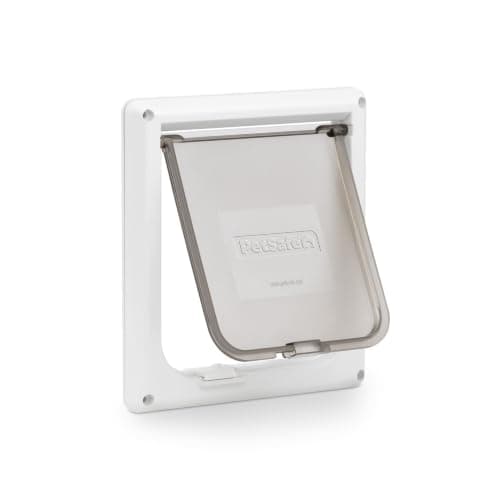
PetSafe Interior 2-Way Locking Cat Door
PetSafe · Interior cat door · Our score 7.9/10
#ad Price as of October 21, 2026. Prices move; we check daily. How we're funded.
No electronics, no batteries and no chip -- a latch and a flap, which is all an interior door between two rooms in the same house actually needs.
Published specs
| Flap opening | 5 3/4" x 5 3/4" |
|---|---|
| Frame | 7 1/2" x 7 7/8" |
| Cut-out | 6 9/16" x 6 13/16" |
| Published pet weight | Cats or dogs up to 15 lb |
| Door thickness | 1/2" to 2" |
| Locking | 2-way manual lock |
| Included | Foam tape, screws, cutting template, manual |
PetSafe publishes a 5.75 inch square opening. SureFlap publishes 4.75 inches of height. A full inch more headroom, on the cheapest door here, because it has no reader hardware to fit around the aperture.
What the specs favor
- Largest flap opening in this comparison, and no reader hardware crowding it
- No batteries, so it cannot fail locked
- Cutting template and hardware included
- Published door thickness range of half an inch to two inches
What they don't
- No selectivity at all -- every cat under 15 lb goes through
- Manual lock means someone has to set it
- Interior only; not weather-sealed for an exterior door
The problem you are solving is one cat eating another cat's food. Without selectivity this door does not solve it, and a microchip door or microchip feeder does.
How it scores
Scores are our editorial weighting of the published specs above, not a test result. They are deliberately kept out of this page's structured data.
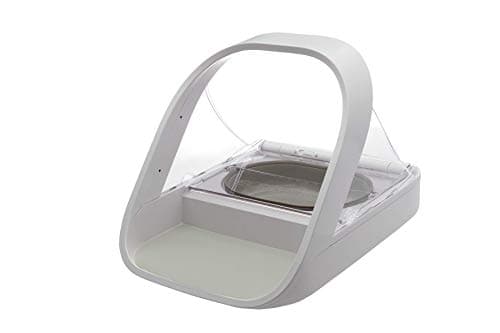
SureFeed Microchip Pet Feeder
Sure Petcare · Microchip feeder · Our score 8.5/10
#ad Price as of October 21, 2026. Prices move; we check daily. How we're funded.
The only feeder here that solves the actual multi-cat feeding problem, which is not portioning -- it is one cat eating another cat's food.
Published specs
| Bowl capacity | 400 ml, or two pouches of wet food |
|---|---|
| Pets stored | Up to 32 identities |
| Food types | Wet and dry |
| Power | 4 x C cells, 6-month stated battery life |
| Warranty | 3 years from date of purchase |
| Opens for | Registered microchips or a collar tag |
Source: Sure Petcare -- SureFeed Microchip Pet Feeder product page
Sure Petcare states 6 months from a set of 4 C cells, so 8 cells a year per feeder. In a three-cat house you need one feeder per cat on a controlled diet -- 24 cells a year for three. That is the running cost nobody mentions.
What the specs favor
- Stores up to 32 pet identities -- more than any household needs
- Works with an existing microchip, no new collar required
- Takes wet food, which almost no automatic feeder does
- Three-year warranty, the longest here
What they don't
- Battery only -- 8 C cells a year, per feeder
- One feeder feeds one cat, so a three-cat house needs three
- 400 ml bowl is a meal, not a hopper -- it does not solve holidays
Your problem is being out all day rather than food stealing. This is a lid that opens for the right cat, not a scheduled dispenser -- it will not feed anyone at 6pm on its own.
How it scores
Scores are our editorial weighting of the published specs above, not a test result. They are deliberately kept out of this page's structured data.
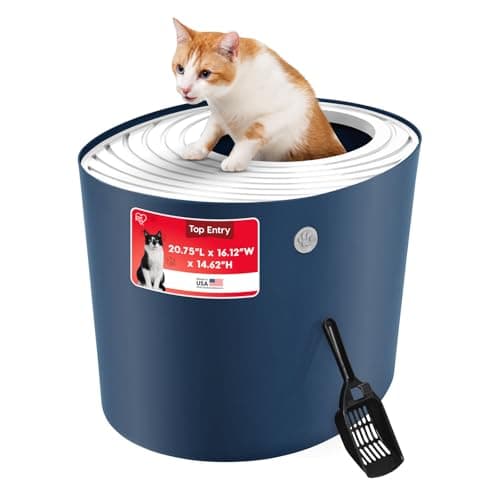
IRIS USA Top Entry Cat Litter Box, Large
IRIS USA · Top-entry litter box · Our score 8.0/10
#ad Price as of October 21, 2026. Prices move; we check daily. How we're funded.
The largest published entry hole of any top-entry box we found at 9 by 10.5 inches, which is the spec that decides whether an average cat will use one at all.
Published specs
| Exterior | 20.75" L x 16.12" W x 14.62" H |
|---|---|
| Entry hole | 9" W x 10.5" H, set off-center |
| Lid | Grooved, catches litter from paws on the way out |
| Scoop | Included on most variants |
Source: IRIS USA -- Top Entry Cat Litter Box, Large listing (20.75 x 16.12 x 14.62 in, 9 x 10.5 in entry)
Large: 9 x 10.5 = 94.5 square inches. IRIS's own Premium square model publishes 7.9 x 7.9 = 62.4. The large gives half again as much aperture. A cat that refuses a top-entry box has usually been offered the smaller hole.
What the specs favor
- Published entry dimensions, which most top-entry listings omit
- Off-center hole leaves a landing platform inside
- Grooved lid does real work against tracking
- Enclosed sides stop nearly all kicked litter
What they don't
- 14.62 inches of height is a jump an arthritic cat may not make
- Interior dimensions not published, only the exterior
- Scooping means lifting the lid off every time
Your cat is elderly, arthritic or recovering from surgery. A top-entry box asks for a vertical jump on the way in and a controlled drop on the way out, twice a day, forever.
How it scores
Scores are our editorial weighting of the published specs above, not a test result. They are deliberately kept out of this page's structured data.
Common questions
How long does it take to introduce two cats?
Should I let my cats fight it out?
What do I need before bringing a second cat home?
Why is my cat hissing at the new cat through the door?
Do cats ever accept a new cat?
Sources
Read next
- The Multi-Cat Household Guide
The pillar guide: resource counts by household size, why separation beats quantity, and the order to fix things in.
- Resource Competition Between Cats
How to recognize resource guarding, why it rarely looks like fighting, and the environmental changes that reduce it.
- Feeding Cats on Different Diets
Four ways to feed cats different diets in one household, ranked by whether they still work when nobody is home.
- How Many Litter Boxes Per Cat?
The n+1 rule, its published source, a count-by-household table, and why four boxes in a row is really only one box.
- Best Gear for Multi-Cat Homes (2026)
The complete multi-cat kit list: one pick per category, with what each one costs to run and what to fix for free first.
- Best Cat Gates and Pet Doors for Multi-Pet Homes (2026)
A walk-through gate with a cat door, an interior cat door and a microchip door compared on what each one keeps out -- and what none of them can.
- Moving House With Cats
The safe-room plan for both ends of a move, the identification jobs to do before the van arrives, and how long to keep a cat in after arrival.
- What to Buy Before Getting a Second Cat
A pre-arrival shopping list built from resource counts: boxes, separate stations, a second carrier, height, and what the safe room actually needs.