Multi-Cat Households
What to Buy Before Getting a Second Cat
Most second-cat problems are resource problems, and resources are easier to add before the cat arrives than after the tension starts.
Affiliate disclosure: we earn a commission if you buy through our links, at no extra cost to you. It never changes which product we rank first — here is how we're funded.
Everyone in this category says they tested twenty litter boxes. We have not tested any, and we say so. What we do instead: compile the published specs, read the manuals, and do the arithmetic on what this gear costs to run and how it behaves once there is more than one cat using it. Every spec is linked to the document it came from. Prices are checked daily — last verified September 27, 2026. Here is exactly how we pick.
A second cat succeeds or fails on whether the house has enough of everything. That is a shopping list, and it is much cheaper to work through it before the carrier comes through the door.
Start with the counts
The Ohio State Indoor Pet Initiative is specific: one litter box per cat plus one, and enough separate feeding, watering, resting and hiding places that no cat has to negotiate for access. A second cat therefore does not add one of each thing — it adds one plus the spare.
| Resource | One cat | Two cats | Why |
|---|---|---|---|
| Litter boxes | 2 | 3 | One per cat plus one, in different locations |
| Feeding stations | 1 | 2, out of sight of each other | Cats do not need to eat together |
| Water stations | 1 or more | 2 or more, away from food | Queueing for water is a real deterrent |
| Carriers | 1 | 2 | Two cats in one carrier is unsafe and stressful |
| Elevated resting places | 1 or more | 3 or more, at different heights | Height is contested; more spots means less negotiation |
| Hiding places | 1 or more | 3 or more | A cat that cannot retreat escalates instead |
Counts follow the published one-per-cat-plus-one guidance; placement notes are ours.
The safe room is the real purchase
One room, door closed, containing: a litter box, food and water at opposite ends from it, a bed, a hiding place, a scratching surface and something at height. That is the whole introduction kit.
The resident cat keeps everything it already had. The newcomer’s room is additional, which is why the shopping happens before arrival — stripping the resident cat’s resources to furnish the new one is how introductions go wrong in week one.
Our introduction guide covers the sequence from there: scent first, then sight, then supervised contact, at the cats’ pace rather than yours.
The gear discussed here
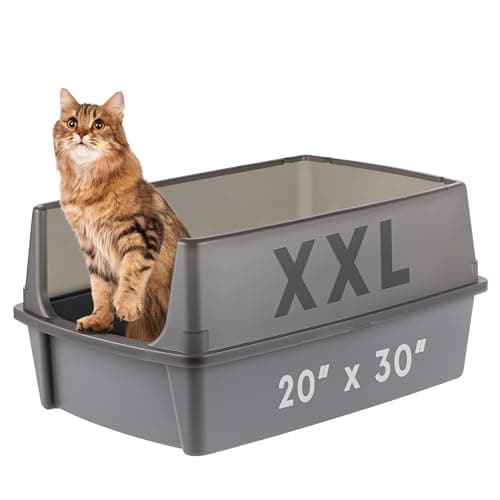
A large open box is the third-box default: at 30.18 by 20.13 inches it is one of the biggest open pans sold, and large uncovered boxes are what the published guidance recommends. Put it in a different room from the existing two — three boxes in a row is one box as far as the cats are concerned.
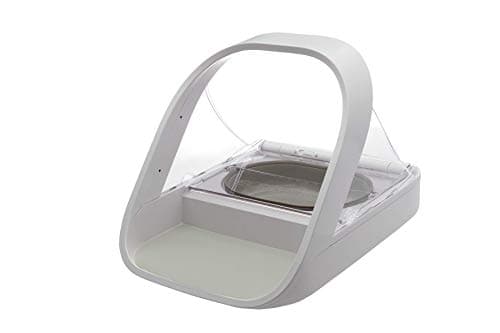
A microchip feeder is worth buying up front if either cat is on a prescription or controlled diet. It stores up to 32 identities and takes wet or dry food, and one unit per cat is what actually separates two diets.
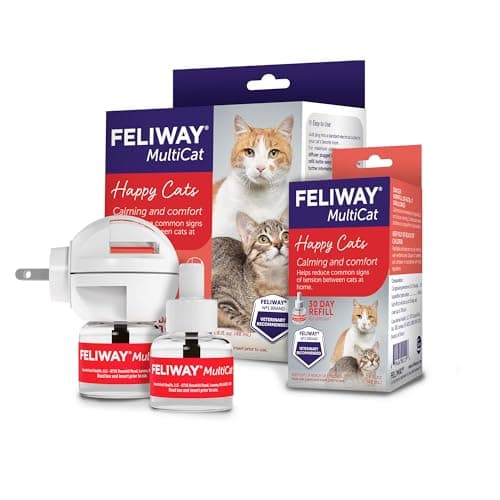
A FELIWAY MultiCat diffuser covers up to 700 sq ft on a 48 mL refill lasting up to 30 days. Set it up in the shared space a few days before arrival if you are going to use one, and read our formula comparison first, because the three FELIWAY products share one specification sheet and are aimed at different problems.
What you do not need to buy
- A second cat tree, immediately. More spots at different heights beats a second tower in the same corner — shelves and perches are cheaper and use no floor.
- Matching everything. Cats do not care that the bowls match; they care that they are far apart.
- A double carrier, in most cases. Our two-cat carrier page explains why the answer is usually two separate carriers.
- Toys. You almost certainly have enough; what changes is running separate play sessions.
Read the guide
Our multi-cat household guide is the pillar for all of this, and the resource competition guide explains what to watch for once both cats are sharing the whole house.
The gear discussed here
Specs are the manufacturer's own, linked to the page they came from. Prices come from a live daily check; where we have no verified price we say so rather than print a stale one.
IRIS USA XX-Large Open Top Litter Box
IRIS USA · Litter box · Our score 8.7/10
#ad Price as of September 27, 2026. Prices move; we check daily. How we're funded.
At 30.18 by 20.13 inches this is the largest open-top pan in general retail, and floor area is the single spec that decides whether two cats will share a box.
Published specs
| External dimensions | 30.18" L x 20.13" W x 13.12" H |
|---|---|
| Type | Open top with scatter shield |
| Litter type | Any |
| Weight capacity | Not published |
Source: Amazon -- IRIS USA XX-Large open top litter box listing
30.18 x 20.13 = 607 sq inches of external footprint. Two cats sharing it get roughly 304 sq inches each -- still more than a whole standard jumbo pan gives one cat. That is why one very large box beats two small ones when floor space is tight.
What the specs favor
- Largest published open-top footprint here at 30.18 x 20.13 inches
- 13.12-inch walls with a scatter shield -- the combination that stops high sprayers
- Open top, the configuration cats are documented to prefer
- Takes any litter, no proprietary anything
What they don't
- 607 square inches of floor is a lot of floor to give up
- IRIS does not publish a weight capacity
- High walls make it a genuine step up for a senior cat
Your cat is elderly or arthritic. A 13-inch wall is a real climb, and a cat that starts avoiding the box because getting in hurts is a much worse problem than litter scatter.
How it scores
Scores are our editorial weighting of the published specs above, not a test result. They are deliberately kept out of this page's structured data.
SureFeed Microchip Pet Feeder
Sure Petcare · Microchip feeder · Our score 8.5/10
#ad Price as of September 27, 2026. Prices move; we check daily. How we're funded.
The only feeder here that solves the actual multi-cat feeding problem, which is not portioning -- it is one cat eating another cat's food.
Published specs
| Bowl capacity | 400 ml, or two pouches of wet food |
|---|---|
| Pets stored | Up to 32 identities |
| Food types | Wet and dry |
| Power | 4 x C cells, 6-month stated battery life |
| Warranty | 3 years from date of purchase |
| Opens for | Registered microchips or a collar tag |
Source: Sure Petcare -- SureFeed Microchip Pet Feeder product page
Sure Petcare states 6 months from a set of 4 C cells, so 8 cells a year per feeder. In a three-cat house you need one feeder per cat on a controlled diet -- 24 cells a year for three. That is the running cost nobody mentions.
What the specs favor
- Stores up to 32 pet identities -- more than any household needs
- Works with an existing microchip, no new collar required
- Takes wet food, which almost no automatic feeder does
- Three-year warranty, the longest here
What they don't
- Battery only -- 8 C cells a year, per feeder
- One feeder feeds one cat, so a three-cat house needs three
- 400 ml bowl is a meal, not a hopper -- it does not solve holidays
Your problem is being out all day rather than food stealing. This is a lid that opens for the right cat, not a scheduled dispenser -- it will not feed anyone at 6pm on its own.
How it scores
Scores are our editorial weighting of the published specs above, not a test result. They are deliberately kept out of this page's structured data.
FELIWAY MultiCat Diffuser
FELIWAY · Pheromone diffuser · Our score 7.1/10
#ad Price as of September 27, 2026. Prices move; we check daily. How we're funded.
FELIWAY's cat appeasing pheromone formula, aimed at conflict between cats rather than at one cat's stress -- the same 700 sq ft and 30 days as Classic, a different job.
Published specs
| Coverage | Up to 700 sq ft |
|---|---|
| Refill | 48 mL, up to 30 days |
| Formula | Synthetic cat appeasing pheromone (maker) |
| Maker's target | Tension and conflict between cats |
| Maker's survey claim | 84 percent of owners noticed improvement |
Source: Chewy -- FELIWAY MultiCat 30 Day Starter Kit listing (48 mL, up to 700 sq ft, up to 30 days)
700 square feet is one floor of a small home. The pheromone is meant to be where the cats interact, so a house where the cats meet on two floors needs a diffuser on each -- which doubles the refill cost that makes any diffuser a subscription.
What the specs favor
- Formula aimed specifically at cat-to-cat tension
- Coverage and refill life published
- Same device format as Classic
What they don't
- Efficacy claims are the maker's; published evidence on pheromones is mixed
- Recurring refill cost
- Does nothing about the resource shortages that usually cause tension
You have not yet fixed litter box, feeding and resting-spot counts. Those changes are free or cheap, and they address the cause.
How it scores
Scores are our editorial weighting of the published specs above, not a test result. They are deliberately kept out of this page's structured data.
Common questions
What do I need to buy before bringing home a second cat?
How many litter boxes for two cats?
Do two cats need separate food bowls?
Do I need a second carrier?
Is a pheromone diffuser worth setting up in advance?
Sources
Read next
- How to Introduce a New Cat
A staged cat introduction, the resource counts to have in place first, and the gear each stage actually needs.
- The Multi-Cat Household Guide
The pillar guide: resource counts by household size, why separation beats quantity, and the order to fix things in.
- Litter Setup for Multiple Cats
Box counts, room-by-room placement, which box types to mix and why, for households with two or more cats.
- Resource Competition Between Cats
How to recognize resource guarding, why it rarely looks like fighting, and the environmental changes that reduce it.
- Best Gear for Multi-Cat Homes (2026)
The complete multi-cat kit list: one pick per category, with what each one costs to run and what to fix for free first.