Multi-Cat Households
Feeding Cats on Different Diets
One cat needs a specific food and the other one wants it. Supervision works until you go to work, and then the whole plan is theoretical.
Affiliate disclosure: we earn a commission if you buy through our links, at no extra cost to you. It never changes which product we rank first — here is how we're funded.
Everyone in this category says they tested twenty litter boxes. We have not tested any, and we say so. What we do instead: compile the published specs, read the manuals, and do the arithmetic on what this gear costs to run and how it behaves once there is more than one cat using it. Every spec is linked to the document it came from. Prices are checked daily — last verified October 22, 2026. Here is exactly how we pick.
One cat is on a weight-control or prescription food and the other one is interested. Every solution to this is really an answer to one question: does it still work at eleven in the morning when nobody is home?
Four approaches, ranked by whether they survive an empty house
| Approach | Works unattended | Cost | Main failure mode |
|---|---|---|---|
| Microchip feeder | Yes | Highest | Second cat waits beside the open lid |
| Closed door at mealtimes | No | None | Requires you to be there twice a day |
| Selective interior cat door | Yes | Moderate | Excluded cat guards the doorway |
| Supervision only | No | None | Fails the moment you leave the room |
Our assessment, not a manufacturer claim. The 'works unattended' column is the one that decides this for most households.
The microchip feeder
Sure Petcare’s SureFeed reads the cat’s existing implanted chip and opens the lid only for a registered animal. Published specifications: up to 32 registered pets, a 400 ml bowl, and about six months of battery life.
Three things worth knowing before buying one:
- The failure mode is behavioral, not electronic. A determined second cat learns to sit alongside and eat from the open bowl while the registered cat is at it. Position the feeder in a corner so the open side faces a wall.
- Some cats need a training period. A lid that moves is a lid a cat distrusts, and the training mode exists for a reason.
- It is a bowl, not a dispenser. You still portion the food yourself; the feeder controls access rather than quantity.
The timed tray, and why it is not the same thing
The Cat Mate C500 is a five-meal rotating tray with ice packs, and it solves a different problem: it controls when food appears, not who gets it. Once a compartment opens, whichever cat is nearest gets the contents.
It is still useful in this context, in one specific way. Scheduling the restricted cat’s meal for a moment the other cat is reliably elsewhere — asleep upstairs, or already eating its own meal from a separate hopper feeder in another room — converts a timing tool into a separation tool. It is less robust than a chip reader and it costs a lot less.
The feeding room
The other reliable approach is to give the restricted cat a room the other cannot enter. A manual interior cat door publishes a 5 3/4 inch square flap for cats up to 15 lb in a door half an inch to two inches thick, and a microchip version does it selectively.
This inverts the usual arrangement in a useful way: instead of protecting a bowl, it protects a space, so the restricted cat also gets a retreat, a litter box and somewhere to rest that the other cat does not visit. In a tense household that is worth more than the feeding control on its own.
Weight management specifically
With one shared bowl kept full, you cannot know what either cat ate. Both cats eat the same food, so the overweight cat cannot be restricted and the underweight one cannot be supplemented.
Meal feeding, even into two ordinary bowls in two rooms, gives you the only piece of information that matters: whether each bowl was emptied. That is also the earliest warning you will get that a cat has stopped eating.
Cornell Feline Health Center associates obesity with lower urinary tract disease among other risk factors, which is why weight is worth this much effort in a multi-cat house rather than being treated as cosmetic.
When it is not really about the food
A cat that persistently raids another’s bowl in a house with adequate food is often not hungry. Guarding, intercepting and monopolizing are territorial behaviors, and the Ohio State Indoor Pet Initiative treats feeding stations as contested resources like any other.
Before buying hardware, try the free version: two feeding stations in different rooms, out of sight of each other, neither in a dead end. A surprising share of diet-mixing problems in multi-cat homes are geometry problems, and our resource competition guide works through how to spot the difference.
The gear discussed here
Specs are the manufacturer's own, linked to the page they came from. Prices come from a live daily check; where we have no verified price we say so rather than print a stale one.
SureFeed Microchip Pet Feeder
Sure Petcare · Microchip feeder · Our score 8.5/10
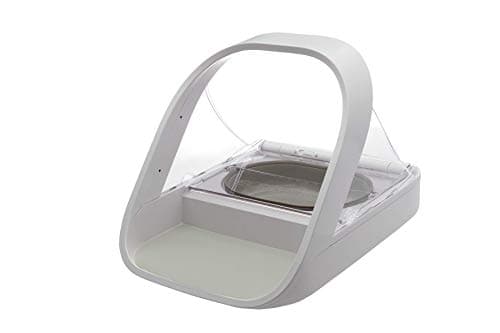
#ad Price as of October 22, 2026. Prices move; we check daily. How we're funded.
The only feeder here that solves the actual multi-cat feeding problem, which is not portioning -- it is one cat eating another cat's food.
Published specs
| Bowl capacity | 400 ml, or two pouches of wet food |
|---|---|
| Pets stored | Up to 32 identities |
| Food types | Wet and dry |
| Power | 4 x C cells, 6-month stated battery life |
| Warranty | 3 years from date of purchase |
| Opens for | Registered microchips or a collar tag |
Source: Sure Petcare -- SureFeed Microchip Pet Feeder product page
Sure Petcare states 6 months from a set of 4 C cells, so 8 cells a year per feeder. In a three-cat house you need one feeder per cat on a controlled diet -- 24 cells a year for three. That is the running cost nobody mentions.
What the specs favor
- Stores up to 32 pet identities -- more than any household needs
- Works with an existing microchip, no new collar required
- Takes wet food, which almost no automatic feeder does
- Three-year warranty, the longest here
What they don't
- Battery only -- 8 C cells a year, per feeder
- One feeder feeds one cat, so a three-cat house needs three
- 400 ml bowl is a meal, not a hopper -- it does not solve holidays
Your problem is being out all day rather than food stealing. This is a lid that opens for the right cat, not a scheduled dispenser -- it will not feed anyone at 6pm on its own.
How it scores
Scores are our editorial weighting of the published specs above, not a test result. They are deliberately kept out of this page's structured data.
Cat Mate C500 5-Meal Automatic Feeder
Cat Mate · Automatic feeder · Our score 8.0/10
#ad No verified live price right now, so we show none rather than a stale one. How we're funded.
Five sealed compartments and twin ice packs, running for up to a year on three AA cells -- the only credible way to put wet food on a schedule.
Published specs
| Meals | 1 immediate + 4 timed |
|---|---|
| Compartment capacity | 11.5 oz (330 g) each |
| Food types | Wet and dry |
| Cooling | Twin ice packs, about 6-8 hours indoors |
| Power | 3 x AA, up to 12 months |
| Suits | Up to two cats or a small dog (maker) |
Source: Chewy -- Cat Mate C500 Digital 5 Meal Automatic Feeder listing
Cat Mate publishes 6-8 hours of indoor cooling from the twin ice packs, not five meals' worth. So the honest read is that this covers a working day, not a weekend -- the 5-meal capacity is about portioning across that day, not about leaving the house for longer.
What the specs favor
- Handles wet food, which no hopper feeder does
- Published compartment capacity in ounces and grams
- Battery-only, so a power cut does not skip a meal
- Up to 12 months from three AA cells
What they don't
- Cooling is published at 6-8 hours indoors, so this is a day, not a trip
- Five compartments is a hard ceiling -- no top-up without opening it
- Shared tray, so it cannot separate two cats' diets
You are away overnight and feeding wet food. Read the published cooling window rather than the meal count: 6-8 hours is the number that governs food safety here.
How it scores
Scores are our editorial weighting of the published specs above, not a test result. They are deliberately kept out of this page's structured data.
PetSafe Smart Feed, 2nd Generation
PetSafe · Automatic feeder · Our score 7.9/10
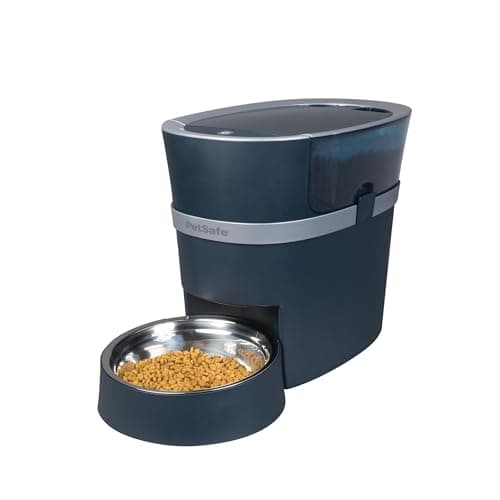
#ad Price as of October 22, 2026. Prices move; we check daily. How we're funded.
24 cups of hopper and portions from an eighth of a cup up to four cups -- the widest published portion range of any feeder on this page.
Published specs
| Hopper capacity | 24 cups (6 L) |
|---|---|
| Portion range | 1/8 cup to 4 cups |
| Meals per day | Up to 12 |
| Dimensions | 20.3" x 9.4" x 12.6" |
| Slow feed | Dispenses a meal over 15 minutes |
| Dishwasher | Lid, hopper, bowl and holder, top shelf |
| Food type | Dry or semi-moist |
Source: PetSafe -- Smart Feed Automatic Dog and Cat Feeder, 2nd Generation
24 cups of hopper. Three cats eating half a cup each per day is 1.5 cups daily, so about 16 days. The slow-feed setting spreads one meal over 15 minutes, which is the published feature that matters if one of your cats inhales food and then takes the other's.
What the specs favor
- Largest published hopper here at 24 cups
- Portions from 1/8 cup to 4 cups -- the widest range on this page
- Slow feed spreads a meal over 15 minutes
- All food-contact parts are dishwasher safe
What they don't
- Single bowl, so no separation between cats
- Dry or semi-moist only
- 20 inches long -- it takes real counter or floor space
You feed wet food. Nothing about this feeder handles it, and leaving wet food in an open bowl on a timer is a food-safety problem, not a convenience.
How it scores
Scores are our editorial weighting of the published specs above, not a test result. They are deliberately kept out of this page's structured data.
Common questions
How do you feed cats different diets in the same house?
Do microchip cat feeders work?
How do I stop one cat eating the other cat's food?
Can you feed a prescription diet with other cats around?
Is free feeding bad in a multi-cat house?
Sources
- Sure Petcare -- SureFeed Microchip Pet Feeder product page (400 ml bowl, up to 32 pets, 6-month battery)
- Chewy -- Cat Mate C500 Digital 5 Meal Automatic Feeder listing
- PetSafe -- Smart Feed Automatic Dog and Cat Feeder, 2nd Generation
- PetSafe -- Interior 2-Way Locking Cat Door (5 3/4 in square flap, up to 15 lb, 1/2-2 in door thickness)
- Cornell Feline Health Center -- Feline Lower Urinary Tract Disease
Read next
- Resource Competition Between Cats
How to recognize resource guarding, why it rarely looks like fighting, and the environmental changes that reduce it.
- Best Automatic Cat Feeders for Multiple Cats (2026)
Ranked on whether a feeder can actually separate two cats' food, plus the battery and hopper arithmetic nobody publishes.
- How to Introduce a New Cat
A staged cat introduction, the resource counts to have in place first, and the gear each stage actually needs.
- Best Microchip Cat Doors (2026)
Microchip and manual cat doors compared on stored identities, flap aperture and published cut-out, with the two specs that actually decide it.
- Best Portion Control Cat Feeders (2026)
Feeders that publish portion sizes in real units, plus how to set one from the ration on your food bag.
- How to Stop Cats Fighting Over Food
Why side-by-side bowls create conflict, the separation rules that fix most of it, and how to find out who is actually stealing from whom.
- Best Cat Scales (2026)
Scales ranked on the specs that matter for a moving animal: a published hold function and a trend memory, not the grams of resolution the category advertises.