Beds, Carriers & Daily Care
Best Microchip Cat Doors (2026)
One door stores 32 identities with a shorter flap. One stores 9 with an inch more headroom. Which spec binds depends on your cats, not your budget.
Affiliate disclosure: we earn a commission if you buy through our links, at no extra cost to you. It never changes which product we rank first — here is how we're funded.
Everyone in this category says they tested twenty litter boxes. We have not tested any, and we say so. What we do instead: compile the published specs, read the manuals, and do the arithmetic on what this gear costs to run and how it behaves once there is more than one cat using it. Every spec is linked to the document it came from. Prices are checked daily — last verified October 21, 2026. Here is exactly how we pick.
Quick picks
Ranked on the published specs and the arithmetic below. Tap any row to jump to the full write-up. We have not tested these — here is exactly how we pick.
| # | Product | Best for | Score | Price |
|---|---|---|---|---|
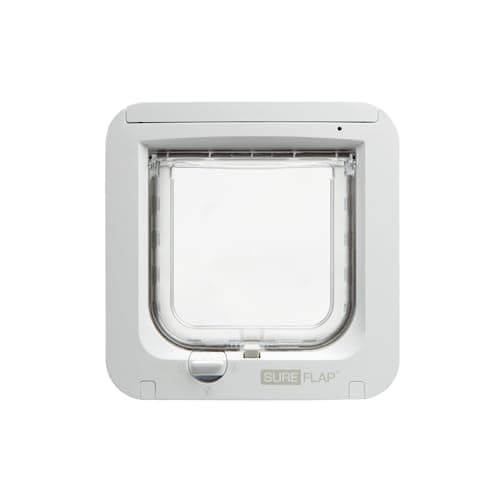
| 1 | SureFlap Microchip Cat Door Thirty-two stored identities against nine on the nearest competitor, which is the spec that decides whether a microchip door scales past a small household. | A household with more cats than one | 8.7 | |
| 2 | 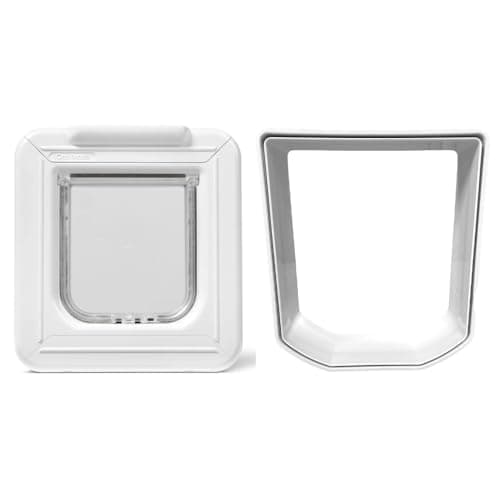 Cat Mate Elite 355 Microchip Cat Flap Nine identities and the one feature the SureFlap does not publish: a timer, so the door locks itself at dusk without anyone remembering to. | A curfew you do not have to enforce yourself | 8.0 | |
| 3 | 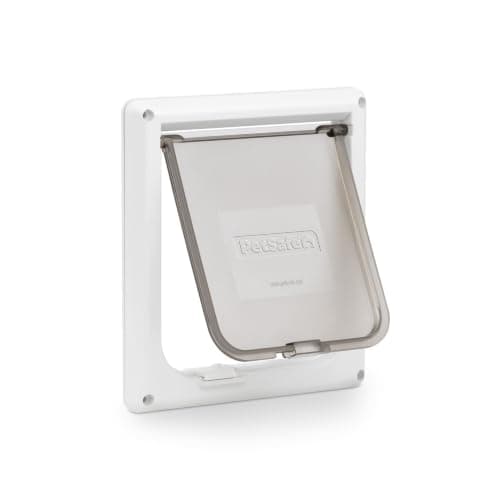 PetSafe Interior 2-Way Locking Cat Door No electronics, no batteries and no chip -- a latch and a flap, which is all an interior door between two rooms in the same house actually needs. | Giving one cat a room the others cannot enter | 7.9 |
#ad Buy links are affiliate links. Prices come from a live daily check; where we have no verified price we say "check price" rather than print a stale one.
A microchip cat door is bought for one of two reasons: keeping other people’s cats out, or keeping your own cats apart. Those two reasons point at different products, and the published specs make it clear which is which.
The published numbers
| Door | Identities | Flap opening | Cut-out |
|---|---|---|---|
| SureFlap Microchip Cat Door | Up to 32 | 5 5/8" x 4 3/4" | 6 1/2" x 6 3/4" (8 3/8" circle in glass) |
| Cat Mate Elite 355 | Up to 9 | 145 x 145 mm (5.71" square) | 7 1/16" x 8 1/16" |
| PetSafe Interior 2-Way | None; manual latch | 5 3/4" x 5 3/4" | 6 9/16" x 6 13/16" |
All figures are the manufacturers' own. Metric-to-inch conversion of the Cat Mate flap is ours.
Cat Mate publishes 145 mm square. 145 / 25.4 = 5.71 inches square.
SureFlap publishes 5 5/8 by 4 3/4 inches — 5.625 wide, 4.75 high.
Nearly the same width, but almost a full inch more height on the Cat Mate. For a broad-chested or long-legged cat, that single inch outranks the identity count entirely.
Which problem are you solving
Keeping strange cats out. This is the microchip door’s real job. A neighborhood cat coming in to eat, spray or fight is a genuine multi-cat stressor, and a chip-reading door ends it in a way nothing else does. Either SureFlap or Cat Mate does this.
Managing your own cats indoors. If one cat needs a feeding room, a litter room, or a refuge the others cannot follow it into, you do not need a chip reader. PetSafe’s interior 2-way door publishes the largest flap opening in this comparison at 5 3/4 inches square, precisely because it has no reader hardware crowding the aperture, and it cannot fail locked because it has no batteries.
The feature only one of them has
Cat Mate’s Elite 355 publishes a digital timer with an LCD display, which means the door can enforce a curfew without anyone remembering to. For anyone who lets cats out but wants them in before dark, that is worth more than 23 extra identity slots.
SureFlap’s equivalent is manual: a lock, and an in-only mode. In-only is the underrated setting — the one that gets a cat home the night before a veterinary appointment without a search of the neighborhood at 7am.
A powered door is a door that can fail
Both microchip doors run on 4 AA cells with a published life of about 12 months. Two consequences follow that no listing puts up front:
- A dead door is a locked door. Set a reminder for eleven months, not thirteen.
- Cold weather shortens cell life. An exterior door in winter is the worst case for alkaline cells, and it is also when you least want a cat shut out.
What a door fixes in a multi-cat house
The Ohio State Indoor Pet Initiative frames most multi-cat friction as competition over resources and territory. A selective door is one of the few interventions that changes the territory itself rather than adding another bowl to it — it can give one cat a room that is genuinely, reliably its own.
If the specific competition is over food rather than space, a microchip feeder is the more precise instrument, and we cover that separately.
The picks in full
Specs are the manufacturer's own, linked to the page they came from. Prices come from a live daily check; where we have no verified price we say so rather than print a stale one.
SureFlap Microchip Cat Door
Sure Petcare · Microchip cat door · Our score 8.7/10
#ad Price as of October 21, 2026. Prices move; we check daily. How we're funded.
Thirty-two stored identities against nine on the nearest competitor, which is the spec that decides whether a microchip door scales past a small household.
Published specs
| Identities stored | Up to 32 |
|---|---|
| Chip compatibility | All common identification microchips and SureFlap RFID collar tags |
| Flap opening | 5 5/8" x 4 3/4" |
| Tunnel depth | 2 3/4" |
| Cut-out | 6 1/2" W x 6 3/4" H |
| Glass cut-out | 8 3/8" diameter, up to 10 1/4" |
| Exterior frame | 8 1/4" W x 8 1/4" H |
| Battery | 4 x AA, up to 12 months |
| Modes | Manual lock, in-only |
Cornell's guidance on resource counts scales with cat numbers, and so does this. At 32 identities you will run out of house before you run out of memory slots. Cat Mate's Elite publishes 9 -- fine for most homes, a real ceiling for a foster or rescue setting.
What the specs favor
- 32 stored identities, by a wide margin the largest here
- Works with all common chip standards and with collar tags
- Fits doors, walls and glass, with a published cut-out for each
- In-only mode, which is the setting that gets a cat home before a vet appointment
What they don't
- Runs on 4 AA batteries with a published 12-month life -- a dead door is a locked door
- Flap opening of 5 5/8 by 4 3/4 inches is tight for a large breed
- Glass installation needs a hole cut by a glazier
You have one indoor cat and a spare room to control access to. This is an outdoor-access product with a microchip reader, and an interior latch door does that job for a fraction of the work.
How it scores
Scores are our editorial weighting of the published specs above, not a test result. They are deliberately kept out of this page's structured data.
Cat Mate Elite 355 Microchip Cat Flap
Cat Mate · Microchip cat door · Our score 8.0/10
#ad Price as of October 21, 2026. Prices move; we check daily. How we're funded.
Nine identities and the one feature the SureFlap does not publish: a timer, so the door locks itself at dusk without anyone remembering to.
Published specs
| Identities stored | Up to 9 cats |
|---|---|
| Chip compatibility | 15-digit ISO microchips |
| Flap opening | 145 mm x 145 mm |
| Cut-out | 7 1/16" W x 8 1/16" H |
| Overall size | 9 3/4" W x 10 3/8" H |
| Battery | 4 x AA, approximately 12 months |
| Control | Digital timer with LCD display |
145 mm is 5.71 inches. So the Cat Mate opening is 5.71 by 5.71 inches against SureFlap's 5.625 by 4.75. Nearly an inch more height. For a broad-chested or long-legged cat that difference is the whole decision, and it goes the other way from the identity count.
What the specs favor
- Timer control locks the flap on a schedule with no human in the loop
- Taller flap opening than the SureFlap by nearly an inch
- LCD display shows the current mode rather than a colored light
- Same 12-month published battery life on the same 4 AA cells
What they don't
- 9 identities against SureFlap's 32
- 15-digit ISO chips only, a narrower compatibility statement
- Larger cut-out, so it is not a drop-in replacement for a smaller flap
You foster, or you have more than nine cats through the house. The identity limit is a hard one and there is no way around it.
How it scores
Scores are our editorial weighting of the published specs above, not a test result. They are deliberately kept out of this page's structured data.
PetSafe Interior 2-Way Locking Cat Door
PetSafe · Interior cat door · Our score 7.9/10
#ad Price as of October 21, 2026. Prices move; we check daily. How we're funded.
No electronics, no batteries and no chip -- a latch and a flap, which is all an interior door between two rooms in the same house actually needs.
Published specs
| Flap opening | 5 3/4" x 5 3/4" |
|---|---|
| Frame | 7 1/2" x 7 7/8" |
| Cut-out | 6 9/16" x 6 13/16" |
| Published pet weight | Cats or dogs up to 15 lb |
| Door thickness | 1/2" to 2" |
| Locking | 2-way manual lock |
| Included | Foam tape, screws, cutting template, manual |
PetSafe publishes a 5.75 inch square opening. SureFlap publishes 4.75 inches of height. A full inch more headroom, on the cheapest door here, because it has no reader hardware to fit around the aperture.
What the specs favor
- Largest flap opening in this comparison, and no reader hardware crowding it
- No batteries, so it cannot fail locked
- Cutting template and hardware included
- Published door thickness range of half an inch to two inches
What they don't
- No selectivity at all -- every cat under 15 lb goes through
- Manual lock means someone has to set it
- Interior only; not weather-sealed for an exterior door
The problem you are solving is one cat eating another cat's food. Without selectivity this door does not solve it, and a microchip door or microchip feeder does.
How it scores
Scores are our editorial weighting of the published specs above, not a test result. They are deliberately kept out of this page's structured data.
Common questions
What is the best microchip cat door?
How many cats can a microchip cat door hold?
Do microchip cat doors work with all microchips?
How big a hole does a cat door need?
Do I need a microchip door for an indoor cat?
Sources
- Sure Petcare -- SureFlap Microchip Cat Flap specifications (32 identities, 5 5/8 x 4 3/4 in flap, 6 1/2 x 6 3/4 in cut-out, 4 x AA up to 12 months)
- Cat Mate -- Elite 355 Microchip Cat Flap with Timer listing (up to 9 cats, 15-digit ISO chips, 145 x 145 mm flap, 7 1/16 x 8 1/16 in cut-out)
- PetSafe -- Interior 2-Way Locking Cat Door (5 3/4 in square flap, 7 1/2 x 7 7/8 in frame, 6 9/16 x 6 13/16 in cut-out, up to 15 lb, 1/2-2 in door)
- Ohio State University Indoor Pet Initiative -- For Cat Owners
Read next
- How to Install a Cat Door
Sizing, positioning and cutting a cat door opening, with published cut-out figures for three doors and the step-height arithmetic.
- Feeding Cats on Different Diets
Four ways to feed cats different diets in one household, ranked by whether they still work when nobody is home.
- Resource Competition Between Cats
How to recognize resource guarding, why it rarely looks like fighting, and the environmental changes that reduce it.
- Best Automatic Cat Feeders for Multiple Cats (2026)
Ranked on whether a feeder can actually separate two cats' food, plus the battery and hopper arithmetic nobody publishes.
- Best Cat Harnesses (2026)
Three cat harnesses compared on published girth ranges, closure type and the escape mechanics that decide whether any of it matters.
- Best Cat Gates and Pet Doors for Multi-Pet Homes (2026)
A walk-through gate with a cat door, an interior cat door and a microchip door compared on what each one keeps out -- and what none of them can.