Beds, Carriers & Daily Care
How to Install a Cat Door
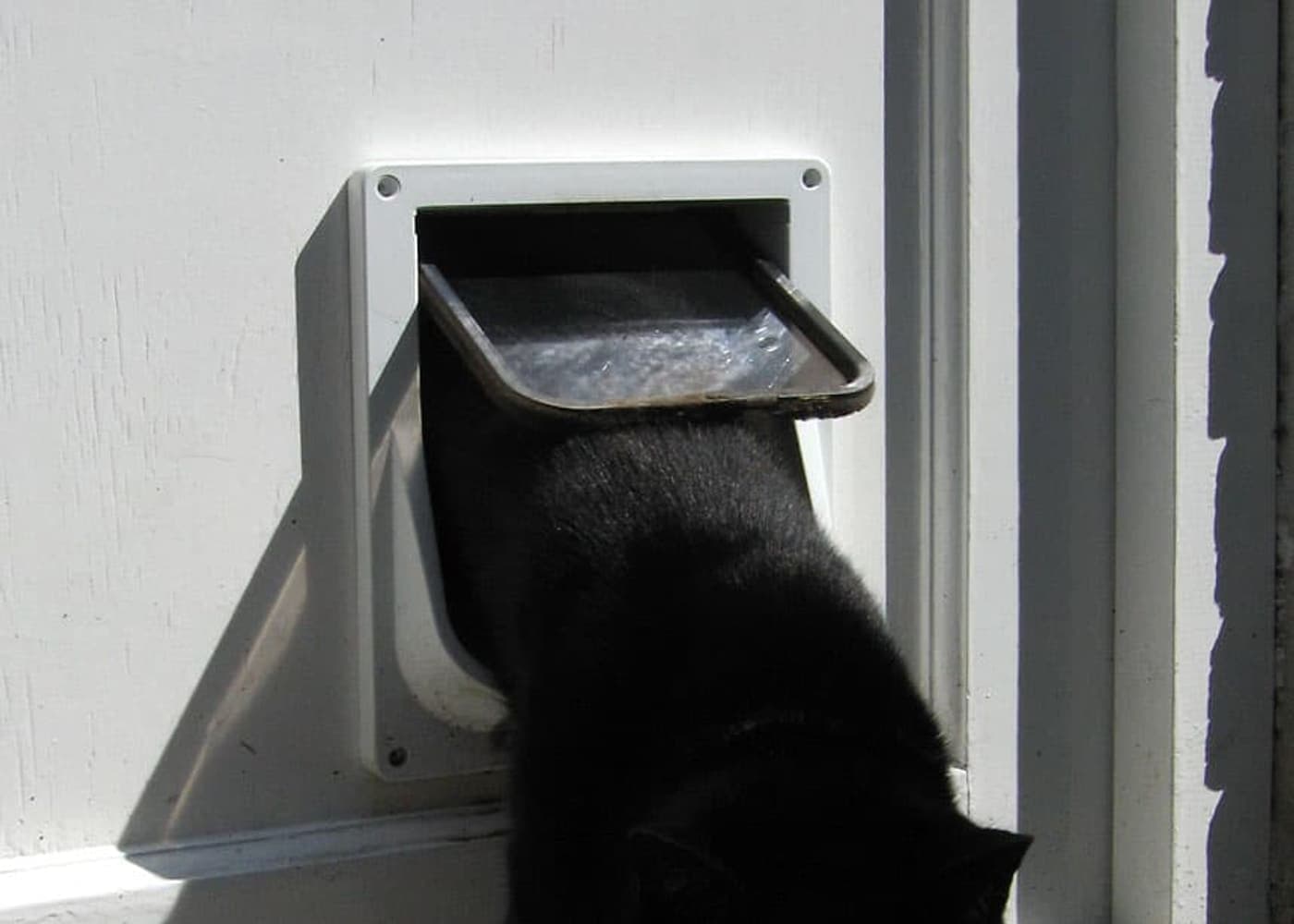
The cut-out dimension is published. The height off the floor is not, and it is the one people get wrong.
Affiliate disclosure: we earn a commission if you buy through our links, at no extra cost to you. It never changes which product we rank first — here is how we're funded.
Everyone in this category says they tested twenty litter boxes. We have not tested any, and we say so. What we do instead: compile the published specs, read the manuals, and do the arithmetic on what this gear costs to run and how it behaves once there is more than one cat using it. Every spec is linked to the document it came from. Prices are checked daily — last verified October 21, 2026. Here is exactly how we pick.
Fitting a cat door is a twenty-minute job and a permanent decision. Two numbers govern it: the cut-out the manufacturer publishes, and the step height it does not.
Published cut-outs are not interchangeable
| Door | Cut-out | Frame | Surfaces |
|---|---|---|---|
| SureFlap Microchip | 6 1/2" W x 6 3/4" H | 8 1/4" x 8 1/4" | Door, wall, glass (8 3/8" circle) |
| Cat Mate Elite 355 | 7 1/16" W x 8 1/16" H | 9 3/4" x 10 3/8" | UPVC, glass, wood |
| PetSafe Interior 2-Way | 6 9/16" W x 6 13/16" H | 7 1/2" x 7 7/8" | Interior doors 1/2" to 2" thick |
Manufacturers' published figures. The spread between the smallest and largest cut-out here is over an inch in both axes.
The step height nobody publishes
Manufacturers publish how big the hole is. None of them publish how far off the floor it should be, because that depends on your cat.
Measure floor to the bottom of the chest with the cat standing — its belly height. For a typical adult cat this is roughly 5 to 7 inches.
Set the bottom of the flap opening at about that height. Then the cat steps through at its natural walking height instead of climbing over a sill or ducking under a lintel.
Too low and the cat has to crouch. Too high and it has to hop, which an arthritic cat will stop doing — and a cat that stops using a door is the most expensive possible outcome of a cheap measurement.
Cutting the opening
- Check what is inside the door. A hollow-core interior door has a cardboard honeycomb; that is fine for a flap but gives nothing to screw into beyond the frame itself.
- Tape the template down and mark both faces. Marking one side and drilling through gets you an opening that is square on the front and not on the back.
- Drill the corners first, then join them. Corner holes give a jigsaw blade somewhere to turn and stop the cut overrunning.
- Cut from the visible side. Jigsaws tear on the upstroke, so the tidy face is the one facing you.
- Test fit before you fix anything. Ease the opening with a file rather than forcing the frame into a tight hole.
- Seal the exposed core. Any cut through an exterior door exposes end grain that will take on water if it is not sealed.
Glass and walls
SureFlap publishes an 8 3/8 inch diameter circular cut-out for glass, able to accommodate up to 10 1/4 inches. That is a glazier’s job. Toughened glass cannot be cut after manufacture at all, so in practice the pane gets replaced with one made to size — get that quote before you buy the door.
Walls need a tunnel extension to bridge the thickness, sold separately by every manufacturer here, and they are not cross-compatible. Check the wall for cables and pipes before cutting, exactly as you would before mounting anything to a wall.
Teaching the door
A flap is a barrier that moves and then hits the cat on the back. From a cat’s point of view that is a reasonable thing to distrust.
- Tape it fully open for several days. Let the route become ordinary before the flap becomes part of it.
- Lower it in stages. Half open, then closed, over a week.
- Never push the cat through. One bad experience is enough to put a cat off a flap for good.
- Feed on the far side. A reason to go through beats encouragement to go through.
What a cat door costs you in security
The gear discussed here
Specs are the manufacturer's own, linked to the page they came from. Prices come from a live daily check; where we have no verified price we say so rather than print a stale one.
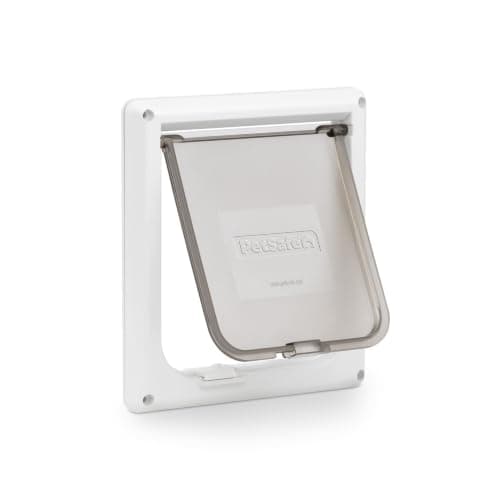
PetSafe Interior 2-Way Locking Cat Door
PetSafe · Interior cat door · Our score 7.9/10
#ad Price as of October 21, 2026. Prices move; we check daily. How we're funded.
No electronics, no batteries and no chip -- a latch and a flap, which is all an interior door between two rooms in the same house actually needs.
Published specs
| Flap opening | 5 3/4" x 5 3/4" |
|---|---|
| Frame | 7 1/2" x 7 7/8" |
| Cut-out | 6 9/16" x 6 13/16" |
| Published pet weight | Cats or dogs up to 15 lb |
| Door thickness | 1/2" to 2" |
| Locking | 2-way manual lock |
| Included | Foam tape, screws, cutting template, manual |
PetSafe publishes a 5.75 inch square opening. SureFlap publishes 4.75 inches of height. A full inch more headroom, on the cheapest door here, because it has no reader hardware to fit around the aperture.
What the specs favor
- Largest flap opening in this comparison, and no reader hardware crowding it
- No batteries, so it cannot fail locked
- Cutting template and hardware included
- Published door thickness range of half an inch to two inches
What they don't
- No selectivity at all -- every cat under 15 lb goes through
- Manual lock means someone has to set it
- Interior only; not weather-sealed for an exterior door
The problem you are solving is one cat eating another cat's food. Without selectivity this door does not solve it, and a microchip door or microchip feeder does.
How it scores
Scores are our editorial weighting of the published specs above, not a test result. They are deliberately kept out of this page's structured data.
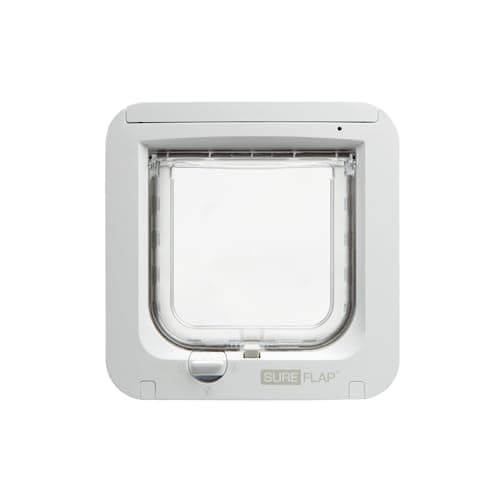
SureFlap Microchip Cat Door
Sure Petcare · Microchip cat door · Our score 8.7/10
#ad Price as of October 21, 2026. Prices move; we check daily. How we're funded.
Thirty-two stored identities against nine on the nearest competitor, which is the spec that decides whether a microchip door scales past a small household.
Published specs
| Identities stored | Up to 32 |
|---|---|
| Chip compatibility | All common identification microchips and SureFlap RFID collar tags |
| Flap opening | 5 5/8" x 4 3/4" |
| Tunnel depth | 2 3/4" |
| Cut-out | 6 1/2" W x 6 3/4" H |
| Glass cut-out | 8 3/8" diameter, up to 10 1/4" |
| Exterior frame | 8 1/4" W x 8 1/4" H |
| Battery | 4 x AA, up to 12 months |
| Modes | Manual lock, in-only |
Cornell's guidance on resource counts scales with cat numbers, and so does this. At 32 identities you will run out of house before you run out of memory slots. Cat Mate's Elite publishes 9 -- fine for most homes, a real ceiling for a foster or rescue setting.
What the specs favor
- 32 stored identities, by a wide margin the largest here
- Works with all common chip standards and with collar tags
- Fits doors, walls and glass, with a published cut-out for each
- In-only mode, which is the setting that gets a cat home before a vet appointment
What they don't
- Runs on 4 AA batteries with a published 12-month life -- a dead door is a locked door
- Flap opening of 5 5/8 by 4 3/4 inches is tight for a large breed
- Glass installation needs a hole cut by a glazier
You have one indoor cat and a spare room to control access to. This is an outdoor-access product with a microchip reader, and an interior latch door does that job for a fraction of the work.
How it scores
Scores are our editorial weighting of the published specs above, not a test result. They are deliberately kept out of this page's structured data.
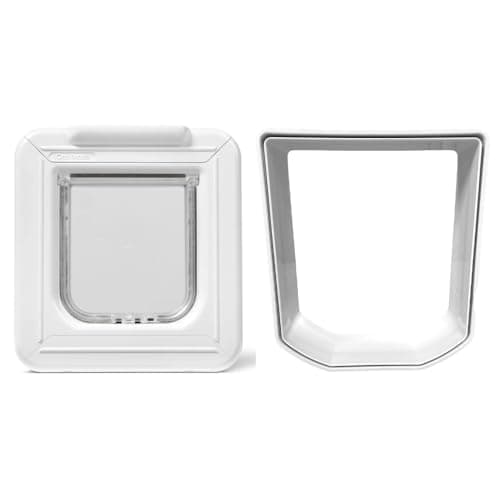
Cat Mate Elite 355 Microchip Cat Flap
Cat Mate · Microchip cat door · Our score 8.0/10
#ad Price as of October 21, 2026. Prices move; we check daily. How we're funded.
Nine identities and the one feature the SureFlap does not publish: a timer, so the door locks itself at dusk without anyone remembering to.
Published specs
| Identities stored | Up to 9 cats |
|---|---|
| Chip compatibility | 15-digit ISO microchips |
| Flap opening | 145 mm x 145 mm |
| Cut-out | 7 1/16" W x 8 1/16" H |
| Overall size | 9 3/4" W x 10 3/8" H |
| Battery | 4 x AA, approximately 12 months |
| Control | Digital timer with LCD display |
145 mm is 5.71 inches. So the Cat Mate opening is 5.71 by 5.71 inches against SureFlap's 5.625 by 4.75. Nearly an inch more height. For a broad-chested or long-legged cat that difference is the whole decision, and it goes the other way from the identity count.
What the specs favor
- Timer control locks the flap on a schedule with no human in the loop
- Taller flap opening than the SureFlap by nearly an inch
- LCD display shows the current mode rather than a colored light
- Same 12-month published battery life on the same 4 AA cells
What they don't
- 9 identities against SureFlap's 32
- 15-digit ISO chips only, a narrower compatibility statement
- Larger cut-out, so it is not a drop-in replacement for a smaller flap
You foster, or you have more than nine cats through the house. The identity limit is a hard one and there is no way around it.
How it scores
Scores are our editorial weighting of the published specs above, not a test result. They are deliberately kept out of this page's structured data.
Common questions
How high should a cat door be off the floor?
What size hole do I cut for a cat door?
Can you put a cat door in glass?
How do I get my cat to use a cat door?
Can you fit a cat door in a rented home?
Sources
- Sure Petcare -- SureFlap Microchip Cat Flap specifications (32 identities, 5 5/8 x 4 3/4 in flap, 6 1/2 x 6 3/4 in cut-out, 4 x AA up to 12 months)
- PetSafe -- Interior 2-Way Locking Cat Door (5 3/4 in square flap, 7 1/2 x 7 7/8 in frame, 6 9/16 x 6 13/16 in cut-out, up to 15 lb, 1/2-2 in door)
- Cat Mate -- Elite 355 Microchip Cat Flap with Timer listing (up to 9 cats, 15-digit ISO chips, 145 x 145 mm flap, 7 1/16 x 8 1/16 in cut-out)
- Ohio State University Indoor Pet Initiative -- For Cat Owners
Read next
- Best Microchip Cat Doors (2026)
Microchip and manual cat doors compared on stored identities, flap aperture and published cut-out, with the two specs that actually decide it.
- Mounting Cat Shelves Safely
Studs, anchors, shelf depth and rise spacing -- the practical detail that decides whether a shelf run is safe and whether an old cat will use it.
- Resource Competition Between Cats
How to recognize resource guarding, why it rarely looks like fighting, and the environmental changes that reduce it.
- Best Litter Boxes for Small Apartments (2026)
Ranked on interior floor per square foot occupied, with a workable multi-box plan for a one-bedroom flat.
- Best Cat Carriers (2026)
Three carriers compared on published interior space, weight limits and crash certification -- and which of the three jobs each one is for.