Scratchers & Furniture Protection
Why Cats Scratch
Scratching does four separate jobs at once. Every one of them is a need, which is why punishment has never worked on any of them.
Affiliate disclosure: we earn a commission if you buy through our links, at no extra cost to you. It never changes which product we rank first — here is how we're funded.
Everyone in this category says they tested twenty litter boxes. We have not tested any, and we say so. What we do instead: compile the published specs, read the manuals, and do the arithmetic on what this gear costs to run and how it behaves once there is more than one cat using it. Every spec is linked to the document it came from. Prices are checked daily — last verified October 22, 2026. Here is exactly how we pick.
Almost every scratching product decision follows from one thing: what a cat is actually doing when it scratches. It is four jobs, not one, and they have different implications.
The four jobs
- Claw maintenance. Scratching strips the worn outer sheath from the claw, exposing the sharp layer beneath. This is why you find crescent-shaped husks near a well-used post — those are shed sheaths, not broken claws.
- Stretching. A cat scratching vertically extends its spine, shoulders and forelimbs against resistance. That is why a post that moves fails: resistance is the point.
- Scent marking. There are glands between the toes. Scratching deposits scent that other cats read.
- Visual marking. The shredded surface is itself a signal, meant to be seen. Which is why cats scratch in prominent places rather than hidden ones.
Why furniture wins
| Requirement | Sofa arm | Cheap post |
|---|---|---|
| Tall enough for a full stretch | Yes | Often not -- many are under 24" |
| Completely rigid | Yes -- it is furniture | Only if the base is heavy or wide |
| In a socially important room | Yes | Usually in a hallway or a corner |
| Carries household scent | Yes | No, until the cat marks it |
Our comparison. The sofa is not a failure of training; it is the best available option meeting all four criteria.
Read that table and the product decision follows. A 32 inch post on a 16 inch square base exists to beat the sofa on the first two rows, and putting it in the living room rather than the hall handles the third.
Vertical or horizontal is a preference
Cats differ, and the difference is stable over a lifetime. A cat that works on the carpet wants a horizontal surface and will keep ignoring vertical posts. A horizontal lounge is not a lesser product for that cat, it is the correct one, and our sisal against cardboard comparison works through the texture question alongside it.
When scratching increases
Because two of the four jobs are marking, scratching rises when a cat feels it needs to mark — and the Ohio State Indoor Pet Initiative connects that to change and to competition. New cat, cat visible through a window, rearranged furniture, a new person in the house.
Scratching in new locations, especially near doorways and windows, is worth reading as information rather than misbehavior. Our tension guide covers what else to look for.
Why telling a cat off does not work
Punishment can suppress a behavior in your presence. It cannot remove a need, so the scratching moves — to when you are out, or to a different piece of furniture. You lose the information and keep the problem.
The approach that does work is two-sided: make the wrong surface unpleasant with something like furniture tape and put a better surface within a foot of it on the same day. Our stop-scratching guide runs through it in order, free fixes first.
The gear discussed here
Specs are the manufacturer's own, linked to the page they came from. Prices come from a live daily check; where we have no verified price we say so rather than print a stale one.
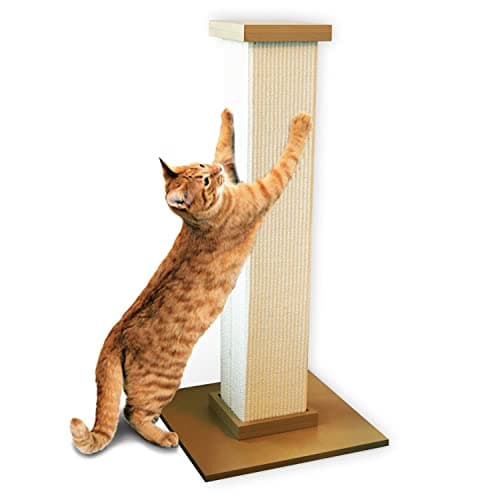
SmartCat Ultimate Scratching Post
Pioneer Pet · Scratching post · Our score 8.9/10
#ad Price as of October 22, 2026. Prices move; we check daily. How we're funded.
32 inches tall on a 16-inch square base in woven sisal -- tall enough for a full stretch, which is the single reason cats reject most posts.
Published specs
| Dimensions | 32" H x 16" W x 16" D |
|---|---|
| Base | 16" x 16" |
| Surface | Woven sisal fabric |
| Orientation | Vertical |
Source: Pioneer Pet -- #3832 The Ultimate Scratching Post product page
A large domestic cat stretched from front claws to hind feet runs roughly 30 inches. At 32 inches this post clears that; a typical 20-inch post from a pet-shop shelf does not, which is why the cat goes back to the sofa arm -- the sofa is tall enough and the post is not.
What the specs favor
- 32 inches is taller than the great majority of retail posts
- 16 x 16 inch base, which is what stops it rocking mid-scratch
- Woven sisal fabric rather than carpet, so it does not teach the cat that carpet is for scratching
- Nothing on it to wear out but the sisal
What they don't
- Only one scratching surface
- Vertical only, and some cats are horizontal scratchers
- Plain -- it looks like what it is
Your cat scratches the carpet rather than the furniture. That is a horizontal scratcher, and a vertical post will not redirect it.
How it scores
Scores are our editorial weighting of the published specs above, not a test result. They are deliberately kept out of this page's structured data.
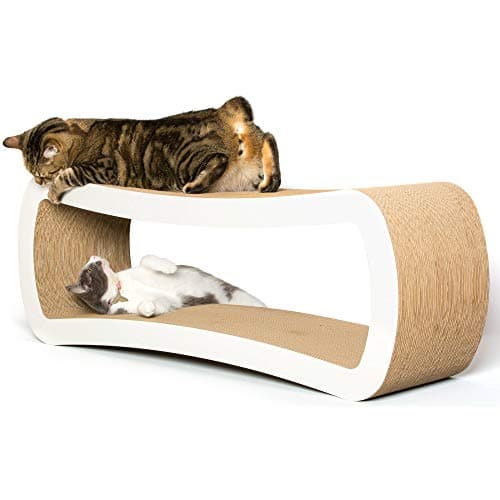
PetFusion Ultimate Cat Scratcher Lounge
PetFusion · Cardboard scratcher · Our score 8.0/10
#ad Price as of October 22, 2026. Prices move; we check daily. How we're funded.
34 inches of reversible corrugate -- the horizontal answer for the cat that is destroying carpet rather than furniture, and it doubles as somewhere to sleep.
Published specs
| Dimensions | 34" L x 10.5" W x 10.5" H |
|---|---|
| Weight | 7.5 lb |
| Material | Recycled cardboard, corn-starch glue |
| Reversible | Yes -- both sides scratchable |
Source: Chewy -- PetFusion Ultimate Cat Scratcher Lounge listing
Reversible means both faces are usable, so one lounge is two pads. Against the flat single-sided cardboard pads sold in threes, that is twice the surface before it goes in the recycling -- the entire economic argument for buying one good scratcher instead of a stack of cheap ones.
What the specs favor
- 34 inches long -- a cat can lie on it and scratch at the same time
- Reversible, doubling usable life
- Corn-starch glue, so nothing unpleasant when the cat chews the edge
- Wide enough that two cats occasionally tolerate sharing it
What they don't
- Cardboard sheds, and it sheds where the cat scratches
- Consumable by design -- it is a wear part
- Will not redirect a cat that scratches vertically
Your problem is the sofa arm. That is a vertical target and this is a horizontal product; the two are not interchangeable.
How it scores
Scores are our editorial weighting of the published specs above, not a test result. They are deliberately kept out of this page's structured data.
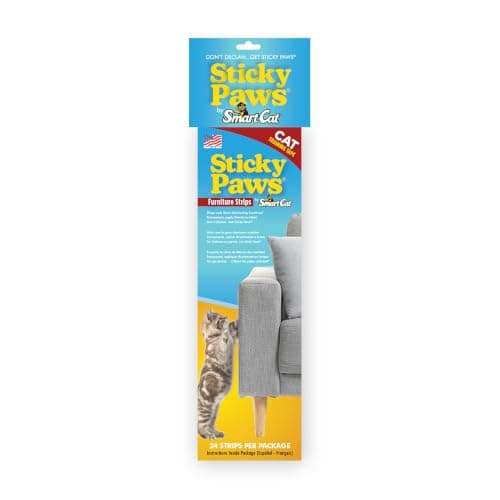
Sticky Paws Furniture Strips
Pioneer Pet · Furniture protector · Our score 6.9/10
#ad Price as of October 22, 2026. Prices move; we check daily. How we're funded.
Double-sided transparent tape that makes one arm of a sofa unpleasant -- genuinely effective, and worth nothing at all unless a scratching post goes up beside it the same day.
Published specs
| Strips | 24 per pack, roughly 2" x 12" each |
|---|---|
| XL sheets | Roughly 9" x 12" |
| On-a-Roll | Over 32 feet, cut to length |
| Adhesive | Transparent, medical grade, odor free |
| Mechanism | Two-sided tape, unpleasant to touch |
A typical sofa arm presents roughly 12 by 24 inches of scratchable face. At 2 by 12 inches a strip covers 24 square inches, so 288 / 24 = 12 strips for full coverage -- or about 6 spaced across the area cats actually target, which is the vertical face nearest the seat.
What the specs favor
- Works immediately, unlike anything that depends on the cat learning something
- Transparent, so it is not furniture-defacing while it is on
- Three formats, including a roll you can cut to any length
- Cheap enough to cover several targets at once
What they don't
- Treats the symptom -- scratching is a need, not a habit
- Adhesive can lift finish on some fabrics and leathers, so test a hidden patch
- Needs replacing as it collects hair and dust
You have not put a post up. Blocking every surface without giving a cat an approved one is how a scratching problem moves to the carpet instead of stopping.
How it scores
Scores are our editorial weighting of the published specs above, not a test result. They are deliberately kept out of this page's structured data.
Common questions
Why do cats scratch furniture?
Can you train a cat not to scratch?
Why does my cat scratch after waking up?
Do cats scratch to mark territory?
Why has my cat suddenly started scratching more?
Sources
Read next
- How to Stop a Cat Scratching the Furniture
Why cats scratch furniture, the free fixes that solve most cases, and the one purchase worth making if they do not.
- How to Train a Cat to Use a Scratching Post
A positive routine for getting a cat onto a scratching post, and the two common techniques that make things worse.
- Where to Put a Scratching Post
Why prominence beats tidiness, how many scratchers a multi-cat home needs, and how to move one without losing the habit.
- Best Cat Scratching Posts (2026)
Ranked on the three published specs that predict whether a cat uses a post: height, base width and surface material.
- Signs of Tension Between Cats
The quiet signals of multi-cat tension -- blocking, route changes, resource avoidance -- and what each one tells you to change.
- Best Cat Scratching Mats (2026)
Horizontal scratching mats compared on published area and surface, for the cat that scratches rugs and ignores every post.