Scratchers & Furniture Protection
How to Train a Cat to Use a Scratching Post
Most of this is not training. It is putting the right object in the right place and then not interfering.
Affiliate disclosure: we earn a commission if you buy through our links, at no extra cost to you. It never changes which product we rank first — here is how we're funded.
Everyone in this category says they tested twenty litter boxes. We have not tested any, and we say so. What we do instead: compile the published specs, read the manuals, and do the arithmetic on what this gear costs to run and how it behaves once there is more than one cat using it. Every spec is linked to the document it came from. Prices are checked daily — last verified October 22, 2026. Here is exactly how we pick.
The framing of this as a training problem is most of why it goes wrong. A cat that is not using a post is usually telling you about the post or where it is, not declining to learn.
Get these right first
No amount of technique compensates for a post that fails the specification. Our why cats scratch page explains what the four requirements are; here is the short version:
- Tall enough. 32 inches for a full adult stretch. This rules out most posts sold under that height.
- Rigid. A 16 inch square base or a wall fixing. Anything that rocks has failed.
- The right orientation. A carpet-scratching cat needs a horizontal surface, not a taller post.
- In the right room. Where the household is, and within a foot of whatever is currently being scratched.
The two techniques that backfire
- Taking the paws and dragging them down the post. This is the most widely repeated advice and it is counterproductive. It teaches the cat that approaching the post leads to being grabbed, and it transfers scent onto the cat from a surface it did not choose.
- Telling the cat off at the furniture. It suppresses scratching while you are watching, which means it moves to when you are not. You lose the chance to redirect and keep the damage.
What to do instead
- Place the post within a foot of the contested furniture. Not across the room. The location was chosen for a reason and the reason has not changed.
- Scent it, if your cat responds. Catnip or silver vine on the post. Our catnip and silver vine guide covers the published response rates — and what to do about the third of cats that ignore catnip entirely.
- Finish play sessions on the post. End a wand session with the lure landing on or beside the post. Cats grab, hold and rake at a caught toy — and they are doing it on the post.
- Reward what you see. Quiet praise or a treat, immediately, every time you catch the cat using it in the first fortnight.
- Make the wrong surface unpleasant on the same day. Not before, not a week later. Both halves at once — see our protectors page.
- Then leave it alone. Weeks, not days, and no further intervention.
Moving a post the cat has adopted
Once a post is in use you can usually relocate it, but not in one go. Move it a few feet a week toward where you would rather it lived.
If use drops off, you have gone too far or too fast. Move it back to the last position that worked and stop there — the Ohio State Indoor Pet Initiative treats scratching sites as territorially significant, and some positions genuinely cannot be traded for a tidier one.
More cats, more posts
Scratching is marking, and marking is competitive. In a multi-cat house a single post becomes a contested resource that the most confident cat controls, which leaves the others marking furniture instead.
One post per cat plus one, in different rooms, follows the same logic as litter box counts. Our resource competition guide covers why that number keeps recurring.
The gear discussed here
Specs are the manufacturer's own, linked to the page they came from. Prices come from a live daily check; where we have no verified price we say so rather than print a stale one.
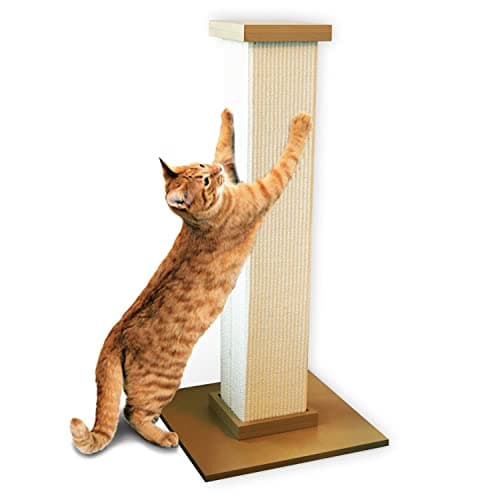
SmartCat Ultimate Scratching Post
Pioneer Pet · Scratching post · Our score 8.9/10
#ad Price as of October 22, 2026. Prices move; we check daily. How we're funded.
32 inches tall on a 16-inch square base in woven sisal -- tall enough for a full stretch, which is the single reason cats reject most posts.
Published specs
| Dimensions | 32" H x 16" W x 16" D |
|---|---|
| Base | 16" x 16" |
| Surface | Woven sisal fabric |
| Orientation | Vertical |
Source: Pioneer Pet -- #3832 The Ultimate Scratching Post product page
A large domestic cat stretched from front claws to hind feet runs roughly 30 inches. At 32 inches this post clears that; a typical 20-inch post from a pet-shop shelf does not, which is why the cat goes back to the sofa arm -- the sofa is tall enough and the post is not.
What the specs favor
- 32 inches is taller than the great majority of retail posts
- 16 x 16 inch base, which is what stops it rocking mid-scratch
- Woven sisal fabric rather than carpet, so it does not teach the cat that carpet is for scratching
- Nothing on it to wear out but the sisal
What they don't
- Only one scratching surface
- Vertical only, and some cats are horizontal scratchers
- Plain -- it looks like what it is
Your cat scratches the carpet rather than the furniture. That is a horizontal scratcher, and a vertical post will not redirect it.
How it scores
Scores are our editorial weighting of the published specs above, not a test result. They are deliberately kept out of this page's structured data.
Go Cat Da Bird Wand, 36-inch
Go Cat · Wand toy · Our score 8.8/10
#ad No verified live price right now, so we show none rather than a stale one. How we're funded.
A 36-inch rod on 50 lb braided line with feathers shaped to fly properly -- the only toy here that delivers the full hunt sequence, which is what boredom behavior is missing.
Published specs
| Rod length | 36" fiberglass, pull-apart |
|---|---|
| Line | 50 lb test braided nylon |
| Lure | Aerodynamically configured feathers |
| Refills | Feather attachments sold separately |
Source: Amazon -- Go Cat Da Bird Single Pole Teaser on 36-inch Rod listing
36 inches of rod and 32 inches of string is 68 inches of working radius, so the lure can travel a genuine arc across a room rather than bobbing in front of the cat. Short wands produce short, unconvincing movement, which is why cats lose interest in them within a minute.
What the specs favor
- 68 inches of combined reach -- real prey-like movement, not a bob
- 50 lb braided line does not snap mid-swing
- Rod pulls apart for storage
- Feather refills, so the rod outlasts many lures
What they don't
- Interactive only -- it does nothing while you are out
- Feathers are a consumable and a successful cat destroys them
- Must be put away; loose string is a swallowing hazard
You are looking for something to occupy the cat while you are at work. This one needs you on the other end of it, which is the whole point of it.
How it scores
Scores are our editorial weighting of the published specs above, not a test result. They are deliberately kept out of this page's structured data.
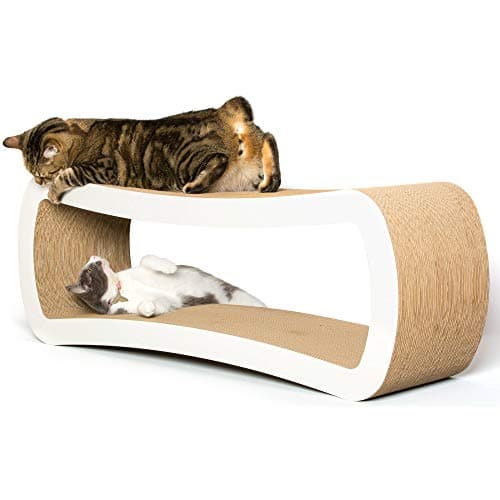
PetFusion Ultimate Cat Scratcher Lounge
PetFusion · Cardboard scratcher · Our score 8.0/10
#ad Price as of October 22, 2026. Prices move; we check daily. How we're funded.
34 inches of reversible corrugate -- the horizontal answer for the cat that is destroying carpet rather than furniture, and it doubles as somewhere to sleep.
Published specs
| Dimensions | 34" L x 10.5" W x 10.5" H |
|---|---|
| Weight | 7.5 lb |
| Material | Recycled cardboard, corn-starch glue |
| Reversible | Yes -- both sides scratchable |
Source: Chewy -- PetFusion Ultimate Cat Scratcher Lounge listing
Reversible means both faces are usable, so one lounge is two pads. Against the flat single-sided cardboard pads sold in threes, that is twice the surface before it goes in the recycling -- the entire economic argument for buying one good scratcher instead of a stack of cheap ones.
What the specs favor
- 34 inches long -- a cat can lie on it and scratch at the same time
- Reversible, doubling usable life
- Corn-starch glue, so nothing unpleasant when the cat chews the edge
- Wide enough that two cats occasionally tolerate sharing it
What they don't
- Cardboard sheds, and it sheds where the cat scratches
- Consumable by design -- it is a wear part
- Will not redirect a cat that scratches vertically
Your problem is the sofa arm. That is a vertical target and this is a horizontal product; the two are not interchangeable.
How it scores
Scores are our editorial weighting of the published specs above, not a test result. They are deliberately kept out of this page's structured data.
Common questions
How do you train a cat to use a scratching post?
Should you move a cat's paws on the scratching post?
Does catnip help a cat use a scratching post?
How long does it take to train a cat to use a post?
Should you punish a cat for scratching furniture?
Sources
Read next
- Where to Put a Scratching Post
Why prominence beats tidiness, how many scratchers a multi-cat home needs, and how to move one without losing the habit.
- Why Cats Scratch
The four jobs scratching does for a cat, and what each one implies about where and what to provide.
- How to Stop a Cat Scratching the Furniture
Why cats scratch furniture, the free fixes that solve most cases, and the one purchase worth making if they do not.
- Best Scratching Posts for Kittens (2026)
Kitten scratching posts compared on published height and stability, with the honest case for skipping straight to an adult post.
- Best Cat Wand Toys (2026)
Two wand toys compared on published construction, and how each one maps onto the stages of the hunting sequence.