Multi-Cat Households
Vertical Space Planning for Multiple Cats
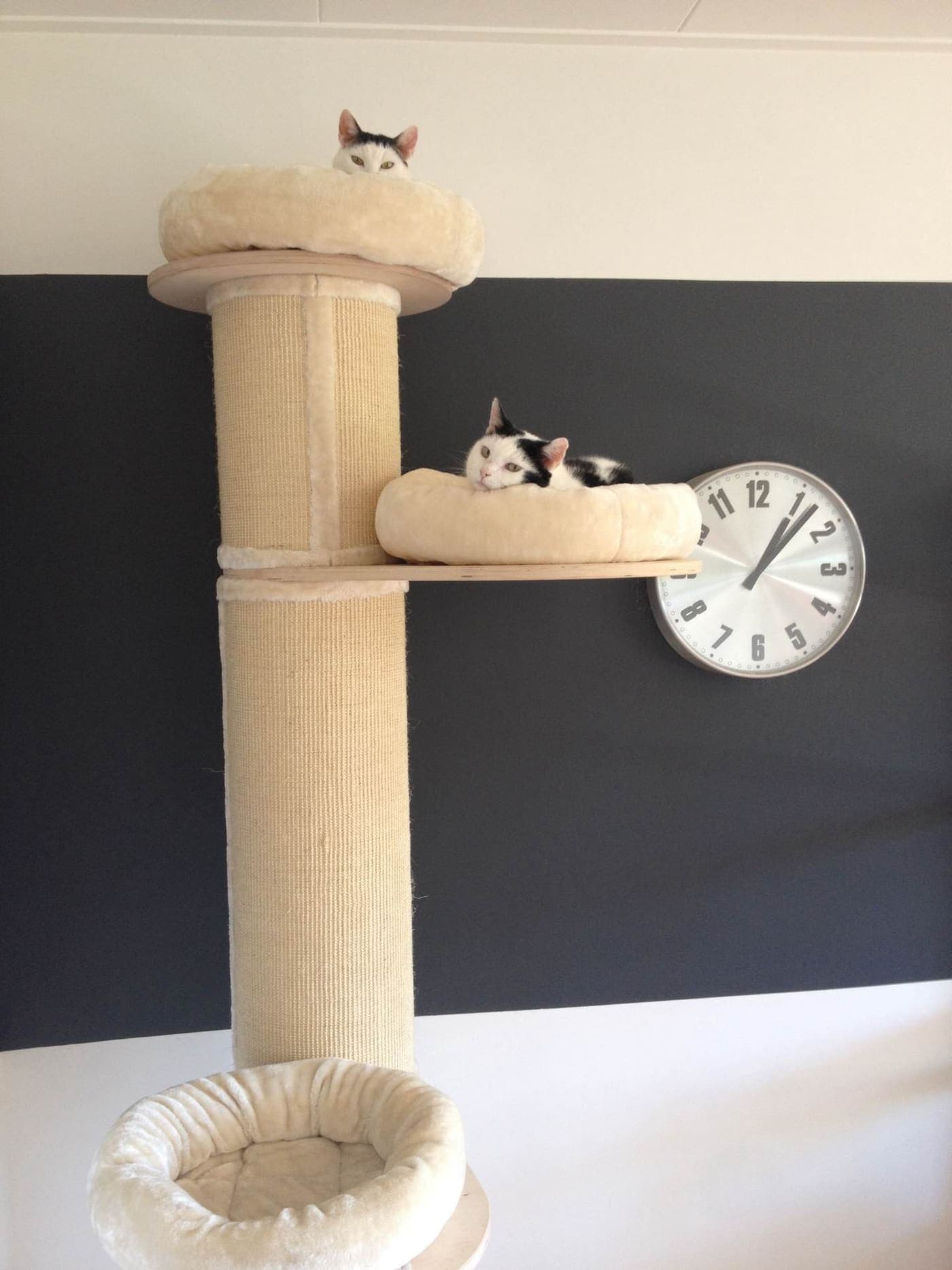
Floor area is fixed and vertical territory is not. In a crowded house that is the only dimension you can actually add.
Affiliate disclosure: we earn a commission if you buy through our links, at no extra cost to you. It never changes which product we rank first — here is how we're funded.
Everyone in this category says they tested twenty litter boxes. We have not tested any, and we say so. What we do instead: compile the published specs, read the manuals, and do the arithmetic on what this gear costs to run and how it behaves once there is more than one cat using it. Every spec is linked to the document it came from. Prices are checked daily — last verified October 22, 2026. Here is exactly how we pick.
Every other multi-cat intervention is about adding more of something. This one is about using a dimension you already own and are not using.
Why height works
The Ohio State Indoor Pet Initiative treats elevated resting places as a core indoor need and frames multi-cat tension as competition over territory. Height addresses both at once, because cats separate vertically as readily as horizontally — two cats six feet apart in height are as separated as two cats in different rooms.
Height per square foot
| Format | Floor cost | Height gained | Per square foot |
|---|---|---|---|
| Wall shelves | None | Whatever the wall allows | Infinite |
| Window perch | None | Sill height | Infinite |
| Floor-to-ceiling pole | 15.5" x 15.5" = 1.67 sq ft | 108" | 65" per sq ft |
| Conventional tower | 22" x 33" = 5.04 sq ft | 72" | 14" per sq ft |
Computed from manufacturers' published dimensions. The bottom row is the format most people buy first.
The ranking is the opposite of the buying order most households follow. A conventional tower is the most floor-hungry way to add height, and it is what people buy first because it is what is marketed.
A room-by-room plan
- Start with the room the household uses most. Cats want to be where the people are, elevated. Vertical space elsewhere gets used less.
- Put something at a window first. A double-stack perch gives two cats two levels on one window for no floor at all — the highest-value single purchase in this plan.
- Add a route, not just a destination. Wall shelves let a cat cross a room without touching the floor, which matters when the floor is where the confrontations happen.
- Add height where floor is tightest. A tension pole in a corner buys 108 inches for 1.67 square feet.
- Then repeat in a second room. Two rooms with modest vertical territory beat one room with a lot of it.
Design routes, not islands
A single high platform reachable one way is not a refuge. A cat on it can be waited out by a cat at the bottom, and both animals know it.
A route — two or more ways up and off — is a refuge, because it cannot be blocked. That is the difference between vertical space that reduces tension and vertical space that concentrates it.
Practically: place shelves so that every high point connects to at least two others, or to a piece of furniture at a different height.
The safety part
- Into studs. FUKUMARU publishes up to 40 lb, and that figure describes the shelf, not the plasterboard. Our mounting guide covers it.
- Short rises. Steps a cat walks up, not gaps it has to jump. An older cat in the house makes this non-negotiable.
- Nothing above hard floor if avoidable. Or put a rug under it.
- Re-check fixings seasonally. Cats land with several times their body weight, repeatedly, for years.
How much is enough
Our working figure is two elevated resting places per cat, spread across at least two rooms and at least two heights. That is our extrapolation from the same resource-competition principle behind Cornell Feline Health Center’s published guidance on litter box counts — and we label it as ours rather than as a veterinary recommendation.
If you are working out whether a home is big enough at all, our density page does that arithmetic.
The gear discussed here
Specs are the manufacturer's own, linked to the page they came from. Prices come from a live daily check; where we have no verified price we say so rather than print a stale one.
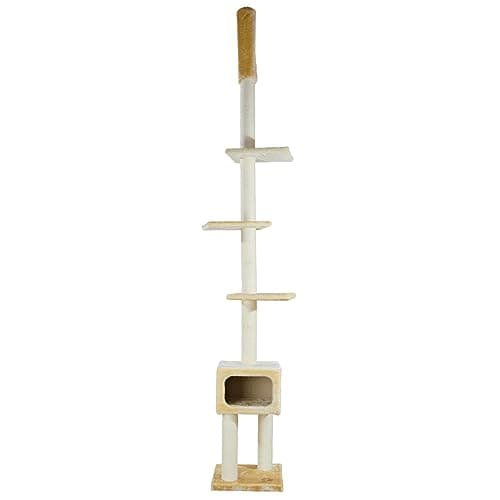
TRIXIE Santander Floor-to-Ceiling Cat Tree
TRIXIE · Floor-to-ceiling cat tree · Our score 8.0/10
#ad Price as of October 22, 2026. Prices move; we check daily. How we're funded.
A 15.5 inch square footprint that reaches 108 inches, because the ceiling does the work a wide base would otherwise have to do.
Published specs
| Footprint | 15.5" L x 15.5" W |
|---|---|
| Height range | 96.25" to 108.25", adjustable |
| Fixing | Spring-activated ceiling attachment, no screws or nails |
| Condo | 14" x 14" x 10" |
| Platforms | 3, each 14" x 14" |
| Posts | 3.5" diameter |
15.5 x 15.5 = 240 square inches = 1.67 square feet of floor. At 108 inches of height that is 65 inches of climbable height per square foot given up. A conventional 72 inch tree on a 22 x 33 inch base gives about 14. This is the most floor-efficient vertical product we track by a factor of four.
What the specs favor
- Most vertical height per square foot of any product on the site
- No screws or nails, so it survives a tenancy agreement
- Adjustable through a full foot of ceiling height
- Published condo and platform dimensions, not just an overall height
What they don't
- Tension fixing depends on your ceiling being solid and flat
- 14 inch platforms are small for a large cat to turn on
- Needs re-tensioning as the building and the pole settle
You have a suspended, textured or sloped ceiling. A tension pole transfers real load upward, and it needs something solid to push against.
How it scores
Scores are our editorial weighting of the published specs above, not a test result. They are deliberately kept out of this page's structured data.
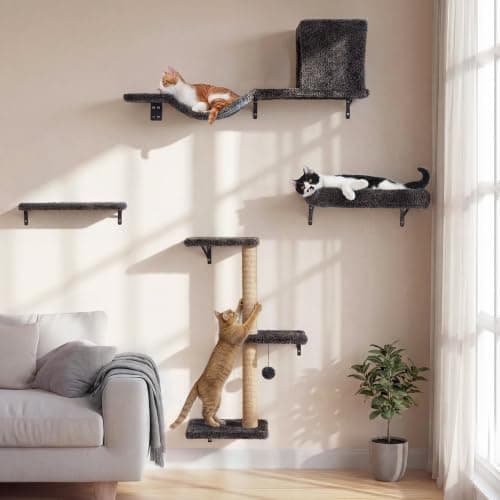
FUKUMARU 4-in-1 Cat Wall Shelves Set
FUKUMARU · Wall shelves · Our score 8.2/10
#ad Price as of October 22, 2026. Prices move; we check daily. How we're funded.
Rated to 40 lb per the maker and takes no floor at all -- the answer when a household needs more vertical territory than the room has square feet.
Published specs
| Weight rating | Up to 40 lb (18 kg), per FUKUMARU |
|---|---|
| Set | 4-in-1: shelves, perch, hammock elements |
| Material | Solid rubber wood |
| Mounting | Wall-mounted; fixings depend on your wall |
| Floor footprint | None |
Source: Chewy -- FUKUMARU 4-in-1 Wall Mounted Cat Wall Shelves Set listing
The Go Pet Club F2081 occupies 22 x 33 inches = 726 sq inches, just over 5 square feet. Wall shelves at the same height occupy none of it. In a one-bedroom flat that is the difference between having a cat tree and having a walkable room.
What the specs favor
- 40 lb published weight rating -- higher than most tree platforms
- Zero floor footprint
- Solid rubber wood rather than particleboard
- Height is limited by your wall, not by the product
What they don't
- Only as strong as what you screw it into -- studs, or nothing
- No good for a cat that cannot jump the gaps
- Wrong fixings in drywall is a serious failure mode
You rent and cannot drill, or you have a senior cat. Shelves demand a jump every time; a tree with stepped platforms does not.
How it scores
Scores are our editorial weighting of the published specs above, not a test result. They are deliberately kept out of this page's structured data.
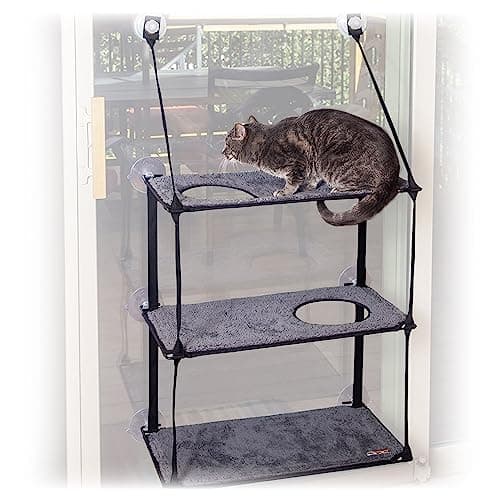
K&H EZ Mount Double Stack Window Perch
K&H Pet Products · Window perch · Our score 8.1/10
#ad Price as of October 22, 2026. Prices move; we check daily. How we're funded.
Two 23 by 12 inch levels on the same 50 lb suction rating -- the answer to the single-ledge problem that makes one perch a thing for two cats to argue over.
Published specs
| Levels | Two, each 23 x 12 in fleece |
|---|---|
| Dimensions | 12 x 23 x 1.75 in |
| Suction rating | Up to 50 lb (K&H) |
| Weight | 3.8 lb |
| Glass needed | 27" W x 31" H or larger |
| Frame | Steel |
| Covers | Two washable shelf covers |
Source: K&H Pet Products -- EZ Mount Window Kitty Sill Double Stack product page
The single-level EZ Mount gives 27 inches split two ways -- 13.5 inches each, less than a cat's body length, so in practice one cat gets it. The double stack gives each cat a full 23-inch level at a different height, which is how cats share space when they have the option.
What the specs favor
- Two separate levels at different heights, not one shared ledge
- Same published 50 lb suction rating as the single
- Steel frame rather than plastic
- Both covers are washable, which matters where cats sleep
What they don't
- Needs a large window -- 27" x 31" of glass minimum
- Suction fails on textured, dirty or very cold glass
- 3.8 lb hanging off suction cups is a lot of trust
Your windows are small or heavily framed. The published glass requirement is a hard constraint, and a perch that will not fit is not a perch.
How it scores
Scores are our editorial weighting of the published specs above, not a test result. They are deliberately kept out of this page's structured data.
Common questions
Why does vertical space matter for multiple cats?
How much vertical space do multiple cats need?
What is the most space-efficient cat furniture?
Do cats need their own cat tree each?
Where should vertical space go in a house?
Sources
- Ohio State University Indoor Pet Initiative -- For Cat Owners
- TRIXIE -- Santander Floor-to-Ceiling Cat Tree listing (15.5 x 15.5 in footprint, 96.25-108.25 in)
- Chewy -- FUKUMARU 4-in-1 Wall Mounted Cat Wall Shelves Set listing (up to 40 lb)
- K&H Pet Products -- EZ Mount Window Kitty Sill Double Stack product page
Read next
- Resource Competition Between Cats
How to recognize resource guarding, why it rarely looks like fighting, and the environmental changes that reduce it.
- Best Floor to Ceiling Cat Trees (2026)
Floor-to-ceiling tension-pole trees compared with conventional towers on climbable height per square foot of floor given up.
- Best Cat Wall Shelves (2026)
Wall shelf sets ranked on published weight rating, with the stud-and-anchor detail that actually governs safety.
- Best Cat Trees for Small Apartments (2026)
Footprint arithmetic for small flats, and why the best answers on that metric are wall-mounted rather than free-standing.
- How Many Cats Can Live in an Apartment?
Why square footage is the wrong measure for how many cats a home holds, and the resource arithmetic that gives a real answer.