Toys & Enrichment
Best Cat Puzzle Feeders and Foraging Toys (2026)
A puzzle that holds a quarter of a cup is a meal. One that holds three treats is a novelty. That is the whole ranking.
Affiliate disclosure: we earn a commission if you buy through our links, at no extra cost to you. It never changes which product we rank first — here is how we're funded.
Everyone in this category says they tested twenty litter boxes. We have not tested any, and we say so. What we do instead: compile the published specs, read the manuals, and do the arithmetic on what this gear costs to run and how it behaves once there is more than one cat using it. Every spec is linked to the document it came from. Prices are checked daily — last verified October 19, 2026. Here is exactly how we pick.
Quick picks
Ranked on the published specs and the arithmetic below. Tap any row to jump to the full write-up. We have not tested these — here is exactly how we pick.
| # | Product | Best for | Score | Price |
|---|---|---|---|---|
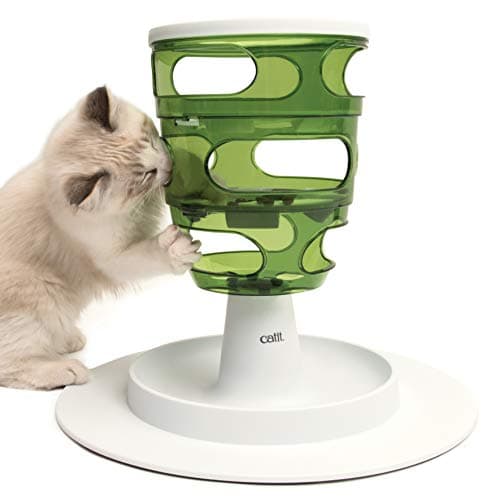
| 1 | Catit Senses 2.0 Digger Five tubes of varying width on a weighted base -- the only foraging toy here you can make harder as the cat works it out. | Slowing down a cat that inhales food | 8.0 | |
| 2 | 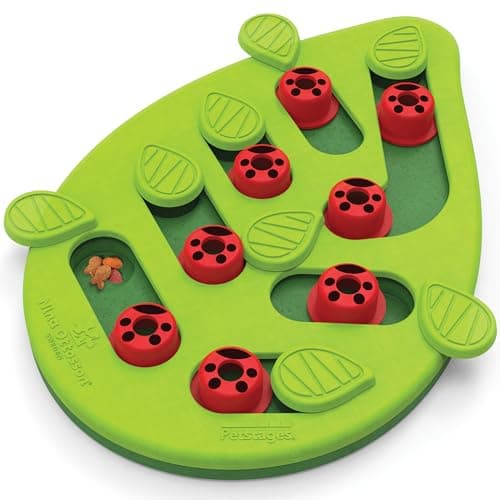 Catstages Nina Ottosson Buggin' Out Puzzle & Play 16 compartments and a published two-mode difficulty -- an easy setting for the first week and a hard one for the month after. | A cat that solves puzzles too quickly | 7.4 | |
| 3 | 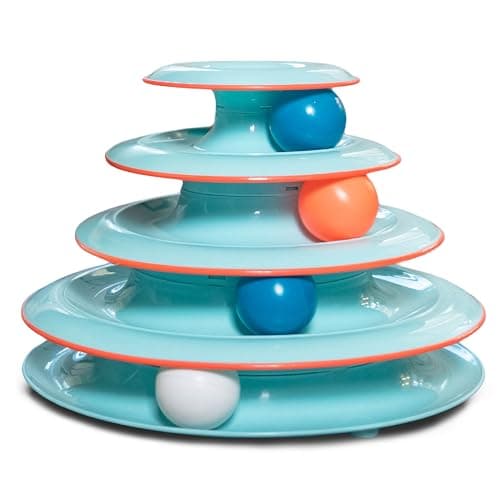 Catstages Chase Meowtain 4-Tier Track Toy Four tiers, four spinning balls, a non-slip base and nothing to charge or replace -- Catstages' current tower, and the solo toy most likely to still be in use in six months. | Play that happens while you are at work | 7.5 |
#ad Buy links are affiliate links. Prices come from a live daily check; where we have no verified price we say "check price" rather than print a stale one.
Puzzle feeders fail for two reasons and only two: they hold too little food to be worth setting up, or they are too annoying to clean. Both are checkable before you buy, and neither is what the reviews usually talk about.
Capacity decides whether it becomes a habit
A puzzle that holds three treats is something you do on a Sunday. A puzzle that holds a meaningful part of a meal replaces the bowl, which means it gets used every day without you having to remember to use it.
| Toy | Published capacity | Roughly | Difficulty |
|---|---|---|---|
| Nina Ottosson Buggin' Out | 1/4 cup across 16 compartments | Half a day's dry ration | Level 2, two modes |
| Catit Senses 2.0 Digger | Five tubes, capacity not published | Configurable portion | Adjustable by tube width |
| Catstages Chase Meowtain | No food capacity | Not a feeder | Fixed |
Capacities are the manufacturers' published figures where they exist. Catit does not publish a volume for the Digger, so we have not estimated one. The 'roughly' column assumes a half-cup daily dry ration, which is an illustration, not a feeding recommendation.
Difficulty has to be adjustable
A cat solves a fixed puzzle and then ignores it. Both feeders here are designed against that, in different ways:
- Catit Digger: three narrow tubes and two wide ones. Start with the wide pair, add narrow ones as the cat speeds up.
- Buggin’ Out: a published easy mode (food in the base wells) and a hard mode (food into sliding cups through the top holes, so the cat has to move pieces to release it).
When you are shopping outside this list, that is the property to look for. A puzzle with one configuration has a lifespan measured in days.
The cleaning problem nobody admits to
Kibble leaves grease. Sliding parts trap it. A puzzle that needs disassembling to clean properly gets cleaned less often than it should, and then it stops being used because it is faintly unpleasant.
Be honest with yourself about this before buying. The Digger’s tubes lift out; the Buggin’ Out’s cups slide apart. Neither is difficult, but both are a weekly job, and a simpler puzzle you actually maintain beats a clever one you do not.
The free version, which genuinely works
The Ohio State Indoor Pet Initiative suggests filling balls with food or treats to encourage foraging. You can go simpler still: a cardboard egg box with kibble in some of the cups, or a toilet roll tube with the ends folded and a few pieces inside, gives most of the benefit for nothing.
Start there. If your cat engages with a cardboard tube, a proper puzzle is worth buying. If it ignores the tube entirely, you have saved yourself the purchase and learned something.
The multi-cat rule
This is the same distribution principle that governs litter boxes and water, and it is set out in full in the multi-cat household guide.
Count the food
A puzzle should hold part of the daily ration, not extra food on top of it. In a household already managing weight, that matters: a foraging toy is a way of making the same food take longer, not a way of adding calories to the day.
If one of your cats is on a controlled diet and another is not, a puzzle in a shared room defeats the whole arrangement — see the multi-cat feeder picks for the microchip approach that actually separates them.
The picks in full
Specs are the manufacturer's own, linked to the page they came from. Prices come from a live daily check; where we have no verified price we say so rather than print a stale one.
Catit Senses 2.0 Digger
Catit · Foraging toy · Our score 8.0/10
#ad Price as of October 19, 2026. Prices move; we check daily. How we're funded.
Five tubes of varying width on a weighted base -- the only foraging toy here you can make harder as the cat works it out.
Published specs
| Dimensions | 14.6" x 14.6" x 4.3" |
|---|---|
| Tubes | 3 short and narrow, 2 long and wide |
| Base | Rubber mat to stop it sliding |
| Material | BPA-free |
| Food | Dry food or treats |
Source: Catit -- Senses Digger product page
Three narrow tubes and two wide ones means you can start with the wide pair and add narrow ones as the cat gets faster. Fixed-difficulty puzzles get solved once and then ignored -- adjustability is the spec that decides whether a puzzle toy is still in use in a month.
What the specs favor
- Two tube widths, so difficulty scales with the cat
- Rubber base mat -- it does not slide across a hard floor
- Uses the cat's ordinary dry food, so it costs nothing to run
- Large 14.6-inch footprint two cats can work at once
What they don't
- Dry food only
- Tubes need washing, and few people do it
- A determined cat tips it if the mat is on carpet
You feed wet food exclusively. Every foraging toy here assumes kibble, and there is no version of this that works with pate.
How it scores
Scores are our editorial weighting of the published specs above, not a test result. They are deliberately kept out of this page's structured data.
Catstages Nina Ottosson Buggin' Out Puzzle & Play
Outward Hound · Puzzle feeder · Our score 7.4/10
#ad Price as of October 19, 2026. Prices move; we check daily. How we're funded.
16 compartments and a published two-mode difficulty -- an easy setting for the first week and a hard one for the month after.
Published specs
| Difficulty | Level 2, with easy and hard modes |
|---|---|
| Compartments | 16 |
| Capacity | 1/4 cup of food or treats |
| Dimensions | 13.97" x 11.55" x 1.65" |
| Mechanism | Bat the pegs, swivel the leaves, slide the cups |
Source: Chewy -- Nina Ottosson by Outward Hound Buggin' Out Interactive Puzzle listing
1/4 cup capacity. A typical adult cat eats around half a cup of dry food a day across two meals, so this holds roughly one whole meal or half a day. That makes it a genuine feeding vessel rather than a treat novelty -- which is the difference between enrichment and a toy that gets ignored.
What the specs favor
- Two published difficulty modes rather than one fixed level
- 16 compartments spread the food so the cat has to keep working
- Holds a quarter cup, enough to be a meal rather than a treat
- Low 1.65-inch profile, so a cautious cat will approach it
What they don't
- Level 2 is solvable in a day by a motivated cat
- Sliding parts trap food and need taking apart to wash
- One cat at a time -- two cats round it is a resource conflict
You have cats that guard food. A single flat puzzle with 16 wells is exactly the shape that starts a fight -- feed puzzles in separate rooms.
How it scores
Scores are our editorial weighting of the published specs above, not a test result. They are deliberately kept out of this page's structured data.
Catstages Chase Meowtain 4-Tier Track Toy
Catstages · Solo play toy · Our score 7.5/10
#ad Price as of October 19, 2026. Prices move; we check daily. How we're funded.
Four tiers, four spinning balls, a non-slip base and nothing to charge or replace -- Catstages' current tower, and the solo toy most likely to still be in use in six months.
Published specs
| Dimensions | 10.125" H x 7.125" L x 10.125" W |
|---|---|
| Levels | 4 |
| Balls | 4, one per tier, captive in the tracks |
| Weight | 13.6 oz |
| Base | Non-slip |
| Material | Plastic, polypropylene |
| Power | None |
| Suitable from | 12 weeks |
No batteries, no motor, no refill, nothing captive to lose -- the balls cannot leave the track. Every automated laser and motorized toy on the market has a consumable or a battery; this one occupies about 72 square inches of floor (10.125 x 7.125) and has no ongoing cost at all.
What the specs favor
- No batteries and no consumables, ever
- Balls are captive, so nothing ends up under the sofa
- Non-slip base keeps it still on hard floors
- About 72 square inches of floor -- a genuinely small footprint
What they don't
- Four tiers of the same motion -- some cats exhaust it quickly
- One cat at a time in practice
- One ball per tier rather than a crowded track
- Does nothing for a cat that needs to chase prey-like movement
Your cat's problem is 4am zoomies. Track toys are low-intensity; that behavior needs wand play that ends in a catch, not a ball on a rail.
How it scores
Scores are our editorial weighting of the published specs above, not a test result. They are deliberately kept out of this page's structured data.
Common questions
Do puzzle feeders work for cats?
How much food does a cat puzzle feeder hold?
Will a puzzle feeder slow down a cat that eats too fast?
Can two cats share a puzzle feeder?
Are puzzle feeders hard to clean?
Sources
- Ohio State University Indoor Pet Initiative -- Toys
- Catit -- Senses Digger product page (14.6 x 14.6 x 4.3 in, five tubes)
- Chewy -- Nina Ottosson by Outward Hound Buggin' Out puzzle (Level 2, 16 compartments, 1/4 cup)
- Chewy -- Catstages Chase Meowtain 4-Tier Interactive Cat Track Toy (10.125 x 7.125 x 10.125 in, 4 tiers, 4 balls)
Read next
- Best Cat Enrichment Toys (2026)
Enrichment toys ranked on adjustable difficulty and foraging value, with the free options the published guidance recommends.
- Cat Enrichment Ideas That Cost Nothing
The five things an indoor cat needs outlets for, the free ways to provide each, and a daily routine that actually fits around a job.
- Best Automatic Cat Feeders (2026)
Hopper capacity converted into days of food for one, two and three cats, plus which feeders handle wet food and which do not.
- Best Cat Toys for Bored Indoor Cats (2026)
Toys ranked by how much of the hunt sequence they support, with a hard look at why laser pointers make the problem worse.
- Resource Competition Between Cats
How to recognize resource guarding, why it rarely looks like fighting, and the environmental changes that reduce it.
- Best Lick Mats for Cats (2026)
A lick mat compared with a puzzle feeder and a slow-feeder bowl, matched to wet food, dry food and the cat that needs a job.