Toys & Enrichment
Best Cat Enrichment Toys (2026)
The specification that predicts whether a toy is still in use in a month is adjustability. Almost nobody ranks on it.
Affiliate disclosure: we earn a commission if you buy through our links, at no extra cost to you. It never changes which product we rank first — here is how we're funded.
Everyone in this category says they tested twenty litter boxes. We have not tested any, and we say so. What we do instead: compile the published specs, read the manuals, and do the arithmetic on what this gear costs to run and how it behaves once there is more than one cat using it. Every spec is linked to the document it came from. Prices are checked daily — last verified October 19, 2026. Here is exactly how we pick.
Quick picks
Ranked on the published specs and the arithmetic below. Tap any row to jump to the full write-up. We have not tested these — here is exactly how we pick.
| # | Product | Best for | Score | Price |
|---|---|---|---|---|
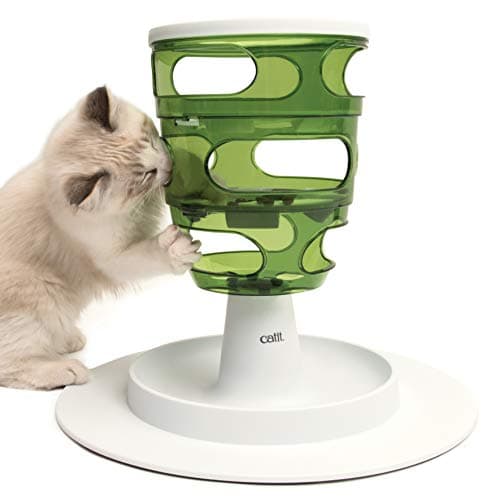
| 1 | Catit Senses 2.0 Digger Five tubes of varying width on a weighted base -- the only foraging toy here you can make harder as the cat works it out. | Slowing down a cat that inhales food | 8.0 | |
| 2 | 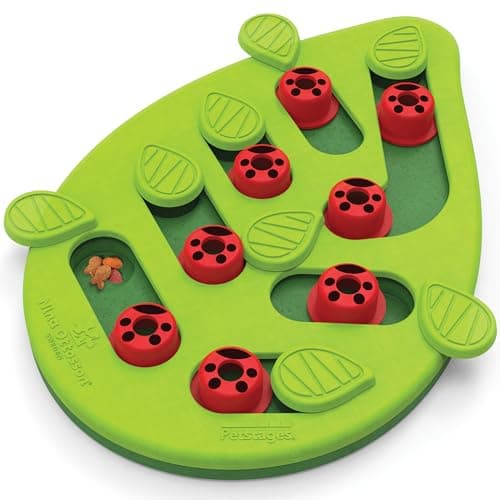 Catstages Nina Ottosson Buggin' Out Puzzle & Play 16 compartments and a published two-mode difficulty -- an easy setting for the first week and a hard one for the month after. | A cat that solves puzzles too quickly | 7.4 | |
| 3 | 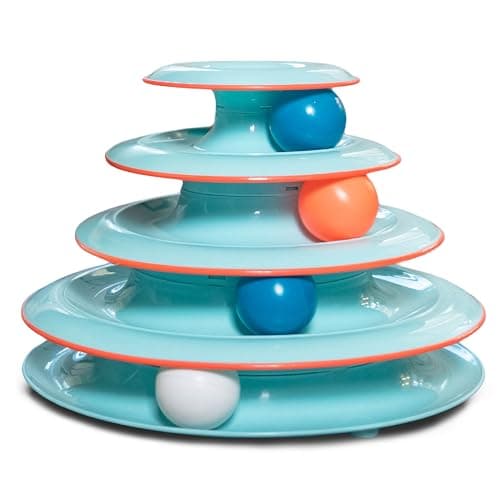 Catstages Chase Meowtain 4-Tier Track Toy Four tiers, four spinning balls, a non-slip base and nothing to charge or replace -- Catstages' current tower, and the solo toy most likely to still be in use in six months. | Play that happens while you are at work | 7.5 | |
| 4 | No photo Go Cat Da Bird Wand, 36-inch A 36-inch rod on 50 lb braided line with feathers shaped to fly properly -- the only toy here that delivers the full hunt sequence, which is what boredom behavior is missing. | The play a bored indoor cat actually needs | 8.8 |
#ad Buy links are affiliate links. Prices come from a live daily check; where we have no verified price we say "check price" rather than print a stale one.
Every enrichment toy works for a week. The interesting question is which ones are still being used in a month, and the answer correlates with one property that almost no review mentions: whether you can make it harder.
Adjustable difficulty is the whole spec
A cat that solves a puzzle stops finding it interesting. That is not a fault in the cat; it is the predictable end of a fixed challenge. So a toy whose difficulty can be raised has a much longer useful life than one whose cannot, and two of the toys here are explicitly designed for it.
| Toy | Difficulty mechanism | Published detail |
|---|---|---|
| Catit Senses 2.0 Digger | Swap tube widths | 3 narrow tubes and 2 wide, on one base |
| Nina Ottosson Buggin' Out | Two modes | Level 2; easy mode in the base wells, hard mode via sliding cups |
| Catstages Chase Meowtain | None | 4 tiers, 4 captive balls |
| Wand toy | You are the difficulty | 36 in rod, 32 in line |
Mechanisms and dimensions are the manufacturers' published descriptions, cited in Sources.
The Chase Meowtain row is not a criticism — it is a different kind of product. It costs nothing to run, has no consumables and nothing to lose under the sofa, and for a cat that enjoys batting it stays in the rotation for years. It just is not a puzzle.
Foraging is the highest-value form of enrichment
The Ohio State Indoor Pet Initiative puts it directly: fill balls or puzzles with food and “cats feel like they are having a hunting and stalking session, and catching their own meal.” That is enrichment which happens while you are out, uses food you were feeding anyway, and slows down a cat that eats too fast.
The free options, up front
The Ohio State Indoor Pet Initiative lists effective toys that cost nothing: crumpled paper balls, the plastic rings off milk jugs, cardboard tubes, an old sock with cotton balls and a little catnip. We earn nothing by telling you that. It is the published advice, it works, and it belongs near the top of the page rather than buried under the products.
More of these, and how to structure them into a routine, is in cat enrichment ideas.
Rotation beats accumulation
Buying a fifth puzzle is a worse investment than putting three of the four you own into a cupboard for a fortnight. The published recommendation is a batch rotated a few at a time, and it is the highest-return thing in this whole category because it costs nothing and it works on toys you have already paid for.
The multi-cat caution
A food puzzle is a concentrated, high-value resource in one location, which is the exact shape that produces conflict between cats. Feed puzzles in separate rooms, one cat per puzzle. A single flat board with sixteen wells and two cats around it is a competition, not enrichment.
If two cats already have a strained relationship, adding food puzzles to a shared space will make it worse before it makes it better. Start with the resource competition guide.
Verdict
- Best all-round: Catit Senses 2.0 Digger — adjustable, uses ordinary kibble, big enough not to be flipped over.
- Best for a fast solver: Nina Ottosson Buggin’ Out, for the two published modes.
- Best for solo batting: Chase Meowtain — no batteries, no consumables, nothing to lose.
- Best full stop: a wand, ten minutes a day, ending in a catch. Enrichment objects supplement it; nothing replaces it.
The picks in full
Specs are the manufacturer's own, linked to the page they came from. Prices come from a live daily check; where we have no verified price we say so rather than print a stale one.
Catit Senses 2.0 Digger
Catit · Foraging toy · Our score 8.0/10
#ad Price as of October 19, 2026. Prices move; we check daily. How we're funded.
Five tubes of varying width on a weighted base -- the only foraging toy here you can make harder as the cat works it out.
Published specs
| Dimensions | 14.6" x 14.6" x 4.3" |
|---|---|
| Tubes | 3 short and narrow, 2 long and wide |
| Base | Rubber mat to stop it sliding |
| Material | BPA-free |
| Food | Dry food or treats |
Source: Catit -- Senses Digger product page
Three narrow tubes and two wide ones means you can start with the wide pair and add narrow ones as the cat gets faster. Fixed-difficulty puzzles get solved once and then ignored -- adjustability is the spec that decides whether a puzzle toy is still in use in a month.
What the specs favor
- Two tube widths, so difficulty scales with the cat
- Rubber base mat -- it does not slide across a hard floor
- Uses the cat's ordinary dry food, so it costs nothing to run
- Large 14.6-inch footprint two cats can work at once
What they don't
- Dry food only
- Tubes need washing, and few people do it
- A determined cat tips it if the mat is on carpet
You feed wet food exclusively. Every foraging toy here assumes kibble, and there is no version of this that works with pate.
How it scores
Scores are our editorial weighting of the published specs above, not a test result. They are deliberately kept out of this page's structured data.
Catstages Nina Ottosson Buggin' Out Puzzle & Play
Outward Hound · Puzzle feeder · Our score 7.4/10
#ad Price as of October 19, 2026. Prices move; we check daily. How we're funded.
16 compartments and a published two-mode difficulty -- an easy setting for the first week and a hard one for the month after.
Published specs
| Difficulty | Level 2, with easy and hard modes |
|---|---|
| Compartments | 16 |
| Capacity | 1/4 cup of food or treats |
| Dimensions | 13.97" x 11.55" x 1.65" |
| Mechanism | Bat the pegs, swivel the leaves, slide the cups |
Source: Chewy -- Nina Ottosson by Outward Hound Buggin' Out Interactive Puzzle listing
1/4 cup capacity. A typical adult cat eats around half a cup of dry food a day across two meals, so this holds roughly one whole meal or half a day. That makes it a genuine feeding vessel rather than a treat novelty -- which is the difference between enrichment and a toy that gets ignored.
What the specs favor
- Two published difficulty modes rather than one fixed level
- 16 compartments spread the food so the cat has to keep working
- Holds a quarter cup, enough to be a meal rather than a treat
- Low 1.65-inch profile, so a cautious cat will approach it
What they don't
- Level 2 is solvable in a day by a motivated cat
- Sliding parts trap food and need taking apart to wash
- One cat at a time -- two cats round it is a resource conflict
You have cats that guard food. A single flat puzzle with 16 wells is exactly the shape that starts a fight -- feed puzzles in separate rooms.
How it scores
Scores are our editorial weighting of the published specs above, not a test result. They are deliberately kept out of this page's structured data.
Catstages Chase Meowtain 4-Tier Track Toy
Catstages · Solo play toy · Our score 7.5/10
#ad Price as of October 19, 2026. Prices move; we check daily. How we're funded.
Four tiers, four spinning balls, a non-slip base and nothing to charge or replace -- Catstages' current tower, and the solo toy most likely to still be in use in six months.
Published specs
| Dimensions | 10.125" H x 7.125" L x 10.125" W |
|---|---|
| Levels | 4 |
| Balls | 4, one per tier, captive in the tracks |
| Weight | 13.6 oz |
| Base | Non-slip |
| Material | Plastic, polypropylene |
| Power | None |
| Suitable from | 12 weeks |
No batteries, no motor, no refill, nothing captive to lose -- the balls cannot leave the track. Every automated laser and motorized toy on the market has a consumable or a battery; this one occupies about 72 square inches of floor (10.125 x 7.125) and has no ongoing cost at all.
What the specs favor
- No batteries and no consumables, ever
- Balls are captive, so nothing ends up under the sofa
- Non-slip base keeps it still on hard floors
- About 72 square inches of floor -- a genuinely small footprint
What they don't
- Four tiers of the same motion -- some cats exhaust it quickly
- One cat at a time in practice
- One ball per tier rather than a crowded track
- Does nothing for a cat that needs to chase prey-like movement
Your cat's problem is 4am zoomies. Track toys are low-intensity; that behavior needs wand play that ends in a catch, not a ball on a rail.
How it scores
Scores are our editorial weighting of the published specs above, not a test result. They are deliberately kept out of this page's structured data.
Go Cat Da Bird Wand, 36-inch
Go Cat · Wand toy · Our score 8.8/10
#ad No verified live price right now, so we show none rather than a stale one. How we're funded.
A 36-inch rod on 50 lb braided line with feathers shaped to fly properly -- the only toy here that delivers the full hunt sequence, which is what boredom behavior is missing.
Published specs
| Rod length | 36" fiberglass, pull-apart |
|---|---|
| Line | 50 lb test braided nylon |
| Lure | Aerodynamically configured feathers |
| Refills | Feather attachments sold separately |
Source: Amazon -- Go Cat Da Bird Single Pole Teaser on 36-inch Rod listing
36 inches of rod and 32 inches of string is 68 inches of working radius, so the lure can travel a genuine arc across a room rather than bobbing in front of the cat. Short wands produce short, unconvincing movement, which is why cats lose interest in them within a minute.
What the specs favor
- 68 inches of combined reach -- real prey-like movement, not a bob
- 50 lb braided line does not snap mid-swing
- Rod pulls apart for storage
- Feather refills, so the rod outlasts many lures
What they don't
- Interactive only -- it does nothing while you are out
- Feathers are a consumable and a successful cat destroys them
- Must be put away; loose string is a swallowing hazard
You are looking for something to occupy the cat while you are at work. This one needs you on the other end of it, which is the whole point of it.
How it scores
Scores are our editorial weighting of the published specs above, not a test result. They are deliberately kept out of this page's structured data.
Common questions
What is cat enrichment?
Do enrichment toys actually work?
Are food puzzles good for cats?
How do I make my own cat enrichment toys?
How many enrichment toys does a cat need?
Sources
- Ohio State University Indoor Pet Initiative -- Toys
- Catit -- Senses Digger product page (14.6 x 14.6 x 4.3 in, five tubes)
- Chewy -- Nina Ottosson by Outward Hound Buggin' Out puzzle (Level 2, 16 compartments, 1/4 cup)
- Chewy -- Catstages Chase Meowtain 4-Tier Interactive Cat Track Toy (10.125 x 7.125 x 10.125 in, 4 tiers, 4 balls)
- Amazon -- Go Cat Da Bird Single Pole Teaser, 36-inch rod listing
Read next
- Best Cat Puzzle Feeders and Foraging Toys (2026)
Puzzle feeders ranked on published capacity and adjustable difficulty, with the multi-cat rule that stops them causing fights.
- Cat Enrichment Ideas That Cost Nothing
The five things an indoor cat needs outlets for, the free ways to provide each, and a daily routine that actually fits around a job.
- Best Cat Toys for Bored Indoor Cats (2026)
Toys ranked by how much of the hunt sequence they support, with a hard look at why laser pointers make the problem worse.
- Signs Your Cat Is Bored
What under-stimulation looks like in an indoor cat, which signs are veterinary questions, and the free changes to try first.
- Best Automatic Cat Feeders (2026)
Hopper capacity converted into days of food for one, two and three cats, plus which feeders handle wet food and which do not.
- Best Cat Ball Track Toys (2026)
Ball track toys compared on footprint, layout and how quickly a cat tires of them, with the motorized step up for a cat that has.