Feeders, Fountains & Bowls
How to Introduce an Automatic Feeder
The failure mode is not the machine jamming. It is a cat that will not approach a plastic box that makes a noise, discovered on the day you needed it to work.
Affiliate disclosure: we earn a commission if you buy through our links, at no extra cost to you. It never changes which product we rank first — here is how we're funded.
Everyone in this category says they tested twenty litter boxes. We have not tested any, and we say so. What we do instead: compile the published specs, read the manuals, and do the arithmetic on what this gear costs to run and how it behaves once there is more than one cat using it. Every spec is linked to the document it came from. Prices are checked daily — last verified September 25, 2026. Here is exactly how we pick.
People buy an automatic feeder on Thursday and leave on Friday. The cat meets a machine it has never seen, it clatters, and nobody is home to sort it out.
The four stages
- Silent object, days 1-2. Feeder in the room, unpowered, nothing in it. Feed the cat from the usual bowl beside it. All you want is for the shape to become furniture.
- Food near it, days 2-4. Still unpowered. Put the cat’s meal in the feeder’s bowl by hand, so eating from that bowl is normal before it ever moves.
- One scheduled meal, days 4-7. Power it up and let it serve a single meal while you are home. Stay out of the room -- your presence at the beep teaches the cat that the noise means you, which is not what you want on a trip.
- Full schedule, a week before you need it. Every meal from the feeder, with the old bowl gone, for at least two days before you rely on it.
The noise is the problem, not the food
A dispense is three events: a motor, kibble hitting a plastic bowl, and often a recorded voice or a beep. A cat that is relaxed about the first can still bolt at the third.
Two things help. Put a mat or a folded towel under the bowl, which takes the rattle out of the kibble. And if the feeder records a call message, record it quietly, or leave it silent for the first week.
The PetSafe Smart Feed has a slow-feed mode that dispenses a meal over 15 minutes, which is a gentler first experience than a single loud drop, and doubles as a pacing tool.
Features that make the transition easier
The PetSafe Smart Feed publishes portions from an eighth of a cup and up to 12 meals a day, which lets you go from many tiny servings to a normal schedule gradually rather than in one jump.
The PETLIBRO Granary Camera is the one that removes the guesswork: you can watch a dispense from wherever you are and see whether the cat came. That is worth a lot in the first fortnight, and our camera feeder page treats it as a diagnostic instrument rather than a gadget.
The Cat Mate C500 is the gentlest introduction of the three, because nothing is dispensed at all: a lid rotates away from a compartment. For a sound-sensitive cat, that is often the difference between acceptance and a standoff.
Once it is running
- Keep weighing the cat. A feeder makes portions exact and appetite invisible; the scale is your feedback loop.
- Plan for power and jams. Our power and backup page covers building a setup that fails safe.
- Do not let it replace the visit. The Ohio State Indoor Pet Initiative treats daily interaction as a basic need, and a feeder covers food and nothing else.
- Two cats, two problems. A shared feeder feeds whoever arrives first -- our microchip feeder page is the fix.
The gear discussed here
Specs are the manufacturer's own, linked to the page they came from. Prices come from a live daily check; where we have no verified price we say so rather than print a stale one.
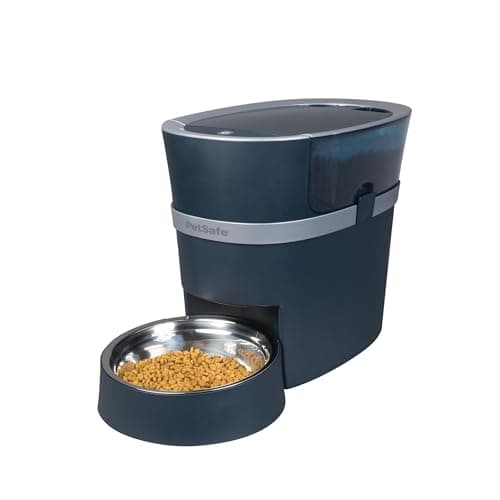
PetSafe Smart Feed, 2nd Generation
PetSafe · Automatic feeder · Our score 7.9/10
#ad Price as of September 25, 2026. Prices move; we check daily. How we're funded.
24 cups of hopper and portions from an eighth of a cup up to four cups -- the widest published portion range of any feeder on this page.
Published specs
| Hopper capacity | 24 cups (6 L) |
|---|---|
| Portion range | 1/8 cup to 4 cups |
| Meals per day | Up to 12 |
| Dimensions | 20.3" x 9.4" x 12.6" |
| Slow feed | Dispenses a meal over 15 minutes |
| Dishwasher | Lid, hopper, bowl and holder, top shelf |
| Food type | Dry or semi-moist |
Source: PetSafe -- Smart Feed Automatic Dog and Cat Feeder, 2nd Generation
24 cups of hopper. Three cats eating half a cup each per day is 1.5 cups daily, so about 16 days. The slow-feed setting spreads one meal over 15 minutes, which is the published feature that matters if one of your cats inhales food and then takes the other's.
What the specs favor
- Largest published hopper here at 24 cups
- Portions from 1/8 cup to 4 cups -- the widest range on this page
- Slow feed spreads a meal over 15 minutes
- All food-contact parts are dishwasher safe
What they don't
- Single bowl, so no separation between cats
- Dry or semi-moist only
- 20 inches long -- it takes real counter or floor space
You feed wet food. Nothing about this feeder handles it, and leaving wet food in an open bowl on a timer is a food-safety problem, not a convenience.
How it scores
Scores are our editorial weighting of the published specs above, not a test result. They are deliberately kept out of this page's structured data.
Cat Mate C500 5-Meal Automatic Feeder
Cat Mate · Automatic feeder · Our score 8.0/10
#ad No verified live price right now, so we show none rather than a stale one. How we're funded.
Five sealed compartments and twin ice packs, running for up to a year on three AA cells -- the only credible way to put wet food on a schedule.
Published specs
| Meals | 1 immediate + 4 timed |
|---|---|
| Compartment capacity | 11.5 oz (330 g) each |
| Food types | Wet and dry |
| Cooling | Twin ice packs, about 6-8 hours indoors |
| Power | 3 x AA, up to 12 months |
| Suits | Up to two cats or a small dog (maker) |
Source: Chewy -- Cat Mate C500 Digital 5 Meal Automatic Feeder listing
Cat Mate publishes 6-8 hours of indoor cooling from the twin ice packs, not five meals' worth. So the honest read is that this covers a working day, not a weekend -- the 5-meal capacity is about portioning across that day, not about leaving the house for longer.
What the specs favor
- Handles wet food, which no hopper feeder does
- Published compartment capacity in ounces and grams
- Battery-only, so a power cut does not skip a meal
- Up to 12 months from three AA cells
What they don't
- Cooling is published at 6-8 hours indoors, so this is a day, not a trip
- Five compartments is a hard ceiling -- no top-up without opening it
- Shared tray, so it cannot separate two cats' diets
You are away overnight and feeding wet food. Read the published cooling window rather than the meal count: 6-8 hours is the number that governs food safety here.
How it scores
Scores are our editorial weighting of the published specs above, not a test result. They are deliberately kept out of this page's structured data.
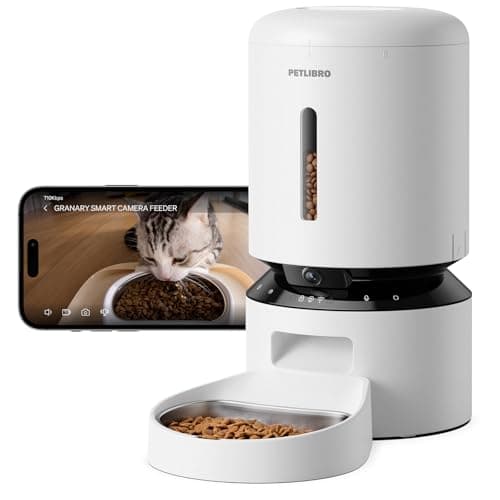
PETLIBRO Granary Camera Feeder
PETLIBRO · Automatic feeder · Our score 7.8/10
#ad Price as of September 25, 2026. Prices move; we check daily. How we're funded.
Publishes its portion size in milliliters rather than vague 'portions', which is the only way to work out whether a hopper will actually last a weekend.
Published specs
| Hopper capacity | 5 L |
|---|---|
| Portion size | 20 ml per portion, 1-50 portions per meal |
| Meals per day | Up to 10 |
| Camera | 1080p, 145-degree lens, night vision |
| Power | DC 5 V adapter plus 3 x D cells backup |
| Kibble size | 2-15 mm diameter |
| Dimensions / weight | 13 x 7.5 x 7.5 in / 4.3 lb |
Source: PETLIBRO -- Granary Smart Camera Feeder product page
5 L hopper, 20 ml per portion, so 250 portions. Two cats on two meals a day at five portions a meal is 20 portions daily -- about 12 days of food. That is the number that tells you whether it covers a holiday, and it comes straight from PETLIBRO's own published portion volume.
What the specs favor
- Portion published as a real volume (20 ml), not an abstract 'portion'
- 5 L hopper -- roughly 12 days for two cats on the arithmetic above
- Battery backup on D cells if the power drops
- Kibble compatibility published as 2-15 mm
What they don't
- One bowl, so it cannot separate two cats' food
- Dry food only
- Camera means a cloud account and a phone in the loop
One of your cats eats the other's food. A single-bowl dispenser with a camera lets you watch the theft happen in 1080p without stopping it.
How it scores
Scores are our editorial weighting of the published specs above, not a test result. They are deliberately kept out of this page's structured data.
Common questions
How long does it take a cat to get used to an automatic feeder?
My cat is scared of the feeder. What do I do?
Should I remove the old bowl straight away?
Where should an automatic feeder go?
Can I test it before I go away?
Sources
Read next
- Best Automatic Cat Feeders (2026)
Hopper capacity converted into days of food for one, two and three cats, plus which feeders handle wet food and which do not.
- What Happens to an Automatic Feeder in a Power Cut
How automatic feeders behave during a power cut, which publish battery backup, and how to build a setup that fails safe.
- Leaving Cats Alone: What a Feeder Actually Covers
Hopper, water and litter capacity converted into days, with a clear line on when a machine stops being enough.
- Best Portion Control Cat Feeders (2026)
Feeders that publish portion sizes in real units, plus how to set one from the ration on your food bag.
- Automatic Feeder vs Free Feeding
Free feeding against scheduled feeding, compared on cost, control, and the information meal feeding gives that a full bowl does not.