Feeders, Fountains & Bowls
Leaving Cats Alone: What a Feeder Actually Covers
Food is the easiest thing to automate and the least likely thing to go wrong. Here is what a feeder does not solve.
Affiliate disclosure: we earn a commission if you buy through our links, at no extra cost to you. It never changes which product we rank first — here is how we're funded.
Everyone in this category says they tested twenty litter boxes. We have not tested any, and we say so. What we do instead: compile the published specs, read the manuals, and do the arithmetic on what this gear costs to run and how it behaves once there is more than one cat using it. Every spec is linked to the document it came from. Prices are checked daily — last verified October 19, 2026. Here is exactly how we pick.
Food is the easiest part of an absence to automate and the part least likely to fail. So a guide that stops at hopper capacity is answering the easy question and ignoring the ones that actually go wrong.
Start with the arithmetic, because it is reassuring
On food alone, a weekend is trivial and a fortnight is arithmetically possible. Which is exactly why food is the wrong thing to plan around.
What actually binds first
| Resource | Realistic limit | Failure mode |
|---|---|---|
| Dry food in a hopper | 8-24 days on capacity | Jam, or the hopper empties unnoticed |
| Water | Days, if there is only one source | Fountain fails, or it is knocked over |
| Litter capacity | 1-3 days before boxes are unpleasant | Cats stop using them and go elsewhere |
| Everything else | Immediately | Illness, injury, a closed door, a power cut |
Food capacities are computed from published figures. The other rows are practical judgments, and we have labeled them as such rather than dressing them up as data.
Litter is the constraint people underestimate most. Following the n+1 guidance, three cats have four boxes and those boxes are meant to be scooped daily. Two days unattended and they are past the point where a fussy cat will use them — and a cat that finds somewhere else to go while you are away may keep using it after you get back.
The honest limit
We would not leave cats without a person checking on them for more than about 48 hours, regardless of what the machines can hold. That is a judgment rather than a rule, and it is not based on a study — it is based on the list of things in the table above that no machine addresses. A feeder cannot notice that a cat has stopped eating. A fountain cannot refill itself after it has been knocked over.
A setup that gives you margin
- Run everything for a full week while you are home. Every jam, misconfiguration and food-size mismatch will show up while you can fix it.
- Redundant water. Fountain plus at least two bowls in different rooms. A fountain is a single point of failure.
- More boxes than usual. Add one or two above the n+1 count for the duration, and place them where a cat that finds one unpleasant has an obvious alternative.
- Split the food across two feeders if you have them, so a single jam is not a total failure.
- Check battery backup. PETLIBRO’s Granary takes three D cells; the SureFeed is battery-only with a stated six-month life.
- A camera helps you know, not act. Pair it with a person who can attend.
- Leave doors open, or wedged, so no cat can shut itself away from food, water or a box.
The multi-cat complication
Everything above gets harder with three cats, because a single-bowl feeder becomes a competition at a predictable time every day and you are not there to see how it resolves. If one of your cats routinely eats faster or guards food, an absence is exactly when that becomes a problem — and the cat that loses out is the one you would least notice losing weight.
That is a reason to separate feeding stations before you go, not after: see the resource competition guide and, if a prescription diet is involved, the multi-cat feeder picks.
The gear discussed here
Specs are the manufacturer's own, linked to the page they came from. Prices come from a live daily check; where we have no verified price we say so rather than print a stale one.
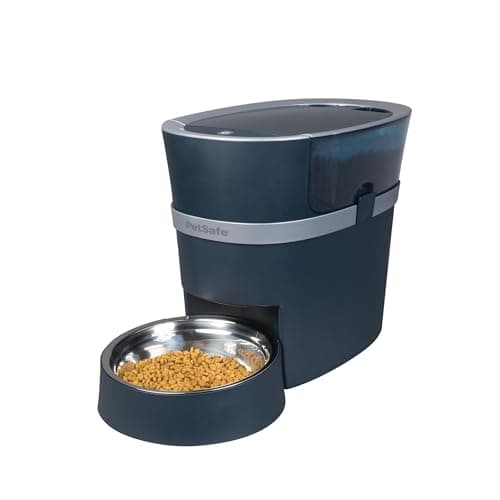
PetSafe Smart Feed, 2nd Generation
PetSafe · Automatic feeder · Our score 7.9/10
#ad Price as of October 19, 2026. Prices move; we check daily. How we're funded.
24 cups of hopper and portions from an eighth of a cup up to four cups -- the widest published portion range of any feeder on this page.
Published specs
| Hopper capacity | 24 cups (6 L) |
|---|---|
| Portion range | 1/8 cup to 4 cups |
| Meals per day | Up to 12 |
| Dimensions | 20.3" x 9.4" x 12.6" |
| Slow feed | Dispenses a meal over 15 minutes |
| Dishwasher | Lid, hopper, bowl and holder, top shelf |
| Food type | Dry or semi-moist |
Source: PetSafe -- Smart Feed Automatic Dog and Cat Feeder, 2nd Generation
24 cups of hopper. Three cats eating half a cup each per day is 1.5 cups daily, so about 16 days. The slow-feed setting spreads one meal over 15 minutes, which is the published feature that matters if one of your cats inhales food and then takes the other's.
What the specs favor
- Largest published hopper here at 24 cups
- Portions from 1/8 cup to 4 cups -- the widest range on this page
- Slow feed spreads a meal over 15 minutes
- All food-contact parts are dishwasher safe
What they don't
- Single bowl, so no separation between cats
- Dry or semi-moist only
- 20 inches long -- it takes real counter or floor space
You feed wet food. Nothing about this feeder handles it, and leaving wet food in an open bowl on a timer is a food-safety problem, not a convenience.
How it scores
Scores are our editorial weighting of the published specs above, not a test result. They are deliberately kept out of this page's structured data.
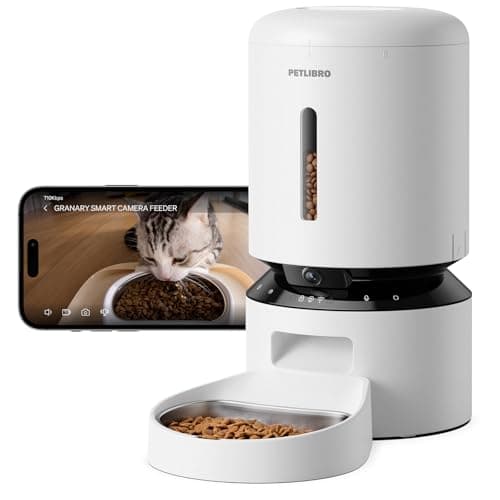
PETLIBRO Granary Camera Feeder
PETLIBRO · Automatic feeder · Our score 7.8/10
#ad Price as of October 19, 2026. Prices move; we check daily. How we're funded.
Publishes its portion size in milliliters rather than vague 'portions', which is the only way to work out whether a hopper will actually last a weekend.
Published specs
| Hopper capacity | 5 L |
|---|---|
| Portion size | 20 ml per portion, 1-50 portions per meal |
| Meals per day | Up to 10 |
| Camera | 1080p, 145-degree lens, night vision |
| Power | DC 5 V adapter plus 3 x D cells backup |
| Kibble size | 2-15 mm diameter |
| Dimensions / weight | 13 x 7.5 x 7.5 in / 4.3 lb |
Source: PETLIBRO -- Granary Smart Camera Feeder product page
5 L hopper, 20 ml per portion, so 250 portions. Two cats on two meals a day at five portions a meal is 20 portions daily -- about 12 days of food. That is the number that tells you whether it covers a holiday, and it comes straight from PETLIBRO's own published portion volume.
What the specs favor
- Portion published as a real volume (20 ml), not an abstract 'portion'
- 5 L hopper -- roughly 12 days for two cats on the arithmetic above
- Battery backup on D cells if the power drops
- Kibble compatibility published as 2-15 mm
What they don't
- One bowl, so it cannot separate two cats' food
- Dry food only
- Camera means a cloud account and a phone in the loop
One of your cats eats the other's food. A single-bowl dispenser with a camera lets you watch the theft happen in 1080p without stopping it.
How it scores
Scores are our editorial weighting of the published specs above, not a test result. They are deliberately kept out of this page's structured data.
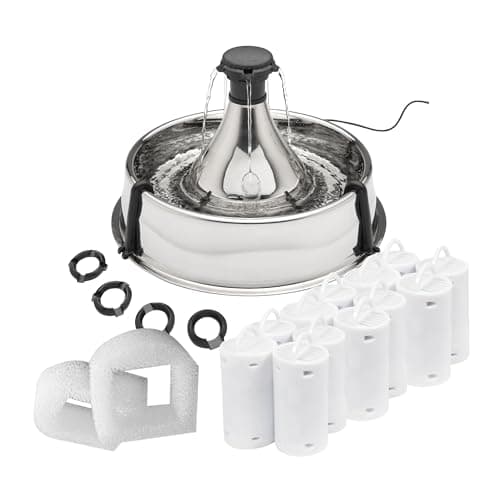
PetSafe Drinkwell 360 Stainless Steel
PetSafe · Water fountain · Our score 8.0/10
#ad Price as of October 19, 2026. Prices move; we check daily. How we're funded.
128 ounces and access from all sides -- the only fountain here designed so two cats can drink without one of them being cornered.
Published specs
| Capacity | 128 oz (3.8 L) |
|---|---|
| Streams | 5 interchangeable stream options |
| Access | 360 degrees, open bowl |
| Filtration | Charcoal plus foam pre-filter |
| Cleaning | Top-rack dishwasher safe |
| Pump | Submersible; wattage not published by PetSafe |
Source: PetSafe -- Drinkwell 360 Stainless Steel Pet Fountain product page
3.8 L divided three ways is 1.27 L a cat between refills -- far more than any cat drinks in a day, so the constraint is not capacity, it is how long water stays fresh. At fortnightly filter intervals the practical refill cycle is what governs, not the tank.
What the specs favor
- Largest capacity here at 128 oz
- 360-degree access removes the cornering problem in a multi-cat house
- Five stream options, so a fussy drinker has somewhere to go
- Top-rack dishwasher safe
What they don't
- PetSafe does not publish pump wattage, so electricity cannot be computed
- Two filter types to buy rather than one
- Big footprint for a water bowl
You want to know what it costs to run. PetSafe publishes no wattage for this pump, and we are not going to invent one.
How it scores
Scores are our editorial weighting of the published specs above, not a test result. They are deliberately kept out of this page's structured data.
Cat Mate C500 5-Meal Automatic Feeder
Cat Mate · Automatic feeder · Our score 8.0/10
#ad No verified live price right now, so we show none rather than a stale one. How we're funded.
Five sealed compartments and twin ice packs, running for up to a year on three AA cells -- the only credible way to put wet food on a schedule.
Published specs
| Meals | 1 immediate + 4 timed |
|---|---|
| Compartment capacity | 11.5 oz (330 g) each |
| Food types | Wet and dry |
| Cooling | Twin ice packs, about 6-8 hours indoors |
| Power | 3 x AA, up to 12 months |
| Suits | Up to two cats or a small dog (maker) |
Source: Chewy -- Cat Mate C500 Digital 5 Meal Automatic Feeder listing
Cat Mate publishes 6-8 hours of indoor cooling from the twin ice packs, not five meals' worth. So the honest read is that this covers a working day, not a weekend -- the 5-meal capacity is about portioning across that day, not about leaving the house for longer.
What the specs favor
- Handles wet food, which no hopper feeder does
- Published compartment capacity in ounces and grams
- Battery-only, so a power cut does not skip a meal
- Up to 12 months from three AA cells
What they don't
- Cooling is published at 6-8 hours indoors, so this is a day, not a trip
- Five compartments is a hard ceiling -- no top-up without opening it
- Shared tray, so it cannot separate two cats' diets
You are away overnight and feeding wet food. Read the published cooling window rather than the meal count: 6-8 hours is the number that governs food safety here.
How it scores
Scores are our editorial weighting of the published specs above, not a test result. They are deliberately kept out of this page's structured data.
Common questions
How long can you leave a cat alone with an automatic feeder?
Can an automatic feeder cover a weekend away?
What is the real constraint when leaving cats alone?
Do I need a camera if I have a feeder?
Is a microchip feeder a good idea when you are away?
Sources
- PetSafe -- Smart Feed Automatic Dog and Cat Feeder, 2nd Generation (24 cups)
- PETLIBRO -- Granary Smart Camera Feeder (5 L, 20 ml portions, up to 10 meals)
- Sure Petcare -- SureFeed Microchip Pet Feeder (400 ml bowl, 32 pets, 6-month battery)
- PetSafe -- Drinkwell 360 Stainless Steel Pet Fountain (128 oz, 5 streams)
Read next
- Best Automatic Cat Feeders (2026)
Hopper capacity converted into days of food for one, two and three cats, plus which feeders handle wet food and which do not.
- Best Automatic Cat Feeders for Multiple Cats (2026)
Ranked on whether a feeder can actually separate two cats' food, plus the battery and hopper arithmetic nobody publishes.
- How Many Litter Boxes Per Cat?
The n+1 rule, its published source, a count-by-household table, and why four boxes in a row is really only one box.
- Cat Hydration: Setup, Not Medicine
Water station counts and placement for multi-cat homes, plus a clear line on which questions belong to a vet.
- The Multi-Cat Household Guide
The pillar guide: resource counts by household size, why separation beats quantity, and the order to fix things in.
- Cat Mate C500 vs PETLIBRO Polar
Twin ice packs against thermoelectric refrigeration, on published cooling windows, meal counts and what each costs to run for a year.