Cat Trees, Shelves & Perches
How to Keep Cats Off Counters and Tables
A cat on the counter is not being naughty. It is choosing the highest surface in the room that smells of food, and the fix is to stop that being the counter.
Affiliate disclosure: we earn a commission if you buy through our links, at no extra cost to you. It never changes which product we rank first — here is how we're funded.
Everyone in this category says they tested twenty litter boxes. We have not tested any, and we say so. What we do instead: compile the published specs, read the manuals, and do the arithmetic on what this gear costs to run and how it behaves once there is more than one cat using it. Every spec is linked to the document it came from. Prices are checked daily — last verified October 19, 2026. Here is exactly how we pick.
Clear the counter, move the food, and give the cat a legal surface that is higher than the one you are trying to defend. That order matters: the first two are free and do most of the work, and the third is where the money goes. Skip the deterrent shelf entirely — it is the weakest product category we cover, and it solves the wrong half of the problem.
Why the counter, specifically
Three things stack up on a kitchen counter and nowhere else in the house: it is usually the highest horizontal surface a cat can reach from the floor, it smells of food more than any other square foot you own, and it looks out over the room people are standing in. A cat is not weighing those against a rule. It is choosing the best seat available.
That framing is not a softening. The Ohio State Indoor Pet Initiative treats elevated resting places as a basic indoor cat need alongside food, water and litter — part of the environment an indoor cat requires rather than an enrichment extra. Read that back against a typical kitchen and the conclusion is uncomfortable: in a lot of rooms, the counter is the only thing on the list.
The free half, which is most of it
- Strip the reward to nothing. Bread, fruit, a butter dish, a roasting tin in the sink, crumbs behind the kettle. A cat that finds something once will check that spot for weeks, so the counter has to be boring every single time, not usually.
- Move the cat’s food off the counter’s circuit. If you feed on the kitchen floor or, worse, on the counter to keep it away from a dog, you have taught the cat that this room dispenses food at height. Our feeding station guide works out where stations should go in a multi-cat house.
- Close the approach, not the room. Most counter access is a two-stage hop — floor to a stool, a bin, a chair or an open dishwasher door, then up. Move the stool. This single change ends more counter-surfing than any product on this page.
- Then add height. Only once the counter is unrewarding is a cat’s choice genuinely between two surfaces, which is when the next section starts working.
How high is high enough
Measure the surface you are defending rather than assuming it. Kitchen counters are commonly around 36 inches and an island or breakfast bar nearer 42, but your kitchen is the one that matters and a tape measure settles it in ten seconds. Then compare that with what each option actually publishes.
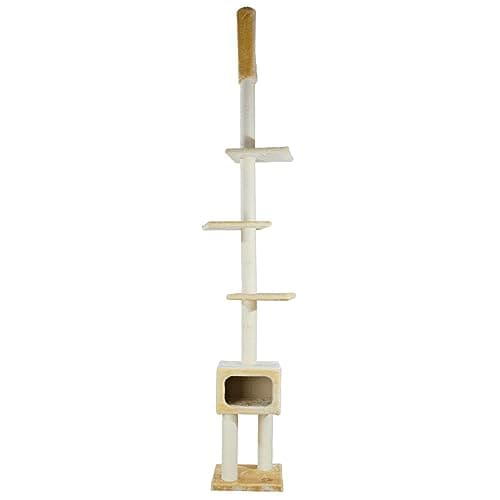
Floor-to-ceiling tower: TRIXIE publishes an adjustable 96.25 to 108.25 inches on a 15.5 by 15.5 inch footprint. That is 1.67 square feet of floor, and dividing the height by it gives about 65 vertical inches per square foot — against roughly 14 for a conventional tower, which is the figure our floor-to-ceiling page is built on. Top platform lands far above any counter.
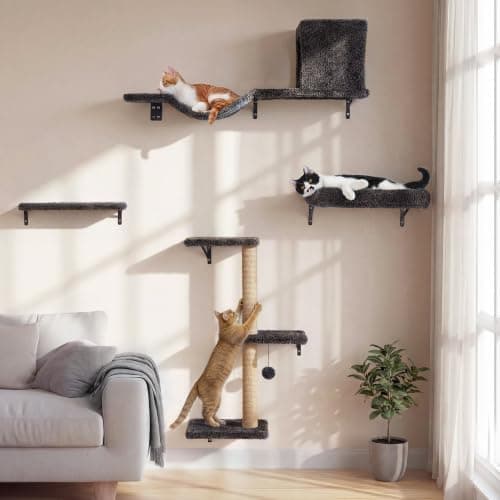
Wall shelves: zero square feet of floor, because the load goes into the wall. Height is whatever you mount it at, which is the only option on this page where you choose the number.
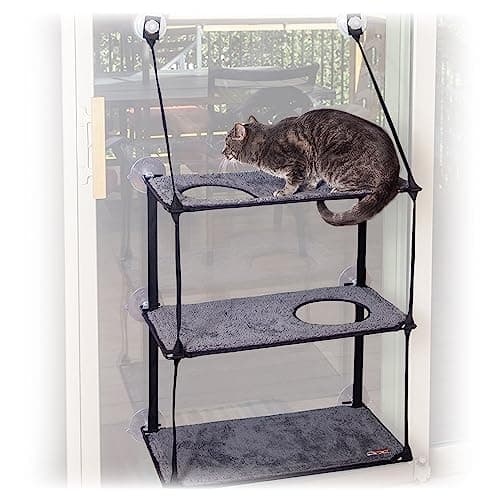
Window perch: also zero floor, but the height is fixed by the window — it is sill height, and no amount of wanting will move it. In a kitchen with a window over the sink, that is frequently just above counter level, which is enough.
So the ranking by floor cost is a tie between two options at zero and a third at 1.67 square feet; the ranking by how much height you control is shelves, then tower, then perch.
The three options on published figures
| TRIXIE Santander (floor-to-ceiling) | FUKUMARU 4-in-1 wall shelves | K&H EZ Mount Double Stack perch | |
|---|---|---|---|
| Height delivered | 96.25"-108.25", adjustable | Whatever you mount it at | Fixed at sill height |
| Floor footprint | 15.5" x 15.5" (1.67 sq ft) | None | None |
| Published load rating | Not published | Up to 40 lb (18 kg) | Up to 50 lb suction (K&H) |
| Fixing method | Spring ceiling attachment, no screws or nails | Wall-mounted; fixings depend on your wall | Suction cups to glass |
| Cats it suits at once | 3 platforms, 14 x 14 in each, plus a condo | 4-in-1 set: shelves, perch, hammock | Two levels, each 23 x 12 in |
| Renter-safe | Yes -- no holes | No -- it is a wall fixing | Yes -- no holes |
| Needs | A ceiling it can brace against | A wall that takes the fixings | Glass at least 27" W x 31" H |
| Material | Posts 3.5 in diameter | Solid rubber wood | Steel frame, washable fleece covers |
Manufacturers' published figures as named in our sources. Where a maker does not publish a figure the cell says so rather than estimating -- TRIXIE publishes no load rating for the Santander's platforms.
What to buy, by what your room allows
The TRIXIE Santander is the pick when you want to end the argument on height and have almost no floor to give. It braces between floor and ceiling on a spring fitting with no screws or nails, adjusts from 96.25 to 108.25 inches to suit the room, and delivers three 14-inch platforms and a condo on a 15.5-inch square base — about 65 vertical inches for every square foot of floor it occupies. Put it where the cat already tries to supervise from and the counter stops being the best seat. The honest cons: TRIXIE publishes no load rating for the platforms, a tension pole needs a ceiling that can take the brace (not a suspended or sloped one), the 3.5-inch posts are the structure so a knock to them matters, and it was down to limited stock when we checked.
The FUKUMARU 4-in-1 wall shelves are the pick when you want to choose the height yourself, which for this specific problem is the strongest argument of the three. A published 40 lb rating in solid rubber wood, four elements — shelves, a perch and hammock pieces — and no floor cost at all, so you can build a route that starts away from the kitchen and ends above it. The honest cons: it is a wall fixing, so it is out for most renters and it is only as strong as what you screw it into; FUKUMARU cannot publish the fixings because they depend on your wall; getting the spacing right for a cat’s jump takes thought, which our mounting guide covers; and a shelf route is the most work to install of anything here.
The K&H EZ Mount Double Stack perch is the pick for the kitchen window over the sink — the exact spot a lot of counter-surfing is actually aimed at. K&H publishes a 50 lb suction rating on a steel frame, two levels of 23 by 12 inches so two cats can use one window, washable fleece covers, and it weighs 3.8 lb with no floor footprint and no holes. If the cat is getting up there to look out, this gives it the view without the worktop. The honest cons: it needs glass at least 27 by 31 inches, suction cups are a maintenance item that need re-seating and wiping, the height is whatever your sill is and cannot be changed, and a kitchen window above a hot or wet sink is not always the right place for a cat to nap.
The shelf we would not buy for this
There is a whole product category aimed at this problem — motion-activated spray cans, pressure-sensitive mats that buzz or shock, sprays that claim to smell unpleasant to cats, double-sided tape across a worktop. We do not recommend any of it here, and the reason is mechanical rather than squeamish.
- It teaches a place, not a rule. A cat learns that this spot is unpleasant when the device is armed. Cats are extremely good at learning schedules and exceptions, which is why these so often work for a fortnight.
- It answers the wrong question. The cat’s question is “where is the best high place”. An aversive answers “not here” and leaves the question open, so the behavior moves to the table, the hob or the top of the fridge.
- Nobody publishes an efficacy figure. We hold every product on this site to what its maker will state in writing, and this category states almost nothing measurable.
- Tape belongs to a different problem. Double-sided tape earns its place against scratching, where it buys time while a post is introduced — that argument is on our furniture protectors page. Across a food preparation surface it is a hygiene problem you have given yourself.
Where to put the thing you buy
Height alone is not enough. A tower in the spare room does not compete with a counter in the kitchen, because the cat is not on the counter for the altitude alone — it is there for the view of you.
- In the same room, or the doorway to it. Line of sight to where people stand is the feature you are actually buying.
- Above the counter’s height, visibly. A cat picks the higher option when both are available; make which one is higher obvious.
- Reachable without using the counter. Check the route. A shelf that is easiest to reach via the worktop has made things worse.
- Out of the cooking triangle. Not over the hob, not where a pan handle swings. Cat-proofing your home covers the kitchen hazards properly.
- Warm, if you can manage it. A sunny window beats a shaded shelf most days, which is half the reason window perches work so well.
Our tree placement guide works through sight lines and traffic in more detail, and for a house with several cats the vertical space plan sets out how many high spots the household actually needs.
What to expect, honestly
A cat with a cleared counter, its food elsewhere and a taller legal option usually changes habit within a week or two. What does not happen is a cat deciding it will never again investigate a worktop; expect the occasional check, especially if something smells interesting, and expect it to stop mattering because there is nothing to find.
Two situations do not resolve this way. A cat that has always been allowed up and is now not will take longer, because you are undoing a learned permission rather than a preference. And a cat competing for space with another cat may be using height defensively — in which case the counter is a symptom and resource competition is the page to read instead.
See the vertical options
Our wall shelves roundup ranks mounted options on published weight ratings, window perches covers the zero-floor route, and floor-to-ceiling trees is where the vertical-inches-per-square-foot arithmetic on this page comes from. If the cat is scratching as well as climbing, stopping furniture scratching is the companion problem.
The gear discussed here
Specs are the manufacturer's own, linked to the page they came from. Prices come from a live daily check; where we have no verified price we say so rather than print a stale one.
TRIXIE Santander Floor-to-Ceiling Cat Tree
TRIXIE · Floor-to-ceiling cat tree · Our score 8.0/10
#ad Price as of October 19, 2026. Prices move; we check daily. How we're funded.
A 15.5 inch square footprint that reaches 108 inches, because the ceiling does the work a wide base would otherwise have to do.
Published specs
| Footprint | 15.5" L x 15.5" W |
|---|---|
| Height range | 96.25" to 108.25", adjustable |
| Fixing | Spring-activated ceiling attachment, no screws or nails |
| Condo | 14" x 14" x 10" |
| Platforms | 3, each 14" x 14" |
| Posts | 3.5" diameter |
15.5 x 15.5 = 240 square inches = 1.67 square feet of floor. At 108 inches of height that is 65 inches of climbable height per square foot given up. A conventional 72 inch tree on a 22 x 33 inch base gives about 14. This is the most floor-efficient vertical product we track by a factor of four.
What the specs favor
- Most vertical height per square foot of any product on the site
- No screws or nails, so it survives a tenancy agreement
- Adjustable through a full foot of ceiling height
- Published condo and platform dimensions, not just an overall height
What they don't
- Tension fixing depends on your ceiling being solid and flat
- 14 inch platforms are small for a large cat to turn on
- Needs re-tensioning as the building and the pole settle
You have a suspended, textured or sloped ceiling. A tension pole transfers real load upward, and it needs something solid to push against.
How it scores
Scores are our editorial weighting of the published specs above, not a test result. They are deliberately kept out of this page's structured data.
FUKUMARU 4-in-1 Cat Wall Shelves Set
FUKUMARU · Wall shelves · Our score 8.2/10
#ad Price as of October 19, 2026. Prices move; we check daily. How we're funded.
Rated to 40 lb per the maker and takes no floor at all -- the answer when a household needs more vertical territory than the room has square feet.
Published specs
| Weight rating | Up to 40 lb (18 kg), per FUKUMARU |
|---|---|
| Set | 4-in-1: shelves, perch, hammock elements |
| Material | Solid rubber wood |
| Mounting | Wall-mounted; fixings depend on your wall |
| Floor footprint | None |
Source: Chewy -- FUKUMARU 4-in-1 Wall Mounted Cat Wall Shelves Set listing
The Go Pet Club F2081 occupies 22 x 33 inches = 726 sq inches, just over 5 square feet. Wall shelves at the same height occupy none of it. In a one-bedroom flat that is the difference between having a cat tree and having a walkable room.
What the specs favor
- 40 lb published weight rating -- higher than most tree platforms
- Zero floor footprint
- Solid rubber wood rather than particleboard
- Height is limited by your wall, not by the product
What they don't
- Only as strong as what you screw it into -- studs, or nothing
- No good for a cat that cannot jump the gaps
- Wrong fixings in drywall is a serious failure mode
You rent and cannot drill, or you have a senior cat. Shelves demand a jump every time; a tree with stepped platforms does not.
How it scores
Scores are our editorial weighting of the published specs above, not a test result. They are deliberately kept out of this page's structured data.
K&H EZ Mount Double Stack Window Perch
K&H Pet Products · Window perch · Our score 8.1/10
#ad Price as of October 19, 2026. Prices move; we check daily. How we're funded.
Two 23 by 12 inch levels on the same 50 lb suction rating -- the answer to the single-ledge problem that makes one perch a thing for two cats to argue over.
Published specs
| Levels | Two, each 23 x 12 in fleece |
|---|---|
| Dimensions | 12 x 23 x 1.75 in |
| Suction rating | Up to 50 lb (K&H) |
| Weight | 3.8 lb |
| Glass needed | 27" W x 31" H or larger |
| Frame | Steel |
| Covers | Two washable shelf covers |
Source: K&H Pet Products -- EZ Mount Window Kitty Sill Double Stack product page
The single-level EZ Mount gives 27 inches split two ways -- 13.5 inches each, less than a cat's body length, so in practice one cat gets it. The double stack gives each cat a full 23-inch level at a different height, which is how cats share space when they have the option.
What the specs favor
- Two separate levels at different heights, not one shared ledge
- Same published 50 lb suction rating as the single
- Steel frame rather than plastic
- Both covers are washable, which matters where cats sleep
What they don't
- Needs a large window -- 27" x 31" of glass minimum
- Suction fails on textured, dirty or very cold glass
- 3.8 lb hanging off suction cups is a lot of trust
Your windows are small or heavily framed. The published glass requirement is a hard constraint, and a perch that will not fit is not a perch.
How it scores
Scores are our editorial weighting of the published specs above, not a test result. They are deliberately kept out of this page's structured data.
Common questions
How do I keep my cat off the kitchen counter?
Why do cats jump on counters and tables?
Do cat deterrent sprays and mats work?
Should I punish a cat for getting on the counter?
What height does a cat perch need to be to beat a counter?
Sources
- TRIXIE -- Santander Floor-to-Ceiling Cat Tree listing (15.5 x 15.5 in footprint, 96.25-108.25 in adjustable, spring ceiling attachment)
- Chewy -- FUKUMARU 4-in-1 Wall Mounted Cat Wall Shelves Set listing
- K&H Pet Products -- EZ Mount Window Kitty Sill Double Stack product page
- Ohio State University Indoor Pet Initiative -- Basic indoor cat needs (resting places, vertical space and environmental enrichment for indoor cats)
- Cornell Feline Health Center -- feline health and behavior information
Read next
- Best Cat Wall Shelves (2026)
Wall shelf sets ranked on published weight rating, with the stud-and-anchor detail that actually governs safety.
- Where to Put a Cat Tree
Windows, sightlines, escape routes and traffic -- how to place a tree so it actually gets used, in a house with more than one cat.
- Best Cat Window Perches (2026)
Window perches compared on published suction rating and ledge length, including whether two cats can genuinely share one.
- Best Floor to Ceiling Cat Trees (2026)
Floor-to-ceiling tension-pole trees compared with conventional towers on climbable height per square foot of floor given up.
- Cat-Proofing Your Home
Room-by-room cat-proofing for blinds, carpet, cables and furniture, with the free fixes first and product last.