Scratchers & Furniture Protection
Cat-Proofing Your Home
Most of this costs nothing. The rest costs less than replacing what you are protecting.
Affiliate disclosure: we earn a commission if you buy through our links, at no extra cost to you. It never changes which product we rank first — here is how we're funded.
Everyone in this category says they tested twenty litter boxes. We have not tested any, and we say so. What we do instead: compile the published specs, read the manuals, and do the arithmetic on what this gear costs to run and how it behaves once there is more than one cat using it. Every spec is linked to the document it came from. Prices are checked daily — last verified October 19, 2026. Here is exactly how we pick.
Cat-proofing sounds like a shopping list and is mostly a rearrangement exercise. The principle underneath all of it: a cat is going to do the behavior, so the question is never how to stop it but where you would rather it happened.
One rule that covers most of this
Living room
- Sofa arms. A post taller than the cat’s full stretch, placed touching the damaged spot, plus double-sided tape on the spot itself for a fortnight. Details in how to stop a cat scratching furniture.
- Rugs and carpet. Horizontal problem, horizontal solution. A corrugate scratcher on the exact spot, not across the room.
- Cables behind the TV. Bundle them, route them behind furniture, and cut the dangling loops. A loose cable that swings reads as prey.
- Ornaments on open shelves. Cats explore surfaces by pushing things off them. Clear the top shelf and let it be a cat destination instead — it is free vertical territory.
Windows and blinds
Blind damage is almost always a symptom rather than a target: the cat wants the window and the blind is in the way. Give it a legitimate route to the glass and the destruction usually stops on its own.
- Fit a perch or clear a sill at the window they keep going for.
- Tie cords up and out of reach — looped cords are a genuine hazard.
- Raise the blind partly during the day so the cat is not pushing through slats to see out.
Which window matters. A window onto a bird feeder or a street holds a cat’s attention; one onto a wall does not. More on that in the window perch picks.
Kitchen and bathroom
- Counters. Cats go up because up is where cats go. The reliable fix is a better high place nearby — a cleared shelf, a stool, a tree in the corner of the room — rather than a deterrent on the counter.
- Bins. A lidded bin ends a surprising number of arguments.
- Washing machines and tumble dryers. Keep the doors shut. This one is not about damage.
- Toilet lids down, particularly with kittens.
Houseplants: ask, do not guess
The non-medical half of the problem is that pots of soil read as litter and leaves read as grass. Large pebbles over the soil surface address the first, and a pot of cat grass gives an outlet for the second.
When it is not a proofing problem
If destructive behavior has appeared suddenly or is escalating across several categories at once, more scratchers will not fix it. Two things to consider first:
- Under-stimulation. Bored cats redirect into whatever is available. Start with signs your cat is bored.
- Tension between cats. Scratching is partly territorial marking, and marking increases when territory feels contested. See the resource competition guide, and the Ohio State Indoor Pet Initiative problem-solving section for the behavioral side we do not cover.
And anything sudden is a veterinary question before it is a furniture question. Pain changes behavior, and we are not qualified to tell one from the other.
The order to work in
- Move things and clear surfaces. Free, and it happens today.
- Give a legitimate alternative in the same place as the problem.
- Make the target temporarily unpleasant, for a fortnight only.
- Add vertical territory, which quietly resolves several of these at once.
- Buy the post or scratcher the cat actually needs.
The gear discussed here
Specs are the manufacturer's own, linked to the page they came from. Prices come from a live daily check; where we have no verified price we say so rather than print a stale one.
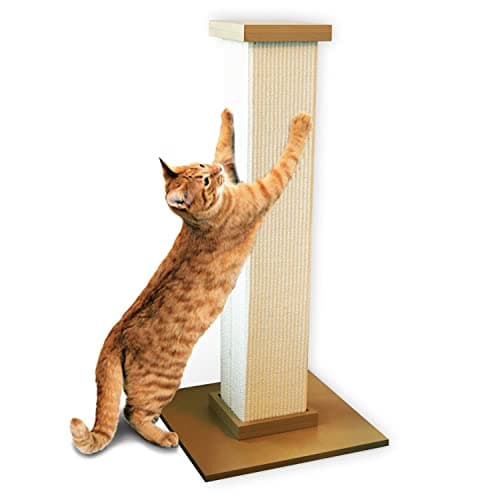
SmartCat Ultimate Scratching Post
Pioneer Pet · Scratching post · Our score 8.9/10
#ad Price as of October 19, 2026. Prices move; we check daily. How we're funded.
32 inches tall on a 16-inch square base in woven sisal -- tall enough for a full stretch, which is the single reason cats reject most posts.
Published specs
| Dimensions | 32" H x 16" W x 16" D |
|---|---|
| Base | 16" x 16" |
| Surface | Woven sisal fabric |
| Orientation | Vertical |
Source: Pioneer Pet -- #3832 The Ultimate Scratching Post product page
A large domestic cat stretched from front claws to hind feet runs roughly 30 inches. At 32 inches this post clears that; a typical 20-inch post from a pet-shop shelf does not, which is why the cat goes back to the sofa arm -- the sofa is tall enough and the post is not.
What the specs favor
- 32 inches is taller than the great majority of retail posts
- 16 x 16 inch base, which is what stops it rocking mid-scratch
- Woven sisal fabric rather than carpet, so it does not teach the cat that carpet is for scratching
- Nothing on it to wear out but the sisal
What they don't
- Only one scratching surface
- Vertical only, and some cats are horizontal scratchers
- Plain -- it looks like what it is
Your cat scratches the carpet rather than the furniture. That is a horizontal scratcher, and a vertical post will not redirect it.
How it scores
Scores are our editorial weighting of the published specs above, not a test result. They are deliberately kept out of this page's structured data.
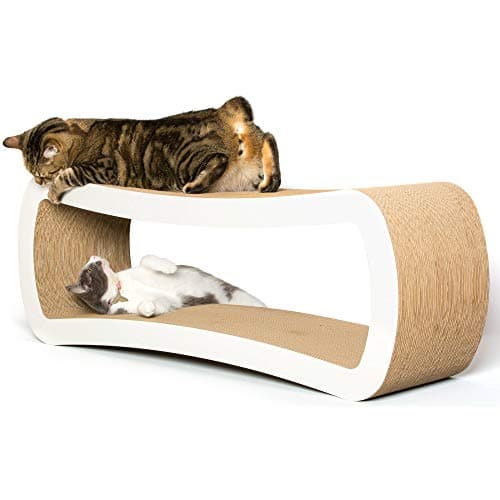
PetFusion Ultimate Cat Scratcher Lounge
PetFusion · Cardboard scratcher · Our score 8.0/10
#ad Price as of October 19, 2026. Prices move; we check daily. How we're funded.
34 inches of reversible corrugate -- the horizontal answer for the cat that is destroying carpet rather than furniture, and it doubles as somewhere to sleep.
Published specs
| Dimensions | 34" L x 10.5" W x 10.5" H |
|---|---|
| Weight | 7.5 lb |
| Material | Recycled cardboard, corn-starch glue |
| Reversible | Yes -- both sides scratchable |
Source: Chewy -- PetFusion Ultimate Cat Scratcher Lounge listing
Reversible means both faces are usable, so one lounge is two pads. Against the flat single-sided cardboard pads sold in threes, that is twice the surface before it goes in the recycling -- the entire economic argument for buying one good scratcher instead of a stack of cheap ones.
What the specs favor
- 34 inches long -- a cat can lie on it and scratch at the same time
- Reversible, doubling usable life
- Corn-starch glue, so nothing unpleasant when the cat chews the edge
- Wide enough that two cats occasionally tolerate sharing it
What they don't
- Cardboard sheds, and it sheds where the cat scratches
- Consumable by design -- it is a wear part
- Will not redirect a cat that scratches vertically
Your problem is the sofa arm. That is a vertical target and this is a horizontal product; the two are not interchangeable.
How it scores
Scores are our editorial weighting of the published specs above, not a test result. They are deliberately kept out of this page's structured data.
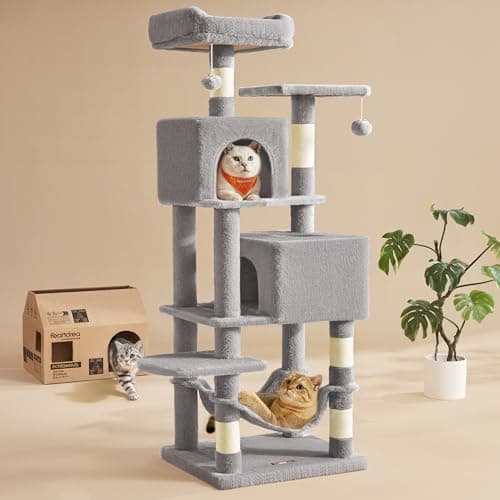
FEANDREA 67-inch Multi-Level Cat Tree
FEANDREA · Cat tree · Our score 8.6/10
#ad Price as of October 19, 2026. Prices move; we check daily. How we're funded.
The best base-to-height ratio of any tree here, and base-to-height is the only spec that predicts whether a tree rocks when a 15 lb cat lands on the top perch.
Published specs
| Dimensions | 24" L x 19.3" W x 67" H |
|---|---|
| Assembled weight | 57.5 lb |
| Materials | Particleboard, plush, sisal rope |
| Post diameter | 3.4" sisal-wrapped |
| Per-platform rating | Not published in the retail listing |
Source: Chewy -- FEANDREA 67-in Multi-Level Cat Tree listing
Our figure, not the maker's: shortest base dimension divided by height, multiplied by assembled weight. 19.3 / 67 = 0.288, x 57.5 lb = 16.5. The Yaheetech 72-inch scores 8.7 on the same sum and the Go Pet Club F2081 scores 15.9. Higher is harder to tip. Redo it yourself on any tree from two published numbers.
What the specs favor
- Heaviest tree here at 57.5 lb, and weight is what resists tipping
- Widest base relative to height of the three trees on this page
- 3.4-inch sisal posts are thick enough for a large cat to actually pull against
- Multiple platforms so two cats are not forced to share one
What they don't
- Particleboard, so it does not survive being moved often
- 57.5 lb is a two-person assembly
- FEANDREA does not publish a per-platform weight rating in the retail listing
You move house often or rearrange furniture. Particleboard trees come apart badly and go back together worse.
How it scores
Scores are our editorial weighting of the published specs above, not a test result. They are deliberately kept out of this page's structured data.
K&H EZ Mount Window Perch
K&H Pet Products · Window perch · Our score 7.5/10
#ad No verified live price right now, so we show none rather than a stale one. How we're funded.
Suction cups rated to 50 lb and 27 inches of ledge -- the cheapest square foot of territory you can add to a multi-cat house.
Published specs
| Dimensions | 27" L x 11" W x 6" H |
|---|---|
| Suction cup rating | Up to 50 lb, per K&H |
| Mounting | Suction to glass or a smooth door |
| Floor footprint | None |
Source: Amazon -- K&H Pet Products EZ Mount Cat Window Perch listing
27 inches of ledge split two ways is 13.5 inches each -- less than a cat's body length. Two cats will not share this; in a multi-cat house it is one perch per window, not one perch for the household.
What the specs favor
- 50 lb published suction rating, well beyond any cat's weight
- No drilling, so it works in a rental
- Puts a cat at a window, which is the enrichment that costs nothing to run
- Moves to another window in five minutes
What they don't
- Suction fails on textured, dirty or very cold glass
- 27 inches is a one-cat ledge
- No good on a window with a deep recessed frame
Your two cats already compete over resting spots. One perch at one window is a new thing to compete over, not a solution -- buy two, at two windows.
How it scores
Scores are our editorial weighting of the published specs above, not a test result. They are deliberately kept out of this page's structured data.
Common questions
How do I stop my cat destroying the blinds?
Why is my cat digging up the carpet?
How do I stop a cat chewing cables?
Which houseplants are dangerous to cats?
Is cat-proofing expensive?
Sources
- Ohio State University Indoor Pet Initiative -- For Cat Owners
- Ohio State University Indoor Pet Initiative -- Problem Solving
- Pioneer Pet -- #3832 The Ultimate Scratching Post (32 in tall, 16 x 16 in base, woven sisal)
- Chewy -- PetFusion Ultimate Cat Scratcher Lounge (34 x 10.5 x 10.5 in, 7.5 lb, reversible)
Read next
- How to Stop a Cat Scratching the Furniture
Why cats scratch furniture, the free fixes that solve most cases, and the one purchase worth making if they do not.
- Best Cat Scratching Posts (2026)
Ranked on the three published specs that predict whether a cat uses a post: height, base width and surface material.
- Where to Put a Scratching Post
Why prominence beats tidiness, how many scratchers a multi-cat home needs, and how to move one without losing the habit.
- Signs Your Cat Is Bored
What under-stimulation looks like in an indoor cat, which signs are veterinary questions, and the free changes to try first.
- Where to Put a Cat Tree
Windows, sightlines, escape routes and traffic -- how to place a tree so it actually gets used, in a house with more than one cat.
- Best Cat-Proof Window Screens (2026)
Pet-resistant screening compared on published strength and openness, with the frame check and the perch that suits a screened window.
- How to Keep Cats Off Counters and Tables
Why cats choose counters, the three free changes that fix most of it, and the vertical options that put a cat above counter height -- plus the deterrent shelf we would not buy.