Scratchers & Furniture Protection
How Many Scratching Posts Per Cat?
Litter boxes have a published rule. Scratching posts do not, so here is ours, built from where cats actually scratch rather than from a number someone made up.
Affiliate disclosure: we earn a commission if you buy through our links, at no extra cost to you. It never changes which product we rank first — here is how we're funded.
Everyone in this category says they tested twenty litter boxes. We have not tested any, and we say so. What we do instead: compile the published specs, read the manuals, and do the arithmetic on what this gear costs to run and how it behaves once there is more than one cat using it. Every spec is linked to the document it came from. Prices are checked daily — last verified September 25, 2026. Here is exactly how we pick.
The litter hub has a rule everyone knows: one box per cat, plus one. Scratching has no equivalent, so households buy one post, put it in a corner, and conclude the cat prefers the sofa.
Scratching is about places, not quantity
Our why cats scratch page covers the reasons: claw maintenance, a full-body stretch, and marking -- visible marks plus scent from the paws. The marking part is why a single post fails: a cat marks the places that matter to it, and those are spread around the house.
The Ohio State Indoor Pet Initiative lists scratching surfaces among the basic needs of an indoor cat. It does not put a number on it, and we are not going to invent a published one. What follows is our rule, stated as ours.
Our count
One tall vertical post per cat. At least 32 inches so an adult cat can stretch out fully, on a base that does not shift.
Plus one horizontal surface per household, minimum. Roughly a third of the cats we hear about are horizontal scratchers, and a household with only vertical posts has effectively provided nothing for them.
Plus one at every place the cat already scratches. This is the important term. The sofa arm, the doorframe, the rug by the bedroom door: those locations are chosen, and the cheapest fix is to put an approved surface exactly there.
One cat, one sofa corner and a rug it works: one post, one mat, one sofa protector. Two cats in a two-bedroom flat: four or five surfaces, spread out.
One of each kind
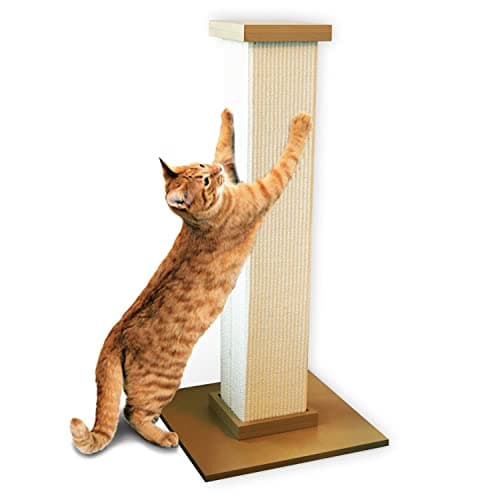
The SmartCat Ultimate post is the vertical: 32 inches on a 16 inch square base in woven sisal, which is the height a 15 lb cat can stretch to without the post moving.
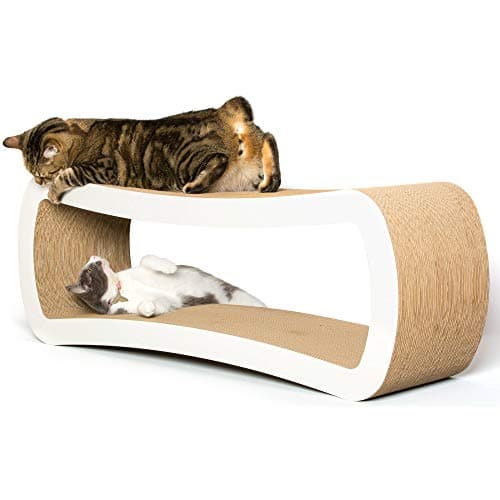
The PetFusion lounge is the horizontal: 34 inches of reversible corrugated cardboard at 7.5 lb, so it does not skate across a floor when a cat digs in.
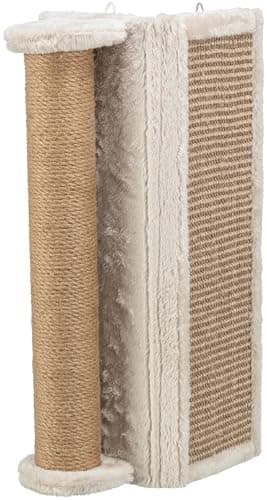
The TRIXIE wall board is the one for a place rather than a room -- 23.6 inches of sisal mounted at the spot the cat has already chosen, using no floor. Our wall-mounted page covers that category.
In a multi-cat house
- Count posts as a resource, like boxes and beds. Our competition guide explains what happens when one cat can guard the only one.
- Spread them across rooms, not along one wall.
- Put one near each cat’s preferred sleeping spot, because scratching follows waking.
- Do not remove a scratched-through post until the replacement has been accepted -- our repair guide covers re-wrapping instead.
The gear discussed here
Specs are the manufacturer's own, linked to the page they came from. Prices come from a live daily check; where we have no verified price we say so rather than print a stale one.
SmartCat Ultimate Scratching Post
Pioneer Pet · Scratching post · Our score 8.9/10
#ad Price as of September 25, 2026. Prices move; we check daily. How we're funded.
32 inches tall on a 16-inch square base in woven sisal -- tall enough for a full stretch, which is the single reason cats reject most posts.
Published specs
| Dimensions | 32" H x 16" W x 16" D |
|---|---|
| Base | 16" x 16" |
| Surface | Woven sisal fabric |
| Orientation | Vertical |
Source: Pioneer Pet -- #3832 The Ultimate Scratching Post product page
A large domestic cat stretched from front claws to hind feet runs roughly 30 inches. At 32 inches this post clears that; a typical 20-inch post from a pet-shop shelf does not, which is why the cat goes back to the sofa arm -- the sofa is tall enough and the post is not.
What the specs favor
- 32 inches is taller than the great majority of retail posts
- 16 x 16 inch base, which is what stops it rocking mid-scratch
- Woven sisal fabric rather than carpet, so it does not teach the cat that carpet is for scratching
- Nothing on it to wear out but the sisal
What they don't
- Only one scratching surface
- Vertical only, and some cats are horizontal scratchers
- Plain -- it looks like what it is
Your cat scratches the carpet rather than the furniture. That is a horizontal scratcher, and a vertical post will not redirect it.
How it scores
Scores are our editorial weighting of the published specs above, not a test result. They are deliberately kept out of this page's structured data.
PetFusion Ultimate Cat Scratcher Lounge
PetFusion · Cardboard scratcher · Our score 8.0/10
#ad Price as of September 25, 2026. Prices move; we check daily. How we're funded.
34 inches of reversible corrugate -- the horizontal answer for the cat that is destroying carpet rather than furniture, and it doubles as somewhere to sleep.
Published specs
| Dimensions | 34" L x 10.5" W x 10.5" H |
|---|---|
| Weight | 7.5 lb |
| Material | Recycled cardboard, corn-starch glue |
| Reversible | Yes -- both sides scratchable |
Source: Chewy -- PetFusion Ultimate Cat Scratcher Lounge listing
Reversible means both faces are usable, so one lounge is two pads. Against the flat single-sided cardboard pads sold in threes, that is twice the surface before it goes in the recycling -- the entire economic argument for buying one good scratcher instead of a stack of cheap ones.
What the specs favor
- 34 inches long -- a cat can lie on it and scratch at the same time
- Reversible, doubling usable life
- Corn-starch glue, so nothing unpleasant when the cat chews the edge
- Wide enough that two cats occasionally tolerate sharing it
What they don't
- Cardboard sheds, and it sheds where the cat scratches
- Consumable by design -- it is a wear part
- Will not redirect a cat that scratches vertically
Your problem is the sofa arm. That is a vertical target and this is a horizontal product; the two are not interchangeable.
How it scores
Scores are our editorial weighting of the published specs above, not a test result. They are deliberately kept out of this page's structured data.
TRIXIE Wall Mount Sisal Scratching Board
TRIXIE · Wall-mounted scratcher · Our score 7.7/10
#ad Price as of September 25, 2026. Prices move; we check daily. How we're funded.
Under an inch thick and mountable in the exact corner a cat is already working on, which is the one placement rule our scratching pages keep coming back to.
Published specs
| Dimensions | 1" x 12.6" x 23.6" |
|---|---|
| Weight | 3.2 lb |
| Materials | MDF, sisal, plush polyester |
| Mounting | Wall hardware included; corner or flat wall |
| Suited to | Cats up to about 15 lb, per the listing |
The board is 1 inch deep and hangs on the wall, so its floor cost is nothing. It gives 23.6 inches of vertical scratch travel -- short of the 32 inches our posts page argues for a full adult stretch, but longer than most cardboard scratchers and available in places a post cannot stand.
What the specs favor
- No floor footprint at all, which no post can match
- Mounts in a corner, where cats often prefer to scratch
- Sisal over MDF is a rigid surface, so it does not flex under a pull
- Hardware included rather than sold separately
What they don't
- 23.6 inches is under the 32 inch full-stretch height for a large cat
- Needs a fixing into something solid, so it is not renter-friendly
- Fixed height, so it suits one cat's stretch rather than a household of sizes
Your cat scratches horizontally. Wall boards answer a vertical need, and a cat working on the carpet is telling you it wants the other orientation.
How it scores
Scores are our editorial weighting of the published specs above, not a test result. They are deliberately kept out of this page's structured data.
Common questions
How many scratching posts does one cat need?
Do cats need more than one scratching post?
How many posts for two cats?
Do I need both vertical and horizontal scratchers?
Can I count a cat tree as a scratching post?
Sources
Read next
- Where to Put a Scratching Post
Why prominence beats tidiness, how many scratchers a multi-cat home needs, and how to move one without losing the habit.
- Best Cat Scratching Posts (2026)
Ranked on the three published specs that predict whether a cat uses a post: height, base width and surface material.
- Why Cats Scratch
The four jobs scratching does for a cat, and what each one implies about where and what to provide.
- Resource Competition Between Cats
How to recognize resource guarding, why it rarely looks like fighting, and the environmental changes that reduce it.
- Best Cat Scratching Mats (2026)
Horizontal scratching mats compared on published area and surface, for the cat that scratches rugs and ignores every post.