Multi-Cat Households
Setting Up a Multi-Cat Home on a Budget
The three highest-value multi-cat interventions are free. Only after those have been exhausted is anything on this site worth buying.
Affiliate disclosure: we earn a commission if you buy through our links, at no extra cost to you. It never changes which product we rank first — here is how we're funded.
Everyone in this category says they tested twenty litter boxes. We have not tested any, and we say so. What we do instead: compile the published specs, read the manuals, and do the arithmetic on what this gear costs to run and how it behaves once there is more than one cat using it. Every spec is linked to the document it came from. Prices are checked daily — last verified October 22, 2026. Here is exactly how we pick.
Most multi-cat problems are geometry problems, and geometry is free. This page is ordered accordingly: everything that costs nothing comes first.
The free tier
- Separate what you already have. Two bowls side by side is one feeding station. Move one to another room. Costs nothing, and it is the single most effective change most households can make.
- Remove the choke points. A litter box in a cupboard under the stairs has one entrance and can be guarded. Move it somewhere with two approaches.
- Scoop more often. Twice a day rather than once. Free, and it does more for box acceptance than any box you can buy.
- Rearrange for height. Clear the top of a bookcase, put a chair beside it, and you have built a two-step climbing route for nothing.
- Add cardboard boxes. Cover, refuge and a scratchable surface, at zero cost, replaced whenever they wear out.
- Play with each cat separately. Fifteen minutes each is free and it addresses the arousal that turns into friction.
The one number that is not negotiable
Cornell Feline Health Center recommends “an adequate number of litter boxes, usually one more than the number of cats”. Three cats means four boxes.
Four plain jumbo pans is the cheapest way to meet that, and it beats one expensive automatic box comprehensively — because the recommendation is about count and distribution, and no single unit satisfies either.
This is the one place where buying the cheap option repeatedly is the correct answer rather than a compromise.
A plain jumbo pan in each of four rooms is the whole solution. Our multi-cat litter setup covers placement, which matters as much as the count.
Where money genuinely helps
| Priority | What | Why | Cheap version |
|---|---|---|---|
| 1 | Enough litter boxes | Cornell's count is the strongest published guidance in cat keeping | Plain jumbo pans |
| 2 | A scratching post per cat | Scratching is marking; one post is a contested resource | Frisco 21 in for a small cat, or a tall post shared between two rooms |
| 3 | Cover at floor level | Somewhere to wait and somewhere to bolt to | Cardboard boxes, then a three-way tunnel |
| 4 | Vertical territory | Multiplies usable space without moving a wall | Rearranged furniture, then a window perch |
| 5 | Selective access | Only when a specific problem needs it | An interior door before a microchip one |
Our spend order. Note that selective-access hardware is last, not first, despite being what people search for.
The cheap version of each
A 21 inch post is honestly sized for a kitten or a small cat and is cheap enough to buy two of. For a full-grown cat it is too short, and our posts page explains why 32 inches is the practical floor — but two short posts in two rooms beats one tall post in one room for a household with tension in it.
A three-way tunnel is the cheapest purchasable cover, and it does something cardboard boxes cannot: three exits, so no cat can be cornered in it.
What we would not buy first
- An automatic litter box, when the money buys four plain boxes in four rooms.
- A large cat tree, before checking whether rearranged furniture gives the same route.
- Calming products, before the environment has been fixed. Stress in a multi-cat house is usually a resource problem wearing a behavior costume, as our competition guide puts it.
- Microchip hardware, unless there is a specific diet or bullying problem it is solving.
The gear discussed here
Specs are the manufacturer's own, linked to the page they came from. Prices come from a live daily check; where we have no verified price we say so rather than print a stale one.
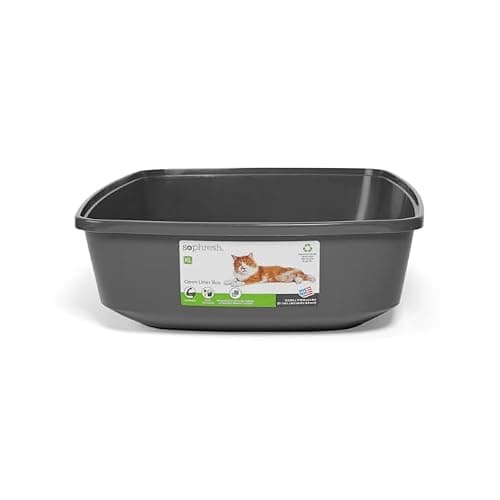
So Phresh Open Cat Litter Box, X-Large
So Phresh · Litter box · Our score 7.4/10
#ad Price as of October 22, 2026. Prices move; we check daily. How we're funded.
The plain plastic pan that lets you follow the one-box-per-cat-plus-one rule without spending like it -- 379 square inches of open floor for the price of a bag of litter.
Published specs
| External dimensions | 22.4" L x 16.9" W x 5.4" H |
|---|---|
| Wall height | 5.4" |
| Type | Open pan, no cover |
| Material | Plastic |
| Color | Charcoal |
| Litter type | Any |
| Published interior | Not published |
| Weight | Not published |
Cornell's guidance is one box more than you have cats. For three cats that is four boxes. The cheapest automatic box on this site is $269.99 -- four plain open pans is a fraction of one of those, and four boxes beat one clever one every time. At 22.4 x 16.9 inches each, four of these is 1,514 square inches of litter floor spread across four rooms, which is the thing a single automatic box cannot buy at any price.
What the specs favor
- Cheap enough to buy four without thinking about it
- 22.4 inches long, which is genuinely jumbo for a plain pan
- Open, uncovered, low -- the configuration cats prefer
- A 5.4 inch wall is an easy step for a kitten or an arthritic cat
- Nothing to break, nothing proprietary
What they don't
- A 5.4 inch wall will not contain a cat that sprays standing up, and it is lower than the 6.5 inch pans it replaces
- No scatter shield at all
- Thin plastic scratches, and scratched plastic holds odor
- No published interior dimension, so usable floor is smaller than the external figure
- No published weight
Odor or scatter is your actual complaint. This pan solves the count problem, not the containment problem -- pair it with a high-sided box rather than replacing one.
How it scores
Scores are our editorial weighting of the published specs above, not a test result. They are deliberately kept out of this page's structured data.
Frisco 21-in Sisal Cat Scratching Post
Frisco · Scratching post · Our score 6.4/10
#ad No verified live price right now, so we show none rather than a stale one. How we're funded.
Twenty-one inches of full-circumference sisal at a weight the listing publishes -- honest about being small, which is more than most kitten-marketed posts manage.
Published specs
| Height | 21" |
|---|---|
| Covering | 360-degree sisal rope on the post, plush base |
| Weight | 5.39 lb |
| Core | Cardboard, sisal wrapped |
| Base | Not weighted |
| Extras | Hanging pom-pom toy |
Our posts page argues 32 inches as the practical floor for an adult cat's full stretch. This publishes 21. That is a kitten post and it will be outgrown -- which is fine if you know it going in and wrong if you were sold it as the household's post.
What the specs favor
- Sisal all the way round rather than on one face
- Light enough for a kitten to be unafraid of it
- Publishes its weight, which is how you know the base is not weighted
- Cheap enough to be a first post rather than the only post
What they don't
- 21 inches is too short for an adult full stretch
- Unweighted base means it can rock under a determined adult cat
- Cardboard core, so it does not take a full-grown cat's pull for years
Your cat is fully grown. Buy the 32 inch post now instead of buying this and then that.
How it scores
Scores are our editorial weighting of the published specs above, not a test result. They are deliberately kept out of this page's structured data.
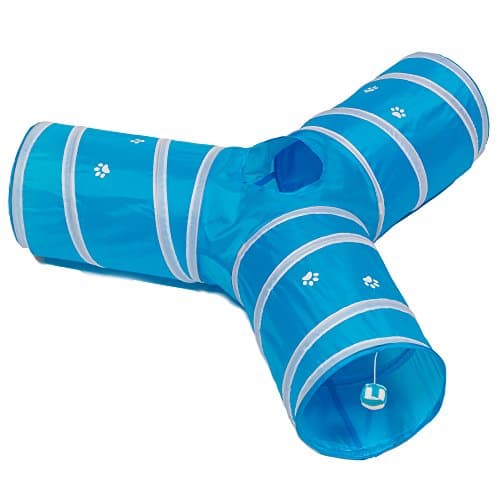
Prosper Pet Collapsible Cat Tunnel
Prosper Pet · Cat tunnel · Our score 7.8/10
#ad Price as of October 22, 2026. Prices move; we check daily. How we're funded.
Three tubes and over fifty inches of run on a sprung-steel frame, which turns an open floor into something a cat can stalk across.
Published specs
| Configuration | 3-way, over 50 inches of total tunnel |
|---|---|
| Tube size | About 10" tall, 17" deep per tube |
| Shell | 190T polyester, tear resistant |
| Frame | Sprung steel with protective ends |
| Features | Crinkle paper lining, peephole, bell toy |
| Storage | Folds flat with an elastic band |
| Washing | Washable |
Three 17 inch tubes radiating from a hub occupy roughly a 24 inch square of floor, about 4 square feet, and deliver over 50 inches of enclosed run. Nothing else on this site converts floor into cover at that ratio, which is why a tunnel is the cheapest fix for a room with nowhere to hide.
What the specs favor
- Three exits, so a cat entering can always leave another way
- Sprung frame means the center does not collapse on the cat
- Folds flat, so it can be put away and reintroduced as novelty
- Washable, which a floor-level fabric item needs to be
What they don't
- Crinkle lining is loud enough to be a household consideration
- Polyester shell snags on claws over time
- Not a substitute for vertical space -- it is cover, not height
Your problem is a cat with nowhere high to go. A tunnel adds cover at floor level, and a cat looking for a lookout wants the opposite.
How it scores
Scores are our editorial weighting of the published specs above, not a test result. They are deliberately kept out of this page's structured data.
Common questions
How much does it cost to set up for multiple cats?
What is the cheapest way to add vertical space for cats?
Do you need expensive litter boxes for multiple cats?
What should you spend money on in a multi-cat house?
Can cardboard boxes replace cat furniture?
Sources
- Ohio State University Indoor Pet Initiative -- For Cat Owners
- Cornell Feline Health Center -- Feline Lower Urinary Tract Disease
- Amazon -- So Phresh by Petco Open Cat Litter Box, Charcoal, X-Large listing (22.4 x 16.9 x 5.4 in, open pan)
- Chewy -- Frisco 21-in Sisal Cat Scratching Post with Toy listing
- Prosper Pet -- Collapsible 3 Way Cat Tunnel listing (over 50 in of tunnel)
Read next
- Best Gear for Multi-Cat Homes (2026)
The complete multi-cat kit list: one pick per category, with what each one costs to run and what to fix for free first.
- Resource Competition Between Cats
How to recognize resource guarding, why it rarely looks like fighting, and the environmental changes that reduce it.
- Vertical Space Planning for Multiple Cats
A room-by-room approach to adding vertical territory for several cats, with height per square foot compared across four formats.
- How Many Litter Boxes Per Cat?
The n+1 rule, its published source, a count-by-household table, and why four boxes in a row is really only one box.
- Signs of Tension Between Cats
The quiet signals of multi-cat tension -- blocking, route changes, resource avoidance -- and what each one tells you to change.