Litter & Litter Tech
Casa Leo Leo's Loo Too vs PETKIT Purobot Max Pro
The two enclosed boxes that actually document themselves. The hard part is that they document different things, and one headline number invites a comparison it cannot support.
Affiliate disclosure: we earn a commission if you buy through our links, at no extra cost to you. It never changes which product we rank first — here is how we're funded.
Everyone in this category says they tested twenty litter boxes. We have not tested any, and we say so. What we do instead: compile the published specs, read the manuals, and do the arithmetic on what this gear costs to run and how it behaves once there is more than one cat using it. Every spec is linked to the document it came from. Prices are checked daily — last verified October 19, 2026. Here is exactly how we pick.
Buy Leo’s Loo Too if the machine has to live somewhere quiet and you want odor sealed and actively treated — about 30 dB, UV-C in a closed drawer, and a warranty you can extend. Buy the PETKIT Purobot Max Pro if you want the bigger bin, a published running cost and genuine multi-cat identification, at a lower price. Both publish far more than Whisker does; the interesting part is that the holes in their spec sheets are in different places.
The spec sheets do not line up
Every other automatic-box comparison in this hub has a Litter-Robot on one side of it, and the recurring complaint is the same: Whisker publishes no capacity figure at all. These two both do publish, which ought to make the comparison easy. It does not, because they publish different quantities with different gaps around them.
Casa Leo publishes a noise figure, a sensor count, an odor mechanism and a warranty, and no power rating you can cost. PETKIT publishes a wattage, a waste volume with a day-count behind it and a full camera specification, and no warranty term and no entrance height. Neither publishes an entry height, which is the figure that matters most for an older cat.
So this is not a case of one maker being more honest than the other. It is a case of deciding which blanks you can live with.
What the two publish
| Specification | Casa Leo Leo's Loo Too | PETKIT Purobot Max Pro |
|---|---|---|
| Design | Enclosed rotating globe | Enclosed drum with camera and sensor array |
| Litter capacity | 1.5 gal (about 5.7 L) | Not published |
| Interior space | Not published | 76 L (cabin volume, not litter) |
| Waste capacity | 1.5 gal (about 5.7 L), retailer figure | 8 L, up to 17 days for one cat |
| Entry height | Not published | Not published |
| Footprint / height | 22" x 24", 27.6" H | 25.86" W x 21.18" D, 23.74" H |
| Cat weight | Up to 20 lb (Casa Leo); 55 lb maximum load (retailer) | 3.3-22 lb (1.5-10 kg) |
| Weight, empty | 27.5 lb | About 24.25 lb (11 kg) |
| Noise | About 30 dB | 35 dB |
| Power | 12 V input; no wattage published | 12 V / 2 A, 24 W rated |
| Sensors | Four weight sensors, plus or minus 1 lb, plus radar and anti-pinch | 12 safety sensors, plus anti-pinch; no accuracy published |
| Camera | None | 1080p, 210-degree, IPX5, one-way audio |
| Odor control | UV-C light, bamboo carbon filter, sealed drawer | Three stages: sealed bin, N50 2.0 eliminator, Breezy Smart |
| Warranty | 1 year, 3-year extension available | Not published for this model |
Manufacturers' published figures except where marked. Casa Leo's own page publishes no waste drawer volume -- it describes the drawer as extra-large -- so the 1.5 gallon waste figure is the retail specification block. Power figures are nameplate ratings, which are ceilings on draw rather than measurements.
The 76 liter number is not litter
If you put these two sheets side by side, the first thing you see is 76 L against 1.5 gallons, and the obvious conclusion is that the PETKIT holds something like thirteen times the litter. That conclusion is wrong, and it is worth being precise about why.
Casa Leo’s 1.5 gallons is a litter capacity: how much litter the globe takes. 1.5 US gallons is 5.68 L, which this site rounds to about 5.7 L.
PETKIT’s 76 L is interior space — the cabin volume inside the drum. PETKIT cites it for access, saying the interior space and wide entrance let large, short-legged and senior cats get in and out easily. It is a figure about the room the cat stands in, not the litter bed.
A sanity check settles it. The Purobot Max Pro’s external envelope is 25.86 x 21.18 x 23.74 inches, which is about 13,000 cubic inches, or 213 L. A 76 L interior is roughly a third of the whole machine — exactly what a cat cavity should be, and far too much to be a litter charge. No automatic box takes 76 L of litter; that would be most of a 40 lb bag poured into one drum.
So the honest reading is the dull one: PETKIT does not publish a litter capacity and Casa Leo does. There is no litter comparison to make here, and anyone who offers you one has read 76 L as something it is not.
Noise, where Casa Leo wins the only way it can be won
Casa Leo publishes about 30 dB. PETKIT publishes 35 dB. Both are manufacturer claims with no stated measurement distance or method, which is the normal state of this category — and it is still more than Whisker offers, which is no decibel figure for the Litter-Robot 4 at all.
Five decibels sounds like a rounding error and is not. The decibel scale is logarithmic, so a 5 dB difference is a meaningful step in sound pressure rather than a sliver. If the box has to share a wall with a bedroom or sit in a studio flat, Casa Leo has the better published number and it is the right tie-breaker.
Two cautions, both of which cut against reading too much into it. An unpublished number is not the same as a loud machine, and neither of these figures tells you the one thing that actually wakes people up, which is the character of the noise rather than its level — a motor whirr at 35 dB and litter clattering through a sifter at 30 dB are not the same experience.
Where the cat rules both of them out
Casa Leo publishes cats up to 20 lb. PETKIT publishes 3.3 to 22 lb, and adds that kittens under 1.5 kg or younger than six months are not recommended — a more careful statement than most makers offer, and a more restrictive one.
The PETKIT therefore has about two pounds more headroom, which is a real difference only if your cat sits in that two-pound band. The more useful conclusion is the one neither maker wants you to draw: if your cat is over about twenty pounds, this comparison is the wrong one. Our large-cat page ranks the category on that figure, and the answers there are the Litter-Robot 4 at a published 3 to 25 lb and the open-topped Neakasa M1 at 2.2 to 33 lb.
At the small end Casa Leo is the more accommodating of the two on the retail listing, which claims automatic features from around a pound or two of kitten against PETKIT’s 3.3 lb floor. For a genuinely small kitten neither is the right first box, and our kitten box page explains why a low open pan comes first.
Running cost, and an honest blank
PETKIT: publishes a 12 V / 2 A input and a 24 W rated power, so 24 W is a hard ceiling. 24 W x 8,760 h = 210.24 kWh, and at the EIA residential average of 18.34 cents/kWh that is $38.56 a year at the ceiling.
Casa Leo: publishes a 12 V input and no current rating, so there is no wattage and no annual figure to compute. We are not going to multiply a voltage by a guess.
What can be said without inventing anything: Leo’s Loo Too has no camera to keep powered, which is the one component on the PETKIT that plausibly draws around the clock rather than in bursts. It does run a UV-C lamp, which the PETKIT does not. The direction is genuinely unclear, and that is a more honest answer than a number.
For context, the only other automatic box on this site that publishes a rating is the Litter-Robot 4, at 6-15 W or about $24.10 a year at its ceiling — which still makes PETKIT’s 24 W the highest published rating in the category, and Casa Leo’s blank the most common state of affairs in it. Our running costs page does this arithmetic for every machine here, consumables included, where the figures exist.
Footprint, height and the room
Leo’s Loo Too: 22 x 24 in = 528 square inches of floor, standing 27.6 inches tall.
Purobot Max Pro: 25.86 x 21.18 in = about 548 square inches, standing 23.74 inches tall.
On floor area these two are effectively the same object: 548 against 528 is under 4 percent of difference, and no real placement decision turns on it. The shapes differ more than the areas — Leo’s is the narrower, deeper unit and the PETKIT is the wider, shallower one, so a narrow alcove and a shallow shelf recess favor opposite machines.
Height is the figure that actually decides it. Leo’s Loo Too stands 3.9 inches taller, and at 27.6 inches it is close to the underside of a standard countertop. If the spot you have in mind is under a vanity or a shelf, measure the clearance before anything else on this page.
Empty weights are close enough not to matter: 27.5 lb against 24.25 lb, a difference you notice once, on the day you move it.
Odor, and the camera question
The two odor systems are built on different ideas. Casa Leo pairs a sealed waste drawer with a bamboo carbon filter and a UV-C lamp, which is the only ultraviolet treatment on any box on this site. PETKIT runs three stages — a sealed bin, an Odor Eliminator N50 2.0 cartridge and a Breezy Smart eliminator. Both seal the waste; Casa Leo treats it and PETKIT scrubs the air around it.
Neither maker publishes a measured odor result, because nobody in this category does. What you can compare is consumables: a bamboo carbon filter is a cheap standard part, where PETKIT’s eliminator cartridges are proprietary. Over three years that difference is more predictable than any claim about freshness.
The camera is the real asymmetry. PETKIT publishes 1080p, a 210-degree field of view, IPX5 and one-way audio, and combines weight with facial-feature recognition. In a multi-cat house the useful function is identification — which cat used the box, how often, for how long — and that is genuinely hard information to get any other way, because Leo’s four weight sensors cannot separate two ten-pound cats however accurate they are.
Two things to be clear about. PETKIT positions its stool and behavior analysis as pre-screening, not diagnosis, and that framing is correct: a flag is a reason to telephone a vet, and the Cornell Feline Health Center is the place to read what litter box changes can mean. And this is a camera in whatever room your litter box lives in, which is a decision about your household rather than your cat. Casa Leo offers no equivalent feature and no equivalent question.
The two machines
Casa Leo’s Leo’s Loo Too is the one to buy when the box has to be unobtrusive. About 30 dB is the better published noise figure of the two, the sealed drawer with UV-C and a bamboo carbon filter is the most thorough odor treatment here, the four weight sensors come with a published accuracy of plus or minus 1 lb, and it is the only one of the pair with a stated warranty — one year, extendable to three. The honest cons: it is the taller machine by 3.9 inches and the closest of any box here to blocking a countertop; Casa Leo publishes no waste drawer volume at all, so the 1.5 gallon figure everyone quotes is a retailer number; there is no wattage, so its running cost cannot be computed; the published cat ceiling is 20 lb; and it is the dearer of the two at current prices.
The PETKIT Purobot Max Pro is the one to buy for capacity, data and a documented running cost. The 8 L bin is about 40 percent larger than the figure quoted for Leo’s drawer and comes with a 17-day single-cat claim attached, the camera does multi-cat identification that weight sensing cannot, the 24 W rating means you can actually cost a year of electricity, and it is both shorter and cheaper. The honest cons: PETKIT publishes no warranty term for this model and no entrance height, both of which the discontinued Purobot Ultra did publish; 35 dB is the louder of the two published figures; 24 W is the highest published rating of any automatic box on this site; its odor cartridges are proprietary where Leo’s filter is generic; and a camera with audio in the litter box room is a privacy decision rather than a feature.
Deciding in one minute
- Weigh the cat. Over about 20 lb and neither of these is your machine — both makers have said so themselves. Go to the large-cat page.
- Measure the height above the spot. 27.6 inches against 23.74 is the difference between fitting under a counter and not.
- Decide about the camera. Several similar-weight cats makes it the single most useful thing on either sheet; a shared bathroom may make it unwelcome.
- Check what is on the other side of the wall. A bedroom makes Casa Leo’s 30 dB the number that matters most.
- Count the emptying trips. 8 L against about 5.7 L is roughly 40 percent fewer, and that is the chore an automatic box leaves you.
See the category
Our automatic litter box roundup ranks the whole field, and the other head-to-heads cover the Whisker comparisons: Litter-Robot 4 against Leo’s Loo Too, Litter-Robot 4 against the Purobot Max Pro and the Neakasa M1 against Leo’s. If the running cost is what you are really weighing, the worth-it page argues the case against buying either.
The gear discussed here
Specs are the manufacturer's own, linked to the page they came from. Prices come from a live daily check; where we have no verified price we say so rather than print a stale one.
Casa Leo Leo's Loo Too
Casa Leo · Automatic litter box · Our score 7.9/10
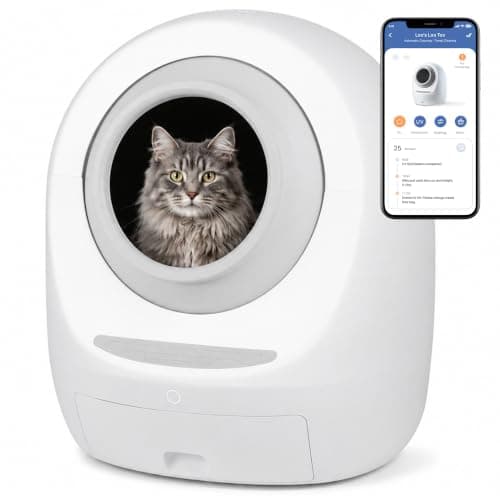
#ad Price as of October 19, 2026. Prices move; we check daily. How we're funded.
Publishes both litter and waste capacity at 1.5 gallons each, which is more than Whisker will tell you about either of its units.
Published specs
| Litter capacity | 1.5 gal (6 L) |
|---|---|
| Waste drawer capacity | 1.5 gal (6 L) |
| Dimensions | 22" x 24" x 27.6" |
| Weight | 27.5 lb |
| Noise | About 30 dB (Casa Leo) |
| Weight sensors | Four, accurate to plus or minus 1 lb |
| Cat weight | 1-20 lb typical; 55 lb maximum load |
| Odor control | Bamboo carbon filter plus UV |
Published 6 L litter capacity. At the 2-inch depth the Ohio State Indoor Pet Initiative recommends, that is a full charge of litter every time you strip it -- roughly a 12 lb bag of clumping clay every two changes on package volumes.
What the specs favor
- Publishes litter AND waste capacity, both 1.5 gallons
- Four weight sensors with a published accuracy of plus or minus 1 lb
- Bamboo carbon filter is a standard consumable, not a proprietary tray
- Takes ordinary clumping litter
What they don't
- 27.6 inches tall and 27.5 lb -- awkward in a small bathroom
- Published cat range tops out around 20 lb for comfortable use
- 6 L waste drawer is smaller than the Neakasa M1's 11.23 L
You have a Maine Coon or a Ragdoll over 20 lb. The published comfortable range stops around 20 lb and a large cat in a rotating drum is not a place to find out where the limit is.
How it scores
Scores are our editorial weighting of the published specs above, not a test result. They are deliberately kept out of this page's structured data.
PETKIT Purobot Max Pro
PETKIT · Automatic litter box · Our score 8.0/10
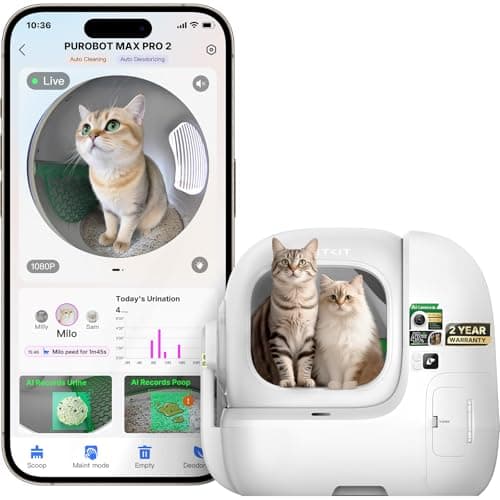
#ad Price as of October 19, 2026. Prices move; we check daily. How we're funded.
Still the automatic box that publishes what Whisker will not -- both capacity figures, a decibel number, a rated wattage and a full camera specification -- but the entrance height its predecessor published is gone from this model's sheet.
Published specs
| Model | P9904 |
|---|---|
| Footprint / height | 25.86" W x 21.18" D x 23.74" H (657 x 538 x 603 mm) |
| Entrance | Height not published -- PETKIT states only a "wide entrance" |
| Interior space | 76 L |
| Waste bin capacity | 8 L, up to 17 days for one cat |
| Cat weight | 3.3-22 lb (1.5-10 kg) |
| Weight, empty | About 24.25 lb (11 kg) |
| Power | 12 V / 2 A, 24 W rated |
| Noise | 35 dB |
| Camera | 1080p, 210-degree field of view, IPX5, one-way audio |
| Sensors | 12 safety sensors, plus an anti-pinch structure |
| Odor control | Three stages: sealed waste bin, Odor Eliminator N50 2.0, Breezy Smart eliminator |
| Litter | Most clumping litters, granules under 12 mm (0.5 in) |
| Warranty | Not published for this model |
PETKIT publishes a 12 V / 2 A input and a 24 W rated power, so 24 W is a CEILING on draw, not a measurement. 24 W x 8,760 h = 210.24 kWh, and at the EIA residential average of 18.34 cents/kWh that is $38.56 a year. The real figure will be lower, because the motor runs in bursts and the camera idles between them -- but it is still the highest published rating of any automatic box on this site, and it is exactly half what the discontinued Purobot Ultra's 12 V / 4 A supply implied.
What the specs favor
- Publishes both an interior and a waste capacity, which Whisker does for neither of its boxes
- 35 dB published, where Whisker publishes no decibel figure at all
- 17-day scoop-free claim for one cat, with the 8 L bin volume published behind it
- A real camera specification: 1080p, 210 degrees, IPX5
- Identifies cats by facial features plus weight, which weight sensing alone cannot do
What they don't
- No published entrance height, which the discontinued Purobot Ultra did publish
- A 22 lb cat ceiling rules out large cats the Neakasa M1 accepts
- A camera in the litter box is a privacy decision, not just a feature
- The 24 W rating is the highest published of any automatic box here
- No warranty term published for this model
- AI stool and behavior screening is pre-screening, not diagnosis, and PETKIT says so
Your cat is near or over 22 lb, or you do not want a camera and microphone in the room the litter box lives in. Both are stated limits rather than preferences.
How it scores
Scores are our editorial weighting of the published specs above, not a test result. They are deliberately kept out of this page's structured data.
Common questions
Leo's Loo Too or the PETKIT Purobot Max Pro: which should I buy?
Is the PETKIT's 76 L figure its litter capacity?
Which one is quieter?
Which needs emptying less often?
Which is cheaper to run?
Does either suit a cat over 20 pounds?
Sources
- Chewy -- Casa Leo Leo's Loo Too listing and specification block (dimensions, capacities, 55 lb max load); noise, sensor count, UV-C and warranty from Casa Leo's own product page
- PETKIT -- Purobot Max Pro product introduction, distributor-hosted PDF (76 L interior, 8 L waste bin for 17 days, 35 dB, 12 safety sensors, 210-degree camera with one-way audio, triple odor control, 1.5-10 kg cat range); 12 V/2 A 24 W rating and 1080p resolution from PETKIT's published P9904 specification
- Casa Leo -- Leo's Loo Too product page (cats up to 20 lb / 9 kg, about 30 dB, four weight sensors plus radar and anti-pinch, UV-C light and sealed waste drawer, 1-year warranty with a 3-year extension available; no waste drawer volume published)
- U.S. Energy Information Administration, Electric Power Monthly Table 5.3 -- residential average 18.34 cents/kWh, June 2026
- Ohio State University Indoor Pet Initiative -- Litter Boxes
- Cornell Feline Health Center -- feline health information
Read next
- Best Automatic Litter Boxes (2026)
The head-term roundup, ranked on published capacity and consumable model rather than app features.
- Litter-Robot 4 vs Leo's Loo Too
The two enclosed self-cleaners compared on what each maker actually publishes -- entryway and wattage against capacity, noise and footprint.
- Litter-Robot 4 vs PETKIT Purobot Max Pro
The transparency comparison: PETKIT publishes 76 L of interior space, an 8 L bin, 35 dB and a 24 W rating; Whisker publishes no capacity at all but a lower power ceiling.
- Neakasa M1 vs Leo's Loo Too
Open top against enclosed globe on published figures: a waste bin twice the size and a 33 lb cat ceiling, against a quieter machine with UV in a sealed drawer.
- What an Automatic Litter Box Actually Costs to Run
The full year-one and year-two running cost of every major automatic litter box, computed from published prices with the arithmetic shown.