Litter & Litter Tech
Covered vs Uncovered Litter Boxes
The lid is the most-argued accessory in this hub. The published guidance has a clear default, and the geometry explains why.
Affiliate disclosure: we earn a commission if you buy through our links, at no extra cost to you. It never changes which product we rank first — here is how we're funded.
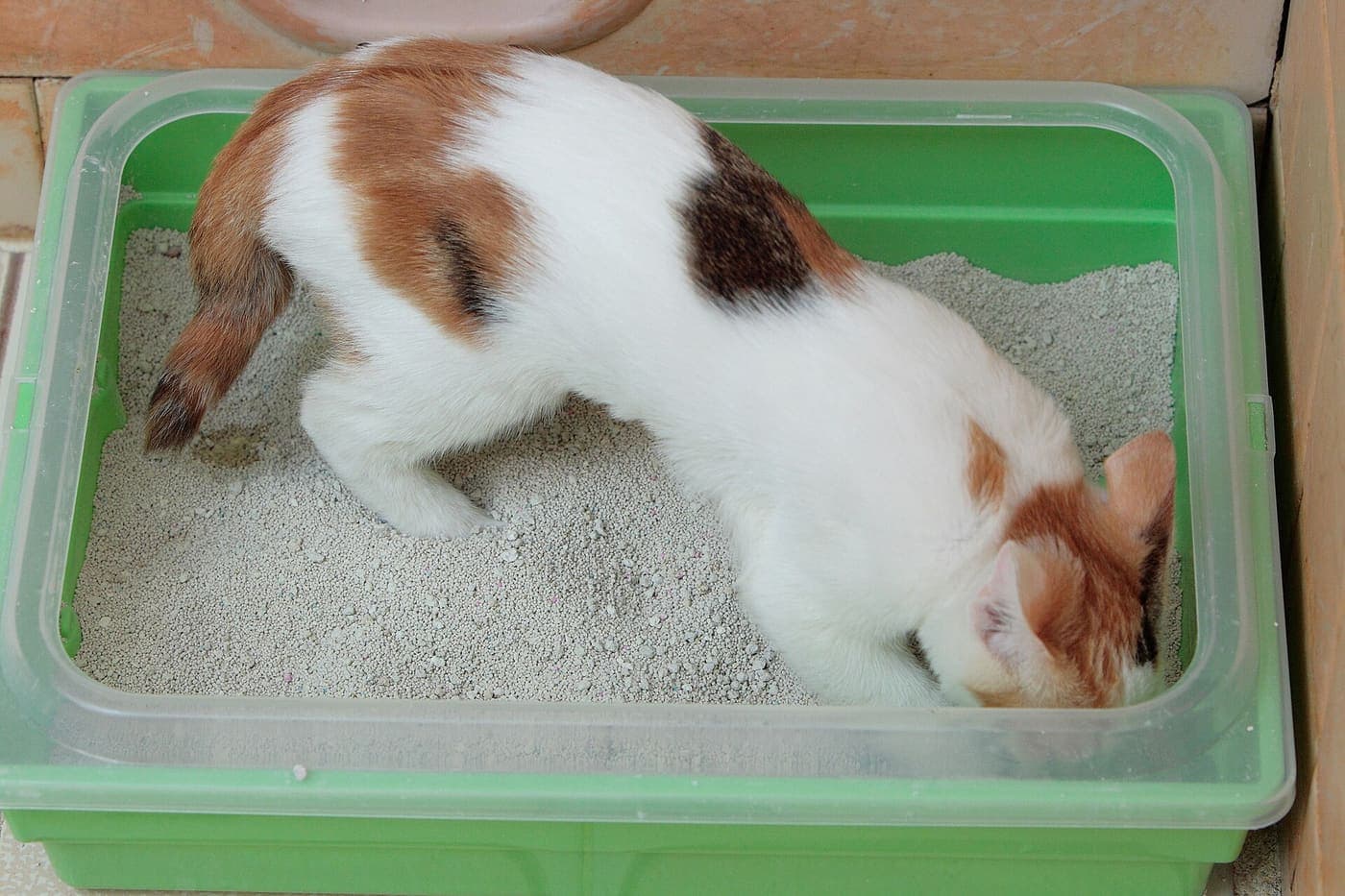
Everyone in this category says they tested twenty litter boxes. We have not tested any, and we say so. What we do instead: compile the published specs, read the manuals, and do the arithmetic on what this gear costs to run and how it behaves once there is more than one cat using it. Every spec is linked to the document it came from. Prices are checked daily — last verified September 27, 2026. Here is exactly how we pick.
This is the one litter question where published guidance takes a side. It does not settle every case, but it does mean the burden of proof sits with the lid.
What the guidance actually says
The Ohio State Indoor Pet Initiative is direct about it: cats generally prefer large, uncovered boxes, the box should be big enough for the cat to stand on all fours and turn around in, and covered boxes concentrate odor and may be refused if they are not kept extremely clean.
Notice that the objection to a cover is conditional. It is not that a lid is forbidden. It is that a lid raises the standard of cleaning required to keep the box acceptable, and most refusals happen when the standard quietly slips.
What the two publish
| Specification | Petmate Booda Dome Cleanstep | IRIS USA XX-Large Open Top |
|---|---|---|
| Exterior | 22.5" L x 22.5" W x 19" H | 30.18" L x 20.13" W x 13.12" H |
| Entry | Stepped ramp, not a top hole | Open, with a raised scatter shield |
| Interior floor | Not published | Not published separately |
| Odor handling | Built-in carbon filter | Open air |
| Weight capacity | Not published | Not published |
| Material note | 95 percent recycled content | Any litter type |
Manufacturers' published figures. Neither maker publishes an interior floor measurement, which is the number this decision actually turns on.
The floor the cat gets
The IRIS open box is 30.18 x 20.13 inches, about 607 square inches of exterior footprint, and because the walls are thin and vertical, nearly all of it is floor the cat can stand on.
The Booda Dome occupies a 22.5 inch square. Its interior is round, so the most floor it can possibly contain is the circle inside that square: about 398 square inches before you subtract the wall thickness and the ramp. Petmate does not publish the real figure.
So the dome takes up a little over half the room on your floor and gives the cat at best about two thirds of the standing space — and part of that space has a roof over it. That is the trade, stated in the units that matter.
The gear discussed here
The IRIS XX-Large open box is the default this comparison recommends. It is one of the largest open pans sold, the scatter shield does most of what people buy a lid for, and there is no roof to trap air. The honest cons: at 30 inches long it dominates a small bathroom, and IRIS publishes no weight capacity.
The Booda Dome Cleanstep is the covered case done properly. The entry is a stepped ramp rather than a top hole, so it asks less of a cat than a top-entry box, and the carbon filter is a real attempt at the odor problem a cover creates. The honest cons: no published interior, a single exit, and a cleaning standard you have to actually meet.
How to decide in your house
- Start uncovered unless you already know your cat sprays upward. It is the published default and the cheaper experiment.
- If scatter is the complaint, try a scatter shield or a high-sided box before a lid. Our high-sided page covers the difference between a digging problem and a spraying one.
- If odor is the complaint, a lid makes it worse where the cat stands. Fix it with scooping frequency, litter depth and box count first.
- If you add a cover, run both for two weeks. Put the covered box beside the open one and let the cat vote. This is the only test that answers the question for your cat rather than for cats in general.
- Re-check as the cat ages. A cover that was fine at four can be the reason a twelve-year-old starts going beside the box.
Compare the two
Buy the open box if you have the floor space and no specific reason for a lid. Buy the dome if a cover solves a problem you actually have — and then treat daily scooping as part of the purchase rather than an optional extra. If you want the lid mainly so the box is not visible, our litter box furniture page solves that without putting a roof directly over the cat.
The gear discussed here
Specs are the manufacturer's own, linked to the page they came from. Prices come from a live daily check; where we have no verified price we say so rather than print a stale one.
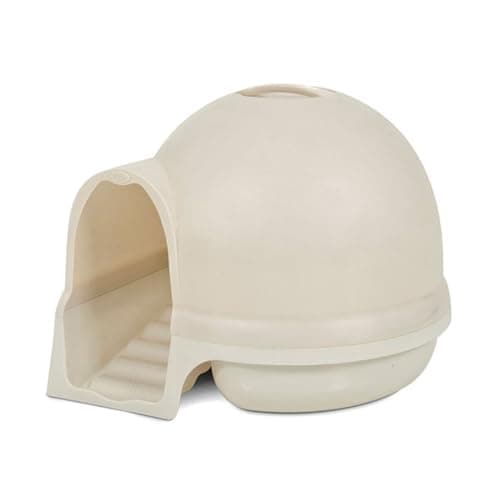
Petmate Booda Dome Cleanstep Litter Box
Petmate · Covered litter box · Our score 8.0/10
#ad Price as of September 27, 2026. Prices move; we check daily. How we're funded.
The enclosure of a top-entry box with a stepped ramp instead of a hole, which is the version an older cat can still use.
Published specs
| Dimensions | 22.5" L x 22.5" W x 19" H |
|---|---|
| Entry | Stepped ramp, not a top hole |
| Odor control | Built-in carbon filter |
| Material | 95 percent recycled content |
| Handle | Built in, for lifting the dome |
| Interior dimensions | Not published |
22.5 x 22.5 = 506 square inches of floor. The IRIS top-entry large takes 20.75 x 16.12 = 334. Petmate's own jumbo open pan is about 372. The dome is the largest floor footprint here by a clear margin -- it buys the ramp with floor space.
What the specs favor
- Ramp entry rather than a jump, so it stays usable for an old cat
- Carbon filter fitted as standard
- 95 percent recycled content published
- Ramp traps a good share of the litter carried out on paws
What they don't
- Largest floor footprint here at 506 square inches
- Interior dimensions not published
- Round shape wastes corner space in a small room
You are short on floor. This is the biggest box in this comparison and the shape does not tuck into a corner.
How it scores
Scores are our editorial weighting of the published specs above, not a test result. They are deliberately kept out of this page's structured data.
IRIS USA XX-Large Open Top Litter Box
IRIS USA · Litter box · Our score 8.7/10
#ad Price as of September 27, 2026. Prices move; we check daily. How we're funded.
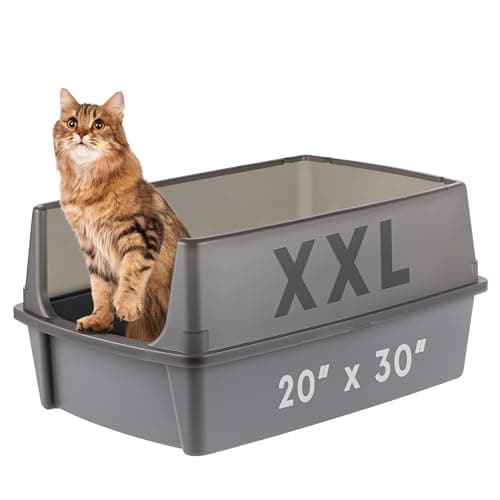
At 30.18 by 20.13 inches this is the largest open-top pan in general retail, and floor area is the single spec that decides whether two cats will share a box.
Published specs
| External dimensions | 30.18" L x 20.13" W x 13.12" H |
|---|---|
| Type | Open top with scatter shield |
| Litter type | Any |
| Weight capacity | Not published |
Source: Amazon -- IRIS USA XX-Large open top litter box listing
30.18 x 20.13 = 607 sq inches of external footprint. Two cats sharing it get roughly 304 sq inches each -- still more than a whole standard jumbo pan gives one cat. That is why one very large box beats two small ones when floor space is tight.
What the specs favor
- Largest published open-top footprint here at 30.18 x 20.13 inches
- 13.12-inch walls with a scatter shield -- the combination that stops high sprayers
- Open top, the configuration cats are documented to prefer
- Takes any litter, no proprietary anything
What they don't
- 607 square inches of floor is a lot of floor to give up
- IRIS does not publish a weight capacity
- High walls make it a genuine step up for a senior cat
Your cat is elderly or arthritic. A 13-inch wall is a real climb, and a cat that starts avoiding the box because getting in hurts is a much worse problem than litter scatter.
How it scores
Scores are our editorial weighting of the published specs above, not a test result. They are deliberately kept out of this page's structured data.
Common questions
Do cats prefer covered or uncovered litter boxes?
Does a covered litter box smell worse?
Is a covered box better for litter scatter?
When is a covered box the right choice?
Should a senior cat have a covered box?
Sources
Read next
- Best Top Entry Litter Boxes (2026)
Top-entry litter boxes ranked on published entry-hole area, with the arithmetic on which cats can actually use one.
- Best High Sided Litter Boxes (2026)
High-sided boxes compared on published wall height and floor, and how to tell a spraying problem from a digging one.
- Best Litter Box Furniture and Enclosures (2026)
Litter box enclosures compared on published interior dimensions and cat-door size, with the footprint arithmetic.
- Why Your Litter Box Smells (and How to Fix It)
Ammonia smell diagnosed cause-first: what it means, the free fixes that solve most cases, and the products worth buying only if those fail.
- Where to Put a Litter Box
The placement rules from published feline guidance, plus what to do when the only spot you have is a bathroom corner.