Feeders, Fountains & Bowls
How Long Can Wet Food Sit Out?
Every feeder maker publishes a number. They are not the same number, they are measured differently, and none of them is a food-safety authority.
Affiliate disclosure: we earn a commission if you buy through our links, at no extra cost to you. It never changes which product we rank first — here is how we're funded.
Everyone in this category says they tested twenty litter boxes. We have not tested any, and we say so. What we do instead: compile the published specs, read the manuals, and do the arithmetic on what this gear costs to run and how it behaves once there is more than one cat using it. Every spec is linked to the document it came from. Prices are checked daily — last verified September 25, 2026. Here is exactly how we pick.
This is the question the whole wet-food-feeder category exists to answer, and the honest version of the answer starts by saying who is qualified to give it.
Where our answer stops
We publish specifications and arithmetic. Food safety for your cat is a veterinary and label question, and the two authorities that outrank anything on this page are the feeding instructions on the can and your own vet.
What we can do is collect what the machine makers publish, because those numbers are concrete, they differ a lot, and they are what you are actually buying when you buy a wet-food feeder.
What the makers publish
| Product | Mechanism | Published window | What it does not do |
|---|---|---|---|
| Cat Mate C500 | Twin ice packs under the compartments | About 6-8 hours indoors | No active cooling once the packs warm |
| PETLIBRO Polar | Thermoelectric cooling, below 50F within 4 hours | Wet food up to 72 hours | Needs mains power; 12-hour battery keeps the timer, not the chill |
| SureFeed Microchip Feeder | Sealed lid, opens for a registered chip | No cooling claim | Keeps other pets and insects out; does not chill |
Manufacturers' published figures. A sealed lid and a cooled compartment solve different problems.
What moves the number
Room temperature. Every published figure assumes an indoor room. A conservatory in July and a hallway in February are not the same environment, and no maker publishes a temperature curve.
Whether the food started cold. A tray loaded straight from the refrigerator has a head start on one that sat on the counter while you found the timer.
Portion size. A thin layer in a wide tray warms faster than a deep serving. The Polar’s tray is 7.4 oz and deliberately wide, which is good for whiskers and slightly against you here.
What each feeder is actually for
The Cat Mate C500 is the day-out feeder: five compartments, ice packs, batteries lasting up to a year, no socket needed.
The PETLIBRO Polar is the trip feeder, and the only one here that actively refrigerates. Our head-to-head covers the running cost, which is the highest on this site.
The SureFeed solves a different problem that often gets confused with this one: it keeps the other cat out of the food. Its lid slows drying, but a sealed bowl at room temperature is still a bowl at room temperature.
Practical rules
- Match the machine to the absence, not the other way round.
- Load cold food and pre-chill the ice packs properly.
- Site it out of the sun, away from radiators and appliances.
- Wash the tray between meals. Dried wet food is where the problem starts.
- For anything over a day, have someone check in. The Ohio State Indoor Pet Initiative treats daily interaction as part of an indoor cat’s needs, and a feeder does not cover a litter box or a water bowl that has been knocked over.
The gear discussed here
Specs are the manufacturer's own, linked to the page they came from. Prices come from a live daily check; where we have no verified price we say so rather than print a stale one.
Cat Mate C500 5-Meal Automatic Feeder
Cat Mate · Automatic feeder · Our score 8.0/10
#ad No verified live price right now, so we show none rather than a stale one. How we're funded.
Five sealed compartments and twin ice packs, running for up to a year on three AA cells -- the only credible way to put wet food on a schedule.
Published specs
| Meals | 1 immediate + 4 timed |
|---|---|
| Compartment capacity | 11.5 oz (330 g) each |
| Food types | Wet and dry |
| Cooling | Twin ice packs, about 6-8 hours indoors |
| Power | 3 x AA, up to 12 months |
| Suits | Up to two cats or a small dog (maker) |
Source: Chewy -- Cat Mate C500 Digital 5 Meal Automatic Feeder listing
Cat Mate publishes 6-8 hours of indoor cooling from the twin ice packs, not five meals' worth. So the honest read is that this covers a working day, not a weekend -- the 5-meal capacity is about portioning across that day, not about leaving the house for longer.
What the specs favor
- Handles wet food, which no hopper feeder does
- Published compartment capacity in ounces and grams
- Battery-only, so a power cut does not skip a meal
- Up to 12 months from three AA cells
What they don't
- Cooling is published at 6-8 hours indoors, so this is a day, not a trip
- Five compartments is a hard ceiling -- no top-up without opening it
- Shared tray, so it cannot separate two cats' diets
You are away overnight and feeding wet food. Read the published cooling window rather than the meal count: 6-8 hours is the number that governs food safety here.
How it scores
Scores are our editorial weighting of the published specs above, not a test result. They are deliberately kept out of this page's structured data.
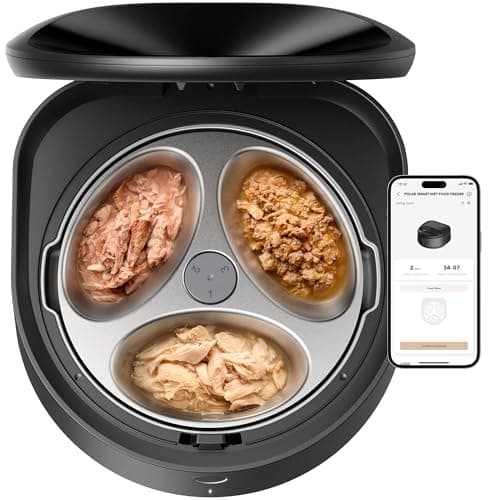
PETLIBRO Polar Wet Food Feeder
PETLIBRO · Automatic feeder · Our score 7.7/10
#ad Price as of September 25, 2026. Prices move; we check daily. How we're funded.
Actively refrigerated rather than ice-packed, and the only feeder here whose maker publishes a wattage -- which turns out to be the highest running cost on this site.
Published specs
| Cooling | Thermoelectric, below 50F within 4 hours |
|---|---|
| Freshness claim | Wet food kept up to 72 hours |
| Tray capacity | 7.4 oz, extra-wide to reduce whisker contact |
| Meals | Up to 3, scheduled by app |
| Power | 60 W adapter; 3 x AA backup for 12 hours |
| Serving | Cooling pauses 30 minutes before each meal |
Source: PETLIBRO -- Polar Refrigerated Wet Food Cat Feeder product page
PETLIBRO publishes a 60 W adapter. 60 W x 24 h x 365 = 525.6 kWh, x $0.1834 = $96.40 a year at the ceiling. A thermoelectric cooler cycles rather than drawing full rating continuously, so the real figure is lower and PETLIBRO does not publish it -- but even at half duty this is the most expensive thing to run on this entire site, and nothing on the box says so.
What the specs favor
- Real refrigeration, not an ice pack -- a published 72-hour freshness window
- Publishes a wattage, which almost nothing in this category does
- Extra-wide 7.4 oz tray addresses whisker contact
- Battery backup keeps the schedule through a 12-hour outage
What they don't
- 60 W adapter -- up to $96.40 a year of electricity at the ceiling
- Only three scheduled meals
- Mains-dependent for the cooling itself; the battery covers timing, not chilling
- One tray, so it cannot separate two cats
You are buying it to save money over a pet sitter for a single overnight. At up to $96 a year to run it is the most expensive appliance we cover, and an ice-pack feeder covers a working day for a fraction of that.
How it scores
Scores are our editorial weighting of the published specs above, not a test result. They are deliberately kept out of this page's structured data.
SureFeed Microchip Pet Feeder
Sure Petcare · Microchip feeder · Our score 8.5/10
#ad Price as of September 25, 2026. Prices move; we check daily. How we're funded.
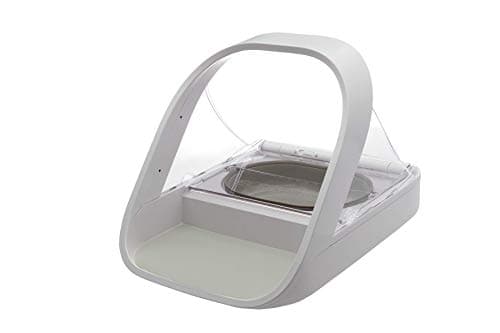
The only feeder here that solves the actual multi-cat feeding problem, which is not portioning -- it is one cat eating another cat's food.
Published specs
| Bowl capacity | 400 ml, or two pouches of wet food |
|---|---|
| Pets stored | Up to 32 identities |
| Food types | Wet and dry |
| Power | 4 x C cells, 6-month stated battery life |
| Warranty | 3 years from date of purchase |
| Opens for | Registered microchips or a collar tag |
Source: Sure Petcare -- SureFeed Microchip Pet Feeder product page
Sure Petcare states 6 months from a set of 4 C cells, so 8 cells a year per feeder. In a three-cat house you need one feeder per cat on a controlled diet -- 24 cells a year for three. That is the running cost nobody mentions.
What the specs favor
- Stores up to 32 pet identities -- more than any household needs
- Works with an existing microchip, no new collar required
- Takes wet food, which almost no automatic feeder does
- Three-year warranty, the longest here
What they don't
- Battery only -- 8 C cells a year, per feeder
- One feeder feeds one cat, so a three-cat house needs three
- 400 ml bowl is a meal, not a hopper -- it does not solve holidays
Your problem is being out all day rather than food stealing. This is a lid that opens for the right cat, not a scheduled dispenser -- it will not feed anyone at 6pm on its own.
How it scores
Scores are our editorial weighting of the published specs above, not a test result. They are deliberately kept out of this page's structured data.
Common questions
How long can wet cat food sit out?
Does a sealed feeder keep wet food fresh?
Can I leave wet food out overnight?
What about dry food?
My cat left wet food out and ate it later. Is that a problem?
Sources
Read next
- Best Automatic Wet Food Feeders (2026)
Ice-packed against refrigerated, the published cooling windows, and why the refrigerated option is the most expensive thing on this site to run.
- Cat Mate C500 vs PETLIBRO Polar
Twin ice packs against thermoelectric refrigeration, on published cooling windows, meal counts and what each costs to run for a year.
- Leaving Cats Alone: What a Feeder Actually Covers
Hopper, water and litter capacity converted into days, with a clear line on when a machine stops being enough.
- Best Microchip Cat Feeders (2026)
Selective-access feeders compared against timed and hopper feeders, and which one solves the problem you actually have.
- What Happens to an Automatic Feeder in a Power Cut
How automatic feeders behave during a power cut, which publish battery backup, and how to build a setup that fails safe.