Beds, Carriers & Daily Care
How to Size a Cat Carrier
Carrier listings publish an exterior. Cats live in the interior. Here is how to get from one to the other without guessing.
Affiliate disclosure: we earn a commission if you buy through our links, at no extra cost to you. It never changes which product we rank first — here is how we're funded.
Everyone in this category says they tested twenty litter boxes. We have not tested any, and we say so. What we do instead: compile the published specs, read the manuals, and do the arithmetic on what this gear costs to run and how it behaves once there is more than one cat using it. Every spec is linked to the document it came from. Prices are checked daily — last verified October 21, 2026. Here is exactly how we pick.
Sizing a carrier is a two-measurement job that most people skip, and then they buy on the exterior figure printed on the box — which overstates the usable space by the thickness of the shell.
The two measurements
- Standing length, nose to tail base. Not the tail. A cat lying down is not the shape you are sizing for.
- Standing shoulder height, floor to top of shoulder. Not the ears. Ears fold; shoulders do not.
Both with the cat standing on all four feet. If your cat will not cooperate, do it while it is eating, or measure the space it occupies asleep and add roughly a third.
Turning that into a carrier size
Interior length = standing length x 1.25. A 15 inch cat needs about 18.75 inches of interior floor to stand and turn without folding.
Interior height = shoulder height + about 2 inches, so the cat can stand without its spine touching the roof.
Interior width = at least half the standing length, which is roughly what a cat needs to turn around rather than reverse out.
The exterior trap, with real numbers
| Carrier | Exterior length | Interior length | Difference |
|---|---|---|---|
| Petmate Two Door, 19 in | 19.4" | 16.75" | 2.65" |
| Sleepypod Air, extended | 22" | 21" | 1" |
| Sherpa Original Deluxe, small | 15" | Not published | Unknown |
Manufacturers' published figures. Where a maker publishes only an exterior, the usable space cannot be derived and we say so.
Two and a half inches sounds small until you set it against a cat. On a 15 inch cat, 2.65 inches is 18 percent of its body length — the difference between turning around comfortably and shuffling.
Sherpa takes a third approach: it publishes maximum pet size rather than carrier interior — up to 16 inches long and 10 inches tall for the medium. That is arguably more useful, as long as you understand it is a different measurement and cannot be compared directly with an interior figure.
Weight limits are not sizing
Every carrier here publishes a maximum pet weight, and they are not interchangeable with dimensions. A long lean cat can exceed the length while sitting under the weight limit; a short heavy cat does the reverse.
- Sleepypod Air: 18 lb — and it is also the boundary of the crash certification, so it is a genuinely hard limit.
- Petmate Two Door, 19 in: 10 lb, which is under the average adult cat. The larger sizes exist for a reason.
- Sherpa: 8 lb small, 16 lb medium, 22 lb large.
Check both. Buying to the weight limit alone is the most common sizing error we see in this category.
Why bigger is not safer
There is a real ceiling on carrier size and it is not just about fitting under a seat. A cat in an oversized carrier slides during braking, has nothing to brace against, and arrives more rattled than one in a snug carrier. A crash-certified carrier is certified at its published size, with a cat that fits it.
The sizing checklist
- Measure standing length, nose to tail base.
- Measure standing shoulder height.
- Multiply length by 1.25, add 2 inches to height.
- Find the published interior figures. If only an exterior is published, subtract about 2.5 inches from the length before comparing.
- Check the published maximum pet weight separately.
- If you are flying, check your airline’s under-seat dimensions for your aircraft, and check the compressed rather than extended figure.
The gear discussed here
Specs are the manufacturer's own, linked to the page they came from. Prices come from a live daily check; where we have no verified price we say so rather than print a stale one.
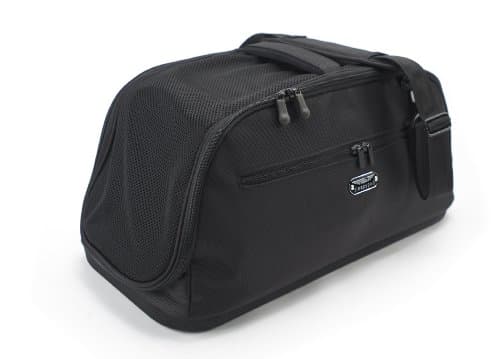
Sleepypod Air
Sleepypod · Cat carrier · Our score 8.9/10
#ad Price as of October 21, 2026. Prices move; we check daily. How we're funded.
The only carrier here with an independent crash certification attached to a published weight limit, and the only one whose length compresses from 22 inches to 16 to meet an under-seat space.
Published specs
| Exterior | 16 to 22" L x 10.5" W x 10.5" H |
|---|---|
| Interior | 15 to 21" L x 9.5" W x 9.5" H |
| Maximum pet weight | 18 lb (8 kg) |
| Carrier weight | 4.5 lb with privacy shield, 4.9 lb with shoulder strap |
| Safety | Crash-tested and certified by the Center for Pet Safety for pets up to 18 lb |
| Shell | Luggage-grade ballistic nylon, rip-stop mesh on four sides |
| Bedding | Removable machine-washable Ultra Plush |
Interior runs 15 to 21 inches. Compressing to fit an under-seat space removes 6 of 21 inches, 29 percent of the cat's floor length. A cat that is comfortable at 21 inches is folded at 15 -- so compress it on the aircraft, not for the whole trip.
What the specs favor
- Independent crash certification tied to a published weight limit
- Interior dimensions published, not just exterior
- Mesh on four sides, which is what international carriage rules tend to ask for
- Washable bedding included rather than sold separately
What they don't
- 18 lb published ceiling rules out large breeds
- 4.5 lb empty is heavy before the cat goes in
- Compressed length is a real reduction in the cat's space, not a design trick
Your cat is over 18 lb. That figure is both the manufacturer's limit and the boundary of the crash certification, so exceeding it discards the main reason to buy this carrier.
How it scores
Scores are our editorial weighting of the published specs above, not a test result. They are deliberately kept out of this page's structured data.
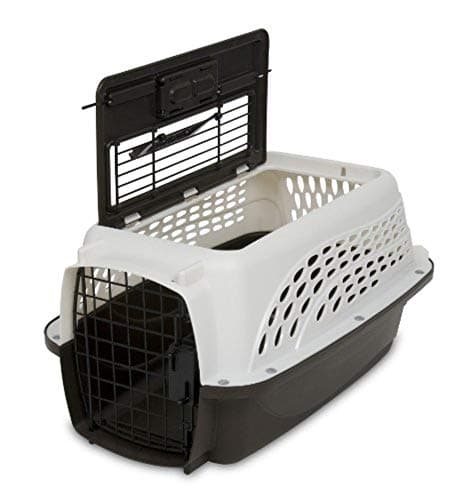
Petmate Two Door Top Load Kennel, 19 inch
Petmate · Cat carrier · Our score 7.6/10
#ad Price as of October 21, 2026. Prices move; we check daily. How we're funded.
A hard shell with a top door, which is the single feature that decides whether loading a frightened cat is a two-minute job or a twenty-minute one.
Published specs
| Exterior | 19.4" x 12.8" x 10" |
|---|---|
| Interior | 16.75" L x 11" W x 9.25" H |
| Published pet weight | Up to 10 lb |
| Carrier weight | 3.8 lb |
| Doors | Front steel door and top opening |
| Material | EcoTEC plastic, minimum 90 percent pre-consumer recycled |
| Assembly | Wing-nut and bolt |
Petmate: 16.75 x 11 x 9.25 = 1,705 cubic inches. Sleepypod Air at full extension: 21 x 9.5 x 9.5 = 1,894. Close -- but the Petmate is wider and shorter, and width is what a cat turning around actually needs.
What the specs favor
- Top loading, so a cat can be lowered in rather than pushed in
- Interior dimensions published, which soft carriers often omit
- Rigid shell does not collapse when a cat braces against it
- 90 percent recycled content published
What they don't
- Published for pets up to 10 lb, which is under the average adult cat
- Wing-nut assembly loosens and wants checking before each trip
- Hard shell does not compress for an under-seat space
Your cat is over 10 lb and the trip is long. Petmate publishes that figure for the 19 inch size, and the larger sizes exist for a reason.
How it scores
Scores are our editorial weighting of the published specs above, not a test result. They are deliberately kept out of this page's structured data.
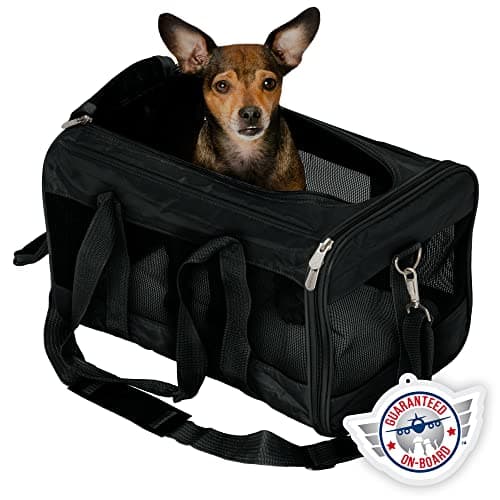
Sherpa Original Deluxe
Sherpa · Cat carrier · Our score 7.8/10
#ad Price as of October 21, 2026. Prices move; we check daily. How we're funded.
The spring wire frame lets the back end press down into an under-seat space, and the small and medium sizes carry Sherpa's own Guaranteed On Board program -- which is a commercial promise, not an aviation rule.
Published specs
| Small | 15" L x 10" W x 8.5" H, pets up to 8 lb |
|---|---|
| Medium | Pets up to 16 in long and 10 in tall, up to 16 lb |
| Large | Pets up to 18 in long and 11 in tall, up to 22 lb |
| Frame | Patented spring wire, rear end presses down several inches |
| Guaranteed On Board | Small and medium only; large is not in the program |
Sherpa publishes 8 lb for the small and 16 lb for the medium. A 12 lb cat is above the small's published limit by half again. People buy the small because it fits more under-seat spaces, and then find the published figure was the honest one.
What the specs favor
- Compresses at the rear to meet a published under-seat height
- Three sizes with a published pet weight for each
- Sherpa's own on-board guarantee covers the two smaller sizes
- Soft sides are far lighter than a comparable hard shell
What they don't
- Guaranteed On Board is Sherpa's program, not an airline rule -- the airline still decides
- Large size sits outside the guarantee entirely
- Soft sides give a determined cat something to push against
You want a carrier that doubles as car restraint. This one has no crash certification, and a soft carrier on a seat is not a restraint.
How it scores
Scores are our editorial weighting of the published specs above, not a test result. They are deliberately kept out of this page's structured data.
Common questions
How do I measure my cat for a carrier?
How much bigger than my cat should a carrier be?
Is a bigger carrier always better?
What is the difference between interior and exterior carrier dimensions?
Does my cat need to stand up in the carrier?
Sources
- Sleepypod -- Sleepypod Air product page (16-22 x 10.5 x 10.5 in exterior, 15-21 x 9.5 x 9.5 in interior, 18 lb, Center for Pet Safety certified)
- Petmate -- Two Door Top Load Kennel, 19 in (19.4 x 12.8 x 10 in exterior, 16.75 x 11 x 9.25 in interior, up to 10 lb)
- Sherpa -- Original Deluxe Travel Pet Carrier listing (small 15 x 10 x 8.5 in up to 8 lb, medium up to 16 lb, large up to 22 lb)
- Cornell Feline Health Center -- Do I Need a Cat Carrier?
Read next
- Best Cat Carriers (2026)
Three carriers compared on published interior space, weight limits and crash certification -- and which of the three jobs each one is for.
- Best Cat Harnesses (2026)
Three cat harnesses compared on published girth ranges, closure type and the escape mechanics that decide whether any of it matters.
- How to Tell if a Cat Tree Is Stable (Before You Buy)
The stability index explained: how to compute it in a shop, what the numbers mean, and when to wall-anchor regardless.
- How to Introduce a New Cat
A staged cat introduction, the resource counts to have in place first, and the gear each stage actually needs.
- Best Cat Beds (2026)
Cat beds compared on the measurement that matters -- usable interior, not outside diameter -- with the rim arithmetic shown.
- Sleepypod Air vs Sherpa Original Deluxe
The crash-certified carrier against the cabin specialist, on published interiors, weight limits and what each guarantee actually covers.
- Best Top-Loading Cat Carriers (2026)
Carriers that open at the top, ranked on published opening type and dimensions, with the drawer design that answers the same problem another way.