Multi-Cat Households
Bringing a Kitten Home to an Adult Cat
Adults rarely reject kittens. What they object to is being pestered constantly by an animal that never gets tired.
Affiliate disclosure: we earn a commission if you buy through our links, at no extra cost to you. It never changes which product we rank first — here is how we're funded.
Everyone in this category says they tested twenty litter boxes. We have not tested any, and we say so. What we do instead: compile the published specs, read the manuals, and do the arithmetic on what this gear costs to run and how it behaves once there is more than one cat using it. Every spec is linked to the document it came from. Prices are checked daily — last verified October 22, 2026. Here is exactly how we pick.
A kitten and an adult is the easiest introduction to get partly right and one of the easiest to get quietly wrong, because the failure is not a fight. It is an older cat slowly withdrawing.
The actual problem
Adults do not usually read a kitten as a territorial rival, which is why this combination is recommended. What they do read is an animal that wants to play at every hour, does not understand refusal signals, and does not get tired.
That reframes the whole job. Instead of managing an introduction, you are managing a kitten’s energy so it arrives at the adult already spent.
Drain the kitten first
- Three or four short play sessions a day, with a wand toy, before any shared time.
- Finish each on a catch and then food. Hunt, catch, eat, groom, sleep — the sequence ends in a sleeping kitten, which is the goal.
- Time shared access for after a session, not before one.
- Give the kitten solo outlets for the hours you are not playing. Our kitten toys page covers what is safe to leave out.
Protect the adult's escape routes
An adult cat that can leave is an adult cat that stays tolerant. The Ohio State Indoor Pet Initiative frames refuge and control as core needs, and here they are the whole intervention.
- Height the kitten cannot reach yet. A window perch or a cleared bookcase top. A young kitten cannot make the jump, and that gap is a gift.
- A room with a door. A selective interior door lets the adult keep a territory the kitten does not enter.
- Its own resources, out of the traffic. The adult’s bowl, box and bed should not be somewhere a kitten hurtles past.
- Uninterrupted attention. Separate lap time, separate play. This is the thing most often lost when a kitten arrives.
If the resident cat is elderly
What to watch for
| Going well | Not going well |
|---|---|
| Adult hisses, kitten backs off, both move on | Adult withdraws to one room and stays there |
| Adult watches from height, relaxed | Adult stops using its usual sleeping spots |
| Chasing swaps direction sometimes | Kitten always chases, adult always flees |
| Both eat normally | Adult eats less, or eats only at night |
The right-hand column is the quiet failure. None of it involves fighting, which is why it gets missed.
Any of the right-hand column means slowing down: more separation, more energy drained from the kitten before contact, more refuge for the adult. Our tension guide covers the signals in more detail, and the staged process in our introduction guide still applies in full.
Cornell Feline Health Center connects stress to lower urinary tract disease, so an older cat that changes its litter box habits after a kitten arrives is a vet visit rather than a waiting game.
The gear discussed here
Specs are the manufacturer's own, linked to the page they came from. Prices come from a live daily check; where we have no verified price we say so rather than print a stale one.
Go Cat Da Bird Wand, 36-inch
Go Cat · Wand toy · Our score 8.8/10
#ad No verified live price right now, so we show none rather than a stale one. How we're funded.
A 36-inch rod on 50 lb braided line with feathers shaped to fly properly -- the only toy here that delivers the full hunt sequence, which is what boredom behavior is missing.
Published specs
| Rod length | 36" fiberglass, pull-apart |
|---|---|
| Line | 50 lb test braided nylon |
| Lure | Aerodynamically configured feathers |
| Refills | Feather attachments sold separately |
Source: Amazon -- Go Cat Da Bird Single Pole Teaser on 36-inch Rod listing
36 inches of rod and 32 inches of string is 68 inches of working radius, so the lure can travel a genuine arc across a room rather than bobbing in front of the cat. Short wands produce short, unconvincing movement, which is why cats lose interest in them within a minute.
What the specs favor
- 68 inches of combined reach -- real prey-like movement, not a bob
- 50 lb braided line does not snap mid-swing
- Rod pulls apart for storage
- Feather refills, so the rod outlasts many lures
What they don't
- Interactive only -- it does nothing while you are out
- Feathers are a consumable and a successful cat destroys them
- Must be put away; loose string is a swallowing hazard
You are looking for something to occupy the cat while you are at work. This one needs you on the other end of it, which is the whole point of it.
How it scores
Scores are our editorial weighting of the published specs above, not a test result. They are deliberately kept out of this page's structured data.
K&H EZ Mount Window Perch
K&H Pet Products · Window perch · Our score 7.5/10
#ad No verified live price right now, so we show none rather than a stale one. How we're funded.
Suction cups rated to 50 lb and 27 inches of ledge -- the cheapest square foot of territory you can add to a multi-cat house.
Published specs
| Dimensions | 27" L x 11" W x 6" H |
|---|---|
| Suction cup rating | Up to 50 lb, per K&H |
| Mounting | Suction to glass or a smooth door |
| Floor footprint | None |
Source: Amazon -- K&H Pet Products EZ Mount Cat Window Perch listing
27 inches of ledge split two ways is 13.5 inches each -- less than a cat's body length. Two cats will not share this; in a multi-cat house it is one perch per window, not one perch for the household.
What the specs favor
- 50 lb published suction rating, well beyond any cat's weight
- No drilling, so it works in a rental
- Puts a cat at a window, which is the enrichment that costs nothing to run
- Moves to another window in five minutes
What they don't
- Suction fails on textured, dirty or very cold glass
- 27 inches is a one-cat ledge
- No good on a window with a deep recessed frame
Your two cats already compete over resting spots. One perch at one window is a new thing to compete over, not a solution -- buy two, at two windows.
How it scores
Scores are our editorial weighting of the published specs above, not a test result. They are deliberately kept out of this page's structured data.
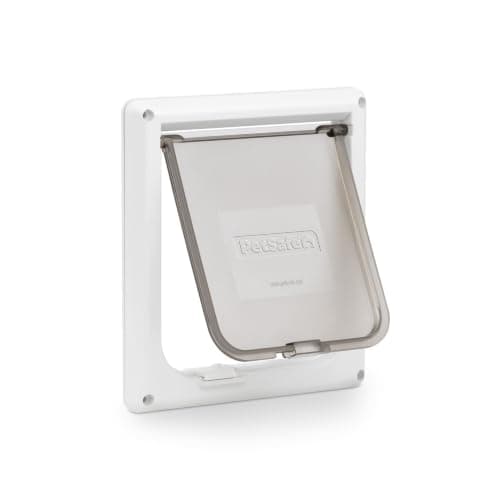
PetSafe Interior 2-Way Locking Cat Door
PetSafe · Interior cat door · Our score 7.9/10
#ad Price as of October 22, 2026. Prices move; we check daily. How we're funded.
No electronics, no batteries and no chip -- a latch and a flap, which is all an interior door between two rooms in the same house actually needs.
Published specs
| Flap opening | 5 3/4" x 5 3/4" |
|---|---|
| Frame | 7 1/2" x 7 7/8" |
| Cut-out | 6 9/16" x 6 13/16" |
| Published pet weight | Cats or dogs up to 15 lb |
| Door thickness | 1/2" to 2" |
| Locking | 2-way manual lock |
| Included | Foam tape, screws, cutting template, manual |
PetSafe publishes a 5.75 inch square opening. SureFlap publishes 4.75 inches of height. A full inch more headroom, on the cheapest door here, because it has no reader hardware to fit around the aperture.
What the specs favor
- Largest flap opening in this comparison, and no reader hardware crowding it
- No batteries, so it cannot fail locked
- Cutting template and hardware included
- Published door thickness range of half an inch to two inches
What they don't
- No selectivity at all -- every cat under 15 lb goes through
- Manual lock means someone has to set it
- Interior only; not weather-sealed for an exterior door
The problem you are solving is one cat eating another cat's food. Without selectivity this door does not solve it, and a microchip door or microchip feeder does.
How it scores
Scores are our editorial weighting of the published specs above, not a test result. They are deliberately kept out of this page's structured data.
Common questions
Will my adult cat accept a kitten?
How do you introduce a kitten to an older cat?
Is it cruel to get a kitten for an older cat?
Why is my older cat hissing at the new kitten?
How long until a cat accepts a kitten?
Sources
- Ohio State University Indoor Pet Initiative -- For Cat Owners
- Cornell Feline Health Center -- Feline Lower Urinary Tract Disease
- Amazon -- Go Cat Da Bird Single Pole Teaser on 36-inch Rod listing
- Amazon -- K&H Pet Products EZ Mount Cat Window Perch listing (50 lb suction)
- PetSafe -- Interior 2-Way Locking Cat Door (5 3/4 in square flap, up to 15 lb)
Read next
- How to Introduce a New Cat
A staged cat introduction, the resource counts to have in place first, and the gear each stage actually needs.
- Resource Competition Between Cats
How to recognize resource guarding, why it rarely looks like fighting, and the environmental changes that reduce it.
- Best Cat Toys for Kittens (2026)
Kitten toys chosen on safety and on the adult habits they build, with the hand-play rule that matters most.
- Best Litter Boxes for Senior Cats (2026)
Litter boxes ranked on published entry height for arthritic and older cats, with the step arithmetic worked through.
- Signs of Tension Between Cats
The quiet signals of multi-cat tension -- blocking, route changes, resource avoidance -- and what each one tells you to change.
- Best Litter Boxes for Kittens (2026)
Kitten litter boxes compared on published entry height and floor size, with the case for buying the adult box on day one.