Litter & Litter Tech
How to Stop Cat Litter Tracking
Most of the litter on your floor did not get kicked there. It walked out on paws, and that is a different problem with a different fix.
Affiliate disclosure: we earn a commission if you buy through our links, at no extra cost to you. It never changes which product we rank first — here is how we're funded.
Everyone in this category says they tested twenty litter boxes. We have not tested any, and we say so. What we do instead: compile the published specs, read the manuals, and do the arithmetic on what this gear costs to run and how it behaves once there is more than one cat using it. Every spec is linked to the document it came from. Prices are checked daily — last verified October 22, 2026. Here is exactly how we pick.
Tracking is three mechanisms wearing one name, and buying the wrong fix for your mechanism is why the mat you bought did not work.
Where the litter is actually coming from
- Carried on paws. The largest share. Granules lodge between toes and drop off over the next few strides. Nothing about the box stops this; something between the box and the room has to.
- Kicked during covering. Enthusiastic diggers throw litter over the wall. Fixed by wall height and box width, not by mats.
- Static and dust. Fine particles that drift rather than get carried. Fixed by granule size, and covered on our low dust page.
The free fixes, first
- Reduce the depth to three inches. Deep litter is displaced further by every dig. Three to four inches is enough for clumping to work, and more than that is thrown out rather than used.
- Get the box off carpet. Carpet under a litter box is a reservoir. Hard floor releases what lands on it; carpet holds it and hands it back later.
- Move the box out of the walking route. Litter travels as far as the cat walks before it drops. A box beside a wall in a corner spreads it over a smaller area than a box in a hallway.
Sizing a mat properly
The IRIS XX-Large box is 30.18 by 20.13 inches. A 24 by 15 inch mat under it covers about 59 percent of the length and misses both front corners — which is where a cat steps out.
The rule: the mat should be at least as wide as the box and extend a full cat body length beyond the entry. For most cats that is 15 to 18 inches of run-off, not the 6 inches a small mat gives.
Gorilla Grip’s mat and PetFusion’s ToughGrip take different approaches to the same job — one traps granules in a textured surface, the other in a two-layer construction you pour back into the box. Our mats page compares them on catch area.
Changing the box itself
A top-entry box is the most effective single change available, because it makes the anti-tracking surface unavoidable: the cat must cross the grooved lid, and what comes off falls back into the box rather than onto a mat you then have to shake out.
The cost is access. A 14.62 inch climb rules the format out for older, arthritic or recovering cats, and our senior box page explains why that is not a compromise worth making for a cat that struggles.
The order to try things
- Reduce litter depth to three inches. Free.
- Move the box onto hard floor and out of a walking route. Free.
- Add a mat sized to the box plus a body length. Cheap.
- Switch to a larger granule litter, slowly. Moderate.
- Change to a top-entry box, if the cat can use one. Moderate.
- Accept some tracking. Every box in a house with cats produces some, and the last 10 percent costs more than it is worth.
The gear discussed here
Specs are the manufacturer's own, linked to the page they came from. Prices come from a live daily check; where we have no verified price we say so rather than print a stale one.
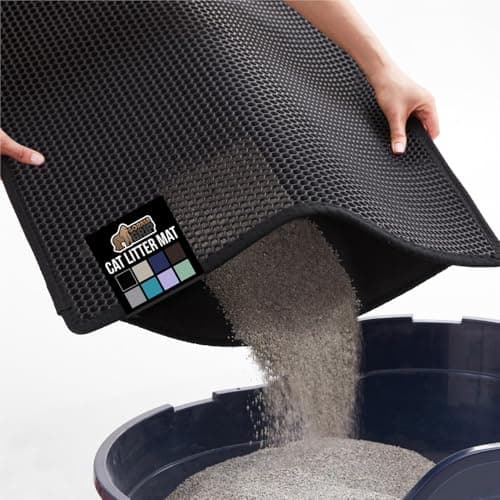
Gorilla Grip Cat Litter Mat
Gorilla Grip · Litter mat · Our score 8.4/10
#ad Price as of October 22, 2026. Prices move; we check daily. How we're funded.
The biggest mat here at 35 by 24 inches, with a two-layer honeycomb that swallows litter rather than letting it sit on the surface to be kicked off again.
Published specs
| Sizes published | 24 x 15", 35 x 24", 47 x 35" jumbo |
|---|---|
| Weight, jumbo | 4.2 lb |
| Construction | Two-layer honeycomb, waterproof |
| Cleaning | Hand wash with mild detergent, air dry only |
| Litter compatibility | Any |
Source: Gorilla Grip -- Cat Litter Mat product page
35 x 24 = 840 sq inches. The IRIS XX-Large box footprint is 30.18 x 20.13 = 607 sq inches. The mat is larger than the box it sits under, which is the whole point -- a mat narrower than the box catches nothing at the corners where cats actually step off.
What the specs favor
- Largest published catch area of the mats here
- Two-layer honeycomb traps litter below the surface
- Waterproof, so a leaked box does not reach the floor
- Three published sizes, so it can be matched to the box
What they don't
- Hand wash and air dry only -- not a throw-it-in-the-machine mat
- Honeycomb holes need shaking or vacuuming, not just a wipe
- 840 square inches is a lot of visible floor covered
You want to hose it down and hang it up wet. The published care instruction is air dry only, and a mat that lives in a damp utility room will not get that.
How it scores
Scores are our editorial weighting of the published specs above, not a test result. They are deliberately kept out of this page's structured data.
PetFusion ToughGrip Silicone Litter Mat
PetFusion · Litter mat · Our score 8.6/10
#ad Price as of October 22, 2026. Prices move; we check daily. How we're funded.
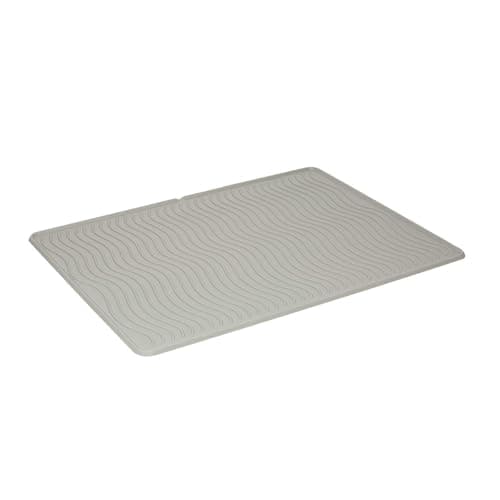
One piece of FDA-grade silicone with a raised outer lip and a pour spout, so cleaning is tip-and-rinse rather than shake-and-hope.
Published specs
| Sizes published | Standard 30 x 23", XL 38 x 26" |
|---|---|
| Outer lip | 0.25" standard, 3" XL |
| Material | Premium FDA-grade silicone |
| Properties | Waterproof, anti-microbial, non-toxic, hypoallergenic |
| Emptying | Side spout pours litter back into the box |
Source: PetFusion -- ToughGrip Cat Litter Mat product page
The published side spout is the specification that matters. A honeycomb mat is emptied into a bin; a spouted silicone tray pours captured litter back into the box. Over a year that is a meaningful share of a bag you would otherwise have swept up and thrown away -- and it is the reason this one wins on running cost despite the higher purchase price.
What the specs favor
- One piece of silicone -- nothing to delaminate or absorb odor
- Published anti-microbial and hypoallergenic silicone
- Side spout returns captured litter to the box
- XL version has a 3-inch lip, which contains a genuine spill
What they don't
- Smaller catch area than the Gorilla Grip jumbo
- Silicone attracts dust and hair as well as litter
- Costs more than a fabric or honeycomb mat
Your cat kicks litter several feet rather than tracking it on its paws. A 30-inch mat catches what is carried out, not what is thrown -- that is a high-sided box problem, not a mat problem.
How it scores
Scores are our editorial weighting of the published specs above, not a test result. They are deliberately kept out of this page's structured data.
IRIS USA Top Entry Cat Litter Box, Large
IRIS USA · Top-entry litter box · Our score 8.0/10
#ad Price as of October 22, 2026. Prices move; we check daily. How we're funded.
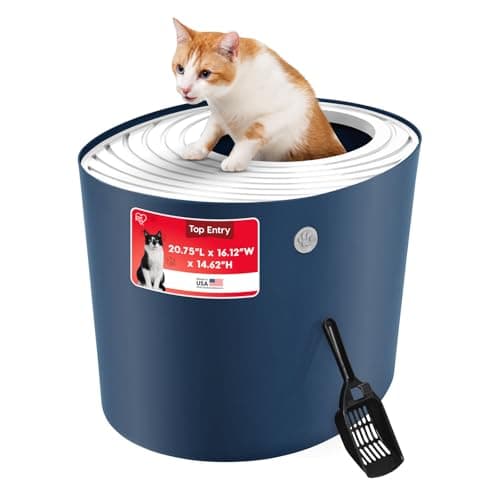
The largest published entry hole of any top-entry box we found at 9 by 10.5 inches, which is the spec that decides whether an average cat will use one at all.
Published specs
| Exterior | 20.75" L x 16.12" W x 14.62" H |
|---|---|
| Entry hole | 9" W x 10.5" H, set off-center |
| Lid | Grooved, catches litter from paws on the way out |
| Scoop | Included on most variants |
Source: IRIS USA -- Top Entry Cat Litter Box, Large listing (20.75 x 16.12 x 14.62 in, 9 x 10.5 in entry)
Large: 9 x 10.5 = 94.5 square inches. IRIS's own Premium square model publishes 7.9 x 7.9 = 62.4. The large gives half again as much aperture. A cat that refuses a top-entry box has usually been offered the smaller hole.
What the specs favor
- Published entry dimensions, which most top-entry listings omit
- Off-center hole leaves a landing platform inside
- Grooved lid does real work against tracking
- Enclosed sides stop nearly all kicked litter
What they don't
- 14.62 inches of height is a jump an arthritic cat may not make
- Interior dimensions not published, only the exterior
- Scooping means lifting the lid off every time
Your cat is elderly, arthritic or recovering from surgery. A top-entry box asks for a vertical jump on the way in and a controlled drop on the way out, twice a day, forever.
How it scores
Scores are our editorial weighting of the published specs above, not a test result. They are deliberately kept out of this page's structured data.
Common questions
How do I stop my cat tracking litter everywhere?
Does litter size affect tracking?
Do litter mats actually work?
What is the best litter box for tracking?
Does putting a rug under a litter box help?
Sources
Read next
- Best Cat Litter Mats (2026)
Mats compared on published catch area against real box footprints, plus the pour-back feature that returns litter instead of binning it.
- Best Top Entry Litter Boxes (2026)
Top-entry litter boxes ranked on published entry-hole area, with the arithmetic on which cats can actually use one.
- Best High Sided Litter Boxes (2026)
High-sided boxes compared on published wall height and floor, and how to tell a spraying problem from a digging one.
- Low Dust Cat Litter, Compared
Dust claims on the major clumping litters, what each is conditioned on, and the handling changes that reduce dust more than a brand switch.
- How Often to Clean a Litter Box
The three separate cleaning jobs a litter box needs, on three different schedules, with the litter volume arithmetic per cat.