Feeders, Fountains & Bowls
Filtered vs Filterless Cat Fountains
Two fountains can look identical and solve the water problem in opposite ways. One costs you money forever; the other costs you a job twice a week.
Affiliate disclosure: we earn a commission if you buy through our links, at no extra cost to you. It never changes which product we rank first — here is how we're funded.
Everyone in this category says they tested twenty litter boxes. We have not tested any, and we say so. What we do instead: compile the published specs, read the manuals, and do the arithmetic on what this gear costs to run and how it behaves once there is more than one cat using it. Every spec is linked to the document it came from. Prices are checked daily — last verified October 19, 2026. Here is exactly how we pick.
Buy filterless if you resent subscriptions more than chores — it deletes a $97.44-a-year line and the recirculation problem with it. Buy filtered if you want the simpler daily object and will genuinely change a cartridge 26 times a year. Almost nobody chooses between these two deliberately, which is why so many fountains end up running on an exhausted filter.
The two mechanisms, stated plainly
A filtered fountain holds one body of water and moves it in a loop: pump, spout, bowl, back through a cartridge, round again. The cartridge is doing three things at once. PETLIBRO publishes the construction — a cotton layer for hair and debris, activated carbon for taste and odor, and an ion exchange resin to soften — which is more disclosure than this category usually offers.
A filterless fountain does not clean water; it refuses to reuse it. FEELNEEDY’s design keeps a 3.5 L clean tank and a separate wastewater tank, so what the cat has drunk around never returns to the supply. There is nothing to filter because nothing is recirculated.
Those are genuinely different answers to the same question, and the specification sheets make the trade visible.
| Filtered (PETLIBRO Stainless 3 L) | Filterless (FEELNEEDY FN-W26) | |
|---|---|---|
| Water handling | One tank, recirculated through a cartridge | Clean tank and wastewater tank kept separate |
| Capacity | 3 L | 3.5 L clean + separate waste tank (volume not published) |
| Consumable | Cartridge every 2 weeks | None |
| Published consumable cost | $14.99 per 4-pack ($97.44/yr) | $0 |
| Power | 5 V / 1 A adapter (5 W ceiling) | 3,000 mAh battery, USB-C, up to 180 days |
| Published noise | Not more than 30 dB | 30 dB motor; 30-35 dB while it pours |
| Your recurring job | Change a filter, 26 times a year | Empty and refill two tanks |
| Tank material | Stainless steel; plastic water outlet | 304 stainless bowl; plastic tanks |
| Still needs a full scrub? | Yes, on the same schedule | Yes, on the same schedule |
Manufacturers' published figures. Power ratings are nameplate ceilings, not measurements. Neither design cleans itself.
What the cartridge costs, and what deleting it is worth
PETLIBRO publishes every 2 weeks and $14.99 per 4-pack: $3.7475 a filter, 26 filters a year = $97.44.
Electricity on the same fountain, at a 5 W ceiling and the EIA residential average of 18.34 cents/kWh: 43.8 kWh = $8.03.
The filter is therefore 12.1 times the power cost. Over three years the cartridge line alone is $292.32.
A filterless fountain does not make that number smaller. It removes it. That is the entire financial case, and it is a bigger number than any price difference between the two fountains.
The hygiene argument, honestly
A filtered fountain is a warm, aerated body of water that recirculates for days at a time. Run on schedule it is fine; run past its interval it is the opposite of fine, and the filter’s carbon has stopped adsorbing long before the cotton layer looks dirty. That is the real failure mode in this category — not a bad design, a missed interval.
A filterless design sidesteps that specific problem by never mixing used water back in. What it does not do — and what no fountain does — is clean itself. Biofilm forms on wet plastic and wet steel alike, in both architectures, and the scrub schedule in our cleaning guide applies identically to both.
Who should buy which
- Buy filterless if: you have let a filter go stale before, you dislike consumable subscriptions, you want the lowest three-year cost, or the idea of recirculated water bothers you.
- Buy filtered if: you want one tank and the simplest possible refill, you have hard water you would like softened, or you want the deepest published spec sheet in the category.
- Buy neither if: the honest answer to “will I maintain this twice a month?” is no. Several wide bowls refreshed daily beat a neglected fountain of either kind, which is the argument our worth-it page makes at length.
The gear discussed here
The FEELNEEDY FN-W26 is the filterless side of the argument and the cheaper object to own. A 3.5 L clean tank with a separate wastewater tank, a published 30 dB motor, a 304 stainless drinking bowl, and a rechargeable 3,000 mAh battery over USB-C rated up to 180 days, so it does not need to live by an outlet. The honest cons: two tanks is two things to handle; FEELNEEDY publishes no draw rating, no wastewater volume and no dimensions at all; and a battery is a part that degrades where a mains adapter is not.
The PETLIBRO Stainless Steel 3 L is the filtered side, and the best-documented fountain on this site: stainless tank, a published 5 V / 1 A adapter, a 30 dB noise ceiling, a stated filter interval and a stated filter price. If you want a filtered fountain, want to know its true cost, and will do the fortnightly change, this is the one. The honest cons: $97.44 a year in filters at the maker’s own interval, a plastic water outlet on a stainless tank, and 3 L is tight for three cats.
The PETLIBRO replacement filters are listed here because they are the decision, not an accessory to it. Four filters and four sponges per pack, cotton plus activated carbon plus ion exchange resin, and a 15-minute soak before first use to shed carbon dust. The honest cons: PETLIBRO says two weeks while the retail listing says two to four, and which you believe changes your annual cost by $48.72.
Both lists, side by side
If you have made the mechanism decision, the product lists are built: filterless fountains on one side, the main fountain roundup and the filter page on the other. For what each option costs over three years rather than at checkout, our price comparison has the full table.
The gear discussed here
Specs are the manufacturer's own, linked to the page they came from. Prices come from a live daily check; where we have no verified price we say so rather than print a stale one.
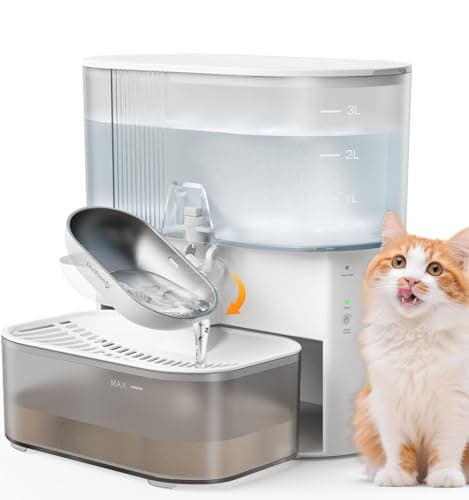
FEELNEEDY FN-W26 Filterless Cat Water Fountain
FEELNEEDY · Filterless fountain · Our score 7.4/10
#ad Price as of October 19, 2026. Prices move; we check daily. How we're funded.
Replaces the cartridge with a second tank: a timed cycle pours stale water into a separate wastewater reservoir instead of recirculating it, and the bowl the cat actually drinks from is 304 stainless rather than plastic.
Published specs
| Clean water tank | 3.5 L (118 oz), published to last 3-9 days |
|---|---|
| Wastewater tank | Separate tank; volume not published |
| Filter | None |
| Bowl material | 304 stainless steel (both tanks are plastic) |
| Power | 3,000 mAh USB-C rechargeable, up to 180 days per charge |
| Noise | 30 dB motor; 30-35 dB while it pours |
A recirculating fountain polishes the same water through a cartridge, and the cartridge is the running cost -- roughly $97 a year on PETLIBRO's published filter pricing. A separated design discards used water into its own tank instead, so the recurring job is emptying that tank rather than buying filters. FEELNEEDY does not publish how much it holds, which is the one figure you would want in order to plan the chore; it publishes only that the 3.5 L clean side lasts 3 to 9 days.
What the specs favor
- No filter, so no cartridge subscription at all
- Used water is never recirculated back to the bowl
- A 304 stainless bowl rather than plastic, which is the easier surface to keep clean
- Cordless on a published 3,000 mAh battery, so it goes where there is no socket
- Publishes a motor noise figure, which most fountains decline to do
What they don't
- Does not publish the wastewater tank volume, so the emptying interval cannot be planned
- A second tank to empty is a new chore that recirculating fountains do not have
- No published dimensions or weight at all
- Still needs cleaning -- no design removes biofilm
Your cat drinks happily from a bowl. A plain wide bowl is the only truly zero-running-cost water source, and our water bowls page makes that case with the numbers.
How it scores
Scores are our editorial weighting of the published specs above, not a test result. They are deliberately kept out of this page's structured data.
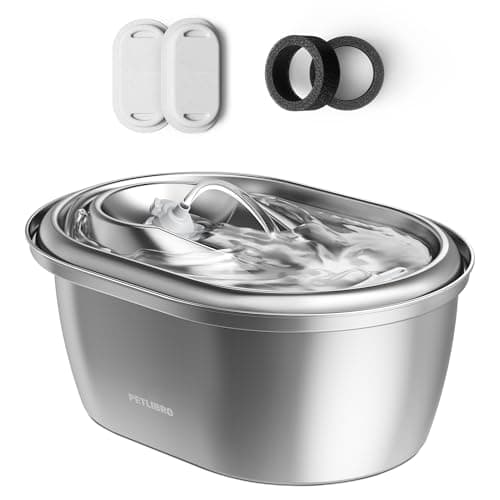
PETLIBRO Stainless Steel Fountain, 3 L
PETLIBRO · Water fountain · Our score 8.7/10
#ad Price as of October 19, 2026. Prices move; we check daily. How we're funded.
The only fountain here that publishes its adapter rating, its noise figure and its filter interval -- which is everything you need to cost a year of ownership before you buy.
Published specs
| Capacity | 3 L |
|---|---|
| Tank material | Stainless steel; PP water outlet |
| Power adapter | Input 100-240 V, output 5 V / 1 A (5 W ceiling) |
| Noise | Not more than 30 dB (published) |
| Filter interval | Every 2 weeks (PETLIBRO) |
| Filter price | $14.99 per 4-pack (PETLIBRO list) |
| Dimensions / weight | 10.8 x 8.1 x 4.7 in / 1.6 lb |
Source: PETLIBRO -- Stainless Steel Fountain 3 L product page and filter listing
Adapter output is 5 V x 1 A = 5 W, which is a nameplate ceiling, not a measurement. 5 W x 24 h x 365 = 43.8 kWh, x $0.1834 = $8.03. Filters at PETLIBRO's own $14.99 per 4-pack is $3.75 each, changed fortnightly = 26 a year = $97.44. The filters cost twelve times the electricity. Nobody puts that on the box.
What the specs favor
- Publishes the adapter rating, so running cost is computable rather than guessed
- Publishes a noise figure of 30 dB or less
- 304 stainless tank -- no plastic to scratch and harbor biofilm
- 3 L is enough for three cats between top-ups
What they don't
- Fortnightly filter changes are the real cost, at roughly $97 a year
- Plastic water outlet on an otherwise stainless fountain
- Small footprint means a determined cat can shove it around
You will not commit to a filter every two weeks. Run past the interval and a fountain is a warm, aerated, recirculating bacterial culture -- worse than a bowl you rinse daily.
How it scores
Scores are our editorial weighting of the published specs above, not a test result. They are deliberately kept out of this page's structured data.
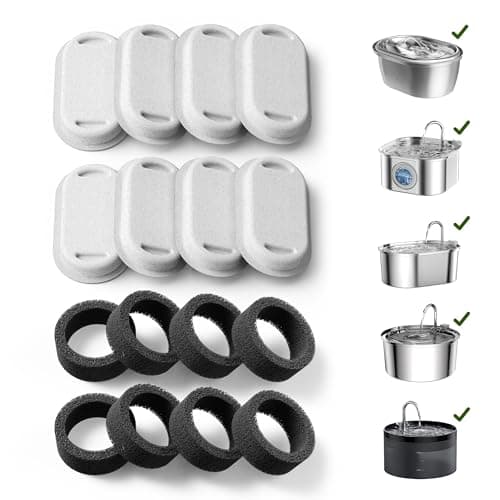
PETLIBRO Stainless Steel Fountain Replacement Filters
PETLIBRO · Fountain filter · Our score 7.1/10
#ad Price as of October 19, 2026. Prices move; we check daily. How we're funded.
Publishes its three-layer construction and two different change intervals, which is unusual candour for a consumable -- and the gap between those two intervals is worth money.
Published specs
| Pack | 4 filters and 4 sponges |
|---|---|
| Construction | Cotton layer, activated carbon, ion exchange resin |
| Maker's interval | Every 2 weeks (PETLIBRO official) |
| Listing interval | Every 2 to 4 weeks depending on pets and use |
| Before first use | Soak 15 minutes and rinse to shed carbon dust |
At the official two-week interval you use 26 filters a year. At the listing's four-week upper bound you use 13. That is a two-to-one difference in the dominant running cost of owning a fountain -- and our fountain running-costs page puts filters at roughly twelve times the electricity.
What the specs favor
- Publishes the actual filter construction rather than just 'carbon filter'
- Sponges included, which are a separate purchase on some fountains
- Publishes a pre-soak instruction, which prevents carbon dust in the bowl
What they don't
- Two different published intervals from the same manufacturer
- Proprietary to PETLIBRO fountains
- The filter polishes water; it does not clean the fountain
You do not own the fountain these fit. Fountain filters are not cross-compatible, and a third-party filter that does not seat properly bypasses entirely.
How it scores
Scores are our editorial weighting of the published specs above, not a test result. They are deliberately kept out of this page's structured data.
Common questions
Are filterless cat fountains better?
What does a cat fountain filter actually do?
Do you have to use filters in a cat fountain?
How much do cat fountain filters cost per year?
Is a filterless fountain more hygienic?
Sources
- PETLIBRO -- Stainless Steel Fountain 3 L product page and filter listing
- FEELNEEDY -- FN-W26 Wireless No Filters Cat Water Fountain product page (3.5 L clean tank published to last 3-9 days, independent clean and wastewater tanks, 304 stainless bowl, 3,000 mAh USB-C battery up to 180 days, 30 dB motor)
- PETLIBRO -- Stainless Steel Fountain Replacement Filters 4-pack (cotton, activated carbon and ion exchange resin; change every 2 weeks)
- Chewy and PetSmart listings -- Pioneer Pet Big Max Stainless Steel Dog & Cat Fountain, 128 oz (18/8 stainless, dishwasher safe, 13.75 x 12 in footprint with height published as 2.75 in by PetSmart and 4.25 in elsewhere, charcoal filters #3002/#3014, maker guidance to clean weekly and strip the pump monthly; pump wattage and unit weight not published)
- U.S. Energy Information Administration, Electric Power Monthly Table 5.3 -- residential average 18.34 cents/kWh, June 2026
- Cornell Feline Health Center -- Feline Lower Urinary Tract Disease (water intake in the context of FLUTD)
Read next
- Best Filterless Cat Water Fountains (2026)
Filterless water options compared: a separated-tank dispenser and two bowls, with the filter arithmetic that makes the question worth asking.
- Best Cat Fountain Filters (2026)
Fountain replacement filters compared on published construction and change interval, with the annual cost arithmetic.
- Cat Water Fountain Price Comparison
Fountains priced over three years instead of at checkout: a published $97.44 annual filter bill against $8.03 of electricity, and the one design that deletes the bigger number.
- Ceramic vs Stainless vs Plastic Cat Fountains
Why the material debate is really about scratch resistance, and what that means for a fountain in a multi-cat house.
- How to Clean a Cat Water Fountain
A cat fountain cleaning routine built around published filter intervals, including the pump strip-down that decides whether the fountain gets refused.