Feeders, Fountains & Bowls
Cat Water Fountain Price Comparison
The cheapest fountain to buy is routinely the most expensive to own, and the number that decides it is one most makers decline to publish.
Affiliate disclosure: we earn a commission if you buy through our links, at no extra cost to you. It never changes which product we rank first — here is how we're funded.
Everyone in this category says they tested twenty litter boxes. We have not tested any, and we say so. What we do instead: compile the published specs, read the manuals, and do the arithmetic on what this gear costs to run and how it behaves once there is more than one cat using it. Every spec is linked to the document it came from. Prices are checked daily — last verified October 19, 2026. Here is exactly how we pick.
Buy the filterless fountain if you want the lowest three-year cost and you will empty a second tank; buy the stainless PETLIBRO if you want the one fountain in this category whose full running cost is actually published; buy the Pioneer Big Max if cleaning it in a dishwasher matters more than knowing the numbers. The sticker price barely participates in that decision.
The purchase price is the small number
Every fountain comparison online ranks on what the thing costs at checkout. That is the one figure that does not matter much, because a fountain is an appliance with a subscription attached to it, and the subscription is bigger than the appliance.
Here is the arithmetic that settles it, using the only maker on this site that publishes both halves.
PETLIBRO publishes a filter interval of every 2 weeks and a list price of $14.99 per 4-pack. That is $3.7475 per filter, and 52 / 2 = 26 filters a year.
26 x $3.7475 = $97.44 a year in filters.
The same fountain ships a 5 V / 1 A adapter, so 5 W is a hard ceiling on draw. 5 W x 8,760 h = 43.8 kWh, and at the EIA residential average of 18.34 cents/kWh that is $8.03 a year in electricity.
So the filters cost 12.1 times the electricity, and the annual consumable bill of $105.47 will exceed the purchase price of the fountain inside the first year.
What each maker will and will not tell you
This is the table that does not exist elsewhere, and the blank cells are the point. A price comparison is only possible where a maker publishes both an interval and a price; most do not, so most annual-cost figures you read online were invented.
| Fountain | Capacity | Published power | Filter interval | Filter price published? | Computable annual consumables |
|---|---|---|---|---|---|
| FEELNEEDY FN-W26 (filterless) | 3.5 L clean + separate waste tank | 3,000 mAh battery, USB-C | No filter | N/A | $0 in filters |
| PETLIBRO Stainless Steel 3 L | 3 L | 5 V / 1 A (5 W ceiling) | Every 2 weeks | Yes -- $14.99 / 4 | $97.44 filters + $8.03 power |
| Pioneer Pet Big Max Stainless | 60 oz | Not published | Every 2-4 weeks | Not published | Not computable |
| PetSafe Drinkwell 360 Stainless | 128 oz (3.8 L) | Not published | Not published | Not published | Not computable |
| Catit Flower Fountain 3 L | 3 L | 120 V, 12 VA | Not published in our source | Not published | Power ceiling $19.28 only |
| PETLIBRO Dockstream 2 (cordless) | 3 L | Battery, up to 30 days per charge | Not published in our source | Not published | Not computable |
Manufacturers' published figures and the retailer listings named in our sources. Power figures are nameplate ratings, which are ceilings on draw rather than measurements. Blank cells are not research gaps -- they are what the maker declines to publish.
Three years, which is how long you will own it
Filtered, at PETLIBRO’s published interval: 3 x $105.47 = $316.41 in consumables, plus the fountain.
Filtered, at a four-week interval instead: 13 filters a year x $3.7475 = $48.72, plus $8.03 power = $56.75 a year = $170.25 over three years. Stretching the interval halves the bill — and departs from what the maker tells you to do.
Filterless: no filter line at all. Electricity is a rechargeable battery rather than a mains draw, so the three-year consumable cost is effectively the purchase price and nothing else.
The gap between the first and third rows is roughly $300 over three years — several times the price difference between any two fountains on this page.
That second row deserves a word, because it is what most people actually do. Pioneer Pet publishes a range rather than a figure — Pioneer Pet says every two to four weeks — and the range matters more than the price: at 26 filters a year against 13, the interval you choose is worth twice as much money as the fountain you choose. Our filter page works through what stretching it costs in water quality.
The cheap fountain is not the cheap fountain
One more inversion worth having in mind. The least expensive fountain on this page publishes a 12 VA power rating; the mid-priced stainless one publishes a 5 W ceiling. On published figures the budget plastic fountain’s electricity ceiling is about 2.4 times the premium one’s — $19.28 a year against $8.03.
Both numbers are small, and neither should decide a purchase on its own. The reason to mention it is that it runs the opposite way to the price tag, which tells you that in this category price is not a proxy for anything — not running cost, not spec depth, not cleanability. You have to read the actual figures, and for several of these fountains the actual figures do not exist.
What to buy, by what you are optimizing for
The FEELNEEDY FN-W26 is the pick if the three-year number is what you care about, because it deletes the line that dominates it. A 3.5 L clean tank and a separate wastewater tank keep used and fresh water apart instead of filtering recirculated water, and there is no cartridge to buy ever again. The honest cons: you are trading a filter change for emptying a second tank, the published spec sheet is thinner than PETLIBRO’s, and FEELNEEDY publishes a motor noise figure (30 dB) but no draw rating and no volume for the wastewater tank, so even here numbers are missing.
The PETLIBRO Stainless Steel 3 L is the pick if you want to know what you are signing up for. It is the only fountain in this category that publishes capacity, adapter rating, a noise ceiling, a filter interval and a filter price — which is why every piece of arithmetic on this page runs through it. Stainless tank, 30 dB published ceiling, 1.6 lb. The honest cons: that transparency reveals a $97.44 annual filter bill rather than hiding it, the water outlet is plastic even though the tank is not, and 3 L is modest for three or more cats.
The Pioneer Pet Big Max Stainless is the pick if the thing you will actually fail at is cleaning. 18/8 stainless, dishwasher safe, 2.5 lb, and a published two-to-four-week filter interval that gives you honest latitude rather than a single demand. The honest cons: Pioneer publishes no pump wattage and no filter price, so its annual cost genuinely cannot be computed; 60 oz is the smallest capacity here; and a range rather than an interval pushes the most expensive decision back onto you.
How to price any fountain in two minutes
- Find the filter interval on the maker’s own page. Not the retailer’s, which is often longer and more flattering.
- Find the maker’s own filter price per unit. Divide the multipack price by the count.
- Multiply. 52 divided by the interval in weeks, times the unit price. That is your real annual cost.
- Add electricity only if you are curious. Watts x 8.76 x 0.1834 gives dollars a year. It will be a rounding error next to step 3.
- If either number is missing, write “unknown”. Do not substitute a guess, and do not trust a review that did.
When none of this is the purchase
If the reason you are shopping is that a cat is not drinking enough, the cheapest intervention is not on this page. Cornell Feline Health Center discusses water intake in the context of lower urinary tract disease, and several wide bowls in separate rooms, refreshed daily, cost nothing to run and no filters at all. Our worth-it page argues that case properly, and the bowls page is where it ends up for a lot of households.
We are not veterinarians and nothing here is medical advice. What we can do is the arithmetic, and the arithmetic says the fountain is the cheap part.
See the fountains
For the full category ranked on specification rather than cost, our main fountain roundup is the place to start, and filtered against filterless is the mechanism decision that sits underneath every number on this page.
The gear discussed here
Specs are the manufacturer's own, linked to the page they came from. Prices come from a live daily check; where we have no verified price we say so rather than print a stale one.
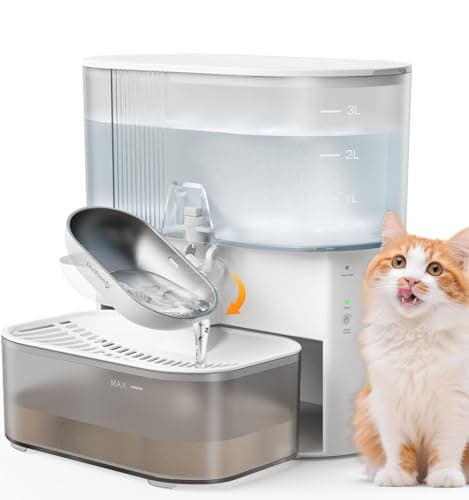
FEELNEEDY FN-W26 Filterless Cat Water Fountain
FEELNEEDY · Filterless fountain · Our score 7.4/10
#ad Price as of October 19, 2026. Prices move; we check daily. How we're funded.
Replaces the cartridge with a second tank: a timed cycle pours stale water into a separate wastewater reservoir instead of recirculating it, and the bowl the cat actually drinks from is 304 stainless rather than plastic.
Published specs
| Clean water tank | 3.5 L (118 oz), published to last 3-9 days |
|---|---|
| Wastewater tank | Separate tank; volume not published |
| Filter | None |
| Bowl material | 304 stainless steel (both tanks are plastic) |
| Power | 3,000 mAh USB-C rechargeable, up to 180 days per charge |
| Noise | 30 dB motor; 30-35 dB while it pours |
A recirculating fountain polishes the same water through a cartridge, and the cartridge is the running cost -- roughly $97 a year on PETLIBRO's published filter pricing. A separated design discards used water into its own tank instead, so the recurring job is emptying that tank rather than buying filters. FEELNEEDY does not publish how much it holds, which is the one figure you would want in order to plan the chore; it publishes only that the 3.5 L clean side lasts 3 to 9 days.
What the specs favor
- No filter, so no cartridge subscription at all
- Used water is never recirculated back to the bowl
- A 304 stainless bowl rather than plastic, which is the easier surface to keep clean
- Cordless on a published 3,000 mAh battery, so it goes where there is no socket
- Publishes a motor noise figure, which most fountains decline to do
What they don't
- Does not publish the wastewater tank volume, so the emptying interval cannot be planned
- A second tank to empty is a new chore that recirculating fountains do not have
- No published dimensions or weight at all
- Still needs cleaning -- no design removes biofilm
Your cat drinks happily from a bowl. A plain wide bowl is the only truly zero-running-cost water source, and our water bowls page makes that case with the numbers.
How it scores
Scores are our editorial weighting of the published specs above, not a test result. They are deliberately kept out of this page's structured data.
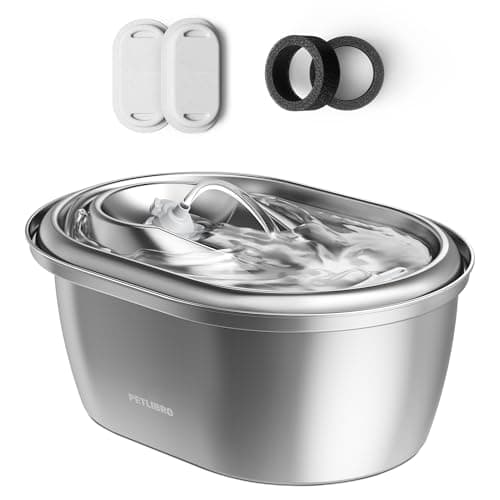
PETLIBRO Stainless Steel Fountain, 3 L
PETLIBRO · Water fountain · Our score 8.7/10
#ad Price as of October 19, 2026. Prices move; we check daily. How we're funded.
The only fountain here that publishes its adapter rating, its noise figure and its filter interval -- which is everything you need to cost a year of ownership before you buy.
Published specs
| Capacity | 3 L |
|---|---|
| Tank material | Stainless steel; PP water outlet |
| Power adapter | Input 100-240 V, output 5 V / 1 A (5 W ceiling) |
| Noise | Not more than 30 dB (published) |
| Filter interval | Every 2 weeks (PETLIBRO) |
| Filter price | $14.99 per 4-pack (PETLIBRO list) |
| Dimensions / weight | 10.8 x 8.1 x 4.7 in / 1.6 lb |
Source: PETLIBRO -- Stainless Steel Fountain 3 L product page and filter listing
Adapter output is 5 V x 1 A = 5 W, which is a nameplate ceiling, not a measurement. 5 W x 24 h x 365 = 43.8 kWh, x $0.1834 = $8.03. Filters at PETLIBRO's own $14.99 per 4-pack is $3.75 each, changed fortnightly = 26 a year = $97.44. The filters cost twelve times the electricity. Nobody puts that on the box.
What the specs favor
- Publishes the adapter rating, so running cost is computable rather than guessed
- Publishes a noise figure of 30 dB or less
- 304 stainless tank -- no plastic to scratch and harbor biofilm
- 3 L is enough for three cats between top-ups
What they don't
- Fortnightly filter changes are the real cost, at roughly $97 a year
- Plastic water outlet on an otherwise stainless fountain
- Small footprint means a determined cat can shove it around
You will not commit to a filter every two weeks. Run past the interval and a fountain is a warm, aerated, recirculating bacterial culture -- worse than a bowl you rinse daily.
How it scores
Scores are our editorial weighting of the published specs above, not a test result. They are deliberately kept out of this page's structured data.
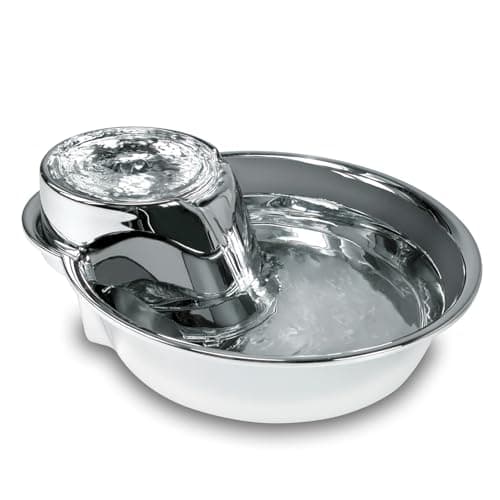
Pioneer Pet Big Max Stainless Steel Fountain
Pioneer Pet · Water fountain · Our score 7.9/10
#ad Price as of October 19, 2026. Prices move; we check daily. How we're funded.
18/8 stainless at 128 oz and dishwasher safe -- the stainless fountain Pioneer still actually sells, and the one with room for three or four cats.
Published specs
| Capacity | 128 oz (3.78 L) |
|---|---|
| Material | 18/8 stainless steel |
| Dimensions | Footprint 13.75" x 12"; height published as 2.75" by one retailer and 4.25" by another -- they disagree |
| Weight | Not published |
| Filter | Replaceable charcoal; part numbers #3002 (3-pack) and #3014 (4-pack) |
| Filter interval | Every 2-4 weeks (Pioneer Pet) |
| Cleaning | Dishwasher safe; maker says clean weekly and strip the pump monthly |
| Power | Corded, low voltage; wattage not published |
Pioneer Pet gives an interval rather than a fixed number: every 2 to 4 weeks. That is 13 filters a year at the slow end and 26 at the fast end -- a two-fold spread in running cost that depends entirely on how many cats are using it. Makers who quote a single interval are quoting the single-cat case. Pioneer also publishes a maintenance schedule most makers skip: clean the fountain weekly and take the pump apart monthly.
What the specs favor
- 18/8 stainless, which cannot scratch into a surface that holds biofilm
- 128 oz is genuine multi-cat capacity rather than a daily top-up
- Filter interval published as a range, which is more honest than a single number
- Dishwasher safe, and Pioneer publishes a weekly-clean and monthly-pump schedule
- Named filter part numbers, so the consumable is findable rather than proprietary-mystery
What they don't
- Retailers disagree about its height (2.75 in against 4.25 in), so drinking posture cannot be checked before it arrives
- No published pump wattage, so electricity cannot be costed
- No published weight
- 13.75 by 12 inch footprint is a lot of counter for a fountain
- The most expensive fountain on this site by a clear margin
You have one cat and a small kitchen. 128 oz and a 13.75 by 12 inch footprint is capacity you will not use, and a smaller stainless fountain does the same job in less space.
How it scores
Scores are our editorial weighting of the published specs above, not a test result. They are deliberately kept out of this page's structured data.
Common questions
How much does a cat water fountain cost?
Which cat fountain is cheapest over three years?
Why is it so hard to compare cat fountain prices?
Is a more expensive cat fountain better?
Do cheap cat fountains cost more to run?
Sources
- PETLIBRO -- Stainless Steel Fountain 3 L product page and filter listing
- FEELNEEDY -- FN-W26 Wireless No Filters Cat Water Fountain product page (3.5 L clean tank published to last 3-9 days, independent clean and wastewater tanks, 304 stainless bowl, 3,000 mAh USB-C battery up to 180 days, 30 dB motor)
- Chewy and PetSmart listings -- Pioneer Pet Big Max Stainless Steel Dog & Cat Fountain, 128 oz (18/8 stainless, dishwasher safe, 13.75 x 12 in footprint with height published as 2.75 in by PetSmart and 4.25 in elsewhere, charcoal filters #3002/#3014, maker guidance to clean weekly and strip the pump monthly; pump wattage and unit weight not published)
- Catit -- Flower Fountain product page
- PETLIBRO -- Stainless Steel Fountain Replacement Filters 4-pack (cotton, activated carbon and ion exchange resin; change every 2 weeks)
- U.S. Energy Information Administration, Electric Power Monthly Table 5.3 -- residential average 18.34 cents/kWh, June 2026
- Cornell Feline Health Center -- Feline Lower Urinary Tract Disease (water intake in the context of FLUTD)
Read next
- Best Cat Water Fountains (2026)
Four fountains compared on wattage, noise, filter interval and material -- and what each one costs across a year.
- What a Cat Water Fountain Actually Costs to Run
Electricity and filters costed from published adapter ratings and manufacturers' own filter prices, with every sum shown.
- Filtered vs Filterless Cat Fountains
The mechanism decision under every fountain purchase: recirculate-and-filter against keep-clean-and-used-water-apart, costed from published intervals and prices.
- Best Cat Fountain Filters (2026)
Fountain replacement filters compared on published construction and change interval, with the annual cost arithmetic.
- Are Cat Water Fountains Worth It?
The fountain-versus-bowl trade laid out in a table, with the year-one running cost of doing it properly.