Feeders, Fountains & Bowls
Best Cat Food Mats (2026)
A mat that fits the bowls is a coaster. The mess lands outside the bowls, which is the whole point of the product.
Affiliate disclosure: we earn a commission if you buy through our links, at no extra cost to you. It never changes which product we rank first — here is how we're funded.
Everyone in this category says they tested twenty litter boxes. We have not tested any, and we say so. What we do instead: compile the published specs, read the manuals, and do the arithmetic on what this gear costs to run and how it behaves once there is more than one cat using it. Every spec is linked to the document it came from. Prices are checked daily — last verified September 25, 2026. Here is exactly how we pick.
Quick picks
Ranked on the published specs and the arithmetic below. Tap any row to jump to the full write-up. We have not tested these — here is exactly how we pick.
| # | Product | Best for | Score | Price |
|---|---|---|---|---|
| 1 | No photo Silicone Pet Feeding Mat with Raised Edges The published raised-edge height is the whole product, and it is the one dimension most feeding mats leave off the listing. | A cat that paws food onto the floor | 7.9 | |
| 2 | No photo Dr. Catsby's Food Bowl for Whisker Relief A single piece of stainless 7.08 inches across and only 1.25 inches deep -- the shallow-and-wide geometry the whisker-fatigue argument actually calls for. | A cat that paws food out of the dish | 8.2 | |
| 3 | 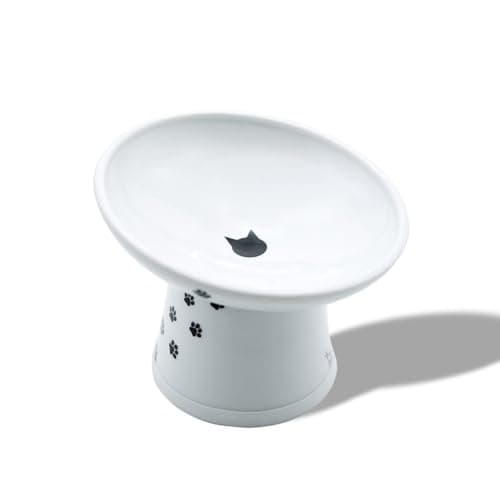 Necoichi Raised Cat Food Bowl Elevated porcelain on a 2.75-inch leg with a published lead-and-cadmium-free glaze -- the one bowl here that addresses neck posture as well as whisker clearance. | Cats that bring food back up after eating | 8.3 |
#ad Buy links are affiliate links. Prices come from a live daily check; where we have no verified price we say "check price" rather than print a stale one.
This is the same mistake as the litter mat, in a different room. People buy a mat sized to the bowls, and the mess lands beyond the bowls, which is where it was always going to land.
Size it to the mess
A published 18 x 12 inch mat is 216 square inches.
Two 6 inch bowls occupy about 56 square inches between them. That leaves roughly 160 square inches of catch area around them — three times the area of the bowls themselves.
A 12 by 8 inch mat gives 96 square inches total, of which 56 is under the bowls. You are left with 40 square inches of catch, and food kicked out of a bowl travels further than that.
Silicone against fabric
| Material | Wet food | Cleaning | Downside |
|---|---|---|---|
| Food-grade silicone | Good -- non-porous | Wipe, hand wash or dishwasher | Attracts hair and dust between washes |
| Fabric / microfibre | Poor -- absorbs | Machine wash | Holds odor; needs a wash cycle not a wipe |
| Hard plastic tray | Good | Wipe or dishwasher | Noisy under a bowl; scratches over time |
Our comparison. Only the silicone option is one that both contains liquid and cleans in ten seconds.
The specification worth checking is the raised edge, because it is the one most listings omit. A bevel does nothing for spilled water; a genuine lip holds it. The published figures in this category run from about a quarter inch to nearly an inch, and the mat we lead with publishes 0.5 inches of total thickness with a raised perimeter.
One caution nobody prints
The mat does not fix the bowl
A feeding mat catches mess. It does not change why the mess is happening, and in a fair number of cases the cause is the bowl.
A wide shallow bowl keeps whiskers off the sides, which is the geometry our bowls page ranks on. A cat pawing food out of a deep narrow dish onto the floor is telling you about the dish.
An elevated bowl addresses the other common cause: a cat that has to crouch awkwardly to reach floor level eats messily and sometimes eats less.
Where the station goes still matters most
The Ohio State Indoor Pet Initiative treats feeding stations as contested resources in a multi-cat house, and our station setup guide works through the counts and distances. A mat is a floor-protection accessory; it does not change who eats where.
One practical note for several cats: a single large mat under two bowls creates one station, not two. If the goal is separation, buy two smaller mats and put them in different rooms — which is cheaper as well as better.
The picks in full
Specs are the manufacturer's own, linked to the page they came from. Prices come from a live daily check; where we have no verified price we say so rather than print a stale one.
Silicone Pet Feeding Mat with Raised Edges
FEELNEEDY · Feeding mat · Our score 7.9/10
#ad No verified live price right now, so we show none rather than a stale one. How we're funded.
The published raised-edge height is the whole product, and it is the one dimension most feeding mats leave off the listing.
Published specs
| Dimensions | 18" x 12" x 0.5" |
|---|---|
| Material | Food-grade silicone |
| Edge | Raised lip for leakage protection |
| Base | Non-slip |
| Cleaning | Wipe, hand wash or dishwasher |
| Waterproof | Yes |
18 x 12 = 216 square inches. Two 6 inch bowls occupy about 56 square inches between them, leaving roughly 160 for the mess -- which is the point. A mat sized only to the bowls catches nothing, exactly like an undersized litter mat.
What the specs favor
- Publishes a thickness and an edge height rather than only a footprint
- Food-grade silicone named on the spec, not just 'silicone'
- Dishwasher safe, which a wet-food mat needs to be
- Rolls up, so it travels
What they don't
- Silicone attracts hair and dust between washes
- A raised lip is a trip hazard for an unsteady older cat stepping onto it
- Thin mats curl at the corners after a dishwasher cycle
Your cat already dislikes stepping onto a new surface to eat. Some cats refuse a raised-edge mat outright, and a refused mat moves the feeding station rather than protecting the floor.
How it scores
Scores are our editorial weighting of the published specs above, not a test result. They are deliberately kept out of this page's structured data.
Dr. Catsby's Food Bowl for Whisker Relief
Dr. Catsby · Cat bowl · Our score 8.2/10
#ad No verified live price right now, so we show none rather than a stale one. How we're funded.
A single piece of stainless 7.08 inches across and only 1.25 inches deep -- the shallow-and-wide geometry the whisker-fatigue argument actually calls for.
Published specs
| Diameter | 7.08" |
|---|---|
| Depth | 1.25" |
| Weight | 14.1 oz |
| Capacity | Holds a 5 oz can of wet food |
| Material | Stainless steel, one piece |
| Included | Silicone non-slip mat for the base |
| Cleaning | Dishwasher safe |
Source: Amazon -- Dr. Catsby's Food Bowl for Whisker Relief listing
7.08 inches wide divided by 1.25 inches deep = 5.7. A typical deep ceramic cat dish is nearer 2:1. That ratio is the entire whisker-fatigue argument expressed as a number you can check on any bowl before buying -- and almost no listing publishes both figures.
What the specs favor
- Published width and depth, so the ratio above is checkable
- One piece of stainless -- nothing to scratch and harbor residue
- Silicone mat included rather than sold separately
- Dishwasher safe
What they don't
- 1.25 inches deep is shallow for a large dry-food portion
- Stainless is light enough that a determined cat can move it
- One bowl per cat gets expensive in a multi-cat house
You free-feed a big daily ration of dry food. A 1.25-inch dish is sized around a 5 oz can, not around a cup of kibble.
How it scores
Scores are our editorial weighting of the published specs above, not a test result. They are deliberately kept out of this page's structured data.
Necoichi Raised Cat Food Bowl
Necoichi · Cat bowl · Our score 8.3/10
#ad Price as of September 25, 2026. Prices move; we check daily. How we're funded.
Elevated porcelain on a 2.75-inch leg with a published lead-and-cadmium-free glaze -- the one bowl here that addresses neck posture as well as whisker clearance.
Published specs
| Extra-wide dimensions | 6.1" W x 4.13" L x 1.18" D |
|---|---|
| Leg height | 2.75" |
| Base width | 4.17" |
| Weight | 1.2 lb |
| Material | Porcelain, free from lead and cadmium |
| Cleaning | Dishwasher and microwave safe |
| Included | Removable non-slip silicone ring |
Source: Chewy -- Necoichi Extra Wide Raised Cat Food Bowl listing
1.2 lb of porcelain against 14.1 oz (0.88 lb) for the stainless Dr. Catsby, plus a wider 4.17-inch base. Roughly 36 percent more mass on a wider footprint is why a ceramic bowl stays where you put it and a light stainless one travels across the kitchen.
What the specs favor
- Raised 2.75 inches, which changes eating posture as well as whisker contact
- Published lead-free and cadmium-free porcelain
- Heaviest bowl here, on the widest base -- it does not slide
- Dishwasher and microwave safe
What they don't
- Porcelain chips if it is dropped; stainless does not
- 1.18 inches deep in the extra-wide version is shallow for dry food
- Costs more than a plain dish
Your cat is a kitten or has mobility problems that make reaching up awkward. Elevation helps some cats and is simply an obstacle for others.
How it scores
Scores are our editorial weighting of the published specs above, not a test result. They are deliberately kept out of this page's structured data.
Common questions
What size cat food mat do I need?
Are silicone food mats better than fabric ones?
Do cat food mats stop bowls sliding?
How high should the raised edge be on a feeding mat?
Can you put a cat food mat in the dishwasher?
Sources
Read next
- How to Set Up a Cat Feeding Station
Counts, distances and sightlines for feeding and water stations in a multi-cat home, with the free fixes first.
- Best Cat Food Bowls (2026)
Bowls compared on published width-to-depth ratio, material and elevation, with the whisker-fatigue claim handled carefully.
- Best Slow Feeder Cat Bowls (2026)
Slow feeder bowls compared on published capacity and why the smallest size is the one a cat needs.
- Best Cat Litter Mats (2026)
Mats compared on published catch area against real box footprints, plus the pour-back feature that returns litter instead of binning it.
- Best Cat Water Bowls (2026)
Plain water bowls compared on width, material and stability, with the running-cost case against a fountain.